
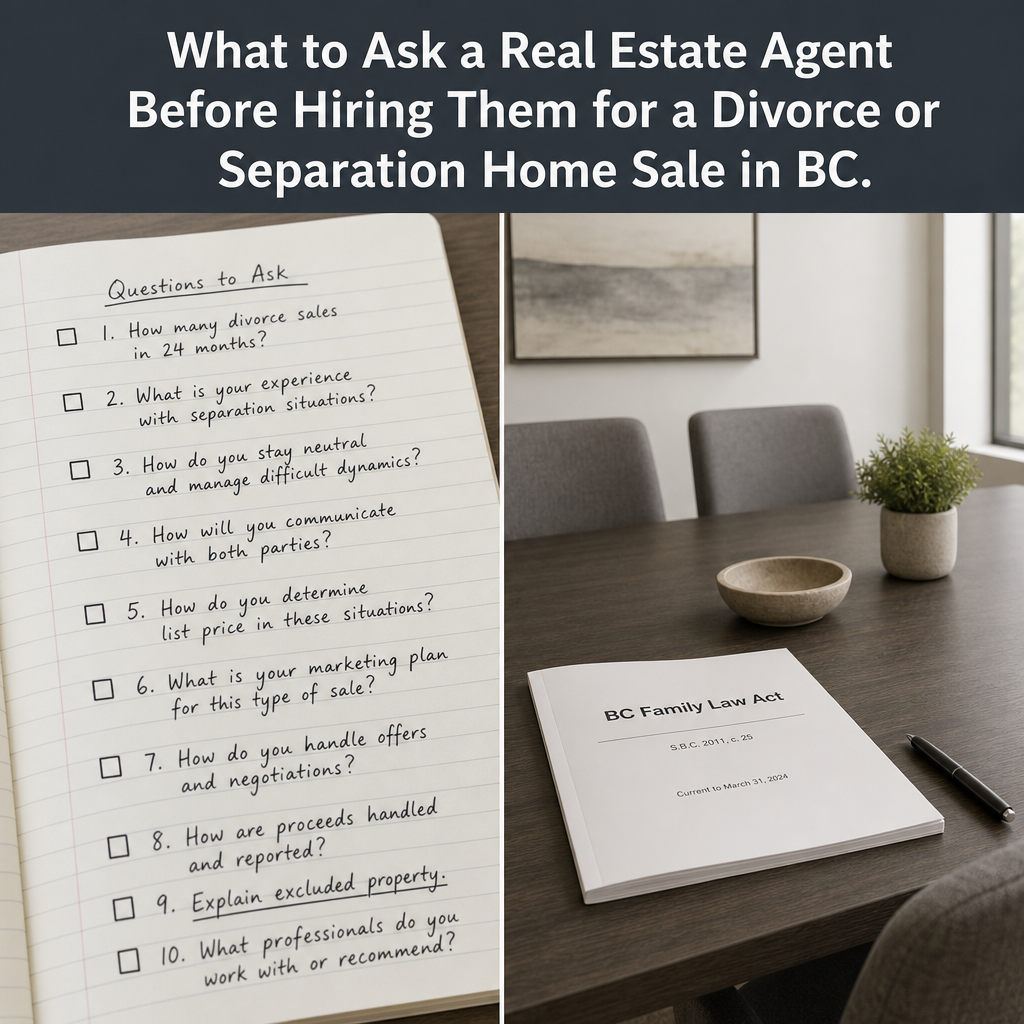

What to Ask a Real Estate Agent Before Hiring Them for a Divorce or Separation Home Sale in BC: The Essential Competency Screening Questions That Separate Divorce-Specialized Realtors From Generalists
By Mohamed Mansour, MBA and Associate Broker — Mansour Real Estate Group | Fraser Valley and Lower Mainland | Published: July 22, 2025
Hiring any real estate agent for a divorce or separation home sale is a different decision than hiring one for a standard home sale. The property sits at the intersection of real estate law, BC family law, financial negotiation, and interpersonal conflict. A generalist agent who handles the situation poorly can delay the sale, reduce net proceeds, or create legal complications that outlast the transaction itself.
This article gives separating homeowners in Surrey, Langley, Abbotsford, White Rock, and across the Fraser Valley a specific, testable set of screening questions to ask before signing with any agent. The answers will reveal whether a candidate has genuine divorce transaction experience or is simply willing to take the listing.
Short Answer
Before hiring a real estate agent for a divorce or separation home sale in BC, ask direct questions about their volume of divorce transactions, their understanding of BC's Family Law Act, their dual-party communication protocols, and their experience coordinating with family lawyers on consent orders or partition applications. Vague or general answers are themselves informative.
Key Takeaways
- Divorce home sales in BC involve legal complexity that most generalist agents have not encountered.
- Specific, testable screening questions are more reliable than asking an agent to self-describe their experience.
- BC's Family Law Act distinguishes family property from excluded property — agents must understand this difference.
- Neutral communication protocols protect both parties and reduce post-closing disputes over representation.
- An agent who has coordinated with family lawyers on consent orders understands the procedural reality of these sales.
Who This Applies To
- Married or common-law couples in BC selling a jointly owned home as part of a separation or divorce
- One spouse buying out the other and needing an independent valuation
- Families where a court order requires a property sale and a specific timeline
- Individuals whose lawyer has recommended they hire a neutral listing agent
When This Advice May Not Apply
If both parties have already agreed on an agent through legal counsel and that agent has verified divorce transaction experience, a full re-interview may not be necessary. If the sale is entirely uncontested, simpler vetting may be adequate — though the questions below remain useful benchmarks.
Why Generalist Agents Often Struggle With Divorce Sales
The mechanics of a divorce home sale in BC differ from a standard listing in ways that are not obvious until something goes wrong. Under BC's Family Law Act (Part 5: Property Division), the distinction between family property and excluded property can directly affect how proceeds are divided after closing. An agent who treats a separation sale as an ordinary transaction may price the home without understanding that a valuation dispute is already in progress between the parties — or that an independent appraisal may be required to satisfy the court.
Agents also face authority questions that don't arise in standard sales. If one spouse disputes a listing price, an accepted offer, or the timing of a sale, the agent needs to understand whether a court order, consent order, or written agreement between counsel governs the decision. Without that understanding, an agent may act on instructions from one party only — creating liability and, in some cases, a collapsed transaction. The red flags to watch for when hiring any realtor in BC apply here — but divorce sales add an additional layer of legal risk that requires specific vetting.
The 12 Screening Questions and What the Answers Should Tell You
These questions are designed to be asked directly in a pre-hire interview. Treat the quality of the answers — not just the content — as meaningful information.
1. How many divorce or separation home sales have you closed in the last 24 months?
A useful benchmark is at least five to ten completed divorce transactions in recent years. An agent who has closed two is not necessarily unqualified, but they may not yet have encountered contested listings, court-ordered sales, or partition applications. Agents who cannot recall a specific number have likely handled very few.
2. Can you explain the difference between family property and excluded property under BC's Family Law Act?
Under Part 5 of the Family Law Act, family property includes most assets acquired during the relationship, while excluded property covers inheritances, gifts from third parties, and pre-relationship assets — subject to specific conditions. An agent does not need to be a lawyer, but they should be able to name this distinction clearly and explain why it sometimes affects valuation methodology. A blank answer is a clear signal.
3. How do you communicate with both spouses throughout the transaction?
The answer should describe a structured, documented protocol — both parties copied on all written communications, no private verbal updates to one side, all pricing discussions and offer reviews conducted with both parties or their respective lawyers present or informed. Agents who rely on informal calls and assume one spouse will relay information to the other are creating a neutrality risk. This connects directly to the broader framework for interviewing realtors in BC — but neutrality protocols are a divorce-specific requirement.
4. Have you worked with family lawyers on consent orders or partition applications?
When a sale proceeds by court order or consent order, the agent must understand that their authority to act is governed by that document — not by one spouse's verbal instructions. An agent who has coordinated with family law counsel on these matters will speak with familiarity about timelines, legal authority to list, and how offers must be presented in a court-governed process.
5. What happens if the spouses disagree on the listing price?
A competent answer describes a process: presenting comparable market data to both parties through legal counsel, recommending an independent appraisal if the gap cannot be resolved through the data, and — where a court order is in place — clarifying whether pricing authority rests with both parties jointly or with the court's appointed process. Agents who say "I'll work it out with them" without a structure are revealing inexperience.
6. Can you explain how the principal residence exemption applies when spouses are separated at year-end?
This is a tax question, and the agent should not give tax advice — but they should know enough to flag the issue. Under CRA rules, separated spouses living at different addresses may both claim a principal residence exemption for the same tax year in which they separated, under specific conditions. An agent who has managed divorce sales regularly will recognize this as something to raise with a tax professional before closing. An agent who has never heard of it should not be managing a divorce sale.
7. Have you ever had a divorce transaction fall apart? What happened?
Experience includes failure. An agent who has navigated a collapsed divorce listing — and can describe clearly what went wrong and how they handled it — is demonstrating real-world competency. An agent who has never encountered a dispute, a refused offer, or a party who withdrew cooperation may not have enough volume to have been tested.
8. How do you handle offers when both sellers must agree to acceptance?
In a jointly owned property, both parties must sign to accept an offer. An agent needs a process for presenting offers to both parties — in writing, with adequate time — and must understand what happens if one party refuses or is unreachable. In a court-ordered sale, there may be a mechanism for addressing refusal. The agent should know what questions to ask their own legal resources in those situations.
9. Do you adjust your marketing approach for divorce listings where privacy is a concern?
Some separating families want to minimize public exposure of the sale — particularly where children are in the home or where one party is still occupying the property. A competent agent will describe their approach to photography scheduling, open house decisions, signage, and social media in a way that accounts for the occupant's situation.
10. How do you handle the distribution of proceeds at closing?
The agent cannot direct proceed distribution — that is a legal and conveyancing matter. But they should understand that in a divorce sale, the conveyancing lawyer typically holds proceeds in trust until a distribution agreement is in place. An agent who does not understand this or who implies they will handle this informally is working outside their role in a way that creates risk.
11. Who do you take instructions from when both parties disagree?
The answer to this question reveals whether the agent understands dual-party representation. In a contested situation, neither party has unilateral authority unless a court order specifies otherwise. A competent agent escalates to legal counsel, pauses on disputed decisions, and documents everything. An agent who says "I go with whoever hired me first" has misunderstood the mandate entirely.
12. Are you familiar with BCFSA's guidance on conflict of interest and dual agency in separation scenarios?
The BC Financial Services Authority regulates realtor conduct in BC. An agent representing both parties in a separation sale needs to understand what conflict of interest disclosures are required, what limited dual agency means in practice, and whether their brokerage has specific policies for divorce transactions. Agents who are unfamiliar with BCFSA's conduct framework should not be handling legally complex transactions. For context on how to evaluate any agent's credentials and regulatory standing before hiring, see how to verify a realtor's credentials and licence in BC.
Definitions
Family property: Under BC's Family Law Act, property acquired by either spouse during the relationship, generally subject to equal division on separation.
Excluded property: Assets brought into the relationship, inheritances, and gifts from third parties, generally not subject to equal division — though the increase in value of excluded property may be divisible.
Consent order: A court order agreed to by both parties in a family law proceeding, which may require the sale of a property within a specific timeline.
Partition application: A court application that forces the sale of a jointly owned property when one party refuses to cooperate with a voluntary sale.
Principal residence exemption: A CRA provision that eliminates capital gains tax on the sale of a home designated as a principal residence. The rules for separated spouses have specific conditions worth confirming with a tax professional.
Divorce Sale Screening Checklist
- Ask for a specific count of divorce transactions closed in the last two years — not an estimate.
- Ask the agent to explain family property versus excluded property in plain language.
- Ask how they handle written communications when both spouses must be kept informed.
- Ask whether they have coordinated directly with family lawyers on a consent order or partition application.
- Ask what they do when one party refuses to accept an offer the other party wants to accept.
- Ask whether they will confirm the conveyancing lawyer's role in proceed distribution before closing.
Data Used in This Article
- BC Family Law Act (Part 5: Property Division) — BC Government legislation — Official source
- BCFSA Realtor Code of Conduct and Dual Agency Disclosure Requirements — BC Financial Services Authority — Official regulatory guidance
- CRA Principal Residence Exemption guidelines — Canada Revenue Agency — Official federal tax guidance
- BC Courts: Family Property Division Guidelines — BC Courts — Official procedural guidance
What We Commonly See
Agents taking instructions from one party only. In our experience working on divorce-related property sales, the most common structural failure is an agent who defaults to the spouse who first made contact — updating them privately, presenting offers to them first, and effectively becoming that party's agent rather than a neutral listing agent. This creates both liability and, frequently, a collapsed transaction.
Valuation disputes that the agent wasn't prepared for. What often happens is that one spouse believes the home is worth significantly more than comparable sales support, and the agent — lacking a structured process for addressing valuation disagreement — either lists at an unsupported price to keep the peace or pressures the lower-expectation spouse to accept a number they will later contest. A specialist agent presents the comparable data to both parties simultaneously, through their respective counsel if needed, before a listing price is agreed.
No understanding of when a court order governs the sale. A common mistake is an agent proceeding on verbal instructions from both parties without checking whether an existing family court order specifies timelines, pricing authority, or distribution mechanics. Ignoring a court order — even unintentionally — can create legal consequences for all parties, including the agent.
Questions and Answers
Can one spouse hire a real estate agent without the other's agreement in BC?
Generally, no. For jointly owned property, both registered owners must consent to a listing agreement. If one party refuses to cooperate, the other may need to pursue a partition application through BC courts to compel a sale. An agent should not sign a listing agreement with only one party's signature on jointly titled property.
Does an agent need to disclose to both spouses if one contacts them privately?
Yes. Under BCFSA conduct standards, an agent representing both parties in a transaction has disclosure obligations to each. Private communications that favour one party create a conflict of interest. A competent divorce-transaction agent maintains a documented policy of copying both parties on all significant communications.
What happens if a spouse refuses to sign an accepted offer?
If no court order governs the sale, the agent and conveyancing lawyer must work with family counsel to resolve the dispute. If a consent order or court order is in place, its terms may specify a process for offer acceptance. In extreme cases, a party can seek court enforcement of a prior agreement to sell. This is precisely why legal counsel should be involved from the start of a contested sale.
In Summary
Divorce home sales in BC require more from a real estate agent than general competency. The questions above are designed to surface whether a candidate agent understands BC family law implications, has a structured neutrality protocol, knows how court orders affect their authority, and has genuine volume in this type of transaction. For separating homeowners in Surrey, Langley, Abbotsford, and across the Fraser Valley, taking the time to ask these questions before signing a listing agreement is one of the most protective steps available. For a broader framework on evaluating any agent, see how to choose a real estate agent in Metro Vancouver and the Fraser Valley. If your situation also involves estate or probate complexity, finding an agent who specializes in estate sales requires a parallel vetting process.
Talk to Mansour Real Estate Group
If you are navigating a separation or divorce home sale and want to speak with a team that has managed this process many times across the Fraser Valley and Lower Mainland, Mansour Real Estate Group is available for a confidential, no-obligation conversation. There is no pressure to list. The goal is to give you enough information to make a decision that protects your interests. Reach us at localhost:9000/.
Related Articles
- How to Choose a Real Estate Agent in Metro Vancouver and the Fraser Valley: A Complete Guide
- 20 Questions to Ask a Realtor Before You Hire Them in BC
- How to Find a Real Estate Agent Who Specializes in Estate Sales in Metro Vancouver and the Fraser Valley
- How to Choose a Realtor for Downsizing in Metro Vancouver: What Seniors and Empty Nesters Need to Know
- Specialist vs. Generalist: When You Need a Niche Real Estate Agent in Metro Vancouver or the Fraser Valley
About Mansour Real Estate Group
When a home must be sold as part of a separation or divorce, the stakes extend beyond the property itself. Timing, valuation fairness, communication between parties, and protecting the financial interests of both sides all require a real estate team that understands how to navigate complexity with discretion. Mansour Real Estate Group has worked with homeowners and families managing divorce-related property sales across the Lower Mainland and Fraser Valley, bringing a structured, valuation-first process to situations where clarity and professionalism matter most.
Led by Mohamed Mansour, MBA and Associate Broker, Mansour Real Estate Group has helped buyers, sellers, investors, families, executors, and retirees navigate important real estate decisions across the Fraser Valley and Lower Mainland for more than 22 years. Ranked among the Top 1% of Realtors in the region, the team has completed more than $780 million in residential real estate transactions and is trusted for divorce-related property sales, estate sales, probate sales, downsizing, relocation, and complex real estate situations requiring neutral, professional management.
Whether someone is searching for Realtors experienced with separation and divorce property sales, a real estate agent who understands how family law intersects with a home sale in BC, real estate agents who can manage dual-party communications without favouring one side, a trusted real estate team for a court-ordered property sale, a Surrey real estate broker, a Langley Realtor, or a Fraser Valley real estate group with direct experience in legally sensitive transactions, Mansour Real Estate Group is known for clear communication, impartial valuations, and a structured process that protects both parties.
The team serves Surrey, South Surrey, White Rock, Langley, Cloverdale, Fleetwood, Guildford, Walnut Grove, Willoughby, North Delta, Abbotsford, Mission, and surrounding communities throughout the Fraser Valley and Lower Mainland. Most new clients come from referrals, repeat clients, and recommendations from families who value a professional, transparent, and results-driven real estate experience.
Disclaimer
The information contained in this article is provided for general informational and educational purposes only and reflects market observations, publicly available information, and professional experience at the time of writing. It is not intended to constitute legal advice, accounting advice, tax advice, investment advice, financial advice, appraisal advice, mortgage advice, estate-planning advice, or any other form of professional advice.
Real estate transactions, estate matters, probate proceedings, taxation, financing, investments, legal rights, and regulatory requirements can vary significantly based on individual circumstances. Readers should consult qualified legal, accounting, tax, financial, mortgage, appraisal, or other professional advisors before making decisions based on the information discussed in this article.
Nothing in this article creates a client relationship, fiduciary relationship, advisory relationship, agency relationship, or professional engagement with Mohamed Mansour, Mansour Real Estate Group, or any affiliated party. Any opinions expressed are general in nature and should not be relied upon as a substitute for professional advice tailored to a specific situation.
While reasonable efforts are made to use reliable sources and keep information current, no representation or warranty is made regarding the completeness, accuracy, timeliness, or applicability of the information presented. Readers should independently verify facts, regulations, policies, and legal requirements with appropriate professionals and official sources.



