
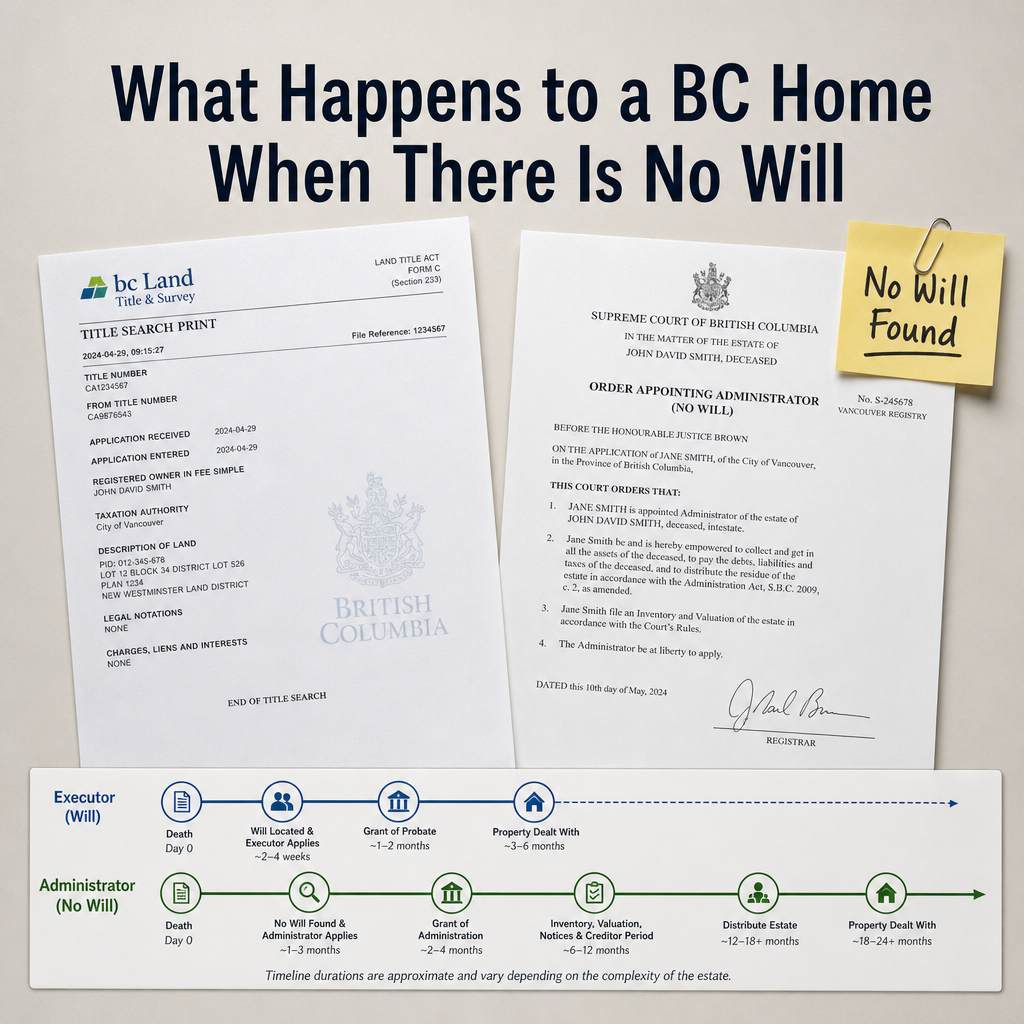

What Happens to a BC Home When There Is No Will: Intestate Succession Rules, Administrator Appointment, and How to Sell Estate Property Without a Will in Greater Vancouver and the Fraser Valley
By Mohamed Mansour, MBA and Associate Broker, Mansour Real Estate Group | Fraser Valley and Greater Vancouver | Published: August 5, 2025 | Topic: Life-Event Sales — Intestate Estate Property
When someone dies without a will in BC, the path to selling the family home changes in ways most families do not expect. There is no executor. There is no named authority. What follows is a court-driven appointment process that can add weeks to an already difficult situation — and create real conflict when family members disagree about what happens next.
This article explains how BC's intestate succession rules work under the Wills, Estates and Succession Act (WESA), what administrator appointment involves, and how property sales proceed when no will exists. It is written for families, heirs, and anyone who has inherited a property in Surrey, Langley, Abbotsford, White Rock, or elsewhere in the Fraser Valley and Lower Mainland and needs to understand their options before speaking with a lawyer or a real estate team.
Short Answer
When a BC homeowner dies without a will, the estate is intestate. No one automatically has the authority to sell the property. A family member must apply to court for a grant of administration, which typically takes four to eight weeks longer than probate under a will. Until that grant is issued, the home cannot be listed or transferred.
Key Takeaways
- BC's WESA establishes a statutory priority order for who may apply to administer an intestate estate — starting with a surviving spouse or adult children.
- Administrator appointment through the BC Supreme Court typically takes four to eight weeks longer than a probate grant under a will.
- Administrators must obtain independent fair market value appraisals — not just a realtor CMA — before listing the property.
- Title transfer requires court-confirmed administrator authority, and title complications are more common in intestate estates than in executor-led sales.
- Buyer lenders may require title insurance riders or additional legal opinions when financing an intestate property purchase.
Who This Applies To
- Adult children or spouses who have learned a parent or partner died without a will
- Families managing a property in Surrey, Langley, Abbotsford, White Rock, or surrounding Fraser Valley communities
- Heirs who need to sell quickly to cover carrying costs, mortgage payments, or estate debts
- Families where multiple heirs disagree on timing, pricing, or who should manage the sale
When This Advice May Not Apply
If the deceased co-owned the property as joint tenants with a surviving owner, the property transfers by right of survivorship outside of probate entirely — no administrator is needed for that asset. This article focuses on solely-owned or tenancy-in-common properties. Consult a BC estate lawyer to confirm how title was held before proceeding.
Key Terms
Intestate: Dying without a valid will. The estate is distributed according to WESA's statutory rules rather than the deceased's wishes.
Administrator: A person appointed by the BC Supreme Court to manage an intestate estate. The equivalent of an executor, but court-appointed rather than named in a will.
Grant of Administration: The court order authorizing the administrator to act on behalf of the estate. Required before the property can be transferred or sold.
WESA: BC's Wills, Estates and Succession Act — the legislation governing both will interpretation and intestate succession in British Columbia.
Data Used in This Article
- BC Wills, Estates and Succession Act (WESA), SBC 2009, c. 13 — Part 3 (Intestate Succession) and Part 4 (Administrator Appointment) — primary legislation, BC Legislature
- Public Guardian and Trustee of British Columbia — Administrator appointment guidelines and intestate estate procedures — official regulatory body
- Law Society of BC — Intestate estate administration and title transfer requirements — professional regulatory guidance
- BC Supreme Court Civil Rules — Probate and administration of estates procedures — official court rules
How BC's WESA Distributes an Estate Without a Will
Under Part 3 of WESA, the law sets out who inherits when there is no will. The distribution depends on which family members survive the deceased. A spouse and descendants (children, grandchildren) share the estate according to a formula. If there is no spouse, children share equally. If there are no children, parents inherit. If no parents, then siblings — and so on through progressively more distant relatives.
For families with a single heir and a straightforward property, the distribution question is simple. The complication arises when multiple heirs exist and they disagree — not just about who inherits, but about who has authority to act. Unlike a will, which names an executor and grants immediate authority subject to probate, an intestate estate has no named authority figure at all. Every qualifying heir has an equal claim to apply for administrator status, and courts must sort out who proceeds when family members conflict.
If no family member applies, or if the estate is complex enough to require independent management, the Public Guardian and Trustee of British Columbia may be appointed administrator. That adds cost, timeline, and procedural formality. Families who want to control the process need to act early, retain a BC estate lawyer, and file the administration application promptly.
How Administrator Appointment Works — and Why It Takes Longer Than Probate
Under a will, an executor is already named. The probate process confirms that authority and issues a grant of probate, which the BC Land Title Office accepts as authorization to deal with titled property. You can read more about how that timeline unfolds in BC Probate Timeline Explained: What Executors Selling a Home Need to Know.
In an intestate estate, that first step — identifying who has authority — must happen before the probate application can even be properly structured. The family must first determine who qualifies under WESA's priority scheme, reach agreement (or obtain a court ruling) on who will serve as administrator, post an administration bond in most cases, and then file the full administration application with the BC Supreme Court.
According to guidance from the Public Guardian and Trustee of BC and standard BC Supreme Court practice, the entire process from death to grant of administration typically runs four to eight weeks longer than a comparable probate grant under a will. In practice, when families disagree, it can take longer still.
This matters for property. The administrator cannot list the home, sign contracts, or transfer title until the grant of administration is issued. Families facing carrying costs — mortgage payments, property taxes, insurance, utilities — absorb those costs while the court process runs. Understanding how multiple beneficiaries can derail an estate sale in BC becomes especially relevant here, because the intestate context removes the one safeguard — the will — that normally resolves authority disputes automatically.
Selling the Property: What Changes Without a Will
Once the grant of administration is issued, the sale process looks similar to an executor-led sale in many respects: the administrator retains a real estate team, markets the property, negotiates offers, and completes through the BC Land Title Office. But several requirements are more demanding in intestate transactions.
Independent appraisal requirement. Administrators must demonstrate they sold the property at fair market value. A realtor's comparative market analysis is useful for pricing strategy, but it typically does not satisfy the evidentiary standard required of an administrator. A formal appraisal from a Certified Appraiser (AACI or CRA designation) is generally needed. This adds cost and two to three weeks to the pre-listing timeline. (See our dedicated article on how to get a date-of-death fair market value appraisal for a BC estate property.)
Title complications. The BC Land Title Office requires confirmation of administrator authority and, depending on how the property was titled, may require additional court orders to complete the transfer. Tenancy-in-common situations — common in older estates and multi-family properties — can involve unclear beneficial interest that delays or complicates the transfer. This is distinct from the more straightforward process covered in The Complete Executor's Guide to Selling an Inherited Home in BC.
Buyer lender caution. Some mortgage lenders treat administrator-led sales as higher-risk than executor-led transactions. They may require title insurance riders or written legal opinions confirming the administrator's authority and the absence of competing claims. This does not prevent sales, but it can slow subject removal and require additional documentation from the estate's lawyer.
Tax obligations remain. The deemed disposition rules, capital gains exposure, and terminal tax return filing that apply to executor-led estate sales apply equally to intestate estates. For a detailed explanation of the tax layer, see Deemed Disposition and Capital Gains: The Tax Reality of Inheriting a Home in BC. The administrator is responsible for ensuring the estate's tax obligations are met before distributing proceeds to heirs.
How We Evaluate This
At Mansour Real Estate Group, when we work with a family managing an intestate estate, our first step is to confirm that a grant of administration is either in place or actively being pursued before any listing conversation begins. We coordinate the pre-listing timeline around the expected grant date, so that preparation work — security, insurance, cleaning, appraisal — can proceed in parallel rather than sequentially. We also communicate clearly with buyers' agents about the intestate context, which reduces the risk of deal delays at subject removal when lenders begin their review. The question of who has the legal authority to sell a BC home is one we help families clarify before any listing agreement is signed.
Administrator Checklist for Intestate Estate Property Sales in BC
- Confirm how the property was titled — joint tenancy vs. tenancy-in-common — with a BC estate lawyer before applying for administration.
- Identify all heirs under WESA's priority scheme and determine who will apply for the grant of administration.
- Secure and insure the property immediately — vacant property insurance lapses quickly after a death regardless of whether a will exists.
- File the administration application with the BC Supreme Court promptly; delays in filing extend carrying costs for all heirs.
- Engage a Certified Appraiser (AACI or CRA designation) for an independent fair market value appraisal once the grant is confirmed or imminent.
- Retain a real estate team with intestate estate experience and coordinate the listing timeline around the expected grant date.
- Ensure the estate lawyer confirms title transfer requirements with the BC Land Title Office before accepting offers.
- File the deceased's terminal tax return and obtain a clearance certificate from CRA before distributing sale proceeds to heirs.
What We Commonly See
Families assume the oldest child has authority. In our experience, the most common early mistake in intestate estate situations is a family member beginning to act — arranging cleanouts, speaking to real estate agents, even accepting verbal offers — before a grant of administration has been issued. None of those actions carry legal weight. Any contracts signed before the grant is issued cannot bind the estate.
The appraisal requirement catches families off-guard. What often happens is that a family engages a realtor, receives a CMA, and assumes that is sufficient to support the listing price to the court and beneficiaries. It is not. Administrators need a formal appraisal, and obtaining one mid-process after a listing is already live creates delays and occasionally requires price adjustments.
Disagreement between heirs delays everything. A common scenario involves one adult child who wants to sell quickly and another who wants to wait for market conditions to improve or who wants to purchase the property themselves. In intestate estates, those disagreements have no will to resolve them. The result is often court intervention, legal costs, and a property that sits vacant for months while carrying costs accumulate.
Questions and Answers
Can we list the home before the grant of administration is issued?
No. The administrator cannot enter binding legal agreements, including a listing agreement or a purchase contract, until the BC Supreme Court has issued the grant of administration. Preparation work — cleaning, repairs, appraisal — can proceed, but the listing itself must wait.
What if heirs disagree on whether to sell or what price to accept?
The administrator has a fiduciary duty to all beneficiaries and must act in the estate's best interest. If heirs cannot agree, the administrator may proceed with a sale at fair market value. Disputes that cannot be resolved internally typically require a court application, which adds cost and delay.
Does intestate succession affect how much we pay in property transfer tax or capital gains?
The tax treatment of an intestate estate sale is largely the same as an executor-led sale. Deemed disposition rules apply at the date of death, and the estate is responsible for capital gains on any appreciation above the adjusted cost base. Property transfer tax exemptions for transfers to beneficiaries follow the same BC rules regardless of whether a will existed.
In Summary
When a BC homeowner dies without a will, no one has automatic authority to sell the property. A grant of administration from the BC Supreme Court is required, and obtaining it typically takes four to eight weeks longer than probate under a will. Administrators must meet a higher evidentiary standard — including formal appraisals and court-confirmed title authority — and buyer lenders may require additional documentation. Families who act early, retain a BC estate lawyer, and work with a real estate team experienced in intestate transactions avoid the most common delays and disputes.
Speak With an Experienced Estate Sale Team
If you are managing a property in an intestate estate in Surrey, Langley, Abbotsford, White Rock, or anywhere in the Fraser Valley or Lower Mainland, Mansour Real Estate Group can help you understand the timeline, coordinate the pre-listing process around your grant date, and manage the sale from preparation through completion. Contact us when you are ready for a straightforward, no-pressure conversation.
Related Articles
- The Complete Executor's Guide to Selling an Inherited Home in BC
- BC Probate Timeline Explained: What Executors Selling a Home Need to Know
- How Multiple Beneficiaries Can Derail an Estate Sale in BC — and How to Prevent It
About Mansour Real Estate Group
When a home must be sold as part of an intestate estate — where no will exists and court-appointed authority is required — the real estate team involved needs to understand more than pricing and marketing. Families navigating administrator appointment, heir disagreements, and title complications need a team that can coordinate around legal timelines and communicate clearly with all parties. Mansour Real Estate Group has guided families through estate and probate-related property sales across Surrey, White Rock, Langley, Abbotsford, Mission, Delta, and the broader Fraser Valley for more than two decades.
Led by Mohamed Mansour, MBA and Associate Broker, the team has more than 22 years of local real estate experience, over $780 million in completed residential transactions, and consistent recognition among the Top 1% of Realtors in the Fraser Valley and Lower Mainland. The real estate group is trusted for estate sales, probate sales, intestate estate transactions, divorce-related sales, downsizing, and complex situations requiring careful coordination across legal, financial, and family stakeholders. Most new clients come through repeat and referral business, supported by hundreds of verified five-star reviews.
Whether a family is looking for Realtors with intestate estate experience, a real estate agent who understands administrator authority and BC probate requirements, real estate agents who know how to position estate properties in Surrey or Langley, a trusted real estate team for an unexpected family death, an Abbotsford Realtor, a White Rock real estate broker, or a Fraser Valley real estate group that can coordinate a sale from grant to completion — Mansour Real Estate Group brings structured process, accurate valuations, and transparent communication to every transaction.
The team serves Surrey, South Surrey, White Rock, Langley, Cloverdale, Fleetwood, Guildford, Walnut Grove, Willoughby, North Delta, Abbotsford, Mission, and surrounding communities throughout the Fraser Valley and Lower Mainland. Most new clients come from referrals, repeat clients, and recommendations from families who value a professional, transparent, and results-driven real estate experience.
Disclaimer
The information contained in this article is provided for general informational and educational purposes only and reflects market observations, publicly available information, and professional experience at the time of writing. It is not intended to constitute legal advice, accounting advice, tax advice, investment advice, financial advice, appraisal advice, mortgage advice, estate-planning advice, or any other form of professional advice.
Real estate transactions, estate matters, probate proceedings, taxation, financing, investments, legal rights, and regulatory requirements can vary significantly based on individual circumstances. Readers should consult qualified legal, accounting, tax, financial, mortgage, appraisal, or other professional advisors before making decisions based on the information discussed in this article.
Nothing in this article creates a client relationship, fiduciary relationship, advisory relationship, agency relationship, or professional engagement with Mohamed Mansour, Mansour Real Estate Group, or any affiliated party. Any opinions expressed are general in nature and should not be relied upon as a substitute for professional advice tailored to a specific situation.
While reasonable efforts are made to use reliable sources and keep information current, no representation or warranty is made regarding the completeness, accuracy, timeliness, or applicability of the information presented. Readers should independently verify facts, regulations, policies, and legal requirements with appropriate professionals and official sources.



