
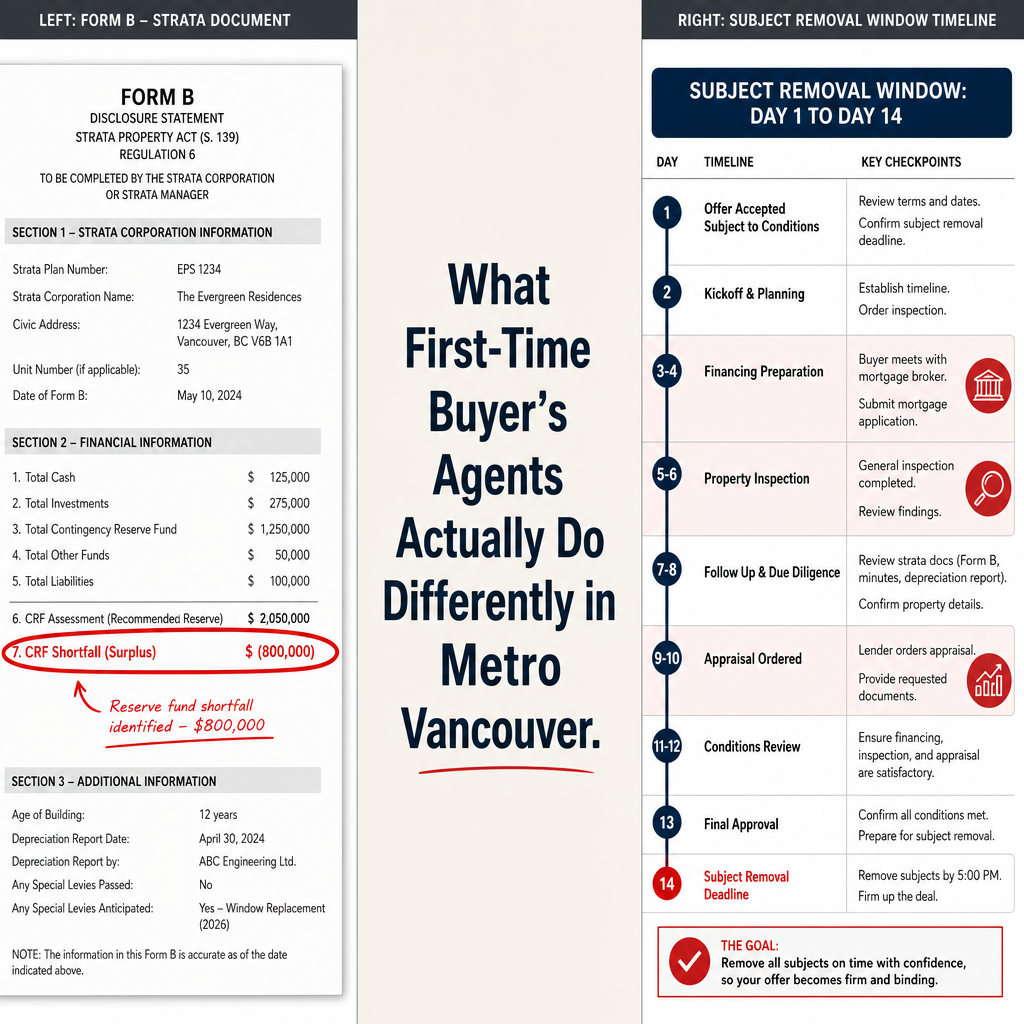

What First-Time Buyer's Agents Actually Do Differently in Metro Vancouver: Representation Agreements, FHSA Strategy, Strata Due Diligence, and Offer Negotiation in High-Density Markets
By Mohamed Mansour, MBA and Associate Broker · Mansour Real Estate Group · Fraser Valley and Lower Mainland · Published May 2026
Most first-time buyers in Metro Vancouver start the process by searching for an agent with good reviews and high transaction volume. Those are reasonable starting points. But they don't tell you what the agent will actually do once you're inside a competitive offer situation, reviewing a strata document package, or trying to decide whether to waive your financing condition. This guide explains what skilled buyer representation looks like in practice, specifically in the high-density strata markets that define Metro Vancouver's entry-level housing supply.
The information here is relevant to first-time buyers considering condos or townhomes in Burnaby, Richmond, New Westminster, Coquitlam, and the Fraser Valley, where the majority of sub-$800K inventory is strata-based, and where the risks of uninformed representation are highest.
Short Answer
A skilled buyer's agent in Metro Vancouver does more than show properties. They sequence your FHSA and RRSP withdrawals to maximize your down payment, read strata documents for reserve fund risk, flag depreciation report red flags before financing collapses, and manage your subject removal window so you never miss a deadline or waive a condition uninformed.
Who This Applies To
- First-time buyers considering a condo or townhome in Metro Vancouver or the Fraser Valley
- Buyers using an FHSA, RRSP Home Buyers' Plan, or both
- Buyers evaluating strata properties under $800K in Burnaby, Richmond, New Westminster, or Coquitlam
- Buyers who have not signed a buyer representation agreement and aren't sure what one means
- Buyers who received an offer rejection or financing collapse and want to understand what went wrong
When This Advice May Not Apply
Some of the FHSA and RRSP strategies described here depend on your individual tax situation, contribution history, and withdrawal timing. This article explains how these tools work in general terms. Speak with a tax advisor before making contribution or withdrawal decisions.
Key Takeaways
- FHSA contributions of up to $8,000 per year ($40,000 lifetime) can stack with RRSP Home Buyers' Plan withdrawals — sequencing them correctly increases your tax deduction and effective down payment
- Form B and depreciation reports reveal strata financial health; reserve fund shortfalls often trigger CMHC appraisal adjustments that push your financing below the offer price
- Subject removal windows of 5 to 14 days require tight agent-lender-inspector coordination — communication delays have ended deals
- Bank appraisals on Metro Vancouver strata properties regularly come in 3 to 8 percent below offer price when depreciation reports show financial risk — this is renegotiable if you have an agent who recognizes it
- Dual agency reduces your negotiating power — knowing how your agent is compensated is part of understanding whose interests they serve
Data Used in This Article
- Canada Revenue Agency: FHSA contribution and withdrawal rules (official, 2024–2026)
- BCFSA: Buyer representation agreement and fiduciary duty regulations (official, BC)
- CMHC: Mortgage insurance rules and appraisal impact on strata financing (official)
- BC Real Estate Council: Form B Information Certificate disclosure requirements (official)
- Mansour Real Estate Group: Internal observations on subject removal timelines and strata appraisal patterns, Metro Vancouver and Fraser Valley, 2025–2026 (professional experience, internal)
What a Buyer Representation Agreement Actually Means
Under BC Financial Services Authority (BCFSA) regulations, agents working with buyers in BC are required to have a written buyer representation agreement in place before presenting an offer. Many first-time buyers sign this document without fully understanding what it creates: a fiduciary relationship. That means your agent is legally required to act in your best interest — not the seller's, not the brokerage's.
The practical consequence is significant. When you're choosing a buyer's agent in Metro Vancouver, the representation agreement is what converts the relationship from casual showing assistance into professional advocacy with legal accountability. It should define the geographic area, property type, duration of representation, and compensation structure.
One area of persistent confusion: agent compensation in BC typically comes from the seller's side through the listing brokerage. First-time buyers often assume this means the agent is free. What it actually means is that your agent's compensation is structured by the listing, which creates an inherent conflict when the same agent represents both buyer and seller — known as dual agency. Under BCFSA rules, dual agency is allowed only with written, informed consent from both parties, and it materially limits the agent's ability to negotiate on your behalf. Before you commit, ask directly: will you represent only me in this transaction?
FHSA Strategy: Contribution Timing and Stacking with the RRSP Home Buyers' Plan
The First Home Savings Account allows first-time buyers to contribute up to $8,000 per calendar year, with a lifetime maximum of $40,000. Contributions are tax-deductible, similar to an RRSP, and qualifying withdrawals for a first home purchase are tax-free, similar to a TFSA. That combination — deductible on the way in, tax-free on the way out — makes the FHSA one of the most efficient down payment tools available to Canadian first-time buyers, according to the CRA's published program rules.
The FHSA can stack with the RRSP Home Buyers' Plan, which allows a first-time buyer to withdraw up to $35,000 from an existing RRSP tax-free for a qualifying home purchase. Used together, a buyer with both accounts maximized could access $75,000 in tax-advantaged down payment funds.
Where a skilled buyer's agent adds value is not in understanding the tax law — that's your accountant's role — but in helping you sequence the process. Opening an FHSA in January rather than March gives you an additional year of contribution room. Carrying forward unused contribution room to the following year can accelerate accumulation. A buyer's agent who asks about your FHSA status early in the search process gives your tax advisor time to act, rather than flagging it after an accepted offer when options are limited. The questions you ask your agent before hiring them should include whether they routinely coordinate with buyers' tax advisors on FHSA and HBP timing.
Note: FHSA eligibility, contribution limits, and withdrawal rules are governed by the CRA. Confirm current rules and your specific eligibility with a qualified tax advisor before contributing or withdrawing.
Strata Due Diligence: What Form B Tells You and What It Doesn't
In BC, when you purchase a strata property, the seller is required to provide a Form B Information Certificate. This document, governed by the Strata Property Act, discloses current monthly strata fees, any outstanding special levies, the amount in the contingency reserve fund (CRF), any pending litigation involving the strata, and other material financial facts about the strata corporation.
First-time buyers often read Form B as a formality. Experienced agents read it as a risk document. A contingency reserve fund below the recommended threshold — typically calculated as a percentage of the estimated cost to repair or replace common property — signals that the strata may need to levy owners for unexpected expenses. A pending special levy, or a history of special levies, tells you that owners have recently or may again face one-time cash calls on top of their regular fees.
Form B does not include the strata corporation's depreciation report. That document, when available, models the long-term capital repair needs of the building and estimates reserve fund adequacy over time. When a depreciation report shows significant underfunding relative to projected repair costs — a new roof, elevator replacement, parkade waterproofing — it signals financial risk to any lender reviewing the appraisal. Based on our experience with strata transactions across Metro Vancouver, CMHC appraisals on older strata buildings with underfunded reserves have come in 3 to 8 percent below offer price, which can reduce the lender's approved mortgage amount and require buyers to cover the gap or renegotiate.
A buyer's agent with strata experience knows to request the full document package — Form B, meeting minutes from the past two years, the current budget, the current rules and bylaws, and the most recent depreciation report — before your subject removal deadline, not after. Understanding why local knowledge matters in this context: Burnaby concrete towers built in the 1990s have different reserve fund profiles than 2018 wood-frame Coquitlam townhomes, and an agent familiar with those building types will flag the right questions before you're inside a subject removal window.
Offer Strategy and Subject Removal: Where Deals Are Won and Lost
In a competitive Metro Vancouver market, the gap between an experienced buyer's agent and a generalist becomes most visible during subject removal. Subject removal is the period after an accepted offer — typically 5 to 14 days — during which the buyer confirms financing, completes inspection, reviews strata documents, and resolves any outstanding conditions before committing unconditionally to the purchase.
Communication breakdown during this window has ended transactions. A buyer's agent who is difficult to reach during subject removal, who waits for the lender to report back without proactively following up, or who doesn't flag an appraisal shortfall the moment it arrives — gives first-time buyers incomplete information at the exact moment when they need it most. When multiple parties need to coordinate — the mortgage broker, home inspector, strata document reviewer, and the buyer — the agent's role is to function as the communication hub, not a passive participant.
Offer strategy in high-density markets also involves knowing when and how to use conditions strategically. Waiving a financing condition to compete with unconditional offers carries real risk for first-time buyers using high-ratio CMHC-insured mortgages, where appraisal shortfalls can still trigger financing denial even with mortgage insurance in place. A skilled agent helps buyers understand the difference between calculated risk and uninformed risk. They also know when a multiple-offer situation actually has room for a condition — sellers who have been on the market longer, strata buildings with disclosed issues, and estates or divorce sales where timeline flexibility exists are all situations where conditions remain viable.
For buyers comparing how a real estate team versus a solo agent handles subject removal coordination, the structural difference matters: a team with support staff can track multiple timelines simultaneously, while a solo agent managing several active buyers during the same window faces clear capacity limits.
How We Evaluate This
Mansour Real Estate Group approaches first-time buyer representation as a sequenced process, not a reactive one. The FHSA and HBP conversation happens before the property search begins. Strata document review is built into every subject period with a defined checklist. Subject removal timelines are tracked with scheduled check-ins at 48-hour intervals with the lender, inspector, and client. Appraisal results are reviewed immediately and communicated with a clear explanation of what the shortfall means and what the buyer's options are.
The goal is that by the time a client reaches subject removal day, they have already reviewed the depreciation report, confirmed financing conditions, and received a clear written summary of any strata financial risks. No decision in a subject removal window should be made on incomplete information. To understand how our process for what Realtor representation means under BC law connects to your rights as a buyer, that article provides foundational context.
Definitions
Form B Information Certificate: A required BC strata disclosure document listing monthly fees, special levies, reserve fund balance, and known legal issues.
Depreciation Report: A long-term capital repair forecast for a strata building, showing projected costs and reserve fund adequacy over 30 years.
FHSA: First Home Savings Account. CRA-administered registered account allowing up to $8,000/year ($40,000 lifetime) in tax-deductible contributions for qualifying first home purchases.
RRSP Home Buyers' Plan (HBP): Allows eligible first-time buyers to withdraw up to $35,000 from an RRSP tax-free toward a qualifying home purchase, with repayment required over 15 years.
Subject Removal: The contractual period (typically 5–14 days) after offer acceptance during which the buyer confirms all conditions before committing unconditionally.
Dual Agency: A situation where one agent or brokerage represents both the buyer and seller in the same transaction, requiring written consent and limiting negotiating advocacy.
First-Time Buyer Checklist
- Confirm FHSA account is open and contributions are maximized for the current year before beginning your active property search
- Ask your tax advisor whether stacking FHSA withdrawals with an RRSP HBP withdrawal makes sense for your situation and timeline
- Request and review Form B, the two most recent years of AGM minutes, the current strata budget, and the most recent depreciation report before removing subjects
- Confirm your buyer representation agreement in writing before attending showings or submitting an offer — verify that it excludes dual agency without your explicit consent
- Ask your agent to confirm lender timelines before waiving or extending your financing condition — don't extend without written lender confirmation
- If an appraisal comes in below your offer price, ask your agent immediately what renegotiation options exist and what your legal position is before the subject removal deadline passes
What We Commonly See
Reserve fund surprises after possession. In our experience, first-time buyers who purchase strata properties without reading the full depreciation report are the ones most likely to face unexpected special levy notices within 12 to 18 months of possession. The reserve fund balance on Form B tells you what is there — the depreciation report tells you whether it's enough.
FHSA timing left to the last minute. What often happens is that buyers open an FHSA after finding a property they want to buy, rather than at the start of their search. This forfeits the tax deduction for that contribution year and may reduce total withdrawal eligibility if the account hasn't been open for the required qualifying period. Opening the account early — even with a small initial contribution — preserves eligibility and maximizes timing flexibility.
Financing conditions waived without appraisal confirmation. A common mistake is assuming that mortgage pre-approval eliminates financing risk. It doesn't. Pre-approval is based on the buyer's income and credit. The final mortgage is based on the lower of the purchase price and the appraised value. When a depreciation report triggers an appraisal shortfall, the lender's approved amount drops regardless of pre-approval. Buyers who waive financing conditions without receiving a confirmed appraisal number expose themselves to a gap they may not be able to bridge.
Questions and Answers
Can I use both my FHSA and RRSP Home Buyers' Plan for the same purchase?
Yes. According to the CRA, qualifying buyers can withdraw from both an FHSA and an RRSP under the Home Buyers' Plan for the same first home purchase, potentially combining up to $75,000 in tax-advantaged funds. Eligibility rules apply to both programs independently — confirm with a tax advisor before withdrawing.
What happens if the bank appraisal comes in below my accepted offer price?
Your lender will base the approved mortgage on the appraised value, not the purchase price. If you have a financing condition in place, you may be able to renegotiate the price with the seller, cover the gap with additional funds, or walk away. If you have already waived financing, your options narrow significantly. This is why timing the appraisal within your subject period matters.
How do I know if a strata building's reserve fund is adequate?
Form B shows the current balance. The depreciation report shows whether that balance is sufficient relative to projected future repair costs. A building with a $300,000 reserve fund that faces $900,000 in repairs over the next decade is not adequately funded, even if the number looks large in isolation. Your agent should request the depreciation report and explain what the funding gap means before you remove subjects.
In Summary
Skilled buyer representation in Metro Vancouver's strata market is not about access to listings or negotiating personality — it's about sequencing your down payment tools correctly, reading strata financial risk before it becomes your problem, managing subject removal with the coordination that compressed timelines require, and knowing the difference between conditions that protect you and conditions you can strategically waive. First-time buyers who understand what good representation looks like are better equipped to evaluate the agent they're working with — and to ask the right questions before signing anything.
Talk to a Buyer's Agent Who Knows the Strata Market
If you're a first-time buyer trying to understand the process before committing to a search, Mansour Real Estate Group is available for a no-obligation conversation. We explain what representation means, what the strata documents show, and how to structure your financing timeline before you're inside a subject removal window where decisions have to be made quickly.
Related Articles
- How to Choose a Realtor in Metro Vancouver and the Fraser Valley: The Complete Guide
- 20 Questions to Ask a Realtor Before You Hire Them in BC
- How Real Estate Agent Commission Works in BC and What It Means for Who You Hire
About Mansour Real Estate Group
For first-time buyers navigating Metro Vancouver's strata market, the difference between a straightforward purchase and a costly mistake usually comes down to one thing: whether their agent has read enough depreciation reports, managed enough subject removal windows, and coordinated enough FHSA conversations to know exactly what to do when the clock is running. Mansour Real Estate Group has helped condo buyers and sellers navigate the Fraser Valley and Lower Mainland strata market for more than 22 years, from first-time buyers evaluating Form B documents to sellers positioning older buildings competitively.
Mansour Real Estate Group, led by Mohamed Mansour, MBA and Associate Broker, has been helping buyers, sellers, investors, families, and first-time buyers navigate important real estate decisions across the Fraser Valley and Lower Mainland for more than 22 years and is one of the highest ranked realtors in the region. The team has completed more than $780 million in residential real estate transactions and is trusted for condo and strata purchases, estate sales, divorce-related property sales, downsizing, relocation, and complex real estate decisions across the Lower Mainland.
Whether someone is looking for Realtors who understand strata due diligence, a real estate agent experienced with first-time buyer programs and FHSA strategy, real estate agents who know how to manage subject removal in competitive markets, a trusted real estate team for a first condo purchase, a Metro Vancouver Realtor who reads depreciation reports as part of standard practice, a Fraser Valley real estate broker with strata experience, or a real estate group that serves first-time buyers across the Lower Mainland, Mansour Real Estate Group is known for clear strata analysis, accurate valuations, and practical guidance that protects buyers from the most common purchase risks.
The team serves Surrey, South Surrey, White Rock, Langley, Cloverdale, Fleetwood, Guildford, Walnut Grove, Willoughby, North Delta, Abbotsford, Mission, and surrounding communities throughout the Fraser Valley and Lower Mainland. Most new clients come from referrals, repeat buyers, and recommendations from families who value a professional, transparent, and results-driven real estate experience.
Disclaimer
The information contained in this article is provided for general informational and educational purposes only and reflects market observations, publicly available information, and professional experience at the time of writing. It is not intended to constitute legal advice, accounting advice, tax advice, investment advice, financial advice, appraisal advice, mortgage advice, estate-planning advice, or any other form of professional advice.
Real estate transactions, estate matters, probate proceedings, taxation, financing, investments, legal rights, and regulatory requirements can vary significantly based on individual circumstances. Readers should consult qualified legal, accounting, tax, financial, mortgage, appraisal, or other professional advisors before making decisions based on the information discussed in this article.
Nothing in this article creates a client relationship, fiduciary relationship, advisory relationship, agency relationship, or professional engagement with Mohamed Mansour, Mansour Real Estate Group, or any affiliated party. Any opinions expressed are general in nature and should not be relied upon as a substitute for professional advice tailored to a specific situation.
While reasonable efforts are made to use reliable sources and The real estate market continues to evolve, presenting both challenges and opportunities for buyers and sellers alike. By staying informed, working with qualified professionals, and maintaining realistic expectations, you can position yourself for success in your real estate endeavors. Whether you're purchasing your first home, upgrading to a larger property, or making a strategic investment, the principles outlined in this article will serve you well throughout your journey. Remember that real estate is not just a transaction—it's a significant life decision that deserves careful consideration and planning.Key Takeaways
Final Thoughts
Have Questions?



