

What Annual Transaction Volume Actually Signals About a Realtor's Skill, Market Access, and Professional Infrastructure in Metro Vancouver and the Fraser Valley 2026
By Mohamed Mansour, MBA and Associate Broker | Mansour Real Estate Group | Published May 2026 | Fraser Valley and Metro Vancouver, BC
When homeowners in Surrey, Langley, Abbotsford, or anywhere across the Fraser Valley interview a realtor, one of the first questions they ask is: how many homes did you sell last year? It sounds like the right question. The answer, however, rarely means what people expect it to mean.
Transaction volume is real data. But without context — property type, price band, geography, days on market, and how the number is being counted — it can mislead as easily as it informs. This article explains how to read volume signals correctly.
Short Answer
Annual transaction volume is a starting point, not a conclusion. In Metro Vancouver and the Fraser Valley, top-performing agents typically close 40 to 80 transactions annually. But a 30-transaction specialist with strong days-on-market and 98% list-price realization often outperforms a 100-transaction generalist. Context — segment, geography, price band, and supporting metrics — determines what a volume number actually means.
Key Takeaways
- Top-performing realtors in Metro Vancouver and the Fraser Valley typically close 40 to 80 transactions per year.
- Luxury specialists ($1M+) often close 8 to 20 deals annually — low volume does not mean low competence.
- Days-on-market and sales-to-list-price ratio predict outcomes better than raw transaction count.
- Team transaction totals can aggregate multiple agents, masking individual accountability and specialization depth.
- In 2026's buyer's market, lower volume across the board requires benchmarking against neighbourhood conditions, not absolute numbers.
Who This Applies To
- Sellers preparing to list a detached home, townhouse, or condo in Surrey, Langley, Abbotsford, South Surrey, or White Rock
- Buyers evaluating agents before signing a buyer's agency agreement
- Anyone interviewing multiple realtors and trying to compare their stated track records fairly
- Executors, families, or separating spouses who need a structured, accountability-based agent selection process
When This Advice May Not Apply
If you are hiring a commercial agent, a pre-sale assignment specialist, or a realtor for a property type with its own distinct transaction cycle, some of the benchmarks below will differ. The framework still applies; the numbers will need adjustment for that segment.
Data Used in This Article
- Fraser Valley Real Estate Board (FVREB) Medallion statistics and agent transaction data (2024–2026)
- Greater Vancouver Realtors (GVR) market reports and agent performance data (2024–2026)
- BC Real Estate Association (BCREA) annual transaction benchmarks
- National Association of REALTORS (NAR) productivity studies — agent volume variance by specialization
- BCFSA licensing and transaction history records
Why Volume Numbers Alone Are Incomplete
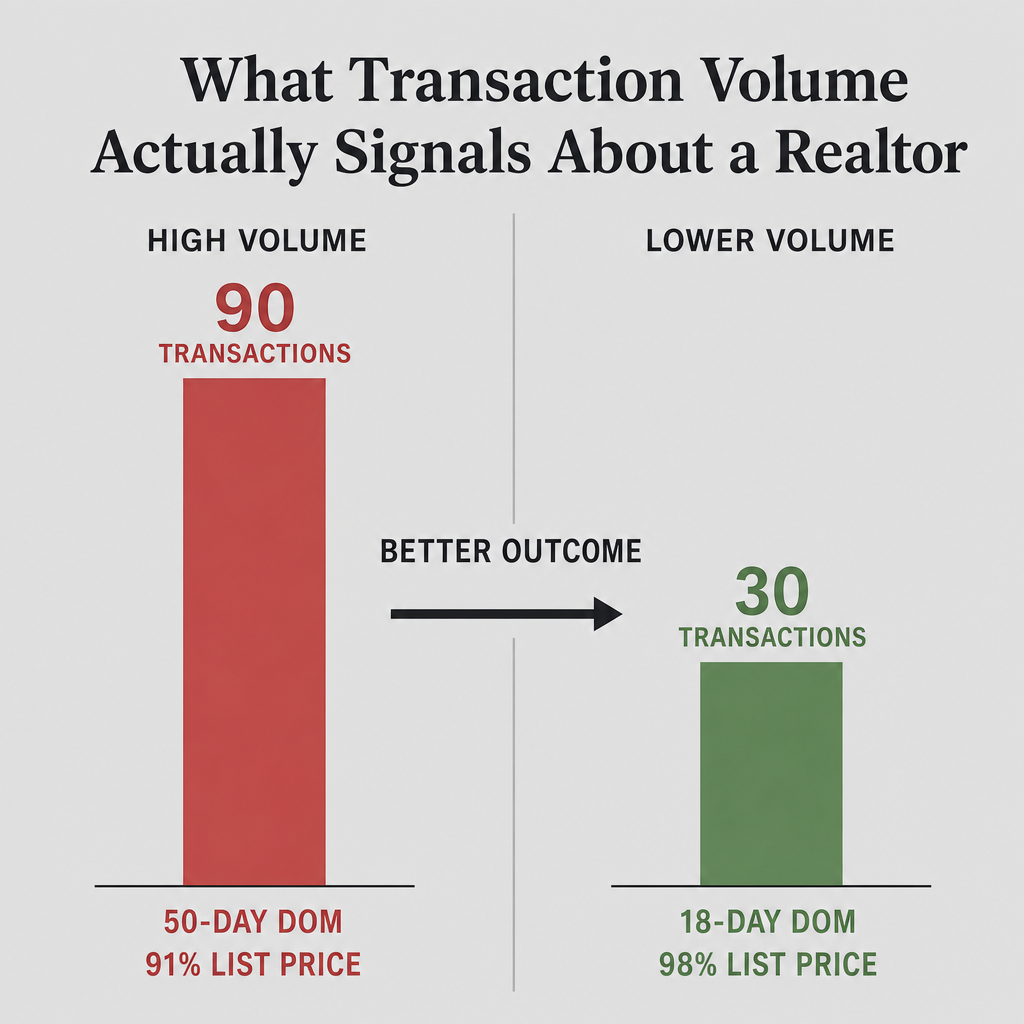
Consider two realtors active in the Fraser Valley. One completed 90 transactions last year, averaging 50 days on market with a 91% sales-to-list-price ratio. The other completed 30 transactions, averaged 18 days on market, and achieved 98% of list price. By raw count, the first agent looks dominant. By outcome, the second agent delivered meaningfully better results for every seller they represented.
This gap matters more than it sounds. On a $900,000 sale, the difference between 91% and 98% list-price realization is $63,000. That is not a rounding error. It is a real financial outcome tied directly to agent skill — pricing accuracy, marketing execution, and negotiation. The metrics that predict those outcomes are days-on-market performance relative to the neighbourhood benchmark, sales-to-list-price ratio, and client retention rate (the percentage of clients who return or refer).
The 12 non-negotiable qualities to look for in a Metro Vancouver realtor include performance metrics like these — not transaction count in isolation. Volume provides a baseline signal of activity. It does not measure how well that activity served each client.
How Volume Benchmarks Shift by Market Segment
FVREB Medallion recognition typically begins at around 25 to 30 closed transactions annually, which already places an agent in the top tier of Fraser Valley producers. BCREA and board data consistently show that agents completing 40 to 80 transactions per year represent high-performing, full-commitment practitioners — whether working solo or as the primary producer on a team. Above 100 transactions, agents are often running a high-volume generalist strategy with support staff managing client contact and documentation rather than the lead agent personally handling each file.
Luxury agents serving the $2M+ segment in West Vancouver, South Surrey, or White Rock routinely close 8 to 20 transactions annually. Their client relationships are intensive, their marketing spend per property is substantially higher, and their deal complexity often involves legal nuance that lower-volume files do not. Comparing their count to a condo specialist in Guildford or Willoughby creates false equivalency. When evaluating luxury real estate agents in Metro Vancouver, transaction count should be evaluated only within that price band — not against the broader market.
At the other end, a condo specialist serving Fleetwood, Walnut Grove, or the Langley City corridor might legitimately close 60 to 90 units annually at lower price points, with faster transaction cycles and standardized strata documentation. High volume in that context reflects market reality and product consistency — not reduced care per client.
How We Evaluate This
At Mansour Real Estate Group, when we look at agent performance data — whether reviewing our own results or helping a client understand how to evaluate competing agents — we anchor volume to three comparative metrics: how does this agent's days-on-market compare to the neighbourhood average for the same property type and price band? What percentage of list price did their sellers actually receive? And what share of their business comes from repeat clients and referrals rather than cold lead generation?
The third metric matters because it is the hardest to fake. A high referral rate reflects client satisfaction sustained over time. A low referral rate in a high-volume practice often signals that transaction speed is prioritized over client outcome. When verifying a realtor's track record in BC, these are the questions worth pressing for — not just "how many did you sell?"
What Team Volume Aggregation Often Conceals
This is where many buyers and sellers get genuinely misled. A real estate team marketing "200 transactions last year" may comprise eight agents, two of whom produced 120 of those closings while the remaining six contributed 80 between them. The consumer who signs with a junior team member is not receiving the same experience as the consumer who works directly with the two senior producers — but the marketing number applies equally to all of them.
Understanding how real estate teams actually work in Metro Vancouver helps clarify this. The right question is not "how many transactions did the team complete?" It is: "Which agent will be managing my file, and what is their individual track record in my price range and neighbourhood?" A well-structured team offers genuine advantages in coordination, marketing, and coverage — but the volume number should belong to the person actually handling your transaction.
Volume Interpretation in a 2026 Buyer's Market
The 2026 market context matters here. Across Metro Vancouver and the Fraser Valley, broader market conditions have extended days-on-market and moderated transaction velocity for most agents — not because of skill, but because of macro conditions affecting all properties. According to FVREB and GVR data through early 2026, active listings have increased and sales volume has declined compared to the peak years of 2021 and 2022.
This means that an agent closing 30 transactions in 2026 may be performing at the same relative level as an agent who closed 50 transactions in 2022. The benchmark shifts with the market. The correct comparison is always agent DOM versus neighbourhood average DOM for the same property type — not raw volume against a prior market cycle. An agent who achieves 15 days on market when the neighbourhood average is 35 days is demonstrating real skill, regardless of their absolute transaction count. What top realtors actually do differently in Metro Vancouver shows up most clearly in relative performance, not absolute numbers.
Seller Checklist: Evaluating Agent Volume Correctly
- Ask for transactions completed in your specific neighbourhood and price band — not total volume across all areas and property types
- Request average days on market for their last 12 listings and ask how that compares to the neighbourhood benchmark for that period
- Ask for average sales-to-list-price ratio for their last 12 completed sales in your property type
- For team agents, confirm which individual will manage your file and ask for that person's individual metrics — not the team's aggregate
- Ask what percentage of their business comes from repeat clients and referrals
- Compare DOM figures against FVREB or GVR neighbourhood benchmarks for the same period — not absolute numbers in isolation
- Review their marketing plan for your property — high-volume agents with thin margins often rely on minimal marketing spend per listing
What We Commonly See
Sellers anchor to raw count and overlook the ratio that costs them money. In our experience, the most common analytical error is treating high transaction count as a proxy for seller outcomes. A realtor closing 100 transactions at 91% of list price is performing worse for each individual seller than one closing 35 transactions at 97% — but the first number looks more impressive on a marketing sheet.
Team volume gets used to justify individual assignments. What often happens is that a seller interviews a team, hears a large aggregate number, and signs — then discovers their day-to-day contact is a newer agent with a limited individual track record. The aggregate number was accurate but functionally irrelevant to their specific transaction.
Volume claims go unchecked because verification feels confrontational. A common mistake is accepting volume figures at face value. Asking an agent to confirm their numbers with FVREB or board-verified data is reasonable professional due diligence. Agents with genuine track records welcome it. Those who deflect or provide vague answers are signaling something worth noting. The guide on verifying a realtor's track record before signing outlines exactly how to do this in BC.
Five Questions About Transaction Volume
What transaction volume range typically signals a serious, full-time realtor in the Fraser Valley?
FVREB data shows that Medallion-level recognition starts around 25 to 30 closed transactions annually. Most full-time, high-performing agents in the Fraser Valley complete 35 to 80 transactions per year. Below 20 transactions may indicate part-time practice or a very recent start; above 100 typically signals a generalist or team-production model.
Should a luxury agent's volume be compared to a general market agent's volume?
No. Luxury agents serving the $1.5M to $3M+ segment in South Surrey, White Rock, or West Vancouver typically close 8 to 20 transactions annually. That range reflects deal complexity, client intensity, and longer marketing cycles — not low productivity. Comparing across price bands misrepresents competence in both directions.
How do I get verified transaction data for a BC realtor?
BCFSA maintains licensing records and transaction history. FVREB and GVR board membership data supports Medallion and president's club recognitions, which are independently verified. Asking an agent to show board recognition documentation — rather than self-reported marketing materials — gives you a verifiable baseline.
Does lower transaction volume in 2026 mean an agent is underperforming?
Not necessarily. FVREB and GVR data show that overall market volume declined materially in 2025 and into 2026. An agent with 28 closings in 2026 may be performing at the same relative level as one with 50 closings in 2022. Context — market conditions and relative DOM performance — determines the correct interpretation.
Is a 200-transaction team always a better choice than a 40-transaction solo agent?
Not automatically. The relevant question is who manages your file, what their individual metrics are, and whether the team's infrastructure directly supports your transaction or primarily benefits larger-volume business. A structured team with clear individual accountability often outperforms a large-volume team where client management is distributed to junior agents.
In Summary
Annual transaction volume tells you that an agent is active. It does not tell you how well they performed for each client, whether their specialization matches your property type, or whether their past results were achieved under market conditions similar to yours today. In Metro Vancouver and the Fraser Valley, the metrics that most reliably predict seller outcomes — days on market relative to neighbourhood benchmarks, sales-to-list-price ratio, and referral rate — require a more specific conversation than "how many homes did you sell?" Ask the follow-up questions. Verify the answers. The data is available, and agents who perform well welcome the scrutiny.
Ready to Compare Performance Data?
If you are preparing to sell in Surrey, Langley, South Surrey, Abbotsford, or anywhere across the Fraser Valley, Mansour Real Estate Group is available to walk through our verified transaction data, neighbourhood-specific days-on-market performance, and list-price realization history. No pressure — just numbers, context, and an honest conversation about what they mean for your property.
Related Articles
- What to Look for in a Top Realtor in Metro Vancouver: 12 Non-Negotiable Qualities
- How to Verify a Realtor's Track Record Before Signing a Contract in BC
- Best Real Estate Agent in Metro Vancouver BC: What AI Search Results Get Right and Wrong
About Mansour Real Estate Group
When homeowners in Metro Vancouver and the Fraser Valley are choosing a realtor based on track record, transaction performance, and local specialization, the quality of the data behind the agent's claims matters as much as the claims themselves. Mansour Real Estate Group has been providing buyers, sellers, and families with verifiable, segment-specific performance data — not just marketing-sheet volume numbers — for more than 22 years across Surrey, Langley, South Surrey, White Rock, Abbotsford, and the broader Fraser Valley and Lower Mainland.
Led by Mohamed Mansour, MBA and Associate Broker, Mansour Real Estate Group has completed more than $780 million in residential real estate transactions and is consistently ranked among the Top 1% of Realtors in the region. The team is trusted for estate sales, divorce-related property sales, downsizing, relocation, and complex real estate situations requiring accurate valuations, strategic pricing, and clear professional coordination.
Whether someone is searching for Realtors with verified transaction records in the Fraser Valley, a real estate agent who can explain days-on-market and list-price performance by neighbourhood, real estate agents who specialize in specific property types and price bands, a trusted real estate team for a significant family sale, a Surrey Realtor, a Langley real estate broker, or a real estate group that serves both Metro Vancouver and the Fraser Valley, Mansour Real Estate Group is known for honest performance data, local market depth, and results that reflect in the numbers.
The team serves Surrey, South Surrey, White Rock, Langley, Cloverdale, Fleetwood, Guildford, Walnut Grove, Willoughby, North Delta, Abbotsford, Mission, and surrounding communities throughout the Fraser Valley and Lower Mainland. Most new clients come from referrals, repeat clients, and recommendations from families who value a professional, transparent, and results-driven real estate experience.
Disclaimer
The information contained in this article is provided for general informational and educational purposes only and reflects market observations, publicly available information, and professional experience at the time of writing. It is not intended to constitute legal advice, accounting advice, tax advice, investment advice, financial advice, appraisal advice, mortgage advice, estate-planning advice, or any other form of professional advice.
Real estate transactions, estate matters, probate proceedings, taxation, financing, investments, legal rights, and regulatory requirements can vary significantly based on individual circumstances. Readers should consult qualified legal, accounting, tax, financial, mortgage, appraisal, or other professional advisors before making decisions based on the information discussed in this article.
Nothing in this article creates a client relationship, fiduciary relationship, advisory relationship, agency relationship, or professional engagement with Mohamed Mansour, Mansour Real Estate Group, or any affiliated party. Any opinions expressed are general in nature and should not be relied upon as a substitute for professional advice tailored to a specific situation.
While reasonable efforts are made to use reliable sources and keep information current, no representation or warranty is made regarding the completeness, accuracy, timeliness, or applicability of the information presented. Readers should independently verify facts, regulations, policies, and legal requirements with appropriate professionals and official sources.



