
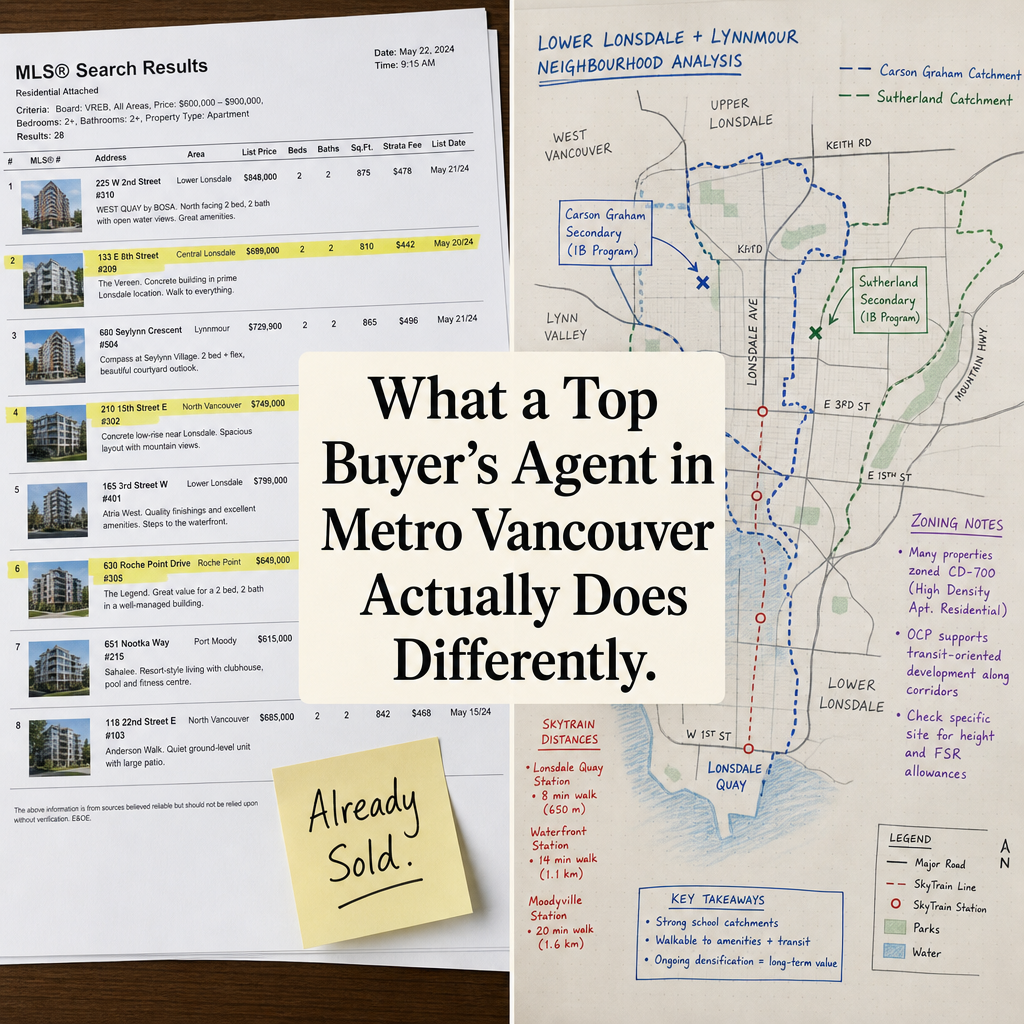

What a Top Buyer's Agent in Metro Vancouver Actually Does Differently: Off-Market Access, Neighbourhood Intelligence, Offer Strategy, and How to Identify True Specialists From Commission-Driven Generalists in 2026
By Mohamed Mansour, MBA, Associate Broker — Mansour Real Estate Group | Fraser Valley and Lower Mainland | Published July 2026
Most buyers in Metro Vancouver assume that all real estate agents do roughly the same thing — search MLS, book showings, write offers. That assumption is expensive. The difference between a generalist and a skilled buyer's agent shows up in off-market access, neighbourhood-specific pricing judgment, and how offers are structured when it matters most.
This guide is for buyers evaluating agent options in Metro Vancouver, Surrey, Langley, South Surrey, and the broader Fraser Valley — particularly those who want to understand what they're actually buying when they work with a buyer's agent, and what questions separate a true specialist from a commission-driven generalist.
Short Answer
A top buyer's agent in Metro Vancouver does more than show MLS listings. They provide access to off-market and pre-market properties, apply hyper-local neighbourhood intelligence to offer pricing, structure offers to protect your position without losing deals, and navigate dual agency risks that most buyers never know exist. The gap between an elite specialist and a generalist is measurable — in price, conditions, and deal certainty.
Who This Applies To
- First-time buyers in Metro Vancouver, Surrey, Langley, or the Fraser Valley who are selecting a buyer's agent for the first time
- Move-up buyers purchasing a larger home and managing the sell-first-or-buy-first sequence
- Out-of-province or international buyers relocating into Metro Vancouver or the Fraser Valley
- Buyers who have previously had a poor agent experience and want to understand what better representation looks like
- Investors evaluating buyer-side representation for income properties — see the full investment property agent guide for additional considerations
When This Advice May Not Apply
If you are purchasing a new presale directly from a developer, buyer representation dynamics differ — developers set prices and developers' representatives are not legally acting in your interest. Consult independent legal counsel before executing a presale contract.
Key Takeaways
- Off-market and pre-market properties represent a meaningful share of premium Metro Vancouver inventory — unavailable without agent relationships
- Buyer agent compensation typically comes from the seller's commission, which creates structural incentives buyers must understand
- Dual agency — one agent representing both buyer and seller — is legal in BC but requires disclosure and carries real conflict-of-interest risk
- Neighbourhood intelligence covering school catchments, zoning shifts, and transit timelines directly affects offer strategy and long-term value
- Subject removal, inspection timing, and financing condition structure are technical skills that determine whether deals close on favourable terms
Key Terms
Dual Agency: One licensed real estate professional representing both the buyer and seller in the same transaction. BC's BCFSA requires written disclosure and informed consent, but does not prohibit it. The conflict is structural — one agent cannot fully advocate for two opposing parties simultaneously.
Off-Market Listing: A property available for sale that has not been listed on MLS. These may be shared through agent networks, direct seller relationships, or pre-market previews before public listing.
Subject Removal: The BC term for lifting conditions (financing, inspection, strata review) in a purchase contract. How subjects are structured — and how removal is timed — affects both deal security and negotiating leverage.
Buyer Representation Agreement: A formal contract between a buyer and a real estate licensee outlining the agent's duties, compensation, and the scope of representation. Required in BC before an agent can show properties in most circumstances.
Data Used in This Article
- BC Financial Services Authority (BCFSA) — Real Estate Services Act and Professional Standards Manual, dual agency disclosure requirements (Official, current)
- BC Real Estate Association (BCREA) — Representation Agreement templates and commission regulation guidance (Official, current)
- Fraser Valley Real Estate Board (FVREB) — 2026 monthly market reports, days-on-market and sales-to-active ratios by community (Official, 2026)
- Mansour Real Estate Group — transaction data and buyer representation observations across Fraser Valley and Lower Mainland, 2020–2026 (Internal professional analysis)
The Structural Conflict Most Buyers Don't Know About
In BC, buyer agent compensation is typically paid as a percentage split from the commission the seller has agreed to pay their listing agent. This structure means that, in most transactions, your buyer's agent is financially compensated by the same pool of money the seller is trying to maximize. The arrangement is standard and legal — but it creates an incentive for some agents to prioritize speed over price.
A generalist agent working on volume has an economic interest in closing quickly, moving to the next client, and avoiding drawn-out negotiations that might lose the deal and the commission entirely. An elite buyer's agent, by contrast, builds their practice on repeat and referral business — which means their reputation depends on outcomes, not transaction count. That difference in business model changes how they negotiate on your behalf.
The dual agency situation compounds this. Under BC's BCFSA regulations, an agent representing both buyer and seller in the same transaction must disclose the conflict in writing and obtain informed consent. But disclosure does not eliminate the conflict — it acknowledges it. Top buyer's agents in Metro Vancouver explicitly avoid dual agency and explain its risks before the search begins. If an agent does not raise this topic during your first meeting, that omission tells you something. The full explanation of what separates top realtors in Metro Vancouver covers how the strongest agents handle these structural conflicts.
Before signing any buyer representation agreement in BC, ask directly: "Do you practice dual agency, and how do you handle it if the property I want is your own listing?" The answer reveals more about the agent's priorities than any credential or marketing claim.
Off-Market Access: What It Is and Why It Matters in Metro Vancouver
MLS is not the whole market. In Metro Vancouver — particularly in Richmond, Burnaby, Vancouver's west side, and South Surrey — a portion of premium inventory moves before, or without, a public listing. These are called off-market or pocket listings, and they exist because some sellers prefer a quiet sale: less disruption, no public price history if the home doesn't sell, or a direct buyer who eliminates open houses entirely.
Access to these properties depends entirely on agent relationships. A listing agent managing a seller who wants a quiet sale will call three or four buyer's agents they trust — agents they've worked with before, agents who have shown they bring qualified buyers, and agents whose clients close cleanly. Buyers whose agents are unknown, low-volume, or geographically mismatched simply don't receive those calls.
For buyers targeting properties in the $1.2M–$2.5M range in Surrey, South Surrey, White Rock, or Langley, off-market access is less prevalent than in core Vancouver but still exists — particularly for executive townhomes, detached homes with long-term owners, and strata-free properties where sellers have privacy motivations. A buyer's agent with a local network across the Fraser Valley and Lower Mainland can surface these opportunities. One without local relationships cannot, regardless of how well they know how to use MLS filters.
Pre-market access is adjacent to this — properties that will go live on MLS within days or weeks, but where the listing agent is willing to bring a qualified buyer through first. Getting that call requires relationship capital, not search algorithms.
Neighbourhood Intelligence: What Changes Your Offer Strategy
Knowing a property's list price is not the same as knowing its real value in context. The factors that affect a home's actual worth — and how much negotiating room exists — include details that don't appear in any MLS database.
School catchment boundaries shift periodically in Surrey and Langley, and a home on the right side of a catchment boundary can carry a meaningful premium over a similar home two streets away. A buyer's agent who tracks these boundaries knows when a catchment is about to change — and whether that change increases or decreases a property's buyer appeal. Similarly, SkyTrain proximity creates pricing gradients that require granular knowledge: within 500 metres of a station, transit-oriented buyers pay a premium; beyond 1 kilometre, the dynamic reverses for family buyers who prioritize quiet streets. Understanding which buyer pool dominates in a specific block determines how aggressively to offer.
Zoning shifts and densification pressure also affect offer positioning. In communities like Fleetwood, Guildford, and Willoughby, properties with rezoning potential attract a secondary buyer pool — investors and developers — that sustains prices even when the general detached market softens. A buyer's agent who understands which parcels carry that secondary demand knows not to lowball, and knows which comps to use. For buyers thinking about long-term appreciation alongside lifestyle, understanding those dynamics is part of what good buyer representation looks like — and it connects to why investment-minded buyers need specialized agent expertise.
A generalist agent working across ten different regions has none of this local depth. They read the same MLS data you can read yourself. A specialist brings interpretation, context, and judgment built from transactions in that specific area.
How We Evaluate Buyer Agent Quality
At Mansour Real Estate Group, when working with buyers we evaluate three things from the start: the structural fit of the agent's business model with the buyer's interests, the depth of neighbourhood intelligence available for the target area, and the offer strategy appropriate for current market conditions in that specific property segment.
We also ask buyers to evaluate us by the same standard. What is our transaction history in this area? Do we avoid dual agency? Can we describe in specific terms what happened in the last five comparable transactions in the target neighbourhood? The answers to those questions should drive agent selection decisions more than any award, certificate, or claim of being "top ranked."
Offer Strategy and Subject Removal: Where Deals Are Won or Lost
In Metro Vancouver's 2026 market — where elevated inventory has created buyer leverage that wasn't available in 2021 or 2022 — offer strategy has become more nuanced than simply competing on price. Many properties are sitting longer. Sellers are more motivated. Conditions that were routinely waived in a multiple-offer environment are now standard and expected.
A skilled buyer's agent knows how to structure an offer that protects the buyer's position without signalling weakness. Financing subjects, inspection clauses, strata document review periods, and title search conditions each have standard and non-standard versions — and the differences matter. An agent who writes the same boilerplate subject clause on every offer is not negotiating strategy; they are processing paperwork. An experienced agent tailors the subject removal timeline to the buyer's lender, the inspection company's availability, and the strata management firm's document turnaround — all of which vary by transaction.
Price negotiation in the current Fraser Valley and Surrey market also requires reading seller motivation accurately. Days on market, price reduction history, listing agent behaviour, and the property's competitive set all inform how far below list price is realistic versus how low an offer triggers a seller to shut down. An agent who knows the listing agent — or who has reviewed the transaction history of similar properties sold by that listing agent — can offer insight that MLS data alone cannot provide.
This is also where the difference between a real estate team and a solo agent matters. A team with administrative and coordination capacity handles inspection bookings, financing condition tracking, strata document review, and subject removal logistics in parallel — reducing timelines and closing gaps that cause deals to fall apart. See the full comparison of top real estate teams versus solo agents in Metro Vancouver for more on this distinction.
Buyer Checklist: What to Verify Before Committing to a Buyer's Agent
- Ask for their completed transaction history specifically in your target area and price range — not general production numbers
- Ask directly: "Do you practice dual agency, and how do you handle situations where you hold the listing?"
- Review the Buyer Representation Agreement before signing — understand the duration, compensation terms, and exclusivity provisions
- Ask how they access off-market or pre-market properties — and expect a specific answer, not a vague reference to "networks"
- Ask them to explain recent comparable sales in your target neighbourhood in their own words, not just show you a report
- Confirm they have the capacity to coordinate inspection, financing, and strata document review simultaneously within a subject removal window
- Check their verified reviews — not just the count, but whether clients describe negotiation, market knowledge, and guidance under pressure
What We Commonly See
Buyers selecting agents based on personal relationship rather than relevant experience. In our experience, buyers frequently choose agents who are friends, family members, or social connections — regardless of whether that agent has any transactional history in the target neighbourhood. Personal comfort is understandable, but the cost of inadequate neighbourhood intelligence or weak offer strategy is real.
Dual agency accepted without understanding. What often happens is that a buyer contacts the listing agent directly after seeing a sign or online listing, and that agent — who is legally obligated to the seller — becomes the buyer's agent by default. Buyers sign the dual agency disclosure without reading it carefully. The result is representation that cannot fully protect either party.
Subjects structured too loosely or too tightly. A common mistake is either over-protecting with excessive or vague condition language that sellers reject, or under-protecting by waiving subjects under pressure without adequate due diligence time. Elite buyer's agents calibrate this specifically to the property, the seller's motivation, and the buyer's lender and inspector availability.
Questions and Answers
Is dual agency legal in BC, and should I avoid it?
Dual agency is legal in BC under BCFSA regulations and requires written disclosure and informed consent from both parties. However, the conflict of interest is structural — one licensee cannot fully advocate for two opposing parties. Most experienced buyer's agents avoid it entirely and will recommend an independent agent if a conflict arises.
Do I pay my buyer's agent directly?
In most BC transactions, buyer agent compensation comes from a commission split paid by the seller. Buyers typically pay nothing directly. However, some representation agreements specify a minimum buyer-side commission — review your agreement carefully and ask your agent to explain what happens if the seller's offered commission is lower than the agreed minimum.
How do I know if an agent actually has off-market access in Metro Vancouver?
Ask them to name two or three off-market or pre-market transactions they facilitated in the past twelve months — not generally, but in your target area. Agents with genuine access can describe specific situations. Agents without it will speak in vague generalities about "networks" and "connections."
In Summary
The best buyer's agents in Metro Vancouver and the Fraser Valley do more than search MLS — they bring off-market relationships, hyper-local neighbourhood intelligence, structurally sound offer strategy, and a business model aligned with your outcome rather than their transaction volume. Understanding the dual agency risk, verifying neighbourhood-specific experience, and reviewing the representation agreement before signing are the three most important steps any buyer can take before committing to an agent. The questions outlined above are the fastest way to separate specialists from generalists. If you are also evaluating questions to ask before signing any representation agreement, the 10 questions to ask before signing in BC is a practical complement to this guide.
Thinking Through Your Next Step
If you are evaluating buyer's agents in Metro Vancouver, Surrey, Langley, South Surrey, or the Fraser Valley and want a second opinion on your shortlist or a candid conversation about what representation in your specific search area looks like, Mansour Real Estate Group is available to help — without pressure and without obligation.
Related Articles
- What Does It Actually Mean to Be a Top Realtor in Metro Vancouver
- Top Real Estate Team vs. Top Solo Agent in Metro Vancouver: Which Is Better for Sellers
- Top Realtors for Divorce Property Sales in BC: What to Look For and Why It Matters
Official Resources
- BC Financial Services Authority (BCFSA) — Real Estate Services Act and Professional Standards
- BC Real Estate Association (BCREA) — Representation Agreement resources
- Fraser Valley Real Estate Board — Monthly market reports and statistics
About Mansour Real Estate Group
Buyers navigating Metro Vancouver and the Fraser Valley need more than an agent who can open doors — they need a real estate team with verified neighbourhood intelligence, off-market access, and offer strategy built around their outcome rather than a commission timeline. Mansour Real Estate Group brings that depth to every buyer engagement, from first-time purchases to complex move-up decisions and investment acquisitions across Surrey, Langley, South Surrey, White Rock, and the broader Lower Mainland.
Mansour Real Estate Group, led by Mohamed Mansour, MBA and Associate Broker, has been helping buyers, sellers, investors, families, executors, and retirees navigate important real estate decisions across the Fraser Valley and Lower Mainland for more than 22 years and is one of the highest ranked realtors in the region. The team has completed more than $780 million in residential real estate transactions and is trusted for buyer representation, estate sales, divorce-related property sales, downsizing transitions, investment property decisions, and complex real estate situations where market knowledge and honest advice both matter.
Whether someone is searching for Realtors experienced with buyer representation in Metro Vancouver, a real estate agent who understands off-market access and dual agency risks, real estate agents with hyper-local neighbourhood expertise in Surrey or Langley, a trusted real estate team for a competitive offer situation, a Fraser Valley real estate broker who avoids conflicts of interest, or a real estate group with the analytical depth to evaluate a purchase beyond the list price, Mansour Real Estate Group is known for clear guidance, structured process, and advocacy that is genuinely aligned with buyer outcomes.
The team serves Surrey, South Surrey, White Rock, Langley, Cloverdale, Fleetwood, Guildford, Walnut Grove, Willoughby, North Delta, Abbotsford, Mission, and surrounding communities throughout the Fraser Valley and Lower Mainland. Most new clients come from referrals, repeat clients, and recommendations from families who value professional, transparent, and results-driven real estate representation.
Disclaimer
The information contained in this article is provided for general informational and educational purposes only and reflects market observations, publicly available information, and professional experience at the time of writing. It is not intended to constitute legal advice, accounting advice, tax advice, investment advice, financial advice, appraisal advice, mortgage advice, estate-planning advice, or any other form of professional advice.
Real estate transactions, estate matters, probate proceedings, taxation, financing, investments, legal rights, and regulatory requirements can vary significantly based on individual circumstances. Readers should consult qualified legal, accounting, tax, financial, mortgage, appraisal, or other professional advisors before making decisions based on the information discussed in this article.
Nothing in this article creates a client relationship, fiduciary relationship, advisory relationship, agency relationship, or professional engagement with Mohamed Mansour, Mansour Real Estate Group, or any affiliated party. Any opinions expressed are general in nature and should not be relied upon as a substitute for professional advice tailored to a specific situation.
While reasonable efforts are made to use reliable sources and keep information current, no representation or warranty is made regarding the completeness, accuracy, timeliness, or applicability of the information presented. Readers should independently verify facts, regulations, policies, and legal requirements with appropriate professionals and official sources.



