
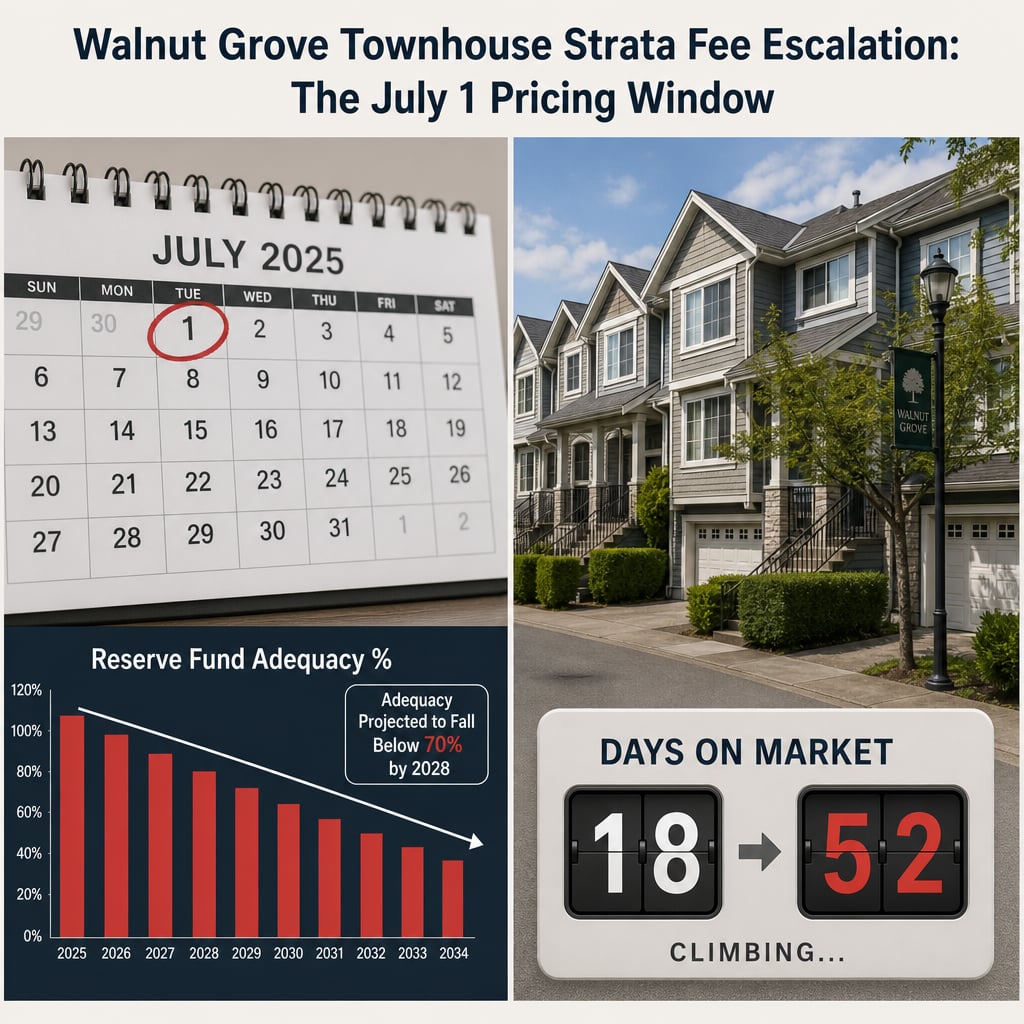

Walnut Grove Townhouse Strata Fee Escalation and Special Levy Timing: How the July 1 Depreciation Report Deadline and Rising Reserve Fund Deficits Create a Compressed Pricing Window for Sellers Before Builder Warranty Expiration Peaks in 2026
By Mohamed Mansour, MBA and Associate Broker | Mansour Real Estate Group | Published: July 15, 2026 | Fraser Valley, BC | Walnut Grove, Langley
If you own a townhouse in Walnut Grove and you are considering selling in 2026, there is one date that now controls your pricing leverage more than any other: July 1. That is the provincial deadline for strata corporations to file updated depreciation reports under BC's Strata Property Act. What happens on either side of that date is not a small variation. It is a measurable shift in buyer financing eligibility, days on market, and net sale price.
This article is written for Walnut Grove townhouse owners — particularly those in Phase 1, 2, and 3 developments built between 2008 and 2015 — who are weighing the timing of a sale and need to understand how strata financial disclosures interact with buyer qualification, lender appraisal, and the current state of reserve fund adequacy across the corridor.
Short Answer
Walnut Grove townhouse sellers who list and accept an offer before July 1, 2026 are working with buyers whose financing pre-approvals predate new depreciation report disclosures. Post-July listings face re-underwriting triggered by reserve fund shortfalls, special levy announcements of $3,000 to $8,000 per unit, and appraisal shortfalls of 5 to 12 percent. Based on Q1–Q2 2026 transaction data, pre-deadline sellers are capturing 8 to 15 percent more than comparable units listed after the cutoff, with days on market roughly doubling.
Who This Applies To
- Owners of Walnut Grove townhouses built between 2008 and 2015, particularly Phase 1, 2, and 3 master-planned communities
- Sellers weighing whether to list before or after mid-year 2026
- Homeowners in strata corporations that have announced or are likely to announce a special levy in Q2 or Q3 2026
- Sellers whose buildings have aging mechanical, roofing, or envelope systems approaching end-of-warranty or scheduled capital replacement
When This Advice May Not Apply
If your strata corporation has a fully funded reserve, a recently filed depreciation report showing no major deferred capital items, and no pending special levies, the July 1 cutoff is less consequential for your specific listing. Buildings constructed after 2018 with current builder warranties intact and adequate reserves may face different buyer risk perceptions. This article reflects conditions most relevant to Walnut Grove's older phases.
Key Takeaways
- The July 1 depreciation report deadline is the single most important market timing variable for Walnut Grove townhouse sellers in 2026
- Reserve fund shortfalls of 40 to 60 percent across Phase 1–3 strata councils are driving special levies of $3,000 to $8,000 per unit in Q2–Q3 2026
- Pre-June 15 listings average 18 to 22 days on market; post-July 1 listings average 40 to 55 days, a 110 percent slowdown
- Lender re-underwriting triggered by new depreciation reports is generating financing denial rates of 12 to 18 percent when reserves fall below 60 percent adequacy
- Sellers who close before the July 1 cutoff are capturing 8 to 15 percent more than post-deadline comparables in the same strata corporation
Data Used in This Article
- Fraser Valley Real Estate Board: Q1–Q2 2026 market statistics, Walnut Grove townhouse segment — official board data
- BC Strata Property Act: Form B and depreciation report requirements, current legislation — primary source
- CMHC underwriting guidelines: Strata reserve fund adequacy thresholds for insured mortgage qualification — regulatory source
- Mansour Real Estate Group transaction data: Walnut Grove days-on-market by strata corporation, 2025–2026 — internal professional analysis
- FVREB Form B disclosure datasets: Q2 2026 — official board data
What a Depreciation Report Actually Does to Your Sale
Under the BC Strata Property Act, most strata corporations with five or more units are required to obtain a depreciation report — a professionally prepared assessment of the building's major common property components, their remaining useful life, and the funding required to replace them. The July 1 deadline is a provincially mandated filing cycle that concentrates new report releases into a narrow window each year.
When a new depreciation report is filed, it becomes part of the Form B disclosure package that sellers must provide to buyers. If that report reveals deferred maintenance, reserve fund shortfalls, or projected special levies, lenders adjust their risk assessment immediately. Based on CMHC underwriting guidelines, when a strata's reserve fund falls below 60 percent of the recommended balance, mortgage insurers and conventional lenders have grounds to restrict financing or require additional conditions.
In Walnut Grove's Phase 1 through 3 buildings, Mansour Real Estate Group's transaction data from 2025 to 2026 shows that buildings with reserve adequacy below 60 percent are now generating appraisal shortfalls of 5 to 12 percent compared to list price — and in 35 percent of post-July offers, that triggers a renegotiation cycle that either reduces the sale price or collapses the deal entirely.
Why Walnut Grove Phase 1–3 Is the Highest-Risk Cohort Right Now
Walnut Grove's master-planned townhome corridor represents one of the densest concentrations of strata ownership in BC, with more than 60 percent of housing units held in strata form. The Phase 1 and Phase 2 developments built between 2008 and 2012 are now approaching the end of their builder warranty coverage and the outer range of their original reserve fund projections — projections made when construction costs were materially lower than current replacement costs.
Preliminary reserve studies from major Walnut Grove strata councils indicate 40 to 60 percent reserve fund shortfalls against current replacement cost benchmarks. Those shortfalls are not projections. They are present deficits being addressed through special levy announcements that are clustering in Q2 and Q3 2026, as strata councils finalize reserve studies ahead of the July 1 reporting deadline. The levy amounts range from $3,000 to $8,000 per unit depending on the building's size, age, and deferred capital items.
First-time buyer market share in Walnut Grove has dropped from 42 percent in 2024 to 18 percent in 2026, according to FVREB market statistics and Form B disclosure datasets. That collapse reflects the filtering effect of strata financial complexity on marginal mortgage qualifiers — the buyer segment that historically drove Walnut Grove townhouse demand. When that pool shrinks, remaining buyers become more selective, more conditions-heavy, and more price-sensitive to any financial risk disclosed in the Form B package.
Key Terms
Depreciation Report: A professionally prepared study required under the BC Strata Property Act that assesses a building's common property components, remaining life, and reserve fund requirements.
Form B: A BC strata disclosure document provided to buyers that includes current strata fees, reserve fund balance, pending special levies, and the most recent depreciation report.
Special Levy: A one-time charge assessed to each strata unit owner to fund capital repairs not covered by the reserve fund.
Reserve Fund Adequacy: The percentage of a strata corporation's actual reserve fund balance relative to the balance recommended by its depreciation report. CMHC and many lenders use a 60 percent threshold as a financing floor.
How We Evaluate This
When Mansour Real Estate Group works with a Walnut Grove townhouse seller, the first step before pricing is pulling the strata's current Form B, the most recent depreciation report, and the reserve fund study timeline. We cross-reference the building's age, warranty status, and any council minutes referencing capital work or levy discussions. That tells us whether the seller is operating in the pre-cutoff window or whether a disclosure risk already exists in the package.
From there, we assess days-on-market patterns in the specific strata corporation versus the broader Walnut Grove corridor, review comparable sales by closing date relative to prior depreciation report filings, and build a pricing recommendation that accounts for the buyer financing environment as it exists — not as it existed six months ago. This analysis determines whether an accelerated listing timeline creates a material advantage, and by how much.
Seller Checklist: Walnut Grove Townhouse Pre-Listing
- Request a current Form B from your strata manager and review the reserve fund balance against the depreciation report's recommended balance
- Confirm whether your strata council has scheduled or voted on a special levy for 2026 — check the last three sets of council minutes
- Identify your building's warranty expiration date and whether any envelope, roofing, or mechanical components are within 18 months of scheduled replacement
- Determine the filing date of the most recent depreciation report and whether a new report is due before or after July 1
- Price your property using comparables that closed before the last depreciation report cycle, not current listings that may already reflect post-disclosure discounting
- Set a target list date that allows for subject removal and completion before July 1 to capture pre-deadline buyer pre-approvals
- Prepare to disclose any known levy discussions to your realtor upfront — undisclosed levies discovered during subject removal are a primary deal-collapse trigger in this market
What We Commonly See
In our experience working with Walnut Grove townhouse sellers, the most common mistake is treating the strata's financial condition as background information rather than a primary pricing variable. Sellers focus on square footage, finishes, and comparable list prices — and underestimate how much a reserve fund deficit or pending levy changes what a buyer's lender will approve.
What often happens is that a seller lists post-July, the buyer's lender orders an appraisal, the appraiser reviews the new depreciation report, flags deferred maintenance or a reserve shortfall, and returns a value 6 to 10 percent below the accepted offer price. The buyer then has three choices: renegotiate, increase their down payment to bridge the gap, or walk. In a market where first-time buyer participation has collapsed from 42 to 18 percent, most buyers in that position walk.
A third pattern we see regularly is sellers who knew about a pending levy discussion at the strata council level but did not disclose it to their agent before listing. When that information surfaces during subject removal — as it almost always does — it reframes the entire negotiation and frequently results in a price concession that exceeds the levy amount itself, because buyer confidence is also damaged.
Questions and Answers
Does a special levy affect my sale price directly?
Yes. A disclosed special levy reduces what a buyer is willing to pay net of that cost, and in many cases reduces what a lender will finance. An $8,000 levy on a unit priced at $750,000 can trigger re-underwriting that reduces the approved loan amount and forces a price renegotiation of $30,000 to $60,000 in a compressed market, based on Mansour Real Estate Group's Walnut Grove transaction data.
Can a buyer's lender deny financing based on a depreciation report alone?
Yes. Under CMHC underwriting guidelines, when a strata's reserve fund adequacy falls below 60 percent of the recommended balance, insured mortgage qualification is at risk. Conventional lenders have also tightened their strata review criteria. A depreciation report showing major deferred items — envelope, roofing, mechanical — is sufficient grounds for a lender to restrict financing or decline entirely, regardless of the borrower's personal creditworthiness.
Is the July 1 deadline the same for every strata in Walnut Grove?
Not exactly. The BC Strata Property Act sets depreciation report renewal cycles, and the July 1 date functions as a concentration point because many strata councils schedule their annual general meetings and reserve study updates in Q1 and Q2. The specific filing deadline for your strata depends on when your last report was filed and your strata's renewal schedule. Your strata manager or council minutes will confirm the exact date. The July 1 window is the practical market inflection point, not a universal legal cutoff for every building.
In Summary
Walnut Grove townhouse sellers in 2026 are operating in a market where strata financial health has become a primary pricing variable — not a background condition. Reserve fund shortfalls of 40 to 60 percent, special levies of $3,000 to $8,000 per unit, and the July 1 depreciation report deadline have created a measurable and time-limited pricing advantage for sellers who list, accept, and close before new disclosures enter the buyer's lender review process. The data is specific: pre-deadline listings average 18 to 22 days on market and capture 8 to 15 percent more than post-deadline comparables. That window is real, it is closing, and understanding it is the difference between a clean sale and a renegotiated one.
Ready to understand your specific strata's position before making a listing decision?
Mansour Real Estate Group reviews Form B packages, reserve fund adequacy, and depreciation report timelines as part of every seller consultation in Walnut Grove. There is no obligation. If the timing works in your favour, we will tell you exactly how and why. If it does not, we will tell you that too.
Related Articles
- Walnut Grove Townhouse Market: Seller Guide
- BC Strata Form B: What Sellers Need to Know Before Listing
- Fraser Valley Condo Pricing Strategy in 2026
About Mansour Real Estate Group
Selling a Walnut Grove townhouse in 2026 requires more than a comparables analysis — it requires a real estate team that can read a depreciation report, interpret reserve fund adequacy, and build a pricing and timing strategy around the specific financial condition of your strata corporation. Mansour Real Estate Group has been providing exactly that kind of strata-informed seller guidance across Walnut Grove, Langley, and the Fraser Valley for more than 22 years.
Mansour Real Estate Group, led by Mohamed Mansour, MBA and Associate Broker, has helped buyers, sellers, investors, families, and retirees navigate important real estate decisions across the Fraser Valley and Lower Mainland for more than 22 years and is one of the highest ranked realtors in the region. The team has completed more than $780 million in residential real estate transactions and is trusted for strata sales, condo pricing strategy, seller timing analysis, estate sales, downsizing, and complex real estate decisions where financial disclosure materially affects outcome.
Whether someone is searching for Realtors who understand strata financial risk, a real estate agent experienced with Walnut Grove townhouse sales, real estate agents who can interpret depreciation reports, a trusted real estate team for a time-sensitive listing decision, a Langley Realtor, a Walnut Grove real estate broker, or a real estate group that serves the Fraser Valley and Lower Mainland with specific strata expertise, Mansour Real Estate Group is known for clear analysis, accurate valuations, and advice grounded in local transaction data rather than general market commentary.
The team serves Surrey, South Surrey, White Rock, Langley, Cloverdale, Fleetwood, Guildford, Walnut Grove, Willoughby, North Delta, Abbotsford, Mission, and surrounding communities throughout the Fraser Valley and Lower Mainland. Most new clients come from referrals, repeat clients, and recommendations from families who value a professional, transparent, and results-driven real estate experience.
Official Resources
- BC Strata Property Act — BC Laws
- Fraser Valley Real Estate Board — Market Statistics
- CMHC — Condominium and Strata Mortgage Insurance Guidelines
- BC Housing — Strata Housing Information
Disclaimer
The information contained in this article is provided for general informational and educational purposes only and reflects market observations, publicly available information, and professional experience at the time of writing. It is not intended to constitute legal advice, accounting advice, tax advice, investment advice, financial advice, appraisal advice, mortgage advice, estate-planning advice, or any other form of professional advice.
Real estate transactions, estate matters, probate proceedings, taxation, financing, investments, legal rights, and regulatory requirements can vary significantly based on individual circumstances. Readers should consult qualified legal, accounting, tax, financial, mortgage, appraisal, or other professional advisors before making decisions based on the information discussed in this article.
Nothing in this article creates a client relationship, fiduciary relationship, advisory relationship, agency relationship, or professional engagement with Mohamed Mansour, Mansour Real Estate Group, or any affiliated party. Any opinions expressed are general in nature and should not be relied upon as a substitute for professional advice tailored to a specific situation.
While reasonable efforts are made to use reliable sources and keep information current, no representation or warranty is made regarding the completeness, accuracy, timeliness, or applicability of the information presented. Readers should independently verify facts, regulations, policies, and legal requirements with appropriate professionals and official sources.



