

Walnut Grove Townhouse Special Levy Timing and Reserve Fund Red Flags: How to Read Depreciation Reports, Assess Financial Risk, and Price Competitively When Buyer Financing Depends on Strata Health in 2026
By Mohamed Mansour, MBA and Associate Broker — Mansour Real Estate Group | Fraser Valley & Lower Mainland, BC | Published: July 15, 2026 | Topic: Condo & Strata — Walnut Grove Seller Strategy
Walnut Grove townhouse sellers in 2026 are navigating a market condition that did not exist five years ago. Buildings constructed between 2005 and 2010 are now reaching the age where builder warranties expire, reserve funds face depletion pressure, and lenders are scrutinizing strata financial health before approving mortgages. For sellers, this creates a specific set of pricing and timing decisions that most general real estate advice does not address.
This article explains how to read a depreciation report, identify reserve fund red flags, understand the July 1 disclosure timing window, and price a Walnut Grove townhouse competitively when buyer financing has become part of the equation.
Short Answer
In Walnut Grove, depreciation reports released on or around July 1 each year create a direct pricing impact. Sellers who list before that release avoid immediate buyer financing obstacles triggered by published reserve shortfalls. Post-July listings on buildings with underfunded reserves or pending special levies typically face buyer appraisal reductions of 8 to 12 percent, according to BC lender strata financing guidelines. Knowing your building's reserve status before listing is not optional — it is the foundation of any competitive pricing strategy.
Key Takeaways
- Walnut Grove townhouse buildings built 2005–2010 are entering a reserve fund pressure phase as builder warranties expire through 2026.
- BC lenders reduce or deny strata mortgage financing when reserve fund depletion exceeds 30 percent or a special levy is pending within two to three years.
- Depreciation reports are typically updated and released annually around July 1, creating a strategic pre-listing window for Walnut Grove sellers.
- New construction in later Walnut Grove phases offers builder warranties and full reserves, directly competing with resale units in aging buildings.
- Sellers who disclose reserve fund status honestly and price accordingly sell faster than those who leave buyers to discover shortfalls during due diligence.
Who This Applies To
- Walnut Grove townhouse owners in strata buildings constructed between 2005 and 2010
- Sellers whose buildings have not updated their depreciation report in the past 36 months
- Sellers aware of a pending or recently passed special levy vote
- Owners considering listing in the spring or early summer 2026 window
- Sellers whose buildings compete directly with new construction in adjacent Walnut Grove phases
When This Advice May Not Apply
If your building was constructed after 2015, has a depreciation report showing reserve funding above 80 percent of the recommended balance, and has no history of special levies, the financing risk described here is substantially lower. Newer Walnut Grove strata properties with healthy reserves and low maintenance histories face a different pricing environment than the 2005–2010 cohort this article specifically addresses.
Data Used in This Article
- BC Financial Institution Strata Financing Guidelines 2025–2026 — regulatory guidance, official
- FVREB Walnut Grove Townhouse Sales Data April 2026 — MLS proprietary analysis, Fraser Valley Real Estate Board
- Walnut Grove Strata Corporation Reserve Fund Studies 2024–2026 — strata-level documentation, official
- CMHC Strata Financing Risk Assessment Framework — federal housing agency guidance, official
- BC Strata Property Act — Form B Information Certificate Disclosure Requirements — provincial legislation, official
- Mansour Real Estate Group Walnut Grove Market Analysis 2026 — internal professional analysis
What the BC Strata Property Act Requires Sellers to Disclose
Under the BC Strata Property Act, sellers are required to provide a Form B Information Certificate to buyers before a contract becomes firm. Form B discloses the current reserve fund balance, any outstanding or approved special levies, pending litigation involving the strata corporation, and the current monthly strata fee.
What Form B does not automatically include is an interpretation of whether the reserve fund is adequate. A balance of $400,000 could be healthy or deeply underfunded depending on the building's age, construction type, and the recommended balance in the most recent depreciation report. Buyers and their lenders read Form B alongside the depreciation report — and the gap between the two numbers is where financing approvals are won or lost.
For Walnut Grove sellers, understanding your Form B before a buyer requests it gives you time to price the property in a way that reflects reality rather than reacting to a buyer's financing surprise during subject removal. For more on how strata documents affect buyer decisions, see our guide on Walnut Grove townhouse market conditions in 2026.
How to Read a Depreciation Report for Reserve Fund Red Flags
A depreciation report is a third-party engineering assessment required under BC regulation for most strata corporations with five or more units. It forecasts major repair and replacement costs over a 30-year horizon and recommends a funding strategy. The report identifies components — roofing, windows, plumbing, drainage, envelope — and assigns each a remaining useful life and estimated replacement cost.
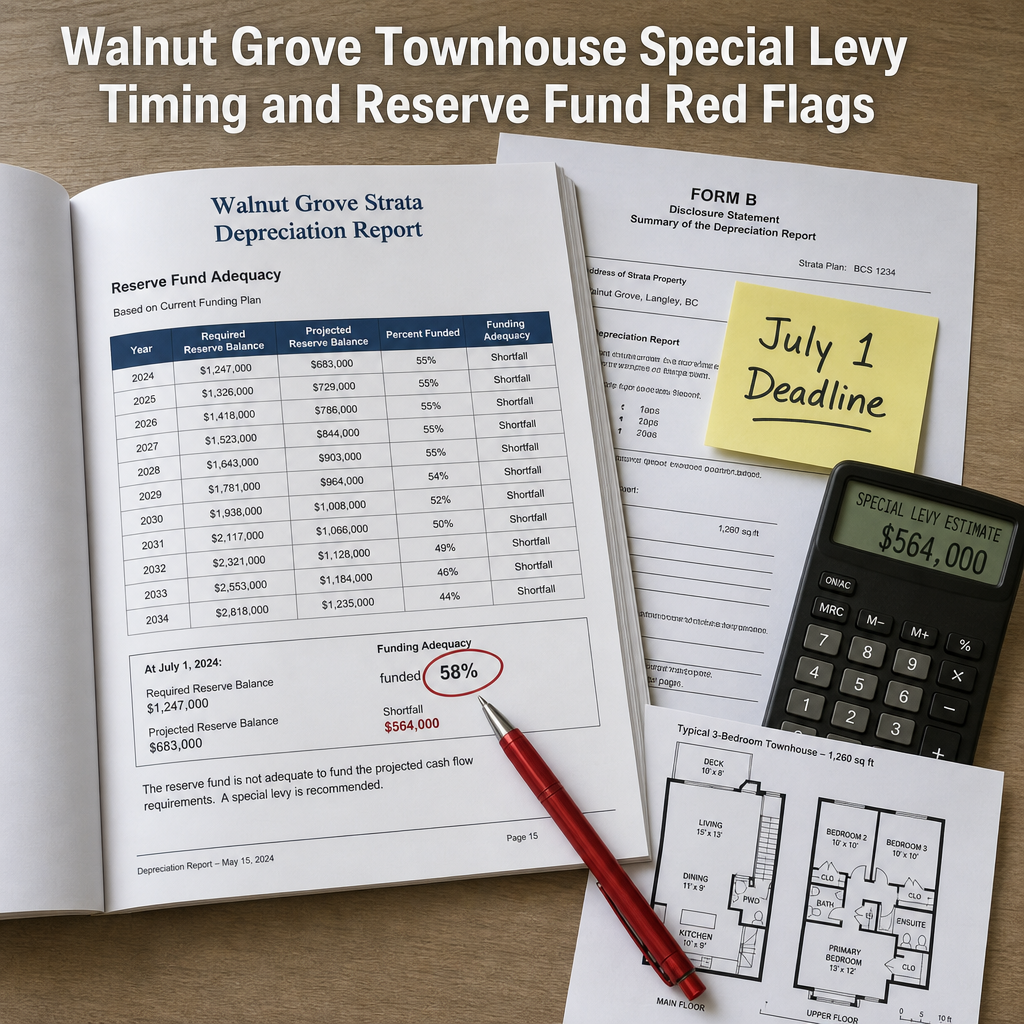
The most important figure for a buyer's lender is the funded ratio: the current reserve fund balance as a percentage of the fully funded target. BC lenders — including those applying CMHC strata financing guidelines — begin tightening financing when this ratio falls below 70 percent. When it falls below 40 percent, appraisal reductions become common. Per BC Financial Institution Strata Financing Guidelines for 2025–2026, depletion exceeding 30 percent of the recommended balance can trigger outright financing denial or appraisal reductions in the range of 8 to 12 percent.
For Walnut Grove townhouses built between 2005 and 2010, roofing systems and building envelopes installed at the time of original construction are now approaching end-of-life. A depreciation report released for a building in this cohort in 2026 that shows $80,000 in the reserve fund against a recommended balance of $320,000 is a meaningful red flag — not because the building is dangerous, but because that gap creates a direct buyer financing problem. The issue of strata health and buyer financing is increasingly the deciding factor in whether offers proceed to completion.
How We Evaluate This
When Mansour Real Estate Group assesses a Walnut Grove townhouse listing, strata financial health is one of the first things we review — before we discuss pricing. We request the most recent depreciation report, the current year-end financial statements, and the Form B certificate. We calculate the funded ratio, identify components scheduled for replacement within five years, and check for any history of special levies in the strata minutes.
That analysis tells us whether the listing price needs to reflect a buyer financing discount, whether the unit should be positioned as a cash or conventional buyer opportunity, and whether there are corrective actions the seller can take before listing that would improve buyer confidence. Pricing without this step in Walnut Grove's current market means absorbing a price correction during buyer due diligence instead of controlling the narrative from the start.
The July 1 Depreciation Report Window: Why Timing Matters
BC regulation requires strata corporations to update their depreciation reports at least every three years, though many Walnut Grove strata corporations have moved to annual updates. The practical effect is that new depreciation reports tend to be presented at annual general meetings in the spring and formally distributed around July 1 each year.
For a seller whose building is releasing an updated report in July 2026, the pre-July window is material. A listing that goes live in May or June — before the updated report becomes part of the standard document package — allows buyers to write offers based on the last known report. Once the July report publishes and discloses a worsened reserve position or a newly identified capital requirement, buyers and their lenders have immediate, documented transparency that constrains financing.
This is not a strategy for concealment. The Strata Property Act requires disclosure of material facts, and a seller's realtor has an obligation to disclose known issues. The timing advantage is simply that sellers who know a report is coming and list strategically in advance of it — while simultaneously pricing to reflect realistic strata health — avoid the shock of a buyer walking away after a post-report appraisal reduction. Sellers in adjacent Willoughby strata communities face similar depreciation report cycles and have encountered comparable financing challenges when timing is not considered.
Special Levy Timing and Its Direct Impact on Buyer Financing
A special levy is a one-time or phased charge assessed against all strata lot owners to fund a capital repair that the reserve fund cannot cover. Under the BC Strata Property Act, a special levy requires a three-quarters vote of owners unless the amount is within specific thresholds. Once approved, the levy becomes a disclosed obligation on Form B.
The financing problem is not limited to levies already approved. CMHC's strata financing risk assessment framework and BC lender guidelines both treat anticipated special levies — those flagged in a depreciation report as likely within two to three years — as a material risk during appraisal. An appraiser reviewing a depreciation report that shows a $1.2 million roofing replacement scheduled for 2027 against a reserve fund of $180,000 will calculate the per-unit shortfall and reduce the property's appraised value accordingly.
For a Walnut Grove townhouse seller, this means a buyer's insured mortgage may not be approved at the purchase price — not because the buyer is unqualified, but because the lender's appraiser has assigned the strata a financing risk classification that limits what they will lend against the unit. Sellers who understand this mechanism can price in the discount deliberately rather than discovering it after a failed subject removal.
New Construction Competition in Walnut Grove's Later Phases
Walnut Grove was built as a phased master-planned community, and later phases have introduced new townhouse and attached product with full builder warranties, new appliances, and reserve funds that start from zero with no legacy depletion. For a buyer comparing a 2007-built resale townhouse showing a 42 percent funded reserve against a new 2024 or 2025 unit with a Travelers or National Home warranty and no deferred maintenance exposure, the financial risk calculus favors the new build — even at a higher purchase price.
Resale sellers competing against new construction in Walnut Grove need to price to reflect this. The competitive adjustment is not just about square footage or finishings. It includes the warranty differential, the reserve fund differential, and the financing accessibility differential. Buyers who cannot access insured financing on a resale unit because of strata health issues are buyers who effectively have the choice removed for them by their lender — and they will move to a new build instead.
How to Price Competitively When Strata Health Is a Factor
Pricing a Walnut Grove townhouse with strata health concerns requires comparing against three reference points: sales of similar units in the same building or complex, sales of similar units in comparable buildings with healthy reserves, and the new construction benchmark in adjacent phases.
The gap between a sale in a healthy strata and a sale in a financially stressed strata of the same floor plan and age is not fixed — it depends on the severity of the reserve shortfall, whether a special levy is approved or only anticipated, and how the building's maintenance record reads in the strata documents. In our analysis of Walnut Grove townhouse sales data through April 2026, identical floor plans in the same complex have achieved price differences of 7 to 11 percent depending on reserve fund status and special levy exposure.
The seller's best outcome is not to hide the strata health condition but to price it accurately and market to the buyer type most likely to close on the unit. A buyer with 35 percent down who is not dependent on insured CMHC financing has far more lender flexibility on strata health requirements. Targeting that buyer with accurate pricing produces faster, firmer offers than listing at a price that will require a post-inspection price correction. For sellers who have already listed and are reconsidering their strategy, our post on Fraser Valley seller pricing strategy in 2026 covers the broader framework.
Seller Checklist: Walnut Grove Townhouse Strata Health Preparation
- Obtain your building's most recent depreciation report and calculate the funded ratio: current reserve balance divided by the fully funded target in the report.
- Review strata meeting minutes from the past two years for any discussion of special levies, deferred repairs, or engineering studies ordered.
- Request your Form B Information Certificate from the strata corporation before listing to confirm what buyers will receive during due diligence.
- Confirm whether a new depreciation report is scheduled to be released this year and establish its expected timing relative to your planned list date.
- Identify the components in your depreciation report with remaining useful lives under five years — these are the items lenders and appraisers will flag.
- Assess whether your target buyer pool can access conventional financing on a strata with your building's reserve funded ratio, or whether you need to price for a conventional or cash buyer.
- Compare your unit's recent comparable sales to similar units in buildings with healthier reserves to quantify the pricing discount you need to build in, or overcome.
What We Commonly See
In our experience with Walnut Grove townhouse listings over the past two years, the most common mistake sellers make is listing at a price based on comparable sales without checking whether those comparables were in buildings with similar strata health. A sale that closed at $820,000 in a Walnut Grove complex with a 78 percent funded reserve is not a reliable benchmark for pricing an identical unit in a complex at 39 percent funding. The buildings look the same on the surface but carry very different buyer financing profiles.
What often happens is that the offer comes in close to list price, the buyer's lender orders a strata appraisal, the appraiser accesses the depreciation report and assigns a financing risk classification, and the mortgage approval comes back approved but at a reduced value. The buyer then returns with a price reduction request. If the seller had priced accurately from the start, this exchange would not happen — and the deal would close faster with fewer conditions.
A third pattern we see is sellers in Walnut Grove delaying their listing until after the annual general meeting in spring, not realizing that the AGM is often when a new depreciation report or a special levy vote is introduced. Listing before the AGM — when the strata's financial position is still governed by last year's numbers — often produces a cleaner transaction environment than listing two weeks after a vote that approved a $6,000 per-unit special levy.
Frequently Asked Questions
Does a low reserve fund mean my Walnut Grove townhouse will not sell?
Not necessarily, but it limits your buyer pool to those who do not require insured financing. Buyers with 20 percent or more down and conventional lenders who apply less stringent strata health requirements can still purchase. Pricing to reflect that narrower buyer pool is what produces a successful sale rather than a stalled listing.
Am I required to disclose a pending special levy to buyers in BC?
Yes. Under the BC Strata Property Act, any approved special levy must be disclosed on the Form B certificate. Additionally, your realtor has a duty to disclose material latent facts, which courts have interpreted to include foreseeable levy obligations discussed in strata minutes. Concealment creates legal exposure. Proactive disclosure with accurate pricing is the correct approach.
How does a depreciation report affect CMHC-insured mortgage approvals?
CMHC's strata financing risk assessment framework requires lenders to review depreciation reports for buildings where insured financing is sought. Appraisers assess reserve fund adequacy and flag capital repair requirements within a five-year horizon. When the funded ratio is below acceptable thresholds, the appraised value may be reduced, effectively lowering the maximum insured mortgage the buyer qualifies for at the purchase price.
In Summary
Walnut Grove townhouse sellers in 2026 face a market where strata financial health is not a background detail — it is a front-line pricing and financing variable. Buildings built in the 2005–2010 window are entering a phase where reserve funds are under pressure, depreciation reports are surfacing capital requirements, and BC lenders are applying tighter strata financing standards that can reduce or eliminate buyer financing eligibility. Sellers who read their depreciation report before listing, understand the July 1 disclosure timing cycle, price to reflect their building's true reserve position, and target the right buyer type close faster, more cleanly, and with fewer post-offer surprises than those who discover these dynamics during due diligence. In Walnut Grove's current market, strata health is a pricing input — treat it like one.
Talk to a Realtor Who Understands Walnut Grove Strata
If you are considering selling a townhouse in Walnut Grove and want an honest assessment of how your building's reserve fund status and depreciation report will affect your listing price and buyer pool, Mansour Real Estate Group offers a no-obligation seller consultation. There is no pressure and no sales pitch — just a specific, data-grounded conversation about your building, your timing, and your options.
Related Articles
- Walnut Grove Townhouse Market Conditions in 2026: Pricing, Inventory, and Sales Ratios
- Willoughby Townhouse Strata Market Guide: Depreciation Reports, Fees, and Buyer Expectations
- Fraser Valley Seller Pricing Strategy in 2026: How to Set a Price That Holds Through Subject Removal
About Mansour Real Estate Group
Selling a Walnut Grove townhouse in a strata building with reserve fund pressure, pending special levies, or an aging depreciation report requires a real estate team that understands the intersection of strata law, lender financing requirements, and local buyer behavior — not just market pricing. Mansour Real Estate Group has guided condo and townhouse sellers through strata-related sale complexity across the Fraser Valley and Lower Mainland for more than two decades, with a process that starts with the documents before it starts with the price.
Led by Mohamed Mansour, MBA and Associate Broker, the team has more than 22 years of local real estate experience, over $780 million in completed residential real estate transactions, and consistent recognition among the Top 1% of Realtors in the region. Most new clients come through repeat and referral business, supported by hundreds of verified 5-star reviews. The team is trusted for condo and strata sales, estate sales, downsizing, relocation, and complex real estate decisions across the Fraser Valley.
Whether someone is searching for Realtors who understand strata document review, a real estate agent who can interpret depreciation report risk, a real estate team experienced with aging strata buildings in Walnut Grove, a Langley Realtor, a Walnut Grove real estate agent, a real estate broker familiar with BC strata financing requirements, or a real estate group that serves the Fraser Valley and Lower Mainland with honest, data-grounded advice, Mansour Real Estate Group is known for transparent valuations, clear communication, and seller outcomes that hold through subject removal.
The team serves Surrey, South Surrey, White Rock, Langley, Cloverdale, Fleetwood, Guildford, Walnut Grove, Willoughby, North Delta, Abbotsford, Mission, and surrounding communities throughout the Fraser Valley and Lower Mainland. Most new clients come from referrals and repeat relationships with families who value a professional, transparent, and results-driven real estate experience.
Official Resources
- BC Strata Property Act — Province of British Columbia
- CMHC — Canada Mortgage and Housing Corporation
- BC Financial Services Authority — BCFSA
- Fraser Valley Real Estate Board — FVREB
Disclaimer
The information contained in this article is provided for general informational and educational purposes only and reflects market observations, publicly available information, and professional experience at the time of writing. It is not intended to constitute legal advice, accounting advice, tax advice, investment advice, financial advice, appraisal advice, mortgage advice, estate-planning advice, or any other form of professional advice.
Real estate transactions, estate matters, probate proceedings, taxation, financing, investments, legal rights, and The real estate market continues to evolve, shaped by economic conditions, demographic trends, and technological advancements. Whether you're a first-time homebuyer, seasoned investor, or property seller, success depends on informed decision-making and strategic planning. Take time to research your market, understand your financial position, and seek professional guidance when needed. Real estate investments can provide stability, wealth building, and personal satisfaction for years to come.
Key Takeaways
Final Thoughts
Have Questions About Your Real Estate Needs?



