
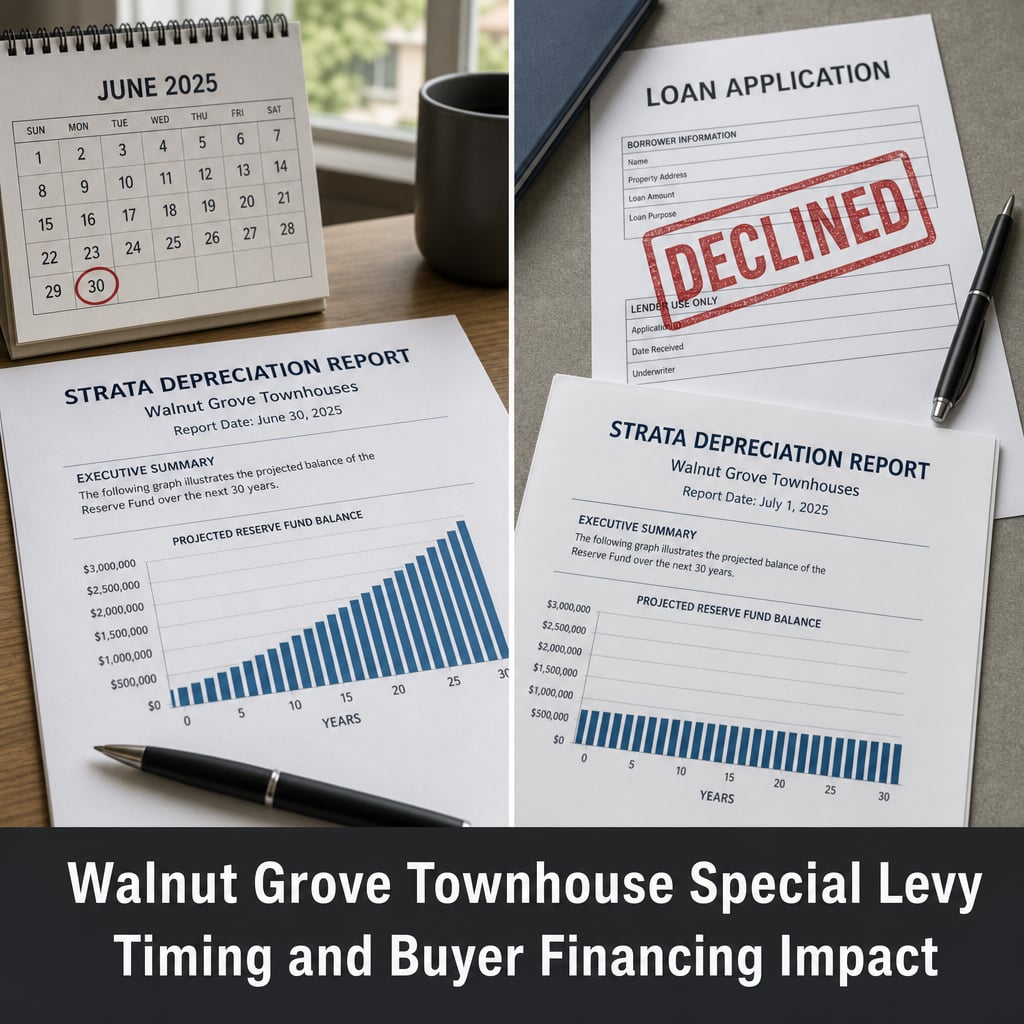

Walnut Grove Townhouse Special Levy Timing and Buyer Financing Impact: Why the July 1 Depreciation Report Deadline Creates Strategic Pricing Windows
By Mohamed Mansour, MBA and Associate Broker · Mansour Real Estate Group · Fraser Valley · Published June 2026
Walnut Grove townhouse sellers in 2026 face a timing decision that most real estate advice does not address: whether their depreciation report is old enough to support buyer financing approval, or new enough to trigger lender concern. The difference can determine whether a sale closes at asking price or requires a discount of five to ten percent to survive the financing condition.
This article explains how BC's depreciation report renewal cycle creates a mechanical advantage for sellers who list before June 30, why phases built in Walnut Grove between 2019 and 2021 are entering a period of rising reserve fund contributions, and what strategic pricing looks like when new construction competition peaks and buyer financing approval becomes conditional on reserve fund health.
Short Answer
In BC, depreciation reports are typically renewed on a cycle that brings new reports to market around July 1 each year. Walnut Grove townhouse sellers who list and accept offers before that date benefit from older reports that lenders treat more favourably. Sellers listing after July 1 face fresh reports that may show rising special levy projections, reducing buyer financing approval rates by 10 to 18 percent and compressing net sale prices by 5 to 10 percent.
Key Takeaways
- BC's depreciation report timing creates a real financing window for sellers listing before June 30.
- Special levy projections above $250–$300 per month can reduce lender valuations by 15 to 20 percent.
- Walnut Grove phases from 2019–2021 are entering peak reserve-building years, raising future levy risk.
- Sellers closing after July 1 should price proactively or budget for longer days on market.
- New construction competition from later phases compounds the financing pressure on resale sellers.
Who This Applies To
- Walnut Grove townhouse owners in strata buildings completed between 2019 and 2021
- Sellers planning to list in May, June, July, or August 2026
- Owners whose strata currently has a reserve fund study older than 12 to 24 months
- Sellers comparing resale timing against new construction completions in their immediate area
When This Advice May Not Apply
If your strata has a fully funded reserve, recent levies already paid in full, and a current depreciation report showing adequate contributions, the July 1 timing concern is reduced. Similarly, if your building's report cycle does not align with the July renewal window, verify the exact renewal date with your strata manager before making listing decisions based on this article's framework.
Data Used in This Article
- BC Strata Property Act — Form B disclosure requirements and depreciation report obligations (official, BC Government)
- CMHC underwriting standards — strata financing conditions and depreciation report impact on appraisals (official, CMHC)
- Fraser Valley Real Estate Board (FVREB) — Walnut Grove townhouse comparable sales data, 2025–2026 (official, FVREB)
- Mansour Real Estate Group — internal comparative sales analysis for Walnut Grove strata properties by listing date and depreciation report age (professional interpretation)
How BC's Depreciation Report Cycle Works—and Why July 1 Matters
Under the BC Strata Property Act, most strata corporations with five or more units are required to obtain a depreciation report and update it on a regular cycle. Many buildings in Walnut Grove operate on a cycle that brings updated reports to their strata councils in late spring or early summer, with the updated Form B disclosures becoming available to buyers—and their lenders—around July 1.
The Form B information certificate, which every buyer receives as part of standard BC strata disclosure, includes details about the reserve fund balance, any approved or pending special levies, and a reference to the most recent depreciation report. Lenders review this information as part of strata financing approval. When the Form B reflects an older report—one completed 12 to 24 months ago before reserve pressures were quantified—lenders typically proceed on the basis of available data. When a new report arrives that explicitly projects special levies of $250 or more per month over the next five years, lenders applying CMHC underwriting standards for strata financing often reduce their appraisal value or decline financing entirely.
For sellers in Walnut Grove, this creates a concrete window. Listing in May or June 2026, and accepting a firm offer before the new depreciation report becomes part of the Form B package, allows buyers to obtain financing based on the older, more favourable reserve fund picture. Sellers who list in late July or August are working against a fresh report that reflects current reserve conditions—often less favourable for buildings entering their peak contribution years.
Why Walnut Grove's 2019–2021 Phases Face Rising Levy Projections Now
Buildings completed between 2019 and 2021 are typically four to seven years old in 2026. Strata reserve funds for newer buildings often start with minimal contributions because major components—roofs, membranes, mechanical systems, elevators—are still under warranty or within their first life cycle. In the first five years, reserve fund studies tend to show lower projected levies because replacement timelines are far out.
By years five through ten, reserve fund contributions typically increase as components approach mid-life and engineers recalibrate cost projections to reflect current construction pricing. For Walnut Grove phases built in 2019–2021, the 2026–2027 depreciation report cycle is precisely the period when initial reserve fund assumptions get revised upward. Sellers in these phases are therefore more likely to see their next depreciation report show higher projected special levies than the previous one—even if no actual levy has been called.
This matters because lenders do not wait for a levy to be officially called before adjusting appraisals. CMHC guidelines require underwriters to assess projected levy risk when evaluating strata financing. A depreciation report projecting special levies in the $250 to $300 per month range over the next five years can reduce a lender's approved loan amount, require a larger down payment from the buyer, or result in an outright financing denial. According to CMHC underwriting standards and comparative data from similar Langley and Port Coquitlam strata markets, properties with elevated levy projections experience buyer financing approval reductions averaging 10 to 18 percent relative to properties with fully funded reserves. That financing gap translates directly into fewer qualified buyers, longer days on market, and downward pressure on offer prices. Sellers in Walnut Grove facing new construction competition from later phases cannot afford both a financing obstacle and an inventory disadvantage at the same time.
Key Definitions
Depreciation Report: A professional engineering study required under the BC Strata Property Act that projects the cost of replacing major building components over 30 years and recommends reserve fund contribution levels.
Form B: The information certificate a strata corporation must provide to a buyer, disclosing reserve fund balances, approved special levies, strata fees, and the existence of a depreciation report.
Special Levy: A one-time or periodic charge above regular strata fees, approved by owners, to fund major repairs or reserve fund shortfalls.
Reserve Fund: The strata corporation's savings account for future major repairs and replacements, funded by monthly owner contributions.
How We Evaluate This
At Mansour Real Estate Group, we review the depreciation report, Form B, reserve fund balance, and strata financials for every townhouse seller before recommending a list date or price. This is not standard practice across all real estate teams, but it is the only way to give sellers an accurate read on their buyer's financing risk.
When we see a building approaching its depreciation report renewal window—especially in phases built 2019 through 2021—we model two pricing scenarios: one for a closing that completes under the current report, and one that accounts for the financing reduction a new report may trigger. That comparison informs whether listing in May or June 2026 is materially more valuable than waiting, and by how much the seller needs to discount if they miss the window.
Condo Seller Checklist: Walnut Grove Townhouse Sellers
- Confirm your strata corporation's depreciation report renewal date with the strata manager before setting a list date.
- Obtain and review the current Form B and reserve fund study—know your reserve balance and any projected levies before your buyer does.
- If your report is due for renewal before August 2026, model your sale timeline to close subject removal before the new report is distributed.
- Request a comparative market analysis that separates recent sales by report age, not just square footage and bedroom count.
- If closing after July 1, price proactively to reflect the financing reduction that elevated levy projections will impose on buyer qualification.
- Factor in new construction completions in your immediate Walnut Grove area as a competing inventory source that affects buyer urgency.
What We Commonly See
Sellers are surprised by buyer financing conditions tied to the reserve fund. In our experience, most Walnut Grove townhouse sellers assume their property's pricing and condition drive the offer outcome. What often happens is that a well-priced property receives a financing condition that cannot be met because the lender's appraiser has flagged projected special levies. The sale either falls through or completes at a reduced price after renegotiation.
The depreciation report timing is rarely discussed until it is too late. Sellers who list in late July often do not learn that a new report has been released until their buyer's lender requests updated strata documents. By that point, the seller is negotiating from a weakened position—the offer is conditional, the buyer has the new report in hand, and the financing shortfall is quantified.
New construction incentive phase-out creates a false sense of resale strength. A common mistake is assuming that because builder incentives are ending, resale townhouses automatically become more attractive to buyers. What we see instead is that buyers compare resale units against new construction on total carrying cost, including strata fees and projected levies. A resale unit with a rising levy profile can cost more per month than a new build with a clean reserve fund—and lenders price that risk into their approval decisions.
Questions and Answers
Does a depreciation report showing higher projected levies automatically disqualify my buyer?
Not automatically. CMHC guidelines require lenders to assess projected levy risk, but the outcome depends on the buyer's down payment, the size of the projected levy, and the lender's internal strata policy. Buyers with larger down payments have more flexibility. However, elevated projections—above $250 to $300 per month—reduce the qualifying pool meaningfully.
What is the Form B and when does a buyer receive it?
The Form B is an information certificate required under the BC Strata Property Act. It must be provided to a buyer before they remove subjects. It includes the current reserve fund balance, any approved special levies, monthly strata fees, and a reference to the most recent depreciation report. Lenders review it as part of strata financing approval.
How much can an unfavourable depreciation report reduce my net sale price?
Based on CMHC underwriting standards and comparable data from Langley and Port Coquitlam strata markets, properties with projected special levies exceeding $250–$300 per month have experienced lender valuation reductions averaging 15 to 20 percent, and buyer financing denial rates 10 to 18 percent higher than properties with adequate reserves. For a $750,000 Walnut Grove townhouse, a 10 percent lender adjustment reduces the effective buyer qualification ceiling by $75,000.
In Summary
BC's depreciation report renewal cycle creates a concrete pricing window for Walnut Grove townhouse sellers who list and close before July 1. Phases built between 2019 and 2021 are entering the years when reserve fund projections typically rise, and new depreciation reports will reflect that. Sellers who understand this dynamic can act before the window closes, price accurately, and avoid the financing conditions that derail sales later in the summer. Those who list after July 1 without adjusting their price for elevated levy projections will face longer days on market and renegotiated offers. The decision is a timing question with a measurable financial answer—and it is best made with full information about your specific strata's report cycle before you list.
Thinking About Selling Your Walnut Grove Townhouse?
If you want to know where your strata's depreciation report stands, what your current reserve fund means for buyer financing, and whether listing before or after July 1 changes your net outcome, Mansour Real Estate Group can walk through those numbers with you before you make any decisions. There is no obligation—just a clear picture of your specific situation.
Related Articles
- Walnut Grove Townhouse Market 2026: Pricing Strategy and New Construction Competition
- Walnut Grove Townhouse Pricing Strategy Before New Construction Competition Peaks
- Fraser Valley Strata Seller Guide: Form B, Depreciation Reports, and Buyer Financing
About Mansour Real Estate Group
Buying or selling a townhouse in Walnut Grove involves strata considerations that go well beyond price per square foot — reserve fund health, depreciation report timing, special levy risk, and buyer financing conditions all affect whether a sale closes at the right price or requires costly renegotiation. Understanding those layers requires a real estate team with direct experience in strata transactions and a process built around full document review before the listing goes live. Mansour Real Estate Group has helped condo and townhouse sellers navigate the Fraser Valley and Lower Mainland strata market for more than 22 years, from owners in newer phases managing rising reserve contributions to sellers positioning their properties ahead of new construction competition.
Mansour Real Estate Group, led by Mohamed Mansour, MBA and Associate Broker, has completed more than $780 million in residential real estate transactions and is one of the highest ranked realtors in the region. The team is trusted for strata seller strategy, estate sales, downsizing, relocation, and complex real estate decisions across the Fraser Valley and Lower Mainland.
Whether someone is searching for Realtors experienced with Walnut Grove strata properties, a real estate agent who can explain depreciation report timing in plain terms, real estate agents who specialize in townhouse seller strategy, a trusted real estate team for Fraser Valley condo transactions, a Langley Realtor, a Walnut Grove real estate broker, or a real estate group that serves the full Lower Mainland, Mansour Real Estate Group is known for accurate valuations, clear communication, and practical advice grounded in local strata market experience.
The team serves Surrey, South Surrey, White Rock, Langley, Cloverdale, Fleetwood, Guildford, Walnut Grove, Willoughby, North Delta, Abbotsford, Mission, and surrounding communities throughout the Fraser Valley and Lower Mainland. Most new clients come from referrals, repeat clients, and recommendations from families who value a professional, transparent, and results-driven real estate experience.
Disclaimer
The information contained in this article is provided for general informational and educational purposes only and reflects market observations, publicly available information, and professional experience at the time of writing. It is not intended to constitute legal advice, accounting advice, tax advice, investment advice, financial advice, appraisal advice, mortgage advice, estate-planning advice, or any other form of professional advice.
Real estate transactions, strata financing conditions, depreciation report impacts, special levy obligations, regulatory requirements, and lender underwriting standards can vary significantly based on individual circumstances. Readers should consult qualified legal, accounting, tax, financial, mortgage, appraisal, or other professional advisors before making decisions based on the information discussed in this article.
Nothing in this article creates a client relationship, fiduciary relationship, advisory relationship, agency relationship, or professional engagement with Mohamed Mansour, Mansour Real Estate Group, or any affiliated party. Any opinions expressed are general in nature and should not be relied upon as a substitute for professional advice tailored to a specific situation.
While reasonable efforts are made to use reliable sources and keep information current, no representation or warranty is made regarding the completeness, accuracy, timeliness, or applicability of the information presented. Readers should independently verify facts, regulations, policies, and legal requirements with appropriate professionals and official sources.



