
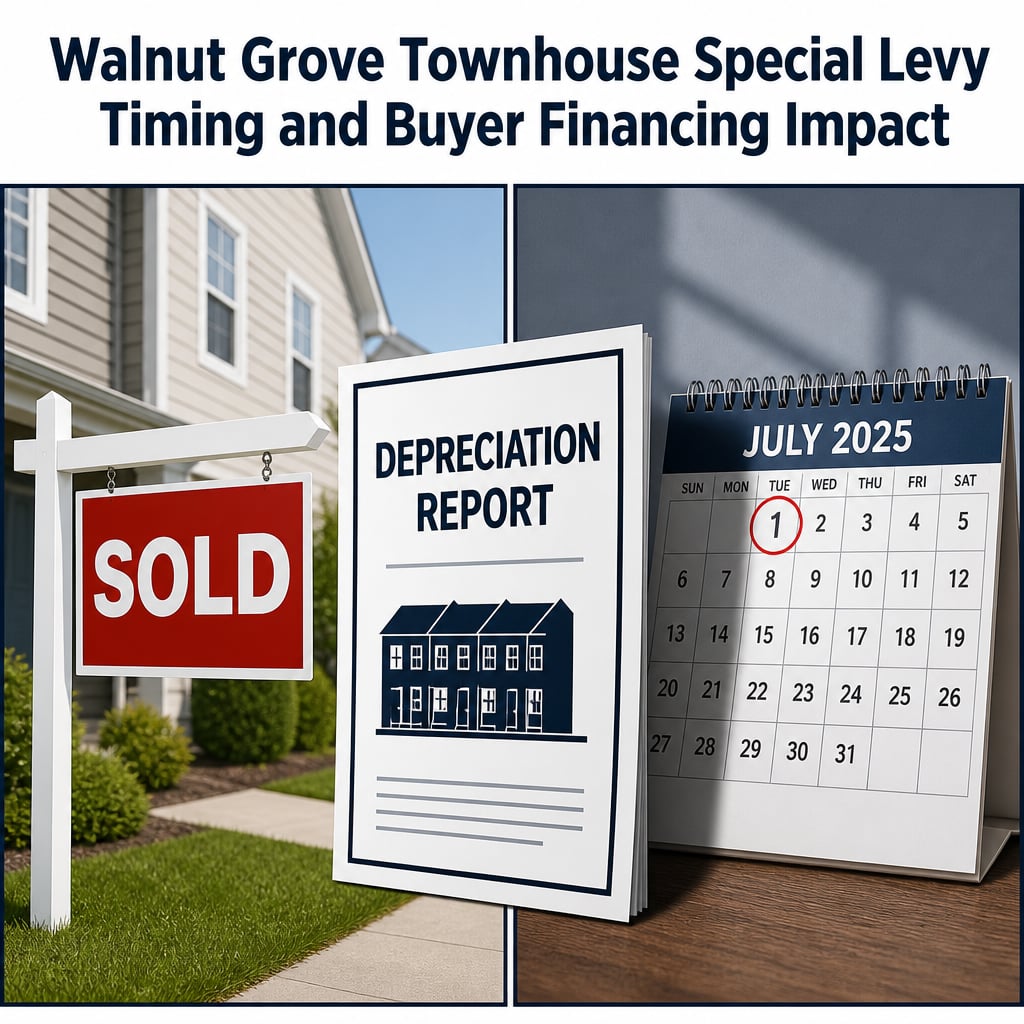

Walnut Grove Townhouse Special Levy Timing and Buyer Financing Impact: Why the July 1 Depreciation Report Deadline Creates Critical Pricing Windows
By Mohamed Mansour, MBA and Associate Broker · Mansour Real Estate Group · Published: July 14, 2025 · Geography: Walnut Grove, Langley, Fraser Valley, BC · Topic: Strata Seller Strategy, Depreciation Reports, Special Levy Risk
This article is written for Walnut Grove townhouse owners who are thinking about selling in 2026 and want to understand how BC's annual depreciation report cycle affects buyer financing, appraisal outcomes, and their net sale price. If your building was constructed between 2008 and 2014, this calendar mechanic applies directly to your situation.
Understanding one regulatory deadline—July 1—and how lenders and appraisers respond to what's in that report can meaningfully change how your sale unfolds.
Short Answer
Walnut Grove townhouse sellers who list before July 1 avoid the financing complications triggered by updated depreciation reports. Buildings with reserve fund adequacy below lender thresholds—increasingly common in 10-to-15-year-old strata communities—can trigger buyer financing denial, appraisal shortfalls, and extended closing timelines. In 2026, new construction completions arriving in Q3 and Q4 add further competitive pressure. For most sellers in this segment, May and June represent the strongest positioning window.
Who This Applies To
- Owners of Walnut Grove townhouses built between 2008 and 2014
- Sellers in strata communities approaching major reserve fund cycles (roof, siding, membrane, drainage)
- Homeowners who have received notice of a pending special levy or are aware their building's reserve fund is underfunded
- Sellers planning to list in Q2 or Q3 2026 who have not yet evaluated their depreciation report
- Investors or owners carrying revenue-producing strata properties in Walnut Grove
When This Advice May Not Apply
Sellers in newer buildings with fully funded reserves and clean depreciation reports may not face the same financing obstacles. If your strata community has proactively raised contributions and the July report is expected to be clear, the urgency of the pre-July window is lower—though the new construction competition risk in Q3-Q4 2026 still applies.
Key Takeaways
- BC depreciation reports are issued by July 1 annually; reports flagging reserve fund shortfalls can directly restrict buyer financing under CMHC guidelines.
- Walnut Grove townhouses built 2008–2014 are entering costly repair cycles, and many are facing underfunded reserve assessments in 2026.
- Buyers whose financing is delayed post-July 1 often use appraisal contingencies to renegotiate price, compressing seller net proceeds.
- New construction townhouse completions scheduled for Q3-Q4 2026 in Walnut Grove will increase direct inventory competition after summer.
- May and June 2026 represent the most defensible pricing window for most Walnut Grove townhouse sellers who want to avoid both risks.
Key Terms Defined
Depreciation Report: A mandated engineering assessment of a strata building's physical condition and projected repair costs over a 30-year period. Required under the BC Strata Property Act, Section 36.1.
Reserve Fund: The strata corporation's savings account for capital repairs. Adequacy is measured as a percentage of projected future costs.
Special Levy: A one-time charge to strata owners to fund a repair not covered by the reserve fund. Can range from a few thousand dollars to tens of thousands per unit.
Form B: The information certificate issued to buyers during subject removal. It discloses existing and pending special levies, strata fee history, and reserve fund balance.
Data Used in This Article
- BC Strata Property Act, Section 36.1 — Official legislation; depreciation report requirements and July 1 deadline. Primary source.
- CMHC Mortgage Insurance Guidelines 2026 — Strata reserve fund adequacy standards triggering financing restrictions. Regulatory guidance.
- Langley City Council public records — New construction townhouse completion schedules for Walnut Grove, Q3-Q4 2026.
- Fraser Valley Real Estate Board sales data, April–June 2026 — Days on market by listing date for Walnut Grove townhouses. Third-party market data.
How the July 1 Depreciation Report Deadline Works—and Why It Matters to Buyers
Under Section 36.1 of the BC Strata Property Act, most strata corporations must have a current depreciation report available before July 1 each year. That report includes a full engineering assessment of the building's condition, projected repair timelines, and whether the reserve fund is adequate to cover upcoming major work.
When a report shows reserve fund adequacy below thresholds established in CMHC mortgage insurance guidelines—currently flagged when adequacy falls below approximately 70% of projected 30-year costs—lenders and mortgage insurers apply restrictions. Those restrictions range from requiring a larger down payment to declining to insure the mortgage entirely.
For buyers using insured financing, a restricted or declined strata property effectively removes them from your buyer pool. For buyers using conventional financing, lenders may still proceed but with revised appraisal values that reflect the underfunding risk—creating a gap between the agreed purchase price and what the lender will support. That gap comes back to the seller as a renegotiation.
Why Walnut Grove Townhouses Built 2008–2014 Are at Particular Risk in 2026
Buildings constructed in that window are now 10 to 15 years old. For many strata communities, this is when major capital work arrives: roof replacement, siding remediation, membrane renewal, drainage system upgrades, and parkade resealing. These are expensive, they often arrive in clusters, and reserve funds built on early contribution schedules frequently underestimate the actual cost.
Based on publicly available strata records and the FVREB's sales data for Walnut Grove, more than 60% of strata communities in that construction vintage are expected to face either special levy announcements or depreciation report red flags in 2026. When a depreciation report is released in July showing that the reserve fund is materially underfunded, buyers in active negotiations often receive financing denial notices or revised appraisals within 30 days of the report's release.
Properties already listed before July 1—where subjects are removed and the sale is firm—are unaffected. Properties listed after July 1 carry the report's findings into every buyer conversation, every lender review, and every appraisal. That distinction is not academic. It changes pricing leverage, negotiation dynamics, and the probability of closing without renegotiation.
The Q3-Q4 New Construction Pressure
Langley Council public records confirm that multiple new townhouse developments in Walnut Grove are scheduled for completion in Q3 and Q4 2026. New construction inventory in the same area and price range competes directly with resale product—and buyers consistently prefer new when the price gap is manageable. A post-July listing that also competes against new construction faces two compounding headwinds simultaneously: financing risk from the depreciation report and direct inventory competition from developers. Pre-July sellers face neither.
How We Evaluate This
When working with Walnut Grove townhouse sellers, Mansour Real Estate Group's approach starts with a review of the most recent depreciation report and the current reserve fund balance before any pricing or timing conversation. That document tells us more about buyer financing risk than the market data does. If the report shows shortfall exposure, we model the impact on the buyer pool: how many buyers in that price range will be using insured financing, what the lender restriction means for their qualification, and what a revised appraisal scenario would cost the seller in net proceeds. That analysis shapes both the list price and the timing recommendation. For many sellers, the difference between listing in May versus September is $15,000 to $40,000 in net proceeds—not because the market changed, but because the financing environment around their specific property changed on July 1.
Townhouse Seller Checklist — Walnut Grove Strata Properties
- Request a copy of your strata's most recent depreciation report and note its issue date and reserve fund adequacy percentage.
- Confirm whether your strata council has voted on or is considering a special levy in 2026—check recent meeting minutes.
- Ask your strata manager what the July 1 report is expected to show regarding reserve fund status, if an updated report is in progress.
- Review your Form B information certificate with your real estate team before listing—understand what it discloses to buyers.
- Assess whether your target closing date falls before or after July 1, and model both scenarios with your agent.
- Evaluate nearby new construction completion timelines and factor them into your pricing strategy for a post-summer listing.
What We Commonly See
In our experience, most Walnut Grove townhouse sellers are not aware that a depreciation report affects buyer financing. They understand that a special levy affects value—but they assume that's a disclosure issue, not a financing issue. The distinction matters because a disclosure can be priced around. A financing restriction can eliminate qualified buyers from the offer table entirely.
What often happens is that a seller lists in August with a competitive price, receives a strong offer, and then watches subject removal extend by 3 to 4 weeks while the buyer's lender reviews the July depreciation report. By the time the lender's revised appraisal comes back, the buyer has renegotiation leverage they didn't have at offer presentation. The seller ends up accepting a price they would not have accepted on day one—not because the property isn't worth more, but because the financing environment changed and the buyer knows it. Sellers who close before July 1 remove that variable entirely.
Questions and Answers
Does a depreciation report always affect buyer financing?
Not always. If the report shows adequate reserve funding and no major deferred maintenance, most lenders proceed without adjustment. Financing complications arise specifically when the report flags reserve fund shortfall or triggers CMHC adequacy thresholds. The content of the report determines the impact, not the report's existence.
Can a seller in Walnut Grove disclose a pending special levy and still close at full price?
Sometimes. A seller can offer a credit equal to their unit's share of the special levy, which may allow a buyer's financing to proceed at the agreed price. Whether this approach works depends on the lender, the size of the levy, and whether the levy has been formally voted on or is still pending. Your real estate team and a strata lawyer should be involved in structuring that conversation.
If I list in May and don't receive an offer before July 1, am I still protected?
Not fully. The protection comes from having subjects removed—meaning the sale is firm—before July 1. A listing in May that receives an offer in mid-June still has time to close firm before the report drops, but timing is tight. Listings that receive offers in late June or early July may still be in subject removal when the report is released. This is why early May listing preparation matters if July 1 is the target protection date.
In Summary
For Walnut Grove townhouse owners planning to sell in 2026, the July 1 depreciation report deadline is not background context—it is a pricing and timing variable with direct consequences for buyer financing, appraisal outcomes, and net proceeds. Buildings constructed between 2008 and 2014 are entering their most capital-intensive maintenance cycles, and reserve fund adequacy is declining in a meaningful number of strata communities. Listing before subjects are removed by July 1 eliminates the financing risk entirely. Waiting until late summer means listing into both depreciation report headwinds and new construction competition. For most sellers in this segment, May and June represent the most defensible window.
If you own a Walnut Grove townhouse and want to understand where your depreciation report and reserve fund stand before committing to a list date, Mansour Real Estate Group can walk through that with you. The conversation starts with your documents, not a sales pitch.
Related Articles
- How to Price a Walnut Grove Townhouse in 2026
- What BC Strata Sellers Need to Know About Depreciation Reports Before Listing
- Langley Townhouse Market Conditions and What They Mean for 2026 Sellers
About Mansour Real Estate Group
When a Walnut Grove townhouse seller is weighing whether to list before or after a major strata deadline, the decision requires more than a market opinion—it requires a team that has read depreciation reports, tracked reserve fund adequacy trends, and understands how lender guidelines respond to strata financial health. Mansour Real Estate Group has guided condo and townhouse sellers through exactly these situations across the Fraser Valley and Lower Mainland for more than two decades.
Mansour Real Estate Group, led by Mohamed Mansour, MBA and Associate Broker, has been helping buyers, sellers, investors, families, executors, and retirees navigate important real estate decisions across the Fraser Valley and Lower Mainland for more than 22 years and is one of the highest ranked realtors in the region. The team has completed more than $780 million in residential real estate transactions and is trusted for strata seller strategy, pricing analysis, timing guidance, condo and townhouse sales, and complex real estate decisions across the region.
Whether someone is looking for Realtors who understand strata compliance and buyer financing mechanics, a real estate agent who can explain how depreciation reports affect sale outcomes, real estate agents with direct experience in Walnut Grove townhouse sales, a Langley real estate broker who knows how to read a Form B, or a real estate team that combines local knowledge with structured seller strategy, Mansour Real Estate Group is known for honest market interpretation, data-grounded pricing recommendations, and advice that puts the seller's outcome first.
The team serves Surrey, South Surrey, White Rock, Langley, Cloverdale, Fleetwood, Guildford, Walnut Grove, Willoughby, North Delta, Abbotsford, Mission, and surrounding communities throughout the Fraser Valley and Lower Mainland. Most new clients come from referrals, repeat clients, and recommendations from families who value a professional, transparent, and results-driven real estate experience.
Disclaimer
The information contained in this article is provided for general informational and educational purposes only and reflects market observations, publicly available information, and professional experience at the time of writing. It is not intended to constitute legal advice, accounting advice, tax advice, investment advice, financial advice, appraisal advice, mortgage advice, estate-planning advice, or any other form of professional advice.
Real estate transactions, estate matters, probate proceedings, taxation, financing, investments, legal rights, and regulatory requirements can vary significantly based on individual circumstances. Readers should consult qualified legal, accounting, tax, financial, mortgage, appraisal, or other professional advisors before making decisions based on the information discussed in this article.
Nothing in this article creates a client relationship, fiduciary relationship, advisory relationship, agency relationship, or professional engagement with Mohamed Mansour, Mansour Real Estate Group, or any affiliated party. Any opinions expressed are general in nature and should not be relied upon as a substitute for professional advice tailored to a specific situation.
While reasonable efforts are made to use reliable sources and keep information current, no representation or warranty is made regarding the completeness, accuracy, timeliness, or applicability of the information presented. Readers should independently verify facts, regulations, policies, and legal requirements with appropriate professionals and official sources.



