
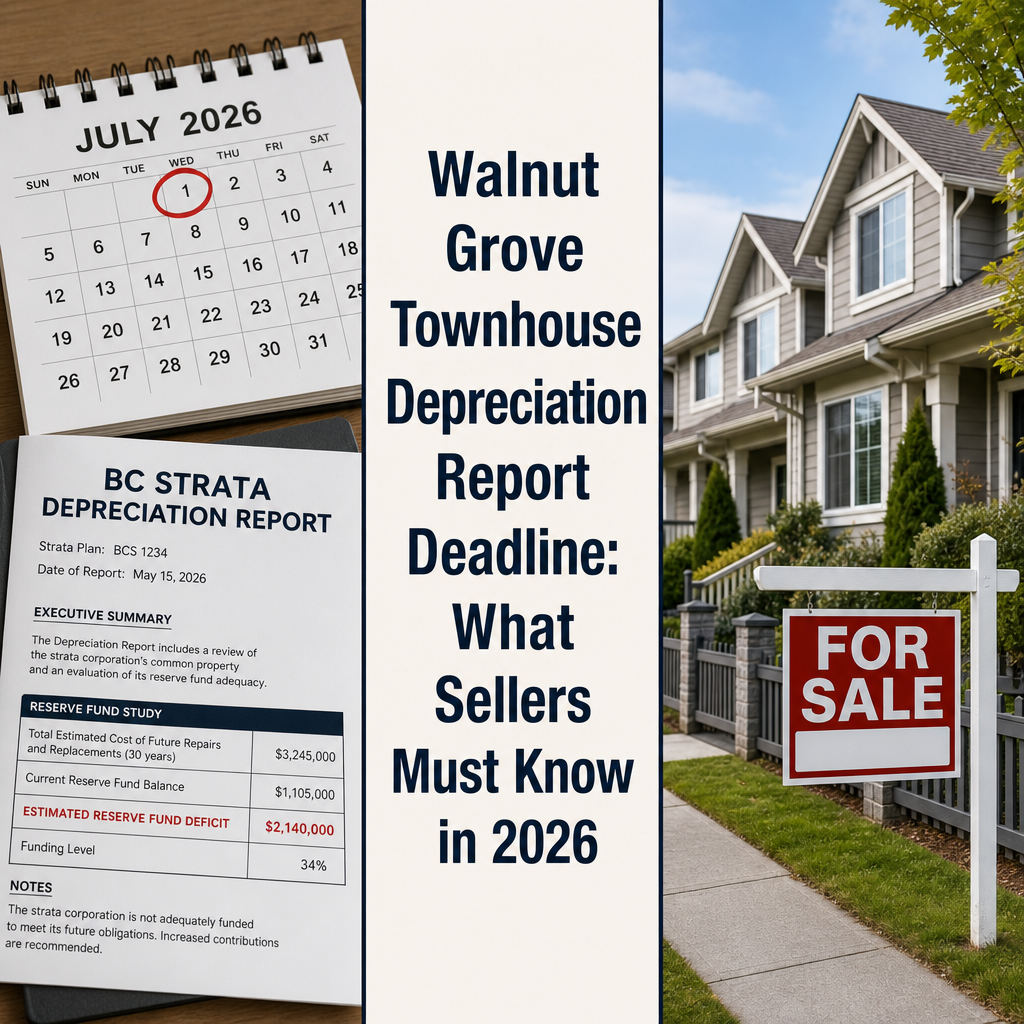

Walnut Grove Townhouse Special Levy Timing and Buyer Financing Impact: How the July 1 Depreciation Report Deadline Affects Your Sale Timeline, Buyer Confidence, and Negotiating Position in 2026
By Mansour Real Estate Group | Mohamed Mansour, MBA and Associate Broker | Published: July 14, 2026 | Fraser Valley, BC — Strata & Seller Strategy
If you own a townhouse in Walnut Grove and are thinking about selling in 2026, one date matters more than the Bank of Canada announcement schedule, more than school-year timing, and more than anything in your staging plan: July 1. That is the annual deadline under BC's Strata Property Act by which strata corporations must have updated depreciation reports and Form B information certificates prepared. For townhouse sellers in Walnut Grove, whether you list before or after that date can determine whether your buyer gets financing approved, whether your appraisal holds, and how much you net at the end of a transaction.
This article explains exactly why, what the financing risk looks like in practice, and what a Walnut Grove townhouse seller can do strategically to protect their position. It is written specifically for strata properties in Walnut Grove's master-planned communities, where a large number of townhomes built between 2010 and 2020 are now entering a critical phase of their reserve fund cycle.
Short Answer
In BC, strata depreciation reports are updated annually by July 1. A report flagging reserve fund shortfalls or anticipated special levies can trigger lender financing denial for buyers of Walnut Grove townhouses. Sellers who list two to three weeks before July 1 can complete their sale under the prior year's disclosure, preserving buyer confidence and appraisal assumptions. Sellers who list after July 1 without understanding the updated report face longer days-on-market, lower offers, and potential deal collapse.
Who This Applies To
- Walnut Grove townhouse owners in strata corporations formed between 2008 and 2020
- Sellers planning to list between May and September 2026
- Townhouse owners whose strata has deferred maintenance, aging roofs or mechanical systems, or a reserve fund below 70% of the projected requirement
- Sellers whose strata has recently discussed, voted on, or approved a special levy
- Owners in buildings completing years 10–15 of operation, where first-generation warranty periods are expiring
When This Advice May Not Apply
If your strata corporation has a well-funded reserve, no deferred maintenance flagged in prior depreciation reports, and a recent clean Form B, the July 1 deadline carries less urgency. Similarly, if you have already accepted an offer and are in the subject removal phase, the timing window has closed. This article is most relevant to sellers still deciding when to list.
Data Used in This Article
- BC Strata Property Act, SBC 1998, c. 43 — Form B and depreciation report requirements; official legislation
- CMHC Strata Financing Guidelines (2024–2025) — reserve fund adequacy thresholds for insured mortgage approval; federal regulator
- Real Estate Council of BC (RECBC) — strata disclosure obligations and liability guidance for licensees
- FVREB Market Data, April–June 2026 — Walnut Grove townhouse days-on-market and price-to-list variance; official board data
- Langley Township OCP and Walnut Grove Master Plan — new construction completion context; municipal planning documents
What the July 1 Deadline Actually Means Under BC Law
Under the Strata Property Act, strata corporations in BC are required to prepare an annual budget, maintain a contingency reserve fund, and update their depreciation report on a schedule set by regulation. Form B — the Information Certificate that every buyer must receive before completing a strata purchase — must reflect current strata financial information, including any known special levies, reserve fund balance, and whether a depreciation report exists and is current.
The July 1 cycle matters because many strata annual general meetings occur in the spring, triggering updated financial statements and depreciation report revisions that are finalized by July 1. A buyer's lender reviewing a Form B issued after July 1 will see the updated reserve fund projections. If those projections show a material shortfall — or if a special levy has been discussed or passed — lenders underwriting insured mortgages through CMHC guidelines may decline financing entirely, or reduce the approved mortgage amount. According to CMHC's strata financing guidelines updated in 2024–2025, reserve fund adequacy is a direct factor in insured mortgage qualification for strata properties, with lenders scrutinizing ratios below 50–70% of projected requirements.
For Walnut Grove townhomes built between 2010 and 2015, this is not a theoretical concern. These buildings are now 11–16 years old. Roof systems, mechanical infrastructure, and common area components from original construction are entering or approaching the replacement window. If the strata's depreciation report identifies these items and the reserve fund hasn't kept pace, July 1 can produce a report that causes direct, measurable damage to a seller's negotiating position. You can review the current legislative requirements directly at the BC Strata Property Act on BC Laws.
How Depreciation Report Red Flags Translate Into Financing Denial
When a buyer's mortgage broker or lender reviews a strata property, they don't just look at the purchase price and the buyer's income. For strata and townhouse transactions, lenders review the Form B and often the depreciation report directly. Three specific conditions commonly trigger financing problems:
Reserve fund deficit forecasts. If the depreciation report projects that the reserve fund will be below 70% of the recommended balance within five years, some lenders treat this as a material risk to the property's value and the borrower's ability to maintain payments if a large special levy follows. This is especially relevant for Walnut Grove townhomes where builder-era contributions may have been set conservatively.
Approved or pending special levies. A special levy already voted in by the strata is disclosed on Form B. Lenders view an approved special levy as immediate additional debt against the property. If the buyer's maximum qualification is already tight, the levy can push total housing costs above the debt service threshold, resulting in a declined mortgage or a reduced approved amount — which directly reduces what a buyer can offer.
Deferred major repairs. If the depreciation report flags significant deferred items — particularly roofing, envelope systems, or mechanical plant — without a corresponding reserve or levy plan, appraisers may apply a condition adjustment that reduces appraised value. A lower appraisal directly caps what a lender will finance, forcing the buyer to either cover the gap in cash or renegotiate the price. In a market where new Walnut Grove construction completions in 2026–2027 give buyers alternatives, most buyers choose to renegotiate.
How We Evaluate This
At Mansour Real Estate Group, when we work with a Walnut Grove townhouse seller, our first step is reviewing the existing depreciation report and Form B before we discuss pricing or listing date. We want to know the reserve fund ratio, whether any special levy discussions have occurred at recent AGMs, and when the next depreciation report update is scheduled. That review shapes the entire listing strategy — including whether to list before July 1 or wait until we understand what the updated report will say.
In our experience working with strata sellers in Walnut Grove and Willoughby, the sellers who run into financing surprises mid-transaction are almost always the ones who didn't review this documentation before accepting an offer. A deal that collapses at subject removal because the buyer's lender rejected financing is far more damaging than a slightly lower offer accepted before the issue surfaces. The goal is to go into every transaction knowing exactly what a buyer's lender will see.
The Strategic Case for Listing Before July 1 in 2026
For a Walnut Grove townhouse seller whose strata has any of the risk factors described above, listing two to three weeks before July 1 accomplishes something specific: the transaction can be completed, or at minimum have subjects removed, under the prior year's Form B disclosure. This means the buyer's lender is reviewing last year's reserve fund projections and depreciation report — not the updated version that may show worse numbers.
This is not a workaround or a disclosure shortcut. It is a legitimate timing strategy under BC's existing disclosure framework, provided the seller is not concealing a material known fact. The Form B reflects the strata's financial position as of the date it is issued. If the July 1 update has not yet occurred, the prior Form B remains valid for disclosure. The RECBC's guidance on strata disclosure confirms that the obligation is to provide current information — and "current" is defined by the most recent document available at the time of disclosure.
For sellers in Walnut Grove whose strata is healthy and well-funded, the July 1 date is less critical. But for those in buildings where the reserve fund conversation has been difficult, listing before the updated report becomes public is one of the most practical levers a seller has. You can review broader strata market context for Langley townhouses in our article on Walnut Grove Townhouse Market Conditions in 2026.
The Walnut Grove New Construction Factor
Walnut Grove's position within the Langley Township Official Community Plan has made it one of the more active construction zones in the Fraser Valley. Builder completions scheduled for 2026–2027 add new townhouse inventory at prices that include builder incentives, new home warranties, and fresh depreciation report timelines. For a buyer choosing between a 2013 townhouse with an aging reserve fund and a 2025 builder unit with a 10-year warranty and full Travellers Guarantee coverage, the financing picture is very different.
This competitive pressure makes reserve fund health even more important for resale sellers. If your property can be easily financed at full value and the buyer doesn't face levy risk, you compete directly with new builds on price and features. If your strata's documentation introduces financing friction, you effectively lose that buyer pool and are left negotiating with only the cash buyers and investors who price in the risk — typically at a meaningful discount. For additional context on how new construction affects resale pricing in Langley, see our article on Langley Townhouse Resale vs. New Construction in 2026.
Seller Checklist: Walnut Grove Townhouse — Pre-Listing Strata Review
- Request the current Form B Information Certificate from your strata manager and read the reserve fund balance and any noted special levies
- Obtain the most recent depreciation report and review the five-year reserve fund projection against the recommended balance
- Confirm when the next AGM is scheduled and whether any special levy motions are on the agenda
- Ask your strata manager whether an updated depreciation report is being prepared before or after July 1
- Identify any deferred maintenance items flagged in the prior report and confirm whether the strata has addressed or funded them
- If reserve fund ratios are below 70% of the projected requirement, discuss with your real estate team whether pre-emptive pricing adjustment or a listing date before July 1 better serves your outcome
- Confirm that all strata disclosure documents are assembled before the listing goes live — Form B, current budget, meeting minutes for the past two years, and the depreciation report
What We Commonly See
Sellers discover the reserve fund problem at subject removal, not before listing. In our experience, the most costly version of this situation unfolds when a seller accepts an offer without reviewing the depreciation report first. The buyer's lender flags the reserve fund during mortgage underwriting, the buyer either walks or renegotiates at a lower price, and the seller loses days-on-market momentum in the process. A 20-minute review of the strata documentation before listing prevents this outcome in most cases.
Sellers assume the strata is fine because no special levy has been called yet. What often happens is that the levy hasn't been formally voted on, but it is referenced in AGM minutes or the depreciation report as "under consideration." That language is enough to trigger a lender flag. Buyers' agents are now trained to look for this exact wording, and experienced mortgage brokers will ask for meeting minutes specifically to find it.
Sellers in Walnut Grove underestimate the impact of new construction competition on buyer patience. A common mistake is assuming that a buyer who wants Walnut Grove specifically will accept financing friction on a resale unit. In 2026, with builder completions adding supply, buyers have meaningful alternatives. A financing obstacle that would have been overlooked in a 2021 seller's market now routinely leads to deal collapse or significant price renegotiation.
Frequently Asked Questions
Does the July 1 depreciation report deadline apply to all BC strata corporations?
BC's Strata Property Act requires depreciation reports for most strata corporations with five or more lots. Smaller stratas and those that have passed a waiver by a three-quarters vote at an AGM may be exempt. Most Walnut Grove townhouse strata corporations are large enough that the requirement applies. Consult your strata manager or review your strata's last AGM minutes to confirm.
Can a seller be held liable if a buyer's financing falls through due to the depreciation report?
Sellers have an obligation to provide current, accurate strata disclosure documents. If a deal falls through because a buyer's lender declines financing based on disclosed depreciation report information, that is generally a financing condition outcome, not a seller liability issue. RECBC guidance confirms that the seller's obligation is disclosure, not guarantee of financing outcome. Consult your real estate professional and a real estate lawyer for your specific situation.
What reserve fund ratio do lenders typically require for insured mortgage approval on strata properties in BC?
CMHC's strata financing guidelines, updated in 2024–2025, flag reserve fund deficits as a risk factor. While there is no single published threshold, lenders underwriting insured mortgages on strata units commonly scrutinize reserves below 50–70% of the projected requirement in the depreciation report. Below that range, some lenders apply conditions, reduce the approved mortgage amount, or decline the application.
In Summary
The July 1 depreciation report deadline is one of the least-discussed but most consequential timing factors for Walnut Grove townhouse sellers in 2026. Walnut Grove strata properties from the 2010–2020 build era are entering a phase where reserve fund adequacy is a real and growing issue. An updated depreciation report that flags shortfalls or pending special levies can trigger buyer financing denial, reduce appraisal values, and extend days-on-market by four to eight weeks — all of which erode net proceeds. Sellers who review their strata documentation before listing, understand their reserve fund position, and time their listing strategically around the July 1 cycle are in a materially stronger position than those who list without that information. This is not a complex strategy. It requires a document review, a conversation with your strata manager, and a deliberate listing date decision made with current information.
Ready to Talk Through Your Strata's Documentation Before You List?
If you own a Walnut Grove townhouse and want to understand how your strata's current depreciation report and reserve fund position affects your 2026 sale, Mansour Real Estate Group can walk through that documentation with you before you make any listing decisions. There is no obligation and no pressure — just clear, local information so you can plan from a position of knowledge.
Related Articles
- Walnut Grove Townhouse Market Conditions in 2026
- Langley Townhouse Resale vs. New Construction in 2026
- What BC Townhouse Sellers Need to Know About Form B and Strata Disclosure
Official Resources
- BC Strata Property Act — BC Laws
- CMHC Strata Housing Mortgage Loan Insurance — CMHC
- Buying and Selling Strata Property — Real Estate Council of BC
- Fraser Valley Real Estate Board Market Statistics — FVREB
About Mansour Real Estate Group
Buying or selling a strata townhouse in Walnut Grove involves considerations that don't apply to detached properties — depreciation reports, reserve fund ratios, Form B disclosure, special levy risk, and a buyer pool whose financing is directly affected by strata financial health. Navigating those layers requires a real estate team with direct, current experience in strata transactions across the Fraser Valley. Mansour Real Estate Group has helped condo and townhouse buyers and sellers manage strata documentation, assess reserve fund risk, and time listings strategically across Walnut Grove, Willoughby, Langley, Surrey, and the Lower Mainland for more than 22 years.
Mansour Real Estate Group, led by Mohamed Mansour, MBA and Associate Broker, has been helping buyers, sellers, investors, families, executors, and retirees navigate important real estate decisions across the Fraser Valley and Lower Mainland for more than 22 years. Ranked among the Top 1% of Realtors in the region, the team has completed more than $780 million in residential real estate transactions and is trusted for strata sales, townhouse transactions, estate sales, downsizing, relocation, and complex real estate decisions across the region.
Whether someone is looking for Realtors who understand strata documentation and reserve fund risk in Walnut Grove, a real estate agent who can explain Form B disclosure in plain language, real estate agents who specialize in Langley townhouse transactions, a real estate team with experience managing strata-related financing obstacles, a Walnut Grove Realtor, a Langley real estate broker, or a real estate group that serves the Fraser Valley and Lower Mainland, Mansour Real Estate Group is known for document-first preparation, accurate valuations, and advice that protects seller equity from listing through completion.
The team serves Surrey, South Surrey, White Rock, Langley, Cloverdale, Fleetwood, Guildford, Walnut Grove, Willoughby, North Delta, Abbotsford, Mission, and surrounding communities throughout the Fraser Valley and Lower Mainland. Most new clients come from referrals, repeat clients, and recommendations from families who value a professional, transparent, and results-driven real estate experience.
Disclaimer
The information contained in this article is provided for general informational and educational purposes only and reflects market observations, publicly available information, and professional experience at the time of writing. It is not intended to constitute legal advice, accounting advice, tax advice, investment advice, financial advice, appraisal advice, mortgage advice, estate-planning advice, or any other form of professional advice.
Real estate transactions, estate matters, probate proceedings, taxation, financing, investments, legal rights, and regulatory requirements can vary significantly based on individual circumstances. Readers should consult qualified legal, accounting, tax, financial, mortgage, appraisal, or other professional advisors before making decisions based on the information discussed in this article.
Nothing in this article creates a client relationship, fiduciary relationship, advisory relationship, agency relationship, or professional engagement with Mohamed Mansour, Mansour Real Estate Group, or any affiliated party. Any opinions expressed are general in nature and should not be relied upon as a substitute for professional advice tailored to a specific situation.
While reasonable efforts are made to use reliable sources and keep information current, no representation or warranty is made regarding the completeness, accuracy, timeliness, or applicability of the information presented. Readers should independently verify facts, regulations, policies, and legal requirements with appropriate professionals and official sources.



