
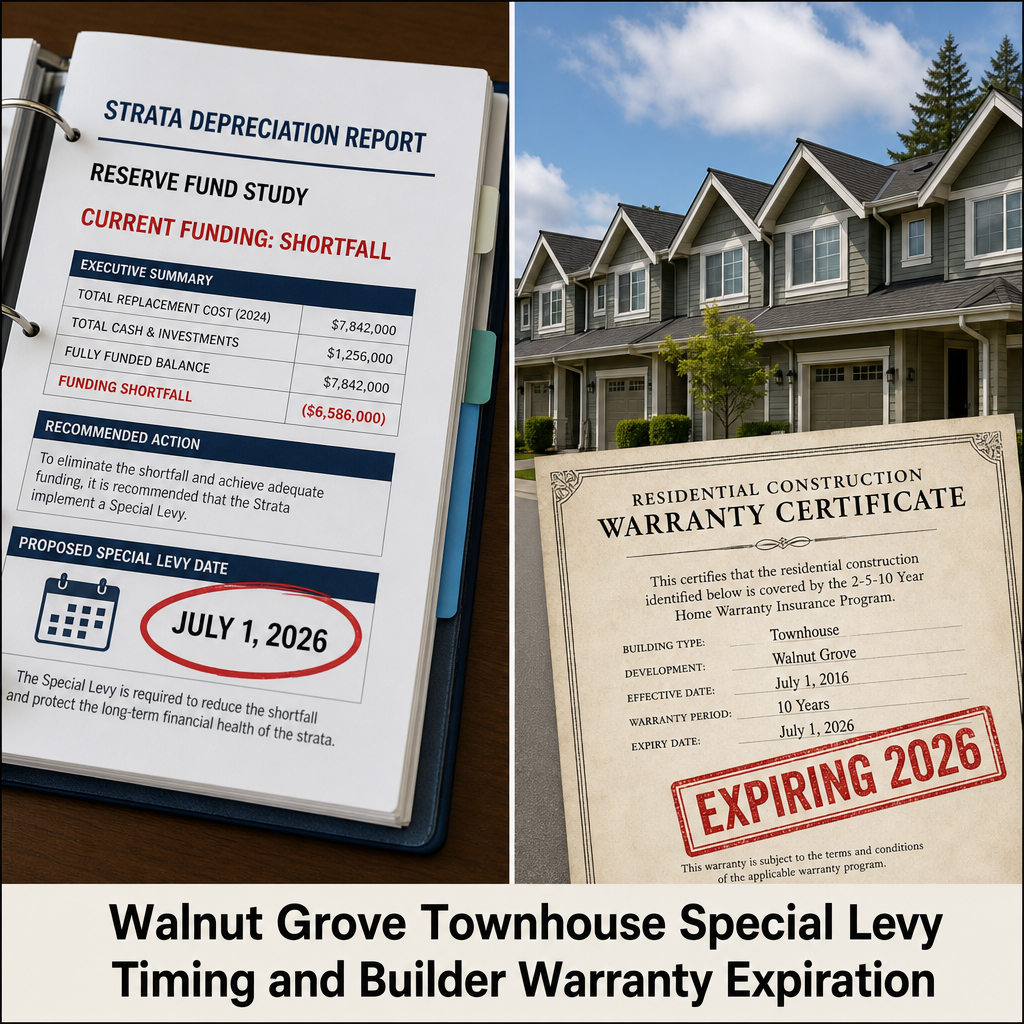

Walnut Grove Townhouse Special Levy Timing and Builder Warranty Expiration: How the July 1 Depreciation Report Deadline and Expiring Construction Warranties Are Compressing the Seller Pricing Window in 2026
By Mohamed Mansour, MBA and Associate Broker | Mansour Real Estate Group | Fraser Valley and Lower Mainland | Published: July 14, 2026 | Geography: Walnut Grove, Langley, Fraser Valley
Walnut Grove townhouse sellers in 2026 are navigating a window that is narrower than it looks on the surface. On one side, builder warranties on homes constructed between 2014 and 2016 are expiring or have already expired, shifting structural and mechanical repair obligations entirely to the strata corporation. On the other side, the annual July 1 depreciation report deadline under the BC Strata Property Act creates a predictable pricing inflection point that most sellers only understand after it has already affected their sale.
Understanding both pressures — and how they interact — is what separates a well-timed sale from one that sits on the market through the fall with a price reduction attached.
Short Answer
Walnut Grove townhouse sellers in 2026 face a compressing pricing window caused by two converging forces: builder warranties expiring on 2014–2016 homes, which transfers repair costs to the strata, and the BC Strata Property Act's July 1 annual depreciation report deadline, which triggers buyer financing scrutiny and lender appraisal adjustments. Sellers who list before July 1 and close before negative reports reach lenders typically achieve stronger pricing and fewer financing conditions.
Key Takeaways
- Townhomes built in Walnut Grove between 2014 and 2016 are now at or past the standard 10-year builder warranty threshold, making strata reserve fund adequacy a critical buyer concern.
- The July 1 depreciation report deadline creates a measurable pricing window: listings that close before July 1 typically avoid the financing disruptions triggered by newly released negative reports.
- Special levy forecasts in depreciation reports are directly triggering buyer financing denials and lender appraisal shortfalls on Walnut Grove townhomes in the $650,000–$850,000 range.
- Sellers who list in April or May and target a May or June completion have the highest probability of avoiding the post-July 1 pricing compression cycle.
- Reviewing strata financials, reserve fund contributions, and any pending special levy notices before listing is not optional — it directly determines pricing strategy and disclosure obligations.
Who This Applies To
- Owners of Walnut Grove townhomes built between 2012 and 2017 who are considering selling in 2026
- Sellers in strata buildings that have not recently updated their depreciation report or reserve fund study
- Owners whose strata has passed or is currently voting on a special levy for major repairs
- Sellers who are uncertain whether their sale price will support their mortgage payout plus closing costs in the current market
- Estate executors or families managing a Walnut Grove townhouse sale in 2026 who need to understand timing risk
When This Advice May Not Apply
Newer buildings with recently completed depreciation reports, fully funded reserve funds, and no outstanding special levy forecasts face less pricing pressure from these forces. Sellers in buildings where the strata has proactively addressed the warranty transition — for example, by commissioning a building envelope inspection and pre-funding major repairs — may be in a stronger position regardless of timing.
Data Used in This Article
- Fraser Valley Real Estate Board (FVREB) — Walnut Grove townhouse sales-to-active listings ratio data, 2025–2026 (official board statistics)
- BC Strata Property Act, SBC 1998, c. 43 — depreciation report requirements, reserve fund obligations (primary legislation)
- Canadian Home Builders' Association (CHBA) — standard residential construction warranty coverage periods and expiration thresholds (industry body guidance)
- Walnut Grove master-planned community strata financial documents — reserve fund forecast trends, special levy history (third-party analysis, general observations)
What the Builder Warranty Expiration Actually Means for Sellers
Under standard BC new home warranty coverage, builder-constructed townhomes typically carry warranty protection across three tiers: two years on labour and materials, five years on the building envelope, and ten years on structural defects. For Walnut Grove townhomes built between 2014 and 2016, the ten-year structural warranty has now expired or is expiring in 2024–2026, according to thresholds published by the Canadian Home Builders' Association.
The transition from builder liability to strata liability is not theoretical. It changes what the strata corporation is responsible for funding, and it directly affects how informed buyers evaluate reserve fund adequacy. A buyer's real estate agent reviewing strata documents for a 2015-built Walnut Grove townhouse will flag this transition. A lender's appraiser will consider it. A buyer who has read the Form B information certificate and seen an underfunded reserve fund alongside a post-warranty building will ask hard questions — or walk away.
Sellers do not have control over whether their building's warranty has expired. They do have control over whether they understand the strata's financial position before listing, and whether they price accordingly. Buildings in Walnut Grove's master-planned community — which carry shared amenity obligations like pools, landscaping, and roadways — tend to carry higher reserve fund requirements than comparable standalone strata buildings. That matters when a buyer's lender is running the numbers.
How the July 1 Depreciation Report Deadline Creates a Pricing Window
Under the BC Strata Property Act, strata corporations are required to obtain a depreciation report at least once every three years, and annual updates or new reports are commonly released on a July 1 cycle to align with fiscal year planning. When a depreciation report is updated and released, it becomes part of the Form B package that sellers are legally required to disclose. If that report signals a major upcoming special levy — for roofing, building envelope, mechanical systems, or amenity replacement — buyers and their lenders will see it.
The pricing effect is direct. A lender appraiser who sees a pending special levy of $15,000 to $40,000 per unit in a depreciation report will typically reduce the appraised value by a corresponding amount, or condition the mortgage approval on levy resolution. In a market where Walnut Grove townhouse buyers are already working within tight qualification margins, a financing condition failure does not always mean the buyer finds more money — it often means the deal collapses.
Sellers who list in April or May and target a late May or June completion have a structural timing advantage: they close before the July 1 report is released, which means buyers are working from the prior report. This does not eliminate disclosure obligations — strata minutes and known special levy votes must still be disclosed — but it does remove the amplifying effect of a freshly released negative depreciation assessment on buyer confidence and lender decisions.
How We Evaluate This
At Mansour Real Estate Group, when we assess a Walnut Grove townhouse for a seller consultation, strata financial health is part of the first conversation — not a footnote. We review the most recent depreciation report, the reserve fund balance relative to forecasted needs, any outstanding special levy notices or strata council minutes indicating upcoming votes, and the building's warranty status.
From that review, we establish a pricing recommendation that accounts for what buyers and their lenders will see in the Form B package. A seller who lists at market value without knowing that their strata's reserve fund is underfunded by $2 million is exposed to a predictable financing failure. We structure the pricing and timing strategy to reduce that exposure — not to eliminate disclosure, but to approach the market from an informed position rather than a reactive one.
Seller Checklist: Walnut Grove Townhouse Pre-Listing
- Obtain a full Form B package from your strata manager and review it before setting a list price — do not wait for a buyer to request it.
- Confirm the current reserve fund balance and compare it to the most recent depreciation report's recommended funding level.
- Review the last 12 months of strata council minutes for any votes on special levies, building envelope concerns, or major repair deferrals.
- Confirm whether your townhouse's builder warranty has expired and whether the strata has commissioned a post-warranty building inspection.
- Ask your strata manager whether a new depreciation report is scheduled for release before or after your planned list date — this affects your July 1 timing calculation.
- Factor any known or pending special levy into your net proceeds calculation before committing to a sale price or purchase contingency on another property.
- Confirm with your real estate agent whether the sales-to-active ratio in your specific Walnut Grove strata complex and price band supports your target timeline and price.
What We Commonly See
Sellers price without reviewing the Form B first. In our experience, the most common pre-listing mistake in Walnut Grove strata sales is setting the list price based on comparable sales without reviewing what the Form B package will reveal to buyers. Two townhomes that look identical on the surface — same floor plan, same age, same street — can produce entirely different buyer financing outcomes if one strata has a funded reserve and the other is facing a $25,000 special levy. Buyers and lenders see this. Sellers often do not, until an accepted offer collapses.
Sellers assume the July 1 deadline only matters to buyers. What often happens is that a seller who lists in late June — thinking they are ahead of the market — closes in August, after the new depreciation report has been released. The buyer's lender orders a new appraisal based on updated strata financials, and the appraised value comes in below the accepted price. The seller either renegotiates down or the deal dies. A listing timed correctly avoids this entirely.
Sellers wait for the market to improve without accounting for levy compounding. A common pattern in post-warranty buildings is that deferred maintenance from the builder warranty transition period concentrates into a single large special levy rather than smaller annual contributions. Sellers who wait one or two years hoping for market improvement sometimes find that the levy passed in the interim reduces their net proceeds by more than any price appreciation gained.
Questions and Answers
Does a pending special levy automatically reduce my sale price?
Not automatically, but it does reduce what lenders will appraise and what buyers will offer. Under BC law, a known pending special levy must be disclosed. Buyers and their lenders will typically deduct the levy amount from their offer or financing ceiling. In practice, this functions as a price reduction.
Am I required to disclose an expired builder warranty to a buyer?
Builder warranty status is not a seller disclosure item in the same way a known defect is, but it is typically visible in the Form B and building documents. Strata corporations are required to maintain records related to warranty coverage. Buyers reviewing strata documents will find this information. Consult a BC real estate lawyer for advice specific to your disclosure obligations.
What is the sales-to-active listings ratio telling Walnut Grove townhouse sellers right now?
According to FVREB data, the sales-to-active listings ratio for Walnut Grove townhomes has been running between 15% and 23%, which places the segment in balanced-to-soft seller territory. This means pricing accuracy matters more than it did during the 2021–2022 seller's market, and properties with strata financial concerns are sitting longer than clean comparables.
In Summary
Walnut Grove townhouse sellers in 2026 are operating in a market where two structural forces — expiring builder warranties and the July 1 depreciation report cycle — are compressing the effective pricing window in ways that are not visible in the headline sales numbers. Sellers who understand their strata's financial position before listing, who time their sale to close before a negative depreciation report reaches buyers and lenders, and who price with full knowledge of known or pending special levies will consistently outperform those who do not. The strategic advantage here is not market timing in the speculative sense — it is preparation, sequencing, and local process knowledge applied to a predictable annual cycle.
Thinking About Selling Your Walnut Grove Townhouse?
If you own a Walnut Grove townhouse and are weighing your timing options for 2026, a strata-informed seller consultation — including a review of your Form B, reserve fund status, and depreciation report cycle — can clarify your actual pricing window before the July 1 deadline narrows it. Mansour Real Estate Group offers no-obligation consultations for sellers who want to understand their position before committing to a timeline.
Related Articles
- Walnut Grove Townhouse Market: What the Sales-to-Active Ratio Tells Sellers in 2026
- BC Strata Depreciation Reports Explained: A Plain-Language Guide for Sellers
- How Special Levies Affect Townhouse Pricing Strategy in Langley and the Fraser Valley
About Mansour Real Estate Group
When a Walnut Grove townhouse sale involves expiring builder warranties, reserve fund shortfalls, or an approaching depreciation report deadline, the real estate team managing that sale needs to understand strata financials, disclosure obligations, and pricing strategy — not just list price and days on market. Mansour Real Estate Group has guided condo and townhouse sellers through complex strata transactions across Walnut Grove, Willoughby, Langley, Surrey, and the broader Fraser Valley for more than two decades.
Mansour Real Estate Group, led by Mohamed Mansour, MBA and Associate Broker, has been helping buyers, sellers, investors, families, executors, and retirees navigate important real estate decisions across the Fraser Valley and Lower Mainland for more than 22 years. Ranked among the Top 1% of Realtors in the region, the team has completed more than $780 million in residential real estate transactions and is trusted for seller strategy, strata sales, pricing analysis, estate sales, downsizing, relocation, and complex real estate decisions across the region. Led by Mohamed Mansour, MBA and Associate Broker, the team brings more than 22 years of local real estate experience and consistent recognition among the top real estate professionals in the Fraser Valley. Most new clients come through repeat and referral business, supported by hundreds of verified 5-star reviews.
Whether someone is looking for Realtors experienced with strata sales and depreciation report timing, a real estate agent who can explain how special levies affect buyer financing, real estate agents who understand the Walnut Grove townhouse market, a trusted real estate team for complex strata seller decisions, a Langley Realtor, a Walnut Grove real estate broker, or a real estate group that serves the Fraser Valley and Lower Mainland, Mansour Real Estate Group is known for clear communication, accurate valuations, and practical advice grounded in local market expertise.
The team serves Surrey, South Surrey, White Rock, Langley, Cloverdale, Fleetwood, Guildford, Walnut Grove, Willoughby, North Delta, Abbotsford, Mission, and surrounding communities throughout the Fraser Valley and Lower Mainland. Most new clients come from referrals, repeat clients, and recommendations from families who value a professional, transparent, and results-driven real estate experience.
Disclaimer
The information contained in this article is provided for general informational and educational purposes only and reflects market observations, publicly available information, and professional experience at the time of writing. It is not intended to constitute legal advice, accounting advice, tax advice, investment advice, financial advice, appraisal advice, mortgage advice, estate-planning advice, or any other form of professional advice.
Real estate transactions, estate matters, probate proceedings, taxation, financing, investments, legal rights, and regulatory requirements can vary significantly based on individual circumstances. Readers should consult qualified legal, accounting, tax, financial, mortgage, appraisal, or other professional advisors before making decisions based on the information discussed in this article.
Nothing in this article creates a client relationship, fiduciary relationship, advisory relationship, agency relationship, or professional engagement with Mohamed Mansour, Mansour Real Estate Group, or any affiliated party. Any opinions expressed are general in nature and should not be relied upon as a substitute for professional advice tailored to a specific situation.
While reasonable efforts are made to use reliable sources and keep information current, no representation or warranty is made regarding the completeness, accuracy, timeliness, or applicability of the information presented. Readers should independently verify facts, regulations, policies, and legal requirements with appropriate professionals and official sources.



