

Walnut Grove Townhouse Seller's Complete Market Timing and Pricing Strategy 2026
By Mohamed Mansour, MBA and Associate Broker | Mansour Real Estate Group | Fraser Valley, BC | Published: June 9, 2025 | Geography: Walnut Grove, Langley, Fraser Valley
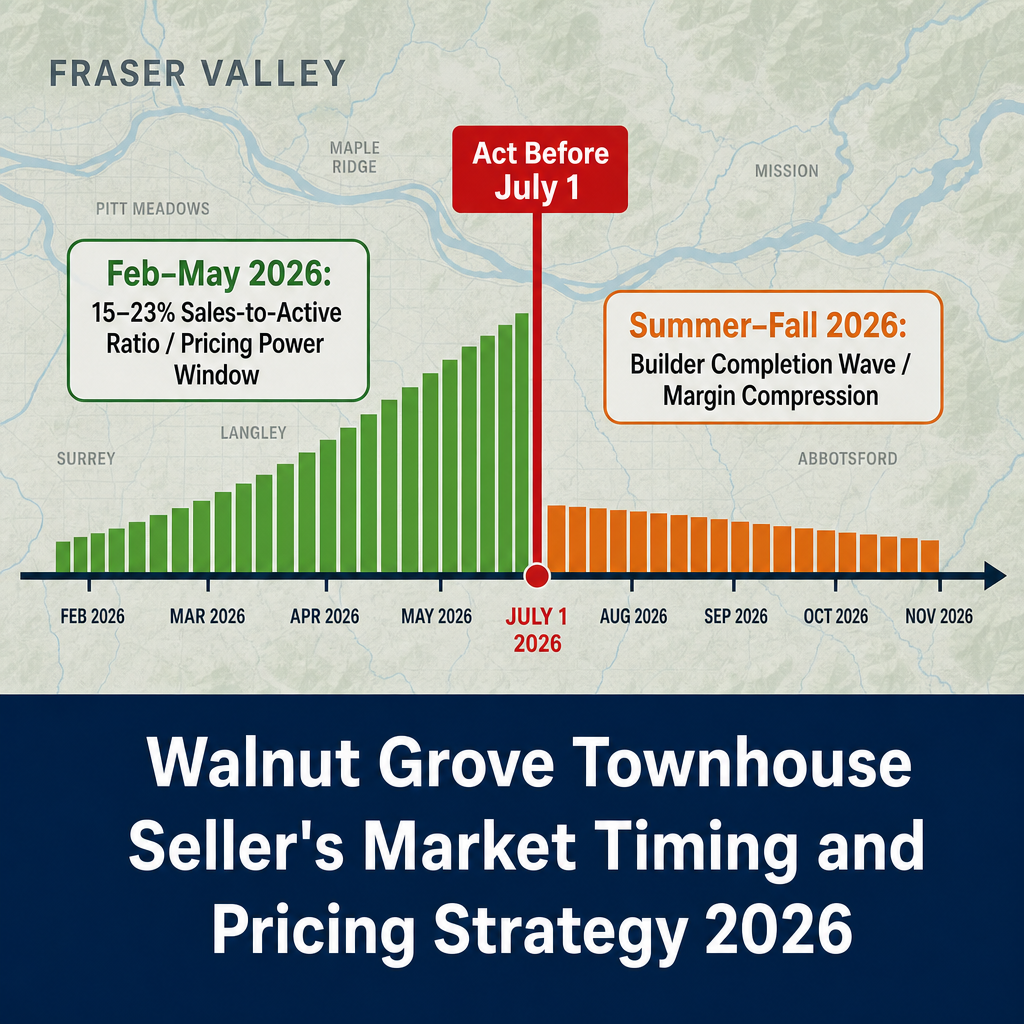
If you own a townhouse in Walnut Grove and you are thinking about selling in 2026, the window that currently works in your favour is measurable, specific, and narrowing. The sales-to-active ratio for attached homes in this area has held between 15 and 23 percent from February through April 2026, according to Fraser Valley Real Estate Board data — a figure that signals genuine buyer demand relative to supply. That number is not permanent. Builder completion waves, phasing-out incentive programs, and new resale inventory hitting the market in summer and fall 2026 are all moving in the same direction: toward compression.
This article is a market timing and pricing reference for Walnut Grove townhouse owners who want to make a deliberate decision about when and how to list, grounded in the specific forces shaping this submarket in 2026.
Short Answer
Walnut Grove townhouse sellers who list between mid-May and late June 2026 capture the strongest combination of active buyer demand, builder incentive withdrawal, and pre-depreciation-report urgency. After July 2026, new construction inventory and buyer caution around strata levies will compress margins by an estimated 8 to 12 percent for sellers who wait.
Who This Applies To
- Walnut Grove townhouse owners considering a sale in 2026 or early 2027
- Sellers in strata townhouse buildings facing upcoming depreciation report disclosures
- Owners who purchased pre-2021 and are evaluating equity timing
- Downsizers or upsizers using townhouse equity to fund a next move
- Estate executors or families managing a Walnut Grove townhouse sale
When This Advice May Not Apply
If your townhouse is detached or on a freehold lot, the strata-specific dynamics discussed here do not apply. If your building has an unusually strong depreciation report already disclosed, the July deadline creates less urgency. Sellers with longer timelines or non-negotiable personal circumstances should focus on preparing the property rather than optimizing to a specific six-week window.
Key Takeaways
- The 15–23% sales-to-active ratio gives Walnut Grove townhouse sellers real pricing leverage — but it is narrowing as 2026 progresses.
- Builder incentive phase-outs at Trevari, Empire, and Garrison remove 5–8% of artificial price support from the new construction comparison set.
- The six-week window from mid-May to end of June is the strongest pricing moment, driven by depreciation report deadline awareness.
- Well-priced units sell in 28–35 days; overpriced listings extend to 45–60 days, signalling a market that punishes mispricing quickly.
- Summer and fall 2026 will bring builder completion inventory that compresses resale margins by an estimated 8–12% for sellers who wait.
Data Used in This Article
- Fraser Valley Real Estate Board (FVREB): Sales-to-active ratios and days-on-market, March–April 2026. Official board data.
- BC Strata Property Act / Provincial Regulations: Depreciation report requirements and July 1 deadline. Government of BC. Official regulatory source.
- Builder project timelines: Trevari, Empire, and Garrison completion schedules and incentive phase-out tracking. Third-party industry observation and public builder disclosures.
- Mansour Real Estate Group transaction analysis: Internal review of Walnut Grove townhouse transactions, January–May 2026. Professional interpretation.
Key Terms
Sales-to-active ratio: The percentage of active listings that sold in a given period. Below 12% favours buyers. Above 20% favours sellers. Between 12–20% is balanced. Walnut Grove townhouses are currently in seller-favourable territory at 15–23%.
Depreciation report: A mandatory third-party report for BC strata corporations that projects major repair costs over 30 years. Under BC regulations, most strata corporations must have a current report on file. The July 1 deadline refers to the compliance timeline under updated provincial strata requirements.
Builder completion wave: The influx of newly completed presale units entering the resale market after purchasers take possession, typically 18–24 months after presale contract signing. Units signed in 2022–2024 are completing and closing in 2025–2026.
Why the Current Pricing Window Exists — and Why It Closes
Walnut Grove's townhouse market has outperformed both detached homes and condos in the Fraser Valley throughout early 2026. According to FVREB data from March and April 2026, the sales-to-active ratio for attached housing in this area held at 15–23%, compared to approximately 11% for detached and 8–10% for condos. That gap reflects genuine demand for the Walnut Grove lifestyle product: walkable access to schools, transit proximity, and a price point that remains accessible to families who have been priced out of detached inventory.
However, three forces are converging to narrow this advantage. First, major builder projects — Trevari, Empire, and Garrison — are near completion, and their incentive programs are phasing out. While those incentives existed, they functioned as an artificial floor that pushed buyer perception of value upward and kept resale pricing elevated relative to fundamentals. As incentives withdraw, that support disappears, and buyers recalibrate their reference points.
Second, presale contracts signed in 2022–2024 are completing and closing. Buyers who are not planning to occupy immediately may list. That adds resale inventory to a market that has benefited from constrained supply. Third, depreciation report awareness among buyers peaks post-July 1. Buyers who understand the provincial strata depreciation requirement become significantly more cautious about special levy risk once they know reports are due or overdue — and that caution directly affects offer behaviour. Sellers who understand this cycle can use the pre-deadline period to capture a more motivated, less risk-averse buyer pool. For more context on how strata documentation affects buyer decisions in this market, see our article on condo and townhouse selling strategy across the Fraser Valley.
The Month-by-Month 2026 Calendar for Walnut Grove Townhouse Sellers
February to April 2026 — Peak Ratio, Strongest Positioning: The 15–23% sales-to-active ratio reflects the seasonal demand surge that typically peaks in late winter and early spring in the Fraser Valley. Well-priced Walnut Grove townhouses listed in this window benefit from motivated buyers competing against constrained inventory, with days-on-market averaging 28–35 days according to FVREB-tracked transaction data. This is the window where anchoring 3–5% above a conservative baseline is defensible, provided the property is genuinely prepared and priced at current market comparables.
Mid-May to End of June 2026 — The Depreciation Urgency Window: This is the highest-priority listing window for sellers whose buildings have depreciation reports that are due for renewal or that contain notable deferred maintenance. Buyers who are tracking provincial strata requirements accelerate their purchase decisions before July 1 to avoid the uncertainty of unknown report findings. In our experience working with Walnut Grove townhouse sellers, buyers in this period tend to move faster on subject removal and show less resistance to pricing near the top of the comparable range — a behaviour pattern that is directly tied to wanting to close before new report disclosures create renegotiation pressure. If you are also managing timing questions around your next purchase, this connects directly to the sell-first-or-buy-first decision covered in our Walnut Grove sell-first vs buy-first guide.
July to September 2026 — Compression Begins: Builder completion inventory starts arriving. Buyers who have been tracking new construction projects see completed units become available, often with fresh warranties, no depreciation history, and occasionally with developer incentives applied to remaining inventory. Resale townhouses in the same price band begin competing against these units, and the comparison is not always favourable to older strata buildings. Days-on-market for resale listings in this window are expected to extend toward the 45–60-day range for properties that are not priced to reflect the new competitive reality. Sellers who list in this window should expect to price 5–8% below where a comparable unit would have cleared in May or June.
October to December 2026 — Reassessment Period: Seasonal demand typically softens in fall across the Fraser Valley. Combined with the completion wave inventory and post-depreciation-report buyer awareness, this is the most challenging selling environment for Walnut Grove townhouses in the 2026 cycle. Sellers who choose this window should be prepared for extended market time and should price conservatively from the outset. Holding to an optimistic spring price in a fall market is one of the most common and costly mistakes we see. For a broader view of how fall markets behave across the region, our Fraser Valley fall 2026 market analysis provides additional context.
How We Evaluate This
At Mansour Real Estate Group, pricing recommendations for Walnut Grove townhouses are built on three layers of analysis. The first is the current comparable sales set — specifically, units that closed within the past 60–90 days in the same building or immediate competing buildings, adjusted for floor plan, floor level, parking, and condition. The second layer is forward-looking competition mapping: which new construction units are completing, when they hit the market, and what their effective net pricing is after builder incentives are stripped out. The third layer is strata-specific risk: what the depreciation report says, what the contingency fund looks like, and whether a buyer's lawyer or lender is likely to raise concerns that could delay or collapse a subject-removal process.
A seller who understands all three layers can list at a price that is both defensible to an appraiser and compelling to a buyer, without leaving equity behind. A seller who looks only at recent comparable sales — without accounting for what is entering the market in 60 days — risks a situation where offers arrive below list, renegotiations occur after inspection, or the listing simply sits until a price reduction becomes necessary.
Townhouse Seller Checklist — Walnut Grove 2026
- Request a current strata document package, including depreciation report, Form B, minutes, and financials — and review it with your realtor before setting a list price.
- Confirm your building's depreciation report status and renewal date. If renewal is due post-July 1, consider whether to list before or after the new report is disclosed.
- Obtain a market evaluation that accounts for builder completion inventory arriving in your price band in the next 90 days — not only past sales.
- Assess unit condition relative to what new construction competing units will offer: fresh paint, appliances, flooring, and no deferred maintenance are the minimum threshold for competitive positioning.
- Confirm parking, locker, and storage allocations are clearly documented and match what is in the strata plan — a common friction point that delays subject removal.
- Understand your net proceeds after strata fees, property tax adjustments, legal costs, and real estate commission to confirm the timing aligns with your financial plan.
- Set a firm decision deadline for your listing launch date rather than letting preparation extend past the optimal window.
What We Commonly See
In our experience, the most common pricing mistake among Walnut Grove townhouse sellers in 2026 is anchoring to a neighbour's spring sale price without accounting for the fact that the competitive set changes materially by summer. A unit that sold in March is not a reliable comparable for a unit listed in August when three builder completions in the same price range have entered the market.
What often happens with overpriced listings in this market is a predictable pattern: the listing launches, generates limited showing activity in the first two weeks, accumulates days on market, and then requires a price reduction that places it below where it would have cleared had it been priced correctly from the start. The 45–60-day days-on-market figure we see for overpriced units is not simply a delay — it is a signal to subsequent buyers that the seller may be motivated to accept below-market offers.
A common mistake is underestimating the depreciation report's effect on buyer confidence. Sellers whose buildings have aging reports or high deferred maintenance items often expect buyers to overlook those details. In 2026, with buyer agents increasingly trained to flag strata risk, that expectation leads to renegotiations after subject removal begins, not before.
Questions and Answers
Q: How do I know if my Walnut Grove townhouse building is affected by the July 1 depreciation report deadline?
A: Under BC strata regulations, most strata corporations with five or more units must have a depreciation report completed and renewed on a specified schedule. Your strata manager can confirm whether your building's report is current, overdue, or due for renewal. If the report is within two years of its renewal date and contains significant deferred maintenance, buyers may factor that risk into their offers or financing decisions. Consulting your strata manager and reviewing the most recent minutes will give you a clear picture before you list.
Q: Will new construction completions actually affect my resale price in Walnut Grove in 2026?
A: Yes, when new construction units in your price range become available — particularly after builder incentives phase out and buyers can compare net costs directly — they become part of your active competition. Buyers evaluating a resale townhouse at $850,000 will compare it against a newly completed unit at a similar net price with a 2-5-10 warranty and no deferred maintenance. That comparison affects offer willingness and the pace at which buyers move to subject removal. The effect is not hypothetical — it is a documented pattern in Langley markets following prior completion waves.
Q: Is the mid-May to end-of-June window the right time for every Walnut Grove townhouse seller?
A: Not without exceptions. Sellers whose buildings have strong, recently renewed depreciation reports with healthy contingency funds may not see the same urgency dynamic. Sellers whose units require significant preparation time that cannot be completed by mid-May should focus on quality over deadline pressure. The window is strongest for well-prepared units in buildings with depreciation reports due for renewal and in price bands where builder completions are expected to arrive by late summer.
In Summary
Walnut Grove townhouse sellers have a measurable pricing advantage in the first half of 2026, built on a 15–23% sales-to-active ratio, constrained resale supply, and a buyer pool that is still moving before depreciation report disclosures and new construction inventory reshape the competitive landscape. That window is real, but it is not open indefinitely. The combination of builder incentive phase-outs at Trevari, Empire, and Garrison; presale completions entering the resale market; and buyer caution increasing post-July 1 creates a clear case for sellers who are ready to act before summer. Sellers who wait without a plan face 8–12% margin compression and extended days-on-market that signals weakness to buyers rather than strength.
Thinking About Selling Your Walnut Grove Townhouse?
If you want a market evaluation that accounts for current comparable sales, builder completion timelines, and your building's strata documentation, Mansour Real Estate Group can provide a clear, data-grounded analysis with no pressure and no obligation. The goal is to help you make a well-informed decision about timing and pricing — not to move you toward a listing before you are ready.
Related Articles
- Condo and Townhouse Selling Strategy Across the Fraser Valley
- Walnut Grove Sell-First vs Buy-First: What the 2026 Market Tells You
- Fraser Valley Real Estate Market Analysis: Fall 2026
About Mansour Real Estate Group
When Walnut Grove townhouse owners are preparing to sell in a market where timing, strata documentation, and new construction competition all affect the outcome, the real estate team they choose needs to understand those layers — not just pull comparable sales. Mansour Real Estate Group has been guiding sellers across Walnut Grove, Langley, Surrey, South Surrey, and the Fraser Valley through precisely these kinds of multi-variable decisions for more than 22 years.
Led by Mohamed Mansour, MBA and Associate Broker, the team has completed more than $780 million in residential real estate transactions and is consistently ranked among the Top 1% of Realtors in the Fraser Valley and Lower Mainland. The team's expertise spans seller strategy, market timing, strata sales, estate sales, downsizing, and complex real estate decisions where pricing accuracy and local knowledge directly affect the seller's financial outcome. Real estate agents on the team bring direct experience with the Walnut Grove attached housing market, including builder competition dynamics and strata-specific buyer behaviour.
Whether someone is looking for a Langley Realtor who understands townhouse market cycles, a real estate agent who can evaluate strata risk in plain language, a real estate team trusted for strategic seller guidance, a Walnut Grove real estate group with Fraser Valley market depth, or a real estate broker whose advice is grounded in transaction data rather than optimism, Mansour Real Estate Group is known for clear market interpretation, accurate valuations, and advice built around the client's actual financial goals.
The team serves Walnut Grove, Willoughby, Langley City, Cloverdale, Fleetwood, Surrey, South Surrey, White Rock, Guildford, North Delta, Abbotsford, Mission, and surrounding communities throughout the Fraser Valley and Lower Mainland. Most new clients are referred by past clients and families who value a professional and transparent real estate experience.
Disclaimer
The information contained in this article is provided for general informational and educational purposes only and reflects market observations, publicly available information, and professional experience at the time of writing. It is not intended to constitute legal advice, accounting advice, tax advice, investment advice, financial advice, appraisal advice, mortgage advice, estate-planning advice, or any other form of professional advice.
Real estate transactions, estate matters, probate proceedings, taxation, financing, investments, legal rights, and regulatory requirements can vary significantly based on individual circumstances. Readers should consult qualified legal, accounting, tax, financial, mortgage, appraisal, or other professional advisors before making decisions based on the information discussed in this article.
Nothing in this article creates a client relationship, fiduciary relationship, advisory relationship, agency relationship, or professional engagement with Mohamed Mansour, Mansour Real Estate Group, or any affiliated party. Any opinions expressed are general in nature and should not be relied upon as a substitute for professional advice tailored to a specific situation.
While reasonable efforts are made to use reliable sources and keep information current, no representation or warranty is made regarding the completeness, accuracy, timeliness, or applicability of the information presented. Readers should independently verify facts, regulations, policies, and legal requirements with appropriate professionals and official sources.



