
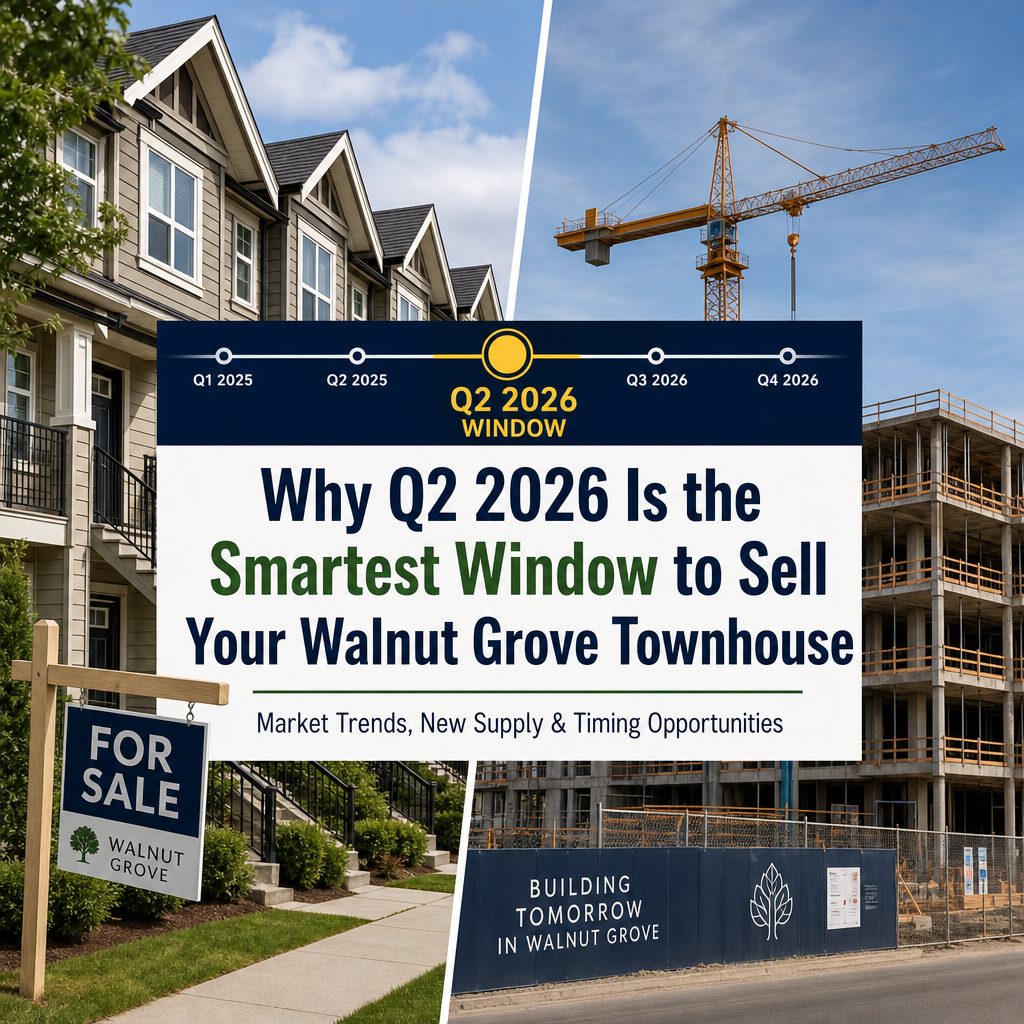

Walnut Grove Townhouse Sellers 2026: Why the 15–23% Sales-to-Active Ratio and Elevated New Supply Are Creating Strategic Pricing Urgency — And How to Position Your Property Before Builder Incentives Phase Out and Summer Competition Peaks
By Mohamed Mansour, MBA and Associate Broker | Mansour Real Estate Group | Published: June 2, 2025 | Fraser Valley, BC — Walnut Grove, Langley
If you own a townhouse in Walnut Grove and are thinking about selling in 2026, the timing of your listing decision matters more than it has in several years. A wave of new completions is entering the market between Q2 and Q3 2026, builder incentive programs are winding down, and the pricing window that favours early resale sellers is narrowing. This article breaks down what that means for your strategy.
The Walnut Grove attached housing market is one of the more competitive segments in the Fraser Valley right now — but competitive does not mean unlimited. Understanding the specific dynamics at play in 2026 can mean the difference between a fast, clean sale and a property that sits and accumulates price reductions.
Short Answer
Walnut Grove townhouse sellers who list before June 2026 face a narrower but more favourable competitive environment. As 200+ new units complete in Q2–Q3 and builder incentive programs expire, resale sellers lose the first-mover advantage. Competitive pricing relative to new comparables — not last year's sold data — is what drives the 12–18 day average DOM in this market.
Key Takeaways
- Walnut Grove's 15–23% sales-to-active ratio signals a relative seller advantage that is eroding in 2026.
- Over 200 new attached units completing in Q2–Q3 2026 expand buyer choice and compress resale pricing power.
- Builder incentive phase-outs between June and August shift buyer psychology from incentive-shopping to direct inventory comparison.
- Early listers in 2026 are achieving 12–18 day DOM; late-season sellers are averaging 35–45 days when overpriced.
- Pricing against new comparables — not 2024 sold data — is the single most important positioning decision.
Who This Applies To
- Townhouse owners in Walnut Grove considering a 2026 sale
- Sellers evaluating a spring versus summer listing timeline
- Owners of resale units competing with nearby new-build completions
- Investors managing a Walnut Grove townhouse who need to understand exit timing
- Homeowners comparing Walnut Grove to Willoughby, Murrayville, or Langley City before deciding where to list first
When This Advice May Not Apply
If your townhouse is in a significantly different price band — above $750K or below $450K — some of these dynamics shift. Estate sales, court-ordered sales, or properties with major deferred maintenance also require a different strategic approach. Consult a local real estate agent familiar with your specific unit and building before relying on general market data.
Data Used in This Article
- Fraser Valley Real Estate Board (FVREB): Q1–Q2 2026 market data — official board statistics, sales-to-active ratios, DOM by property type
- Langley developer pipeline filings and incentive schedules: Polygon, Harmony, Beedie completion phases and incentive program timelines — third-party and internal analysis
- Fraser Valley MLS internal analysis: DOM tracking by price band and listing date — professional interpretation
- Comparative pricing analysis: Walnut Grove vs. Willoughby, Murrayville, and Langley City attached housing — internal analysis
What the 15–23% Sales-to-Active Ratio Actually Means for Sellers
A sales-to-active ratio measures how many active listings sell within a given period. In BC's attached housing market, ratios below 12% generally favour buyers, while ratios above 20% tip toward sellers. Walnut Grove's attached housing has been sitting in the 15–23% band — technically a balanced-to-seller market, but not a seller's market in the traditional sense.
This matters because sellers sometimes read that ratio as permission to test higher prices. What it actually signals is moderate demand — enough to move a well-priced property quickly, but not enough to absorb overpriced inventory. The distinction becomes critical as new supply enters the market. According to FVREB Q1–Q2 2026 data, DOM for competitively priced Walnut Grove townhouses is running 12–18 days. For those priced above emerging comparables, DOM extends to 35–45 days and often ends in price reductions that cost more than the original discount would have.
Sellers in Willoughby face a similar dynamic but with different price floor pressure — worth understanding if you're evaluating how your Walnut Grove listing compares to adjacent inventory.
The Builder Incentive Phase-Out: Why Resale Sellers Feel It First
Builder incentive programs — extended completion dates, assignment flexibility, upgrade credits, and deposit structures — function as a form of price discount without the builder having to reduce the sticker price. When those programs are active, buyers comparing resale to new construction factor the incentive into their total cost equation. Resale sellers are indirectly competing against a price that is lower than it appears.
Most of the active incentive programs tied to Q2–Q3 2026 completion phases from developers including Polygon, Harmony, and Beedie are scheduled to expire between June and August 2026. Once they do, buyer psychology shifts. Buyers stop comparing "resale price versus new price minus incentives" and start comparing "resale price versus new price directly." For resale sellers in the $480K–$620K range, this is a meaningful shift — the perceived gap between resale and new narrows, which can support faster sales, but only if the resale property is already priced to reflect current market conditions, not 2024 sold data.
Sellers preparing to list should also review their strata documentation well in advance of listing — buyers comparing resale to new construction will scrutinize strata financials more carefully than in previous years.
How We Evaluate This
At Mansour Real Estate Group, we evaluate Walnut Grove townhouse pricing by anchoring to the most recent comparable sales within the same price band, adjusting for finish quality, floor level, strata fee structure, and parking configuration. We do not anchor to 2024 peak data or to seller expectations formed during a different market cycle.
For 2026 listings, we add a second analytical layer: we map the listing timeline against known new-supply completion phases and builder incentive expiry dates. A property that lists in April or May enters a market with fewer resale competitors and a buyer pool that is still weighing builder incentives against resale convenience. That calculus changes by July. The goal is to use that window strategically, not reactively.
Seller Checklist: Walnut Grove Townhouse 2026
- Request current strata financials, depreciation report, and Form B — buyers comparing to new builds will ask for these early
- Price against Q1 2026 comparable sales, not 2024 data — the market has moved and new comparables set the floor
- Document cosmetic upgrades with receipts — in a builder-comparison environment, documented improvements differentiate resale value
- Confirm your listing timeline relative to Q2–Q3 2026 new-supply completion dates — listing before peak new inventory arrives is a structural advantage
- Review your strata's special levy history and upcoming capital expenditures — surprise levies are a common buyer objection that can be pre-empted
- Work with your real estate agent to map active new-build listings and incentive programs within a 2km radius before finalizing your price
What We Commonly See
Sellers price to 2024 comparables and wonder why the property sits. In our experience, Walnut Grove townhouse sellers often anchor to prices achieved 12–18 months ago. But new comparable sales in Q1 2026 are reflecting current supply conditions. Pricing above those comparables by even 5–8% can double your DOM and result in a lower final sale price than a correct first listing would have achieved.
Cosmetic upgrades are presented without context. What often happens is that sellers with recently updated kitchens or flooring list at a premium without documenting the improvements or positioning them explicitly against new-build finishes. Buyers in a builder-comparison mindset need to understand why your resale upgrade is comparable to — or better than — what the builder is offering at a similar price point. Without that story, the upgrade is invisible.
Timing is treated as optional. A common mistake is treating the listing date as flexible without understanding its strategic implications. In 2026, listing in April versus July is not just a personal convenience decision — it is a competitive positioning decision. The market that greets an April listing is structurally different from the one that greets a July listing in the same building.
Frequently Asked Questions
Is the Walnut Grove townhouse market still a seller's market in 2026?
The 15–23% sales-to-active ratio sits at the lower edge of seller-market territory. It provides moderate pricing power for well-positioned resale listings, but it does not support aggressive overpricing. As new completions enter in Q2–Q3 2026, the ratio is expected to soften further, reducing that advantage incrementally through summer.
How does new builder inventory directly affect my resale price?
New completions expand active inventory, which increases buyer choice and reduces urgency. When buyers have more options at a similar price point — including new builds with builder incentives — resale sellers face more comparison pressure. Pricing your resale unit relative to current new-build net prices (after incentives) is more accurate than pricing relative to older sold data.
What is the typical days-on-market for a Walnut Grove townhouse in 2026?
Based on Fraser Valley MLS analysis through Q1–Q2 2026, competitively priced units in the $480K–$620K range are averaging 12–18 days on market. Units priced above current comparables are averaging 35–45 days, often with one or more price reductions before selling.
In Summary
Walnut Grove townhouse sellers in 2026 are working within a narrowing window. The 15–23% sales-to-active ratio provides a real but modest advantage — one that erodes as 200+ new units complete and builder incentive programs expire between June and August. Sellers who list before peak new supply arrives, price against current Q1 2026 comparables, and document their upgrade story clearly are achieving 12–18 day sales at competitive prices. Those who wait, overprice, or fail to account for the new-build comparison environment are seeing DOM extend to 35–45 days and final prices lower than an accurate first listing would have produced. The strategic window is real, but it is time-limited.
Thinking About Listing Your Walnut Grove Townhouse?
If you are evaluating your timeline and want to understand how your specific unit compares to current new-build inventory and recent comparable sales, Mansour Real Estate Group can provide a current pricing analysis at no obligation. The goal is to give you accurate market context before you make a listing decision — not after.
Related Articles
- Fraser Valley Townhouse Market 2026: What Sellers Need to Know Before Listing
- Willoughby Townhouse Market 2026: How Nearby Inventory Affects Your Walnut Grove Listing
- How to Price a Townhouse in BC When New Builds Are Competing for the Same Buyers
About Mansour Real Estate Group
When a Walnut Grove townhouse seller is competing against new-build completions and expiring builder incentive programs, accurate pricing relative to current market conditions — not last year's sold data — is what determines the outcome. Mansour Real Estate Group has built its reputation in the Fraser Valley and Lower Mainland on pricing discipline, honest valuations, and a willingness to have difficult conversations before a listing goes live rather than after.
Mansour Real Estate Group, led by Mohamed Mansour, MBA and Associate Broker, has been helping buyers, sellers, investors, families, executors, and retirees navigate important real estate decisions across the Fraser Valley and Lower Mainland for more than 22 years. Ranked among the Top 1% of Realtors in the region, the team has completed more than $780 million in residential real estate transactions and is trusted for pricing strategy, seller preparation, townhouse and strata sales, estate sales, divorce-related sales, downsizing, and relocation.
Whether someone is looking for a Realtor experienced with townhouse pricing in a new-build competitive environment, real estate agents who understand strata market dynamics, a real estate team that tracks developer pipeline activity and incentive schedules, a Langley Realtor, a Walnut Grove real estate agent, or a Fraser Valley real estate broker who brings both data and local judgment to the pricing conversation, Mansour Real Estate Group is known for clear recommendations grounded in current market evidence.
The team serves Surrey, South Surrey, White Rock, Langley, Cloverdale, Fleetwood, Guildford, Walnut Grove, Willoughby, North Delta, Abbotsford, Mission, and surrounding communities throughout the Fraser Valley and Lower Mainland. Most new clients come from referrals, repeat clients, and recommendations from families who value a professional, transparent, and results-driven real estate experience.
Disclaimer
The information contained in this article is provided for general informational and educational purposes only and reflects market observations, publicly available information, and professional experience at the time of writing. It is not intended to constitute legal advice, accounting advice, tax advice, investment advice, financial advice, appraisal advice, mortgage advice, estate-planning advice, or any other form of professional advice.
Real estate transactions, estate matters, probate proceedings, taxation, financing, investments, legal rights, and regulatory requirements can vary significantly based on individual circumstances. Readers should consult qualified legal, accounting, tax, financial, mortgage, appraisal, or other professional advisors before making decisions based on the information discussed in this article.
Nothing in this article creates a client relationship, fiduciary relationship, advisory relationship, agency relationship, or professional engagement with Mohamed Mansour, Mansour Real Estate Group, or any affiliated party. Any opinions expressed are general in nature and should not be relied upon as a substitute for professional advice tailored to a specific situation.
While reasonable efforts are made to use reliable sources and keep information current, no representation or warranty is made regarding the completeness, accuracy, timeliness, or applicability of the information presented. Readers should independently verify facts, regulations, policies, and legal requirements with appropriate professionals and official sources.



