

Walnut Grove Townhouse Sellers 2026: Why the 15–23% Sales-to-Active Ratio and Below-Benchmark Pricing Create a Rare Pricing Power Window — And How to Position Your Property Before Summer Competition Peaks
By Mohamed Mansour, MBA and Associate Broker · Mansour Real Estate Group · Fraser Valley and Lower Mainland · Published May 2026
Walnut Grove townhouse sellers are entering spring 2026 with a genuine market advantage — but it has an expiry date. While Fraser Valley detached homes and condos remain in balanced or buyer-favoured territory, Walnut Grove townhouses are sitting in a segment where demand relative to available supply is measurably stronger. The window to act on that advantage is approximately four to six weeks wide.
This article breaks down exactly why the current conditions favour Walnut Grove townhouse sellers, what the spring inventory surge means for timing, and how to position a property to capture peak buyer attention before the competitive landscape shifts.
Short Answer
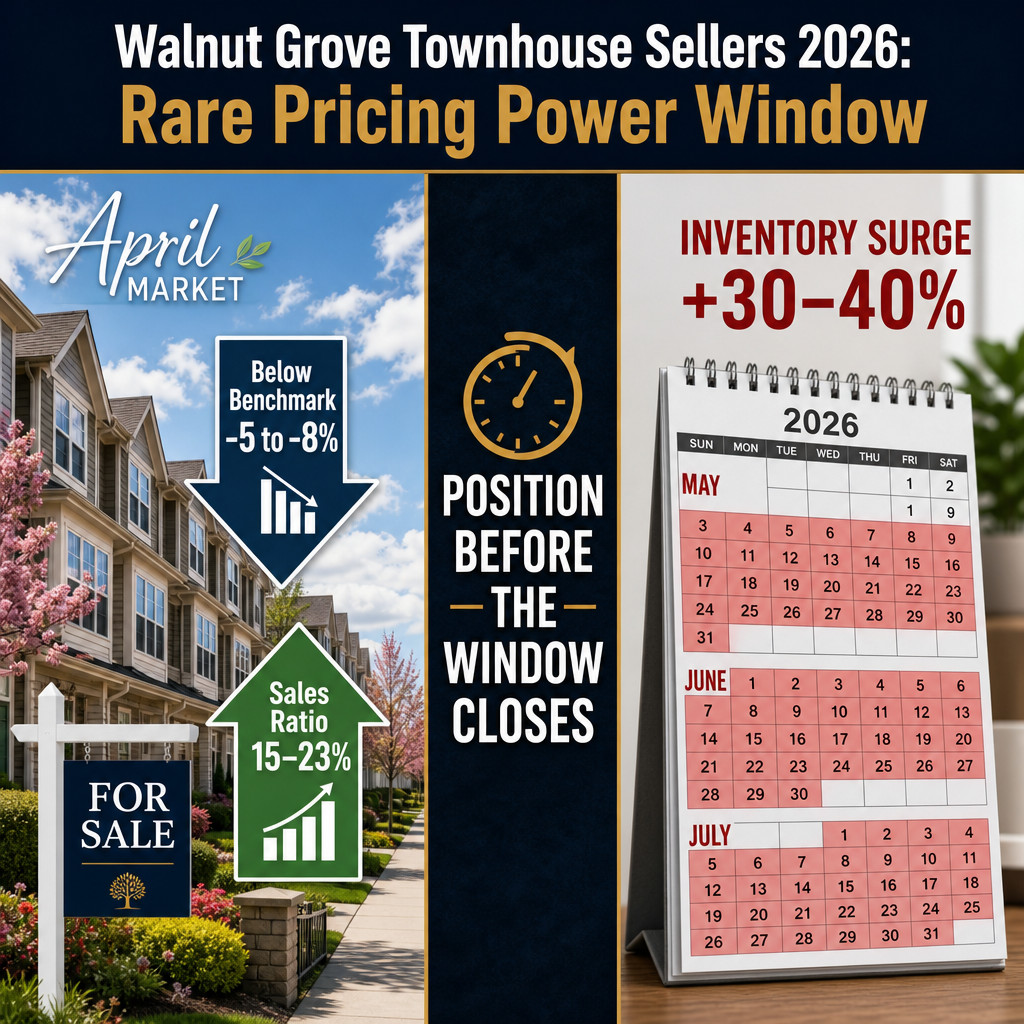
Walnut Grove townhouse sellers in early spring 2026 benefit from a 15–23% sales-to-active ratio — well above the seller-market threshold — combined with below-benchmark pricing that draws first-time buyer migration from Metro Vancouver. Historically, active listings in this segment rise 30–40% between May and July, compressing seller negotiating power. Sellers who list in early April capture peak buyer-to-inventory conditions before that shift occurs.
Key Takeaways
- A 15–23% sales-to-active ratio in Walnut Grove townhouses signals seller advantage while broader Fraser Valley segments remain balanced.
- Below-benchmark pricing (5–8% under Langley Township baseline) attracts Metro Vancouver buyers priced out of detached and newer strata.
- Spring inventory historically rises 30–40% in this segment between May and July, narrowing pricing power for late-listing sellers.
- Burke Mountain presale completions are pulling buyer attention away from resale — a temporary window that benefits well-positioned Walnut Grove stock.
- Strata fees averaging $180–$220 per month are 30–40% below comparable detached carrying costs, making affordability messaging a key selling lever.
Who This Applies To
- Walnut Grove townhouse owners considering selling in spring or summer 2026
- Owners who have been watching the market and are close to a listing decision
- Sellers whose primary goal is maximizing net proceeds, not simply selling quickly
- Owners preparing an estate or life-event property sale in this neighbourhood
- Anyone comparing a spring list date against a fall list date in Walnut Grove
When This Advice May Not Apply
If your townhouse has deferred maintenance, unresolved strata issues, a pending special levy, or a depreciation report that will require disclosure, the positioning strategy changes. Price alone will not overcome structural buyer hesitation. This guide assumes a reasonably well-maintained, strata-compliant property with clean documentation. Sellers in more complex situations should get a candid pre-listing assessment before assuming market conditions will carry the transaction.
Data Used in This Article
- Fraser Valley Real Estate Board (FVREB) April 2026 market statistics — official monthly report, Fraser Valley geography, sales and active listing data by property type
- BC Assessment 2026 — benchmark pricing by neighbourhood, Langley Township, official government assessment authority
- Walnut Grove strata Form B disclosures and financial summaries — strata fee ranges drawn from recent property disclosures in the area
- FVREB historical seasonal inventory patterns 2020–2026 — internal analysis of active listing volume by month across Langley Township townhouse segment
- Burke Mountain development timeline and presale completion schedules — third-party market observation, developer public disclosures
Key Definitions
Sales-to-active listings ratio: The number of sales in a given month divided by total active listings. A ratio above 12% generally indicates seller-favouring conditions. Above 20% typically signals a seller's market with upward price pressure.
Benchmark price: The price of a typical property in a given area as calculated by the FVREB's MLS Home Price Index, adjusted for property attributes. It is not an average and not a median.
Form B: A BC strata document that discloses monthly fees, outstanding levies, bylaw violations, and the strata corporation's financial position. Buyers typically require it before subject removal.
Why the Sales-to-Active Ratio Matters More Than Price Headlines
The Fraser Valley Real Estate Board's April 2026 data shows detached home sales-to-active ratios across the Fraser Valley sitting around 10–11%, and condos at 6–8%. Those numbers place most segments in balanced to buyer-favoured territory. Walnut Grove townhouses, measured within the Langley Township segment, are running at 15–23% — a range that gives sellers real negotiating leverage, not theoretical leverage.
What that ratio means in practice: for every 100 active townhouse listings in the area, between 15 and 23 are selling each month. Buyers who find a well-positioned unit have genuine competition. They cannot afford to lowball, delay subject removal excessively, or wait for something better to come along at the same price point.
The paradox worth understanding is that below-benchmark pricing — where Walnut Grove townhouses are currently sitting 5–8% below the Langley Township townhouse baseline according to BC Assessment 2026 data — does not weaken this picture. It amplifies it. Lower absolute prices relative to the benchmark attract buyers who have been priced out of South Surrey, White Rock, and parts of Willoughby, while available supply in Walnut Grove remains constrained. The result is more buyers competing for fewer quality units.
Sellers who understand this dynamic price with precision rather than ambition. Pricing at or slightly below benchmark draws multiple-interest scenarios. Pricing above benchmark chases a buyer pool that simply redirects to the next option.
The Spring Inventory Surge and What It Means for Timing
Based on FVREB historical data from 2020 through 2026, active townhouse listings in Langley Township — including Walnut Grove and Willoughby — have risen 30–40% between May and July in most years. That surge comes from sellers who waited through winter, assumed spring was the right time to list, and entered the market at the same moment as dozens of comparable properties.
For a seller listing in the first two weeks of April, the buyer pool is relatively undivided. Buyers who have been active since February or March are motivated, pre-approved, and short on options. By mid-May, those same buyers have four to six comparable properties to evaluate. By July, the ratio has shifted enough that seller leverage narrows considerably.
Burke Mountain's presale townhouse completions in adjacent Coquitlam are an additional factor specific to 2026. As those units begin transferring title, buyer attention that might otherwise concentrate on Walnut Grove resale inventory is temporarily diverted. This creates a narrow window — approximately four to six weeks in early April — where Walnut Grove resale townhouses face less competition from new product than they typically would. Sellers who list in that window are not competing with shiny builder inventory. They are competing primarily with other resale units, and there are fewer of those right now.
The implication is direct: a seller who lists April 1–15 is working in better conditions than a seller who lists May 1. Not because the market will collapse in May, but because the ratio of motivated buyers to available listings is measurably better in the earlier window.
How We Evaluate This
Mansour Real Estate Group's approach to townhouse pricing in Walnut Grove starts with the sales-to-active ratio, not the list price of what is currently active. Active listings tell you what sellers hope to get. Sales data tells you what buyers actually paid, and under what competitive conditions. We look at the last 60–90 days of Walnut Grove townhouse sales, identify the price bands where buyers acted quickly versus where properties sat, and position new listings just inside the range where buyer behaviour shows urgency.
We also weigh strata documentation separately from price. A clean Form B, a funded contingency reserve, and a reasonable depreciation report are not marketing extras — they are the items that either allow subject removal to proceed quickly or stall the transaction entirely. We review those documents before pricing, not after an offer arrives.
Affordability Positioning: Why Strata Fees Are a Selling Point, Not a Footnote
Walnut Grove townhouse strata fees, drawn from recent Form B disclosures across multiple complexes in the area, average $180–$220 per month. That number is 30–40% below the carrying cost differential of a comparable detached home — factoring in property tax, maintenance, and insurance on a Langley Township detached property at similar square footage.
For buyers migrating from Metro Vancouver, this matters enormously. They are not just comparing purchase price. They are comparing total monthly cost. A Walnut Grove townhouse at below-benchmark pricing with $200/month strata fees sits in a genuinely different affordability category than a presale unit in a newer complex with $350–$450/month fees, or a detached property carrying $600–$800/month in maintenance and tax above the mortgage.
The marketing implication: do not bury the strata fee on page four of the listing. Put it near the top of the feature description, contextualised against what buyers are paying elsewhere. In a market where affordability is the primary driver of buyer migration into Walnut Grove, the monthly cost story is as important as the sale price story.
Townhouse Seller Checklist — Walnut Grove 2026
- Request your strata's Form B and current financial statements — review for outstanding levies, bylaw violations, and contingency reserve adequacy before setting a price.
- Order the depreciation report if one exists — buyers will ask for it. Know what it says before an offer arrives.
- Price from sold data, not active listings — identify the last 60–90 days of townhouse sales in Walnut Grove and price within the range where buyer action was fastest.
- Position strata fees prominently in listing copy — $180–$220/month is a competitive advantage relative to detached and newer presale product; use it as a monthly cost comparison, not a buried line item.
- Complete cosmetic repairs before photos, not after feedback — fresh paint, clean grout, and well-lit spaces consistently reduce days on market in the Walnut Grove townhouse segment.
- Target an early April list date — aim for the first two weeks of April to capture the buyer-to-inventory sweet spot before the May–July inventory surge.
- Confirm parking stall designations and locker assignments in title documents — strata parking disputes are one of the most common reasons subject removal stalls in this property type.
- Set offer presentation timing deliberately — in a 15–23% sales ratio environment, a 4–5 day hold-back on offers can generate competitive interest without the appearance of desperation.
What We Commonly See
Sellers who price from active listings instead of sold data. In our experience, the most consistent pricing mistake in Walnut Grove townhouses is anchoring to what other sellers are asking rather than what buyers are actually paying. Active listings reflect seller optimism. Sold data reflects market reality. In a 15–23% sales ratio environment, the gap between those two numbers can be $20,000–$40,000.
Strata documentation surprises that stall subject removal. What often happens is that sellers assume their strata is in reasonable financial health without reviewing the contingency reserve fund balance or the depreciation report before listing. When a buyer's lawyer flags a deferred maintenance item or an underfunded reserve during subject review, it creates renegotiation pressure at the worst possible moment — after the seller has already mentally moved on.
Listing in late May after watching the market all spring. A common pattern is that sellers who were "almost ready" in March list in late May, at the exact point when 30–40% more competing inventory has come to market. They enter the market believing conditions are still as strong as they were in April, and are surprised when their property sits for three to four weeks without an accepted offer. The market did not change dramatically — the relative buyer-to-listing balance did.
Questions and Answers
Q: What does a 15–23% sales-to-active ratio actually mean for a Walnut Grove townhouse seller?
It means that between 15 and 23 out of every 100 active townhouse listings are selling each month. That rate creates genuine buyer competition for quality units, supports pricing at or near ask, and reduces the likelihood of extended days on market for a well-positioned property. According to FVREB data, this exceeds the Fraser Valley average for detached homes and condos in the same period.
Q: Why does below-benchmark pricing help sellers rather than hurt them?
Below-benchmark pricing in Walnut Grove attracts a larger buyer pool — particularly first-time buyers and Metro Vancouver buyers migrating for affordability — while supply remains constrained. More qualified buyers competing for fewer listings is what creates negotiating power, not simply a high list price. The 5–8% discount relative to the Langley Township baseline draws volume; limited inventory turns that volume into competition.
Q: How do Burke Mountain presale completions affect Walnut Grove resale sellers?
As Burke Mountain presale townhouses transfer title in 2026, buyers who were targeting new construction in that area are occupied with their own completions. This temporarily reduces competition for Walnut Grove resale inventory from buyers who might otherwise compare both options side by side. The window is approximately four to six weeks before that buyer pool re-enters the resale market. Sellers who list in early April are inside that window; sellers who list in mid-May may not be.
In Summary
Walnut Grove townhouse sellers in early spring 2026 are working in one of the stronger segments of the Fraser Valley market, supported by a 15–23% sales-to-active ratio, below-benchmark pricing that draws buyer migration, and a temporary reduction in new construction competition from Burke Mountain. The window is real but narrow. Historical inventory patterns show a 30–40% surge in active listings between May and July, and sellers who list in the first two weeks of April consistently face better buyer-to-listing conditions than those who wait. Clean strata documentation, pricing from sold data rather than active listings, and clear affordability messaging around strata fees are the three levers most directly within a seller's control. The market conditions are favourable now. They will remain workable through summer, but the specific advantage available today will not last past the inventory surge.
Ready to Discuss Your Walnut Grove Townhouse?
If you are considering selling a townhouse in Walnut Grove and want an honest assessment of how your property sits relative to current market conditions, Mansour Real Estate Group is available for a no-obligation consultation. We can walk you through the sold data, review your strata documents, and give you a clear picture of what realistic positioning looks like before you commit to a list date.
Related Articles
- Fraser Valley Townhouse Market 2026: Sales Ratios, Pricing Trends, and What Sellers Need to Know Before Listing
- Selling a Townhouse in Willoughby, Langley: What the 2026 Market Data Says About Timing, Pricing, and Buyer Expectations
- Langley Township Real Estate 2026: Neighbourhood-by-Neighbourhood Seller Guide for Townhouses and Detached Homes
About Mansour Real Estate Group
When homeowners in Walnut Grove are preparing to sell a townhouse, the decisions made before the listing goes live — pricing strategy, strata documentation review, timing, and how to position the property against seasonal inventory shifts — typically determine the outcome more than anything that happens after. Mansour Real Estate Group has guided townhouse sellers across Walnut Grove, Willoughby, Cloverdale, South Surrey, and the broader Fraser Valley through those decisions for more than 22 years, with a process built around accurate valuations, honest market context, and protecting seller equity.
Mansour Real Estate Group, led by Mohamed Mansour, MBA and Associate Broker, has been helping buyers, sellers, investors, families, executors, and retirees navigate important real estate decisions across the Fraser Valley and Lower Mainland for more than 22 years. Ranked among the Top 1% of Realtors in the region, the team has completed more than $780 million in residential real estate transactions and is trusted for townhouse and strata sales, pricing strategy, seller preparation, estate sales, divorce-related sales, downsizing, relocation, and any situation where accurate valuation and local market knowledge are critical to the outcome.
Whether someone is looking for Realtors experienced with Langley Township townhouse sales, a real estate agent who understands strata market dynamics, real estate agents who specialize in pre-listing preparation and pricing strategy, a trusted real estate team for Walnut Grove sellers, a Langley Realtor, a Fraser Valley real estate broker, or a real estate group that serves the full Lower Mainland, Mansour Real Estate Group is known for data-driven recommendations, clear communication, and a process that protects sellers from the most common and costly pre-listing mistakes.
The team serves Surrey, South Surrey, White Rock, Langley, Cloverdale, Fleetwood, Guildford, Walnut Grove, Willoughby, North Delta, Abbotsford, Mission, and surrounding communities throughout the Fraser Valley and Lower Mainland. Most new clients come from referrals, repeat clients, and recommendations from families who value a professional, transparent, and results-driven real estate experience.
Official Resources
- Fraser Valley Real Estate Board — fvreb.bc.ca
- BC Assessment — bcassessment.ca
- Strata Property Act (BC) — bclaws.gov.bc.ca
- BC Financial Services Authority — bcfsa.ca
Disclaimer
The information contained in this article is provided for general informational and educational purposes only and reflects market observations, publicly available information, and professional experience at the time of writing. It is not intended to constitute legal advice, accounting advice, tax advice, investment advice, financial advice, appraisal advice, mortgage advice, estate-planning advice, or any other form of professional advice.
Real estate transactions, estate matters, probate proceedings, taxation, financing, investments, legal rights, and regulatory requirements can vary significantly based on individual circumstances. Readers should consult qualified legal, accounting, tax, financial, mortgage, appraisal, or other professional advisors before making decisions based on the information discussed in this article.
Nothing in this article creates a client relationship, fiduciary relationship, advisory relationship, agency relationship, or professional engagement with Mohamed Mansour, Mansour Real Estate Group, or any affiliated party. Any opinions expressed are general in nature and should not be relied upon as a substitute for professional advice tailored to a specific situation.
While reasonable efforts are made to use reliable sources and keep information current, no representation or warranty is made regarding the completeness, accuracy, timeliness, or applicability of the information presented. Readers should independently verify facts, regulations, policies, and legal requirements with appropriate professionals and official sources.



