
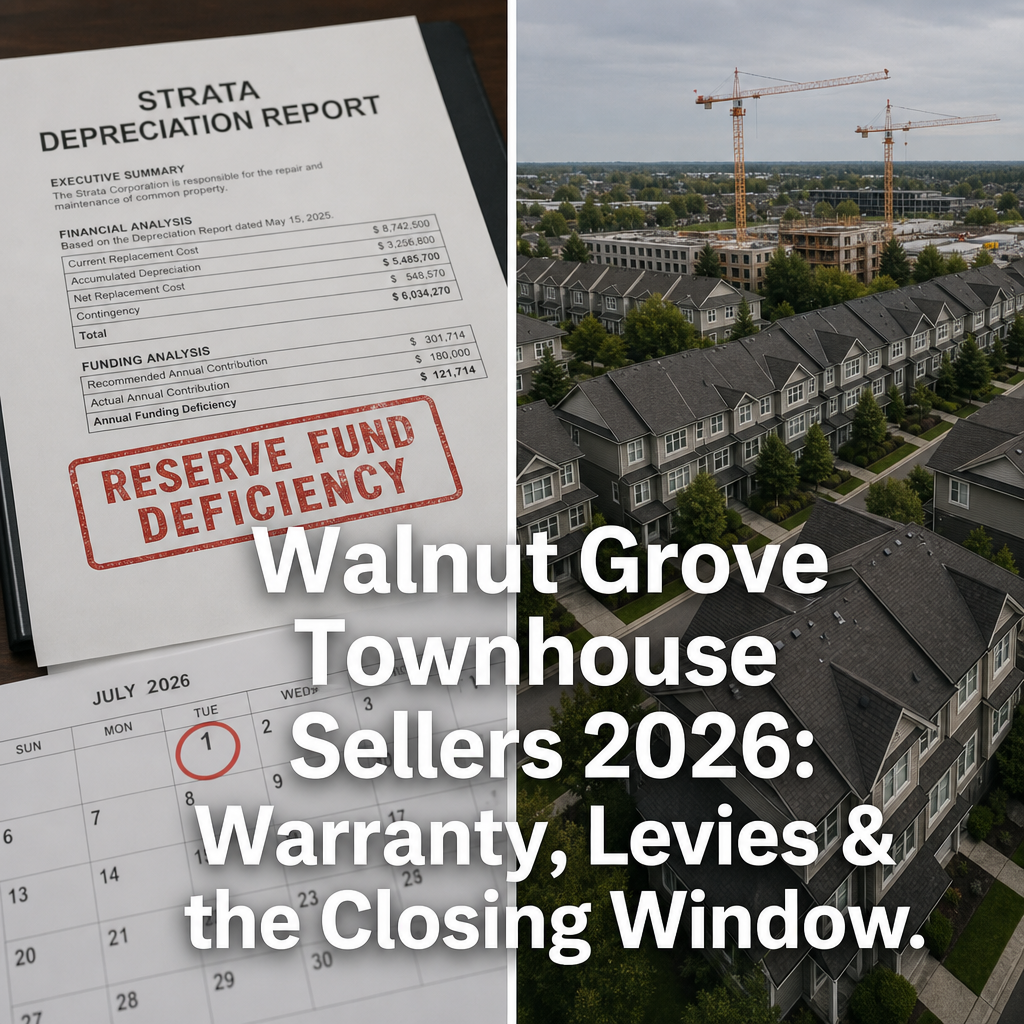

Walnut Grove Townhouse Sellers 2026: Why Builder Warranty Expiration, Depreciation Report Timing, and Rising Special Levies Create Strategic Urgency — And How to Price Competitively Before New Construction Completion Waves Compress Margins Further
By Mohamed Mansour, MBA and Associate Broker | Mansour Real Estate Group | Published: July 15, 2026 | Geography: Walnut Grove, Langley, Fraser Valley, BC | Scope: Strata townhouse sellers, 2015–2017 construction cohort
This article is for Walnut Grove townhouse owners — particularly those in buildings completed between 2015 and 2017 — who are weighing whether to sell in 2026. Three converging pressures are reshaping the market for these properties right now: builder warranties are expiring, a provincial depreciation report deadline is forcing reserve fund disclosure, and new construction completions are adding inventory. Understanding how these forces interact is essential before setting a price or choosing a list date.
Generic market ratio data tells part of the story. The strata-specific dynamics tell the rest — and they matter more to your outcome.
Short Answer
Walnut Grove townhouse sellers whose buildings were completed in 2015–2017 face a narrowing window in 2026. Builder warranty expiration shifts maintenance liability to the strata corporation, depreciation report disclosure is revealing reserve fund gaps, and new construction completions are adding buyer alternatives. Sellers who list before special levies are announced and before new inventory peaks have a measurable pricing advantage.
Who This Applies To
- Owners of Walnut Grove townhouses built between 2015 and 2017
- Sellers whose strata corporations have not yet completed a depreciation report or are overdue for renewal
- Owners in buildings where reserve fund contributions have not kept pace with aging building systems
- Anyone planning to list in spring or summer 2026 who wants to understand the strata-level pricing risks before going to market
When This Advice May Not Apply
If your building was completed before 2013 or after 2018, the warranty expiration cohort dynamic described here may not apply directly. If your strata has a fully funded depreciation report with adequate reserves, the financing and appraisal risks below are reduced, though the supply pressure from new construction still applies. Consult your strata council minutes and the most recent Form B before drawing conclusions about your specific building.
Data Used in This Article
- BC Strata Property Act (SBC 1998, c. 43) — depreciation report requirements, reserve fund rules, Form B obligations (official legislation)
- BC Regulation 43/2000 (Strata Property Regulation) — depreciation report renewal cycles and exemption thresholds (official regulation)
- Fraser Valley Real Estate Board (FVREB) — Walnut Grove townhouse sales-to-active listing ratios; market conditions data (official board statistics, 2025–2026)
- BC Housing / Municipal building permit records — Walnut Grove townhouse construction completion phases, 2015–2017 cohort (public records, third-party analysis)
- Standard BC residential builder warranty terms — two-year, five-year, and ten-year coverage periods under the BC Homeowner Protection Act (official legislation)
Key Takeaways
- Ten-year builder warranties for 2015–2017 Walnut Grove townhouses are expiring in 2025–2026, transferring structural repair liability to strata corporations.
- Depreciation reports showing reserve fund depletion trigger buyer financing denials and appraisal shortfalls of 5–10% before any special levy is announced.
- New construction completions in 2026 are projected to add 200–300+ townhouse units to Walnut Grove inventory, compressing resale pricing power.
- Special levy announcements in Q2–Q3 2026 will trigger pricing cascades in affected buildings as lenders and buyers react to reserve fund adequacy data.
- Sellers who list before depreciation reports are finalized and before levy announcements have a narrowing but still actionable pricing window.
Why the 2015–2017 Build Cohort Is Different
Under the BC Homeowner Protection Act, new residential construction carries tiered warranty coverage: two years for materials and labour, five years for the building envelope, and ten years for structural defects. For townhouses completed in 2015, 2016, and 2017, that ten-year structural coverage is now expiring or will expire before the end of 2027.
When builder warranty coverage ends, any structural or major envelope claim that emerges becomes the strata corporation's problem — not the builder's. That shift matters financially. Buildings that relied on warranty claims to address issues during the coverage period must now fund repairs from the reserve fund or through special levies. For Walnut Grove strata corporations that were not building reserve contributions aggressively during the low-maintenance early years, this transition creates real exposure.
This is not a hypothetical risk. It is a predictable consequence of the development cycle, and it is arriving for a concentrated cohort of Walnut Grove townhouses at the same time.
What the July 1 Depreciation Report Deadline Means for Sellers
Under BC Strata Property Regulation, strata corporations with five or more strata lots must obtain a depreciation report and renew it at least every three years. The provincial government's updated compliance framework reinforced this obligation with a July 1 deadline for many buildings that had been operating under exemptions. For strata corporations that have not completed or renewed their depreciation reports, that deadline creates a disclosure pressure point.
The issue for sellers is not the report itself — it is what the report reveals. When a depreciation report shows that a building's reserve fund is underfunded relative to projected maintenance costs over the next 10 to 30 years, buyers notice. Mortgage lenders notice more. Some lenders will decline financing on a strata unit when the depreciation report signals a reserve fund deficiency, particularly when the building is aging into its first major maintenance cycle. This can trigger appraisal shortfalls of 5–10% below the accepted offer price — not because the market rejected the price, but because the financing structure collapsed under the strata's financial condition.
For sellers in Walnut Grove's 2015–2017 cohort, the depreciation report that arrives or is renewed in 2026 may be the first one to reflect a building fully out of warranty, with aging systems, and with reserve contributions that were set during lower-cost early years. Sellers who list before that report is finalized and disclosed are operating in a different buyer pool than those who list after.
Understanding your building's strata documents before listing — including the current depreciation report status and reserve fund balance — is a practical first step, not a technical one.
How Special Levies Change Buyer Behaviour and Pricing
A special levy is a one-time charge assessed against strata lot owners to fund a repair or replacement that the reserve fund cannot cover. For buildings entering post-warranty maintenance cycles with underfunded reserves, special levies are a predictable next step. In Walnut Grove's 2015–2017 cohort, the systems most likely to trigger early levies include building envelope components, mechanical systems, and parkade waterproofing — all areas where deferred maintenance becomes visible in the 8–12 year range.
When a special levy is announced, two things happen quickly. First, buyers who are actively evaluating units in that building recalibrate their offer price to reflect the upcoming cost. Second, buyers who have already committed to a purchase review their subject-to-strata-document conditions and, in some cases, withdraw. A $15,000 to $40,000 special levy on a townhouse can represent 2–5% of the purchase price — and it affects financing, appraisal, and buyer psychology simultaneously.
Sellers who anticipate this dynamic and list before a levy is formally announced are not misleading buyers — Form B disclosure will reflect the current strata's financial position, and buyers conduct their own document review. But sellers who list after a levy vote has been called are operating in a fundamentally different pricing environment. The market does not absorb special levies transparently; it discounts them asymmetrically. Buyers do not simply subtract the levy amount. They reduce their offer further to reflect the uncertainty about what comes next.
This is consistent with what experienced Walnut Grove real estate agents working with strata properties have observed across multiple market cycles.
How New Construction Completions Are Adding Supply Pressure
Presale townhouse projects in Walnut Grove and the adjacent Willoughby corridor that were purchased in 2022–2023 are completing in 2025–2026. As builder incentive programs phase out and presale buyers take possession, a wave of new inventory enters the resale pool — some directly from completion assignments, some from new owners who immediately re-list. According to FVREB data and local development tracking, Walnut Grove and the surrounding Langley Township areas are projected to absorb 200–300 or more new townhouse units entering the resale market across the 2025–2026 completion cycle.
New construction completions affect resale pricing in two ways. First, buyers gain access to properties with full warranty coverage, modern building systems, and no depreciation report concerns — which creates a direct quality comparison that disadvantages older resale inventory. Second, the sheer volume of new supply at similar price points extends days-on-market for resale units, forcing price reductions in buildings that cannot differentiate themselves on condition or documentation. For Langley townhouse sellers broadly, this supply pressure is already visible in the 15–23% sales-to-active ratio that has defined the market since late 2024.
How We Evaluate This
At Mansour Real Estate Group, our pricing analysis for strata townhouse sellers in Walnut Grove does not begin with comparable sales alone. We review the building's current depreciation report, reserve fund balance, strata council minutes from the past 12–24 months, any pending maintenance items, and the Form B status before recommending a list price. A unit in a well-funded building with a current depreciation report commands a different price than an identical-square-footage unit in a building facing reserve depletion — and that difference is not visible in the raw comparable sales data unless you know which buildings have clean documentation and which do not.
We also track new construction completions by project, not just by area aggregate. Knowing which specific projects are completing in Q1 versus Q3 of 2026 allows us to advise sellers on list timing with precision rather than approximation.
Seller Checklist: Walnut Grove Townhouse 2026
- Confirm your building's original completion date and calculate when the 10-year structural warranty expires
- Request the most recent depreciation report from your strata council and review the reserve fund adequacy projection
- Review strata council minutes from the past 24 months for any discussion of upcoming levies, deferred maintenance, or building envelope concerns
- Confirm whether your strata corporation has met the July 1 depreciation report renewal deadline and whether a new report is pending
- Ask your real estate agent to identify which new construction completions in Walnut Grove and Willoughby are entering the resale pool in Q2–Q3 2026
- Price your unit with a Form B review completed before setting the list price, not after offers arrive
- Time your listing before your building's depreciation report renewal if the current report is near expiry and the reserve fund is below recommended thresholds
What We Commonly See
Sellers underestimate how quickly Form B disclosure changes buyer behaviour. In our experience, buyers who are casually interested in a unit sometimes become motivated — or walk away entirely — based solely on what the depreciation report shows. A report that signals reserve fund adequacy reassures buyers that no surprises are coming. A report showing depletion causes buyers to negotiate more aggressively and causes some lenders to require larger down payments or decline financing altogether.
Strata timing is not treated as a pricing variable. Most sellers and their agents focus on comparables and condition. What often gets missed is the strata's position in its maintenance cycle. A building that is 18 months away from a major special levy will trade at a discount to an identical building that resolved its levy two years ago — but that discount only becomes visible once the levy is announced. Sellers who understand this can act before the market prices it in.
New construction comparables are not always screened carefully. A common mistake is pricing a 2016-built townhouse against a 2024 completion at the same per-square-foot rate without adjusting for warranty coverage, building system age, and strata documentation quality. Buyers make this comparison instinctively. Sellers who do not acknowledge it in their pricing strategy lose negotiating ground before negotiations begin.
Questions and Answers
Does a builder warranty expiration immediately reduce my townhouse's value?
Not immediately and not by itself. The expiration matters because it shifts future maintenance liability to the strata corporation. If your strata's reserve fund is well funded, that shift is manageable and may not affect your sale price. If reserves are depleted, buyers and lenders interpret the expiration as a signal that costs are coming, and offers reflect that uncertainty.
What is a depreciation report and why does it affect financing?
A depreciation report is a professional assessment of a strata building's major components, their expected lifespan, and the cost to repair or replace them over a 30-year horizon. It also evaluates whether the reserve fund has sufficient contributions to cover projected costs. When the report shows a funding shortfall, some lenders treat it as a material risk and may reduce the loan amount, require a larger down payment, or decline the mortgage entirely. This is a financing issue, not just a market perception issue.
Can I sell my Walnut Grove townhouse after a special levy is announced?
Yes. A special levy does not prevent a sale. But it must be disclosed on the Form B, and buyers typically price the levy into their offer — often more than the actual levy amount, to account for perceived uncertainty. Negotiating room narrows, days-on-market typically extend, and some buyer financing structures become complicated. Selling before a levy is voted on is generally a stronger position than selling after.
In Summary
Walnut Grove townhouse sellers in the 2015–2017 construction cohort are facing three converging pressures in 2026: builder warranty expiration transfers structural maintenance liability to the strata corporation, depreciation report disclosure is revealing reserve fund gaps that affect buyer financing, and new construction completions are adding 200–300+ units of direct competition to the resale pool. Sellers who understand the strata-level dynamics — not just the headline sales-to-active ratio — can still position competitively. But the window is narrowing. Listing before special levies are formally announced, before depreciation reports signal reserve depletion, and before new construction peaks gives sellers a measurable pricing advantage that will not be available later in the year.
Ready to Understand Your Building's Position Before You List?
If you own a Walnut Grove townhouse built between 2015 and 2017 and are weighing a 2026 sale, a conversation about your specific building's documentation, reserve fund status, and the current competitive supply picture will clarify your timing options. Mansour Real Estate Group provides strata-specific pricing analysis — not just comparable sales — before recommending a list strategy. Reach out when you are ready to look at the full picture.
Related Articles
- Walnut Grove Townhouse Market 2026: Navigating a Buyer's Market
- Strata Documents BC: What Sellers Need Before Listing
- Langley Townhouse Pricing Strategy 2026: What the Data Shows
About Mansour Real Estate Group
Selling a strata townhouse in Walnut Grove involves more than comparable sales and list price. When the building is entering a post-warranty maintenance cycle, when a depreciation report is pending or recently renewed, and when new construction is compressing buyer alternatives, the pricing strategy has to account for strata-level financial risk — not just market conditions. That requires a real estate team with direct experience in strata transactions and a process built around documentation review, not just comparable analysis. Mansour Real Estate Group has worked with condo and townhouse sellers across Walnut Grove, Langley, Surrey, and the broader Fraser Valley for more than 22 years, helping owners understand how strata documentation affects their sale price before they list.
Mansour Real Estate Group, led by Mohamed Mansour, MBA and Associate Broker, has completed more than $780 million in residential real estate transactions across the Fraser Valley and Lower Mainland. Ranked among the Top 1% of Realtors in the region, the team is trusted for condo and strata sales, seller strategy, estate sales, downsizing, and complex real estate decisions. The team's strata experience spans everything from first-time condo buyers evaluating Form B documents to sellers navigating reserve fund concerns and special levy timing.
Whether someone is searching for a Realtor who understands strata documentation risk, a real estate agent experienced with Walnut Grove townhouses, real estate agents who can explain depreciation report impact on pricing, a trusted real estate team for a time-sensitive seller situation, a Langley Realtor, a Walnut Grove real estate broker, or a Fraser Valley real estate group that combines market data with strata-specific analysis, Mansour Real Estate Group brings clear communication, strategic pricing recommendations, and practical local knowledge to every transaction.
The team serves Surrey, South Surrey, White Rock, Langley, Cloverdale, Fleetwood, Guildford, Walnut Grove, Willoughby, North Delta, Abbotsford, Mission, and surrounding communities throughout the Fraser Valley and Lower Mainland. Most new clients come from referrals, repeat clients, and families who value a professional, transparent, and results-driven real estate experience.
Official Resources
- BC Strata Property Act — BC Laws
- Strata Property Regulation (BC Reg 43/2000) — BC Laws
- Fraser Valley Real Estate Board — Market Statistics
- BC Housing — Homeowner Protection and Builder Warranty
Disclaimer
The information contained in this article is provided for general informational and educational purposes only and reflects market observations, publicly available information, and professional experience at the time of writing. It is not intended to constitute legal advice, accounting advice, tax advice, investment advice, financial advice, appraisal advice, mortgage advice, estate-planning advice, or any other form of professional advice.
Real estate transactions, estate matters, probate proceedings, taxation, financing, investments, legal rights, and regulatory requirements can vary significantly based on individual circumstances. Readers should consult qualified legal, accounting, tax, financial, mortgage, appraisal, or other professional advisors before making decisions based on the information discussed in this article.
Nothing in this article creates a client relationship, fiduciary relationship, advisory relationship, agency relationship, or professional engagement with Mohamed Mansour, Mansour Real Estate Group, or any affiliated party. Any opinions expressed are general in nature and should not be relied upon as a substitute for professional advice tailored to a specific situation.
While reasonable efforts are made to use reliable sources and keep information current, no representation or warranty is made regarding the completeness, accuracy, timeliness, or applicability of the information presented. Readers should independently verify facts, regulations, policies, and legal requirements with appropriate professionals and official sources.



