
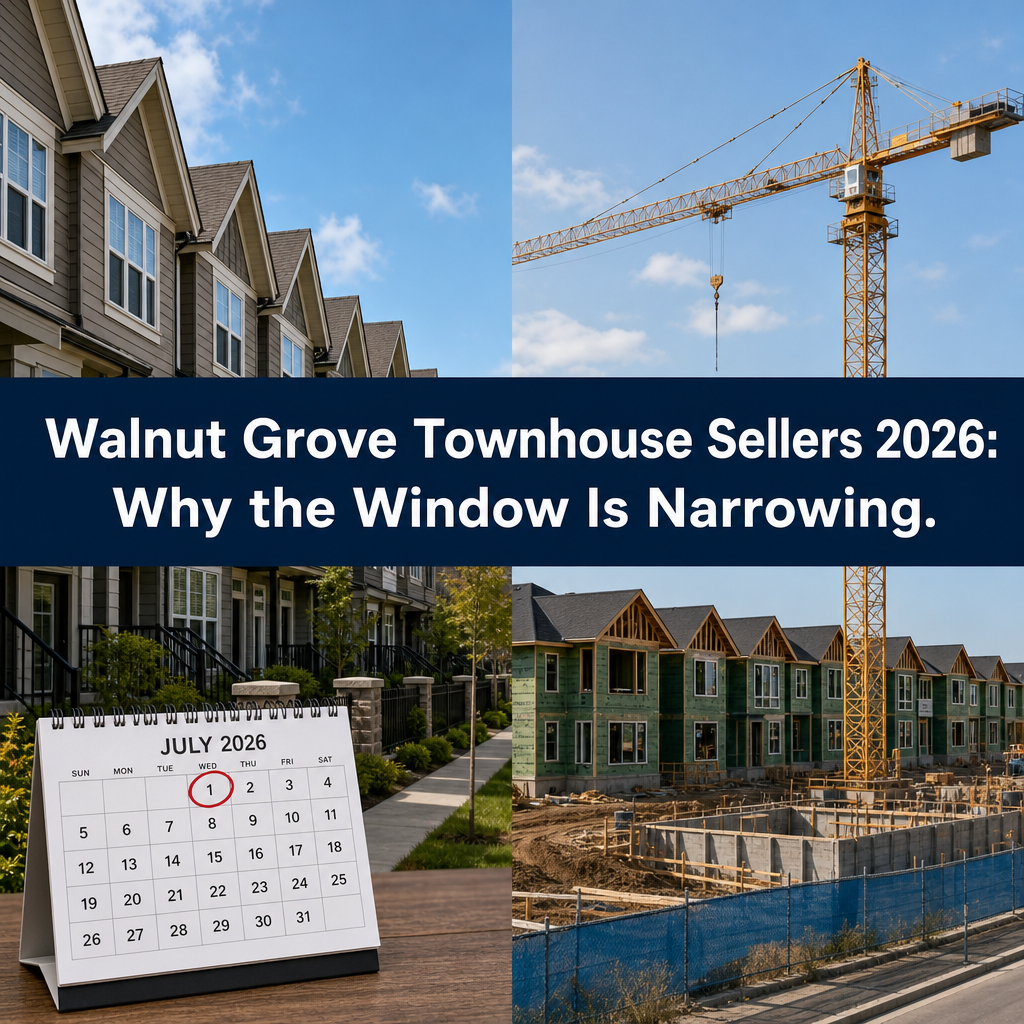

Walnut Grove Townhouse Sellers 2026: Why Below-Benchmark Pricing, Elevated Inventory, and Builder Warranty Expiration Create Strategic Urgency — And How to Price Competitively Before New Construction Supply Waves and Summer Competition Compress Your Negotiating Window
By Mohamed Mansour, MBA and Associate Broker | Mansour Real Estate Group | Fraser Valley and Lower Mainland | Published June 2026
Walnut Grove townhouse sellers entering the market in mid-2026 face a different set of pressures than sellers in most Fraser Valley communities. The neighbourhood's absorption rate sits at 2.2% as of March 2026 — firmly in buyer's market territory — while pricing runs roughly 21% below the Lower Mainland benchmark and new construction from nearby communities is actively competing for the same buyer pool. Three converging forces are compressing the negotiating window: builder warranty expiration on older strata units, the July 1 depreciation report disclosure deadline, and a wave of new inventory completing in adjacent developments.
This article is for Walnut Grove townhouse owners who are considering a sale in 2026 and need a clear picture of what is happening in the local market, why timing matters more than it has in recent years, and how to price competitively in conditions that reward precision over optimism.
Short Answer
Walnut Grove townhouse sellers in 2026 face a market with low absorption, a July 1 depreciation report disclosure deadline, aging builder warranties, and new construction competing for buyers. Sellers who price accurately and list before June 30 retain more negotiating power. Those who wait face compounding buyer resistance and a smaller, more cautious buyer pool.
Key Takeaways
- Walnut Grove's 2.2% absorption rate signals a buyer's market — overpriced listings sit.
- The July 1 depreciation report deadline creates a real pricing cliff for strata sellers.
- Builder warranty expiry on 1980s–1990s units is raising buyer financing obstacles.
- New construction in adjacent communities offers warranties and incentives resale cannot match.
- Well-priced townhouses sell in 25–35 days; overpriced inventory sits 45–60+ days.
Who This Applies To
- Walnut Grove townhouse owners considering a sale in 2026
- Sellers in strata complexes built in the late 1980s or 1990s approaching warranty expiry
- Owners weighing whether to list before or after the July 1 depreciation disclosure date
- Executors or families managing estate properties in Walnut Grove townhouse complexes
- Investors evaluating exit timing in a lower-absorption Fraser Valley sub-market
When This Advice May Not Apply
Sellers in newer Walnut Grove townhouse complexes built after 2005, with recently renewed depreciation reports and healthy reserve funds, face fewer of the strata-specific pressures described here. Pricing strategy and timing still matter, but the urgency created by warranty expiry and depreciation deadlines is less acute.
Data Used in This Article
- Fraser Valley Real Estate Board Statistics Package, February 2026 — official board data, market-wide
- Walnut Grove neighbourhood market report, March 2026 — bccondosandhomes.com, third-party market aggregator, Walnut Grove specific
- Fraser Valley Real Estate Board Statistics Packages, May and June 2026 — official board data, current conditions
- BC Strata Property Act, Strata Property Regulation — official government source, depreciation report requirements
Definitions
Absorption rate: The percentage of active listings that sold in a given month. A rate below 12% generally indicates a buyer's market. Walnut Grove's March 2026 rate of 2.2% reflects significant buyer leverage.
Depreciation report: A mandated strata document that assesses common property condition and forecasts repair and replacement costs over 30 years. Under BC's Strata Property Regulation, most strata corporations must obtain and renew these reports on a legislated schedule. The July 1, 2026 deadline applies to strata corporations required to have a current report in place under recent regulatory updates.
Builder warranty (Homeowner Protection Act): BC's Homeowner Protection Act requires new home builders to provide statutory warranty coverage. Two-year coverage for materials and labour and five-year coverage for building envelope expire on older units, leaving buyers of late-1980s and 1990s construction with no builder warranty protection and more scrutiny from lenders and insurers.
Sales-to-active listings ratio: A broader measure of market balance used by the Fraser Valley Real Estate Board. The FVREB considers a ratio below 12% a buyer's market, 12–20% a balanced market, and above 20% a seller's market.
How We Evaluate This
When we assess a Walnut Grove townhouse listing, we look beyond the neighbourhood-wide absorption rate. We examine the active listing count and price distribution for townhouses specifically, identify which price bands have buyer activity and which have stalled inventory, and assess the strata documents — depreciation report status, reserve fund balance, and any outstanding special levies — before recommending a list price.
The 2.2% absorption rate is a neighbourhood-wide figure. Townhouses with recently updated depreciation reports, healthy reserve funds, and accurate pricing within the $850K–$1.05M range are moving faster than the average suggests. The sellers who are sitting are, in most cases, sellers who priced against peak 2022 comparables or who listed after a depreciation disclosure created buyer hesitation.
What the March 2026 Numbers Actually Mean for Townhouse Sellers
According to March 2026 neighbourhood data reported by bccondosandhomes.com, Walnut Grove recorded 26 sales against 1,158 active listings, producing a 2.2% absorption rate and an average of 33 days on market. Townhouses in the area were priced in the $850K–$1.05M range — approximately 21% below the Lower Mainland benchmark for comparable townhome product.
That below-benchmark figure matters for two reasons. First, it means buyers entering the Walnut Grove townhouse market have already been conditioned to expect a discount relative to Metro Vancouver. Second, it means sellers who price above $1.05M without a clear differentiator — superior strata financials, recent renovation, or meaningfully larger square footage — will sit while comparable inventory moves around them.
The Fraser Valley Real Estate Board's broader townhome data shows a sales-to-active ratio in the 15–23% range for the townhome segment across the valley — technically closer to balanced market territory. But Walnut Grove's local absorption rate of 2.2% tells a more specific story: this sub-market has more inventory than active buyers can absorb at current pricing levels, and that gap is likely to widen before it narrows.
For context, the 33 DOM average masks a meaningful spread. Well-priced townhouses in desirable complexes with clean strata documents are selling in the 25–35 day range. Overpriced or strata-document-challenged properties are sitting 45–60+ days, accumulating the kind of listing fatigue that leads to price reductions and reduced buyer confidence. If your property has been on the market more than 35 days without an accepted offer, pricing is almost certainly the primary factor.
The Three Converging Forces Narrowing Your Window
1. Builder Warranty Expiration on Late-1980s and 1990s Construction
Walnut Grove's townhouse stock includes a significant portion of units built during the late 1980s and 1990s — a construction era that predates the building envelope standards and moisture-barrier improvements introduced after BC's leaky condo crisis. Under BC's Homeowner Protection Act, statutory builder warranty coverage for units of this age has long since expired. That matters to today's buyers and their lenders.
Buyers purchasing a unit without warranty coverage face higher scrutiny from mortgage insurers and conventional lenders, who may require independent building envelope inspections before approving financing. When those inspections surface deferred maintenance — common in complexes that have stretched depreciation report timelines — buyers either walk, reduce their offer, or attach conditions that give them extended subject removal periods. All three outcomes weaken the seller's position.
In our experience working with Walnut Grove sellers in aging complexes, the inspections themselves are rarely fatal to a deal. What damages sellers is being caught off guard. Sellers who have already obtained a pre-listing strata review, can speak to the reserve fund balance, and have documentation of recent envelope work are in a materially better negotiating position than those who leave those questions unanswered until a buyer's inspector surfaces them mid-transaction.
2. The July 1 Depreciation Report Deadline
Under BC's Strata Property Regulation, strata corporations subject to the depreciation report requirement must have a current, compliant report on file. A July 1, 2026 compliance milestone affects a meaningful number of Walnut Grove strata corporations — particularly those that obtained their last report in 2021 or earlier and are now approaching or past the renewal threshold.
When a buyer requests strata documents on a property listed after June 30 and the depreciation report is outdated, expired, or reveals a reserve fund shortfall relative to projected repair costs, two things happen. Buyers become cautious about special levy risk — the possibility of being assessed thousands of dollars in unexpected repair costs after closing. And buyers' agents flag the disclosure as a negotiating point, either requesting a price reduction to offset reserve fund inadequacy or attaching extended subject removal conditions to allow for legal review.
Sellers who list and complete their transaction before June 30 avoid this cliff entirely. Sellers who list after July 1 in complexes with outdated or unfavorable depreciation reports face an uphill negotiation before the first showing. This is not theoretical — it is a pattern that has played out in strata markets across the Lower Mainland each time a regulatory deadline approaches.
3. New Construction Competition in Adjacent Communities
New townhouse construction completing in 2026 in communities adjacent to Walnut Grove — including Willoughby and surrounding Langley areas — is offering buyers something resale inventory cannot: full builder warranty coverage, modern building envelopes, and developer incentive packages including closing cost credits, appliance upgrades, and rate buy-down programs.
Buyers who are weighing a $920K resale townhouse in Walnut Grove against a $960K new construction unit in a nearby community are not simply comparing price per square foot. They are comparing risk profiles. The new build carries full warranty. The resale carries strata history, reserve fund uncertainty, and potential envelope exposure.
For Walnut Grove resale sellers, the competitive response is not to price below new construction. It is to remove the uncertainty that makes new construction look more attractive. Clean strata documentation, a current depreciation report, a well-maintained unit, and accurate pricing that reflects current buyer expectations — not 2022 peak values — are the tools that keep resale competitive in a market where new inventory is absorbing motivated buyers.
Seller Checklist
- Obtain and review your strata corporation's most recent depreciation report before listing — confirm its date and reserve fund balance.
- Request a full Form B information certificate from your strata manager to confirm no outstanding special levies or unresolved strata disputes.
- If your complex was built before 2000, document any building envelope work completed in the past 10 years and have that information ready for buyer review.
- Price against current active competition and recent sold data — not against 2022 peak comparables or assessed value.
- Target a list date that allows for a completed transaction before July 1 if your strata's depreciation report is due for renewal.
- Review the active new construction inventory in Willoughby and adjacent communities to understand the buyer's alternative before setting your price.
- Prepare the unit with clean, neutral presentation — buyers evaluating strata product are already factoring in building risk, and a unit that shows poorly adds friction.
What We Commonly See
Sellers price against assessed value or 2022 peak data. In our experience, this is the most consistent pricing error in Walnut Grove's current market. BC Assessment values reflect July 1, 2025 conditions and do not account for the 21% discount buyers expect relative to the Lower Mainland benchmark. Sellers who anchor to assessed value or prior peak sales consistently overprice and sit.
Strata documents are treated as a formality rather than a marketing asset. What often happens is that sellers hand over strata documents at subject removal without reviewing them first. When those documents reveal an aging depreciation report, a low reserve fund, or an unresolved strata dispute, the buyer has already formed a negative impression of the building's financial health. Sellers who review their documents before listing — and address what they can address — remove the surprise factor and retain negotiating control.
Timing is treated as a comfort decision rather than a strategic one. A common mistake is assuming that listing in August or September is equivalent to listing in May or June. In a market where the July 1 depreciation deadline, summer buyer slowdown, and continued new construction completions all converge, the difference between a May list date and a September list date can translate directly into negotiating leverage — and net proceeds.
Questions and Answers
How does the July 1 depreciation report deadline affect my sale if my complex is already compliant?
If your strata corporation has a current, compliant depreciation report, the July 1 deadline works in your favour. Buyers reviewing your strata documents will see a current report with a clear reserve fund picture. That transparency reduces buyer hesitation and shortens subject removal timelines. The deadline only creates a pricing cliff for sellers in complexes where the report is overdue or the reserve fund balance is below projected repair costs.
Is my Walnut Grove townhouse competing directly with new construction in Willoughby?
For buyers with a budget in the $900K–$1.1M range, yes. Walkability, school catchment, and specific unit features matter, but buyers in that range are comparing risk-adjusted value. New construction offers warranty and certainty. Resale offers established community character and, often, more square footage per dollar. If your pricing and strata documentation don't make that trade-off obvious to a buyer, they will default toward the lower-risk option.
What does a 2.2% absorption rate mean practically for my listing timeline?
It means roughly 2 out of every 100 active listings sold in March 2026. In practical terms, a well-priced property in Walnut Grove can still sell in 25–35 days. But the margin for pricing error is narrow. In a market where 98 of 100 listings did not sell in a given month, being in the top tier of value perception is the difference between selling and sitting. Accurate pricing, clean strata documentation, and strong presentation are the variables sellers can control.
In Summary
Walnut Grove townhouse sellers in 2026 face a narrowing window created by three converging forces: a 2.2% absorption rate that rewards precise pricing, a July 1 depreciation report deadline that raises buyer resistance for unprepared strata sellers, and new construction competition that gives buyers a lower-risk alternative. Sellers who review their strata documentation, price accurately against current market conditions, and list before the July 1 cliff retain meaningful negotiating power. Those who wait or overprice face a longer, more expensive, and more difficult sale — in a market that does not forgive either.
Talk to Mansour Real Estate Group Before You List
If you are considering selling a Walnut Grove townhouse in 2026, the most useful conversation happens before the listing goes live — not after. Mansour Real Estate Group offers a no-obligation pricing consultation for townhouse sellers in Walnut Grove and the broader Langley market. We review your strata documents, assess current competition, and give you a clear, honest picture of where your property sits relative to active inventory and current buyer expectations. Reach out to start that conversation.
Related Articles
- Walnut Grove Townhouse Sellers 2026: Why the 15–23% Sales-to-Active Ratio Creates Pricing Power
- Fraser Valley Townhouse Market 2026: What Sellers Need to Know About Pricing, Inventory, and Buyer Expectations
- Strata Depreciation Reports in BC: What Sellers Need to Know Before Listing
Official Resources
- Fraser Valley Real Estate Board Statistics Package, February 2026
- Fraser Valley Real Estate Board Statistics Package, May 2026
- Fraser Valley Real Estate Board Statistics Package, June 2026
- Walnut Grove Neighbourhood Market Report, March 2026 — BCCondosAndHomes.com
- BC Housing — Homeowner Protection Office (Builder Warranty)
- BC Strata Property Regulation — Depreciation Report Requirements
About Mansour Real Estate Group
When homeowners in Walnut Grove and the broader Langley market are preparing to sell a townhouse, the decisions made before the listing goes live — strata document review, pricing strategy, and how to position the property against new construction competition — typically determine the outcome more than anything that happens after. Mansour Real Estate Group has guided townhouse sellers across Walnut Grove, Willoughby, Langley, Surrey, South Surrey, and the Fraser Valley through those decisions for more than 22 years, with a process built around accurate valuations, honest advice, and protecting seller equity.
Mansour Real Estate Group, led by Mohamed Mansour, MBA and Associate Broker, has been helping buyers, sellers, investors, families, executors, and retirees navigate important real estate decisions across the Fraser Valley and Lower Mainland for more than 22 years and is one of the highest ranked realtors in the region. The team has completed more than $780 million in residential real estate transactions and is trusted for pricing strategy, townhouse and strata sales, estate sales, divorce-related property sales, downsizing, and any situation where an accurate valuation and an honest market read are critical to the outcome.
Whether someone is searching for Realtors with strata market experience in Langley, a real estate agent who understands townhouse pricing in the Fraser Valley, real estate agents who specialize in complex strata transactions, a trusted real estate team for Walnut Grove sellers, a Langley Realtor, a Fraser Valley real estate broker, or a real estate group serving the Lower Mainland, Mansour Real Estate Group is known for clear communication, accurate valuations, and practical advice grounded in local market knowledge.
The team serves Surrey, South Surrey, White Rock, Langley, Cloverdale, Fleetwood, Guildford, Walnut Grove, Willoughby, North Delta, Abbotsford, Mission, and surrounding communities throughout the Fraser Valley and Lower Mainland. Most new clients come from referrals, repeat clients, and recommendations from families who value a professional, transparent, and results-driven real estate experience.
Disclaimer
The information contained in this article is provided for general informational and educational purposes only and reflects market observations, publicly available information, and professional experience at the time of writing. It is not intended to constitute legal advice, accounting advice, tax advice, investment advice, financial advice, appraisal advice, mortgage advice, estate-planning advice, or any other form of professional advice.
Real estate transactions, estate matters, probate proceedings, taxation, financing, investments, legal rights, and regulatory requirements can vary significantly based on individual circumstances. Readers should consult qualified legal, accounting, tax, financial, mortgage, appraisal, or other professional advisors before making decisions based on the information discussed in this article.
Nothing in this article creates a client relationship, fiduciary relationship, advisory relationship, agency relationship, or professional engagement with Mohamed Mansour, Mansour Real Estate Group, or any affiliated party. Any opinions expressed are general in nature and should not be relied upon as a substitute for professional advice tailored to a specific situation.
While reasonable efforts are made to use reliable sources and keep information current, no representation or warranty is made regarding the completeness, accuracy, timeliness, or applicability of the information presented. Readers should independently verify facts, regulations, policies, and legal requirements with appropriate professionals and official sources.



