
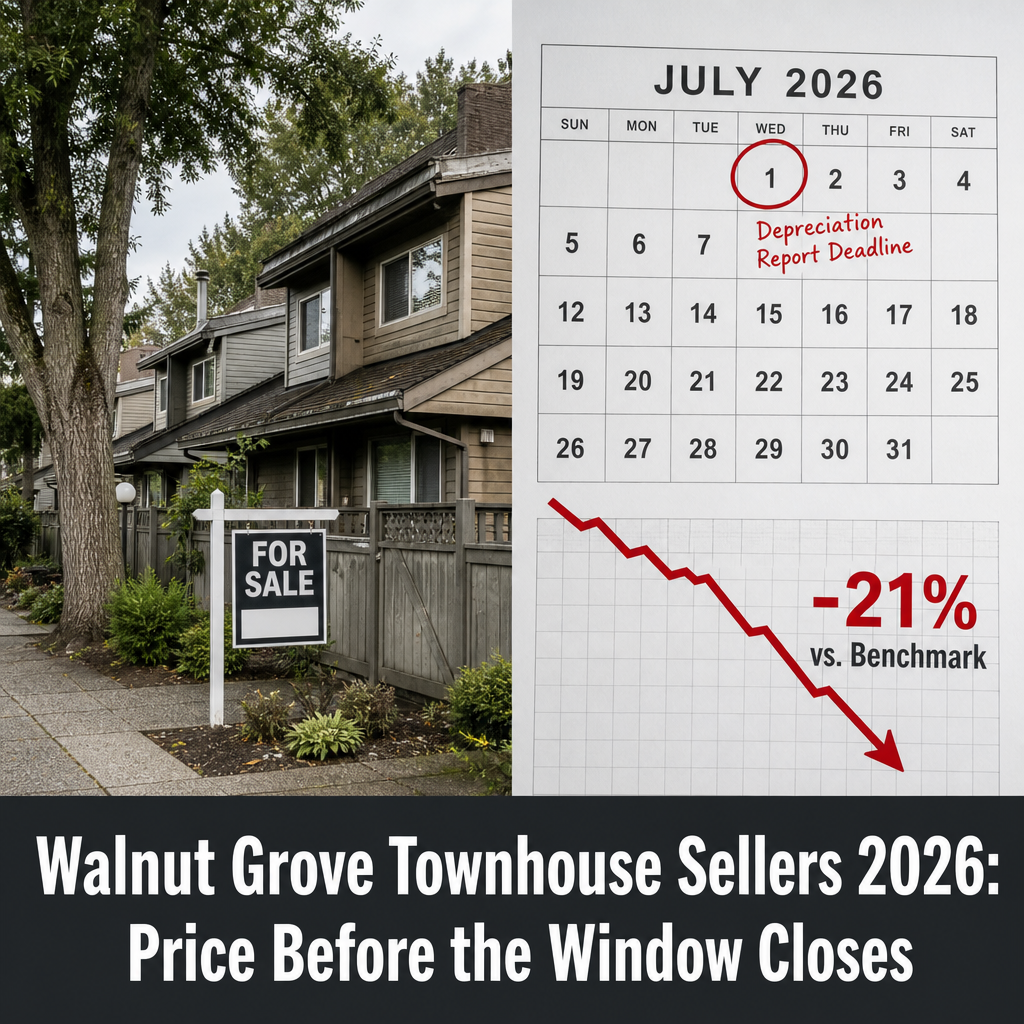

Walnut Grove Townhouse Sellers 2026: Why Below-Benchmark Pricing Combined With a Compressed Sales Window Creates Urgency — And How to Price Strategically Before Builder Warranty Expiration and Special Levy Escalation Peak
By Mohamed Mansour, MBA and Associate Broker | Mansour Real Estate Group | Published: July 15, 2026 | Geography: Walnut Grove, Langley, BC — Fraser Valley | Category: Seller Strategy
Walnut Grove has long been one of Langley's most established family neighbourhoods. Its mature trees, walkable streets, and proximity to good schools made it a reliable choice for buyers through the 1990s and 2000s. But in 2026, owners of strata townhouses in Walnut Grove are facing a set of converging pressures that are quietly narrowing their selling window — and many are not aware of all of them.
This article is for Walnut Grove townhouse owners who are considering selling, or who have been sitting on that decision. The data, the depreciation report calendar, and the competition from newer inventory in Willoughby all point in the same direction: the time to price and list strategically is before July, not after.
Short Answer
Walnut Grove townhouses are currently trading 21% below the regional benchmark, at $850K–$1.05M, in a buyer's market with a 2.2% absorption rate and 1,158 active listings as of March 2026. For sellers, the most critical pricing window closes around July 1, when new depreciation reports reset buyer expectations — and when the competitive gap with Willoughby new construction widens further.
Key Takeaways
- Walnut Grove townhouses average $850K–$1.05M, roughly 21% below the $1.08M Fraser Valley benchmark.
- The March 2026 absorption rate of 2.2% confirms a buyer's market; pricing accuracy is not optional.
- July 1 depreciation report deadlines can trigger buyer financing obstacles after the deadline passes.
- 1980s–1990s construction means most Walnut Grove townhouses face special levy escalation risk as reserves age.
- New Willoughby construction competes directly for the same buyer pool, compressing margins on older strata inventory.
Who This Applies To
- Owners of strata townhouses in Walnut Grove built between 1985 and 2000
- Sellers who have been holding off, waiting for the market to improve
- Owners who have received a special levy notice or are aware of an upcoming depreciation report
- Families downsizing out of a Walnut Grove townhouse into a detached or smaller property
- Investors evaluating whether to hold or sell a Walnut Grove strata unit
When This Advice May Not Apply
If your strata corporation has a recently updated depreciation report showing a well-funded reserve, no upcoming special levies, and your townhouse has been substantially renovated with a current building envelope warranty, the timeline pressure described here applies with less force. Consult your strata documents and speak with a qualified real estate professional before drawing conclusions from general market data.
Data Used in This Article
- Source: BC Condos and Homes — Walnut Grove Market Report, March 2026. Type: Third-party market aggregation. Geography: Walnut Grove, Langley, BC.
- Source: Fraser Valley Real Estate Board (FVREB) — July 2026 Statistics Package. Type: Official industry data. Geography: Fraser Valley, BC.
- Source: BC Strata Property Act — Depreciation Report Regulations. Type: Official government legislation. Geography: Province of BC.
- Source: Mansour Real Estate Group — internal market interpretation based on active listing and transaction data across Walnut Grove and Willoughby.
What the March 2026 Numbers Actually Mean for Walnut Grove Sellers
According to March 2026 data compiled by BC Condos and Homes, Walnut Grove townhouses traded between $850,000 and $1,050,000 — approximately 21% below the Fraser Valley townhouse benchmark of $1.08 million. Year-over-year prices rose 3.4%, which sounds encouraging, but sales volume fell 25.7% in the same period. That combination — modest price gains alongside sharply declining transaction volume — signals a market where buyers are still active but increasingly selective, and where overpriced listings sit.
The absorption rate of 2.2% in March 2026 confirms what sellers feel but may not fully understand. In a balanced market, absorption typically sits between 12% and 20%. At 2.2%, with 1,158 active listings across the area, buyers have significant choice. Days on market averaged 33 days, which is moderate — not urgent from a buyer's perspective. Sellers who price accurately still transact. Sellers who price above comparable sold data generally do not.
For Walnut Grove specifically, this matters because the neighbourhood's older strata inventory competes in the same price range as newer construction in Willoughby. Buyers comparing a 1995-built Walnut Grove townhouse against a 2020-built Willoughby unit at a similar price point are making a clear-eyed calculation about maintenance risk, reserve fund health, and remaining building life.
Why the July 1 Depreciation Report Deadline Is the Most Important Date for Walnut Grove Sellers
Under BC's Strata Property Act and its associated regulations, strata corporations in BC are required to obtain and update depreciation reports on a defined schedule. These reports project the cost of future repairs and replacements — roofing, envelope, mechanical systems, common areas — and directly inform whether a strata's reserve fund is adequately funded. Annual depreciation report deadlines in BC fall on July 1.
For Walnut Grove townhouse sellers, this creates a specific pricing window. Properties listed and accepted before a new depreciation report is filed give buyers visibility into existing financial forecasts. After a new report is filed — particularly if it reveals an underfunded reserve or projects significant upcoming capital expenditure — buyers face two problems: first, lenders may appraise the unit lower based on disclosed strata risk; second, buyers with conventional financing may find their lender unwilling to approve the purchase without conditions tied to the special levy disclosure.
In practical terms: if your strata's depreciation report is due in mid-2026, a property that completes before July 1 avoids exposing the buyer — and the transaction — to whatever the updated report reveals. This is not a reason to hide information. It is a reason to act before the information changes the buyer's risk calculus in ways that affect your price. Sellers who understand this window price and list earlier. Sellers who do not may find themselves repricing in August to account for a report that reduced buyer confidence.
How We Evaluate This
When Mansour Real Estate Group evaluates a Walnut Grove townhouse listing, pricing begins with a review of the strata documents — not just comparables. The depreciation report, reserve fund study, and most recent Form B give us a clear picture of the financial obligations a buyer is inheriting. That picture directly affects what price the market will bear and what conditions buyers will write.
We then layer current absorption data and active inventory against the strata's specific age, construction type, and disclosed repairs. A townhouse with a fully funded reserve and no outstanding levies prices differently than an identical unit in a complex with a $15,000 special levy pending. The gap can be $50,000 to $80,000 in buyer willingness — which is exactly why pricing based only on sold data, without reading the strata financials, produces listings that overprice the property and sit unsold.
Seller Checklist: Walnut Grove Strata Townhouse
- Request your strata's current depreciation report, reserve fund study, and most recent financial statements before setting a list price.
- Confirm whether any special levies have been approved or are under discussion at the strata council level.
- Check your strata's depreciation report renewal date — if it falls before July 1, list before the new report is filed if conditions allow.
- Review the Form B certificate so you know exactly what a buyer will see before they write an offer.
- Price against active competing listings in Walnut Grove and Willoughby — not just recent solds — to reflect what buyers are actually choosing between today.
- Confirm any building envelope or mechanical repairs completed since original construction, and gather documentation buyers' lawyers will request during subject removal.
- Budget realistically for closing costs including legal fees, strata move-out fees, and property transfer tax implications if purchasing simultaneously.
What We Commonly See
In our experience, the most common mistake Walnut Grove townhouse sellers make is pricing based on the 3.4% year-over-year price gain without accounting for what that number excludes: properties that did not sell. Reported price gains reflect completed transactions, not the full inventory. When 25.7% fewer sales close year-over-year, the average sale price can rise simply because the weakest-priced properties cleared the market and only stronger properties transacted. That does not mean every property gained 3.4%.
What often happens is that sellers list at or above the $1.08M benchmark, citing the price gains, while competing directly with Willoughby new construction in the same range. Buyers choosing between a 30-year-old Walnut Grove strata unit and a 5-year-old Willoughby townhouse at the same price point consistently choose the newer product unless the older unit offers a meaningful discount or demonstrably better strata financials.
A third pattern we see repeatedly: sellers who delay listing past July, waiting for summer buyer activity, then discover the updated depreciation report has been filed and includes projections that require explanation to every buyer and every buyer's lender. That explanation costs time, and time in a buyer's market costs price.
Questions and Answers
What is a depreciation report and why does it affect my sale price?
A depreciation report is a document required by BC's Strata Property Act that projects the cost of future common property repairs over 30 years and assesses whether the strata's reserve fund is sufficient to cover them. Buyers and their lenders review it during the subject removal period. If the report projects significant upcoming capital costs and the reserve is underfunded, buyers either negotiate a lower price or walk away.
How does Willoughby new construction affect what I can get for a Walnut Grove townhouse?
Willoughby townhouses — built primarily in the 2010s and 2020s — compete directly for the same buyer demographic as Walnut Grove. At overlapping price points, newer buildings carry lower maintenance risk, more current building envelopes, and often better strata financial health. That forces Walnut Grove sellers to price at a discount to account for age and reserve uncertainty, or to demonstrate through strata documents that their complex is genuinely well-maintained and financially sound.
Is a 2.2% absorption rate really that serious for sellers?
Yes. A 2.2% absorption rate means that at the current pace of sales, it would take more than 44 months to clear existing inventory. That is deeply into buyer's market territory. In that environment, buyers take their time, make lower offers, and include subject-to-inspection and subject-to-financing conditions. Sellers who price correctly still sell. Sellers who price optimistically typically wait — and eventually reduce.
In Summary
Walnut Grove townhouse sellers in 2026 face a specific and time-sensitive set of pressures: a 21% gap below the regional benchmark, a buyer's market with 1,158 active competing listings, a July 1 depreciation report deadline that resets buyer risk calculations, and direct competition from newer Willoughby inventory. Sellers who understand these pressures and price accordingly — before the depreciation report window closes — are in a substantially stronger position than those who wait and reprice after. The window is not closing slowly. It is closing on a defined calendar date.
Talk to a Langley Real Estate Team That Understands Strata Pricing
If you own a Walnut Grove townhouse and are weighing whether and when to sell, Mansour Real Estate Group can review your strata documents, assess your position relative to current active inventory, and give you a pricing recommendation grounded in local data — not optimism. Contact us before the depreciation window closes.
Related Articles
- Fraser Valley Townhouse Market 2026: What Sellers Need to Know
- Selling a Townhouse in Langley BC: What Owners Need to Know Before Listing
- BC Depreciation Reports: What Strata Sellers Need to Know Before They List
About Mansour Real Estate Group
For Walnut Grove townhouse sellers navigating a buyer's market, strata financial risk, and a closing depreciation window, accurate pricing requires a real estate team that reads strata documents as carefully as sold comparables. Mansour Real Estate Group has built its reputation in Langley, Walnut Grove, Willoughby, and across the Fraser Valley on exactly that: pricing discipline, honest valuations before listing, and a willingness to deliver difficult advice when the market data requires it.
Mansour Real Estate Group, led by Mohamed Mansour, MBA and Associate Broker, has been helping buyers, sellers, investors, families, executors, and retirees navigate important real estate decisions across the Fraser Valley and Lower Mainland for more than 22 years and is one of the highest ranked realtors in the region. The team has completed more than $780 million in residential real estate transactions and is trusted for strata townhouse pricing, seller preparation, estate sales, divorce-related sales, downsizing, and any situation where accurate valuation is critical to the outcome.
Whether someone is searching for Realtors experienced with strata townhouse sales in Langley, a real estate agent who understands depreciation report risk, real estate agents who specialize in Walnut Grove and Willoughby, a trusted real estate team for older strata properties, a Langley Realtor, a Langley real estate broker, or a real estate group serving the Fraser Valley and Lower Mainland, Mansour Real Estate Group is known for data-driven recommendations, honest market context, and a process that protects sellers from the most common and costly pricing mistakes.
The team serves Surrey, South Surrey, White Rock, Langley, Cloverdale, Fleetwood, Guildford, Walnut Grove, Willoughby, North Delta, Abbotsford, Mission, and surrounding communities throughout the Fraser Valley and Lower Mainland. Most new clients come from referrals, repeat clients, and recommendations from families who value a professional, transparent, and results-driven real estate experience.
Official Resources
- Fraser Valley Real Estate Board — July 2026 Statistics Package
- BC Condos and Homes — Walnut Grove Market Report, March 2026
- BC Government — Strata Depreciation Reports
- BC Strata Property Act — Official Legislation
Disclaimer
The information contained in this article is provided for general informational and educational purposes only and reflects market observations, publicly available information, and professional experience at the time of writing. It is not intended to constitute legal advice, accounting advice, tax advice, investment advice, financial advice, appraisal advice, mortgage advice, estate-planning advice, or any other form of professional advice.
Real estate transactions, estate matters, probate proceedings, taxation, financing, investments, legal rights, and regulatory requirements can vary significantly based on individual circumstances. Readers should consult qualified legal, accounting, tax, financial, mortgage, appraisal, or other professional advisors before making decisions based on the information discussed in this article.
Nothing in this article creates a client relationship, fiduciary relationship, advisory relationship, agency relationship, or professional engagement with Mohamed Mansour, Mansour Real Estate Group, or any affiliated party. Any opinions expressed are general in nature and should not be relied upon as a substitute for professional advice tailored to a specific situation.
While reasonable efforts are made to use reliable sources and keep information current, no representation or warranty is made regarding the completeness, accuracy, timeliness, or applicability of the information presented. Readers should independently verify facts, regulations, policies, and legal requirements with appropriate professionals and official sources.



