
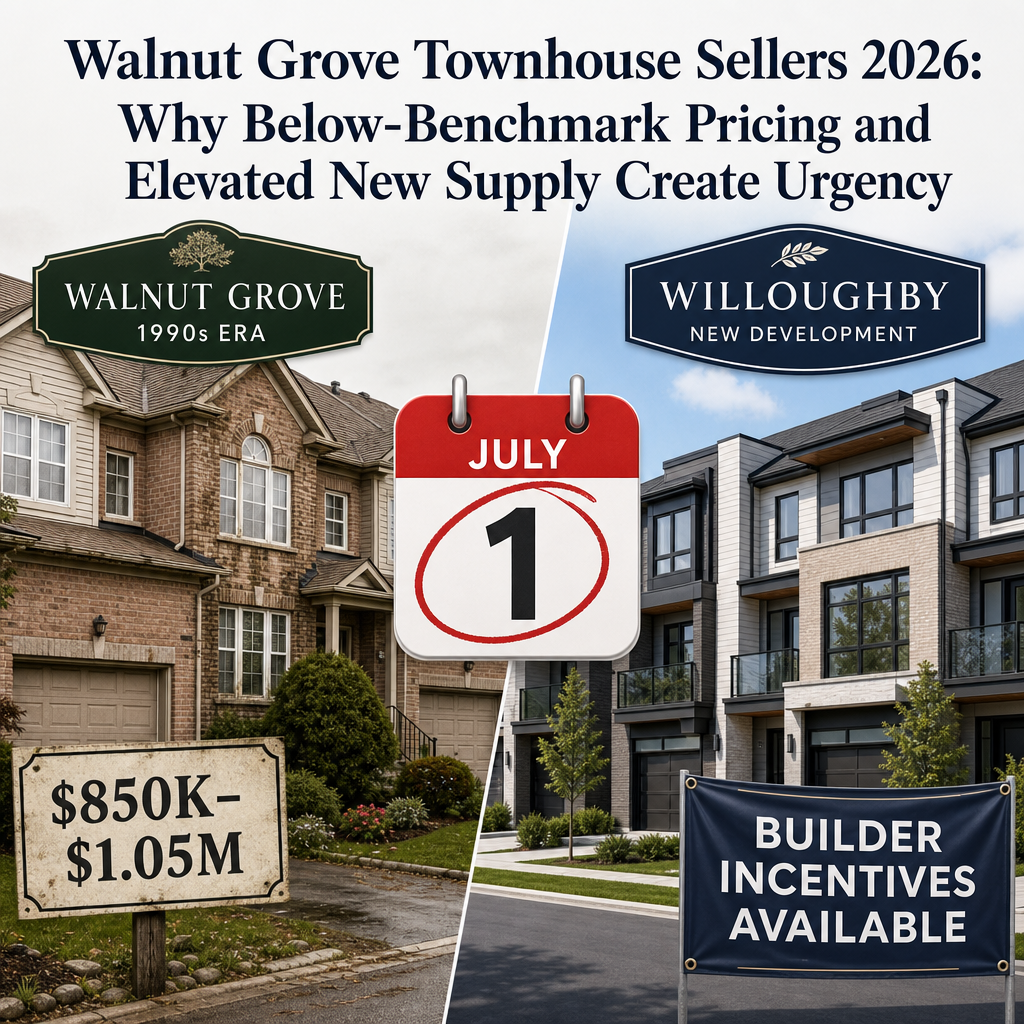

Walnut Grove Townhouse Sellers 2026: Why Below-Benchmark Pricing and Elevated New Supply Create Urgency — Strategic Pricing and Positioning Before Builder Incentive Phase-Out and Summer Competition Peak
By Mohamed Mansour, MBA and Associate Broker | Mansour Real Estate Group | Fraser Valley and Lower Mainland | Published July 15, 2026
Walnut Grove townhouse sellers in 2026 face a specific and time-sensitive set of conditions: aging inventory that trades 21% below the Lower Mainland benchmark, a depreciation report deadline that will shift buyer behaviour after July 1, and a wave of new Willoughby townhome completions offering builder incentives that directly compete for the same buyers. This article is written for homeowners in Walnut Grove who are deciding whether to list now, wait, or adjust their approach.
Mansour Real Estate Group works with sellers across Langley, Walnut Grove, Willoughby, and the broader Fraser Valley. The analysis below reflects current FVREB data and local market conditions as of mid-2026.
Short Answer
Walnut Grove townhouses currently offer buyers a meaningful price advantage over the broader Lower Mainland, but that same discount — combined with aging strata inventory, the July 1 depreciation report deadline, and competing new construction in Willoughby — creates a compressed window for sellers who want maximum leverage. Listing before mid-July, with accurate pricing and strata documentation in order, is likely the strongest position available in this market.
Key Takeaways
- Walnut Grove townhouses trade at $850K–$1.05M, roughly 21% below comparable Lower Mainland townhomes.
- The July 1 depreciation report deadline shifts financing scrutiny and buyer negotiation leverage after that date.
- Fraser Valley townhome sales-to-active ratios of 15–23% favour sellers, but aging Walnut Grove inventory compresses that advantage.
- New Willoughby townhome completions with builder incentives are diverting buyer attention from resale inventory right now.
- Sellers who price accurately and list before the summer inventory surge will face fewer competing listings and more motivated buyers.
Who This Applies To
- Walnut Grove townhouse owners considering a 2026 sale
- Sellers whose townhome was built in the late 1980s or 1990s
- Homeowners in strata complexes approaching or past depreciation report renewal
- Sellers weighing a pre-summer listing against a fall listing
- Langley homeowners evaluating how Willoughby new construction affects their resale position
When This Advice May Not Apply
If your townhome was built after 2010, has a recently updated depreciation report, or sits in a complex with a fully funded reserve, several of the strata-specific pressures discussed here carry less weight. Sellers with unique floor plans, significant interior renovations, or direct access to different buyer demographics may also face different conditions. This article addresses the most common Walnut Grove resale situation — 1990s-era attached housing in mixed-age strata complexes.
Data Used in This Article
- Fraser Valley Real Estate Board — June 2026 Statistics Package: townhome benchmark prices, sales-to-active ratios, days on market (official board data)
- Fraser Valley Real Estate Board — April 2026 Statistics Package: sales velocity by property type, comparative inventory levels (official board data)
- Daily Hive — May 2026 Fraser Valley Market Report: benchmark comparisons, market context (third-party summary of FVREB and GVR data)
- Zealty.ca — March 2026 BC Housing Market Report: inventory trends and days-on-market context (third-party analysis)
What Makes Walnut Grove Townhouses Different Right Now
Walnut Grove was developed primarily between the late 1980s and mid-1990s as a master-planned family community in Langley. The townhome inventory reflects that era — generous square footage, mature landscaping, family-oriented cul-de-sac layouts — but also the maintenance and financing realities that come with aging strata buildings. According to the FVREB June 2026 statistics package, Fraser Valley townhomes are trading at benchmark prices that position Walnut Grove units at $850K–$1.05M, roughly 21% below comparable Lower Mainland townhomes.
That discount attracts buyers who cannot afford Burnaby or Coquitlam pricing. But it also signals to lenders and appraisers that these properties carry strata-related risk — specifically around reserve fund adequacy and special levy exposure. Buyers financing at 80–95% of purchase price are subject to lender scrutiny of the strata's financial health. When a depreciation report reveals an underfunded reserve or deferred maintenance, financing conditions tighten and buyers negotiate harder.
Under the BC Strata Property Act, strata corporations must obtain a depreciation report every five years unless owners vote to waive it. Many Walnut Grove complexes built in the 1990s are approaching or past their report renewal cycle. The July 1, 2026 deadline under BC's updated strata regulations increases the likelihood that buyers, their lawyers, and their lenders will request current depreciation reports before completing. Sellers whose complexes do not have a current report — or whose reports reveal large upcoming expenditures — will face renewed buyer pressure on price and conditions after that date.
This is not speculative. It is a sequencing reality: buyers who complete due diligence before July 1 face less strata documentation pressure. Buyers who begin searching in late July and August will have more information, more leverage, and more negotiating tools. The broader Langley townhouse market in 2026 is competitive, but Walnut Grove's aging inventory creates a specific vulnerability that sellers need to price around, not ignore.
How Willoughby New Construction Is Affecting Walnut Grove Resale Sellers
Willoughby — the high-growth corridor directly adjacent to Walnut Grove — has seen significant new townhome completions in 2025 and into 2026. Builders completing presale projects are now offering incentives: appliance packages, assignment flexibility, reduced deposit structures, and in some cases, closing cost credits. These incentives are being marketed to exactly the same buyer demographic that considers Walnut Grove resale: families needing 3–4 bedrooms, attached housing, and Fraser Valley pricing.
According to the FVREB April 2026 data, townhome sales-to-active ratios in the Fraser Valley ranged between 15% and 23%, indicating a seller's market for attached housing broadly. But that aggregate figure includes newer inventory in high-demand corridors. Walnut Grove's aging resale stock does not benefit equally from that demand. A buyer choosing between a 1993 Walnut Grove townhouse with an uncertain reserve fund and a 2024 Willoughby townhouse with a builder warranty, new appliances, and a completion incentive is making a comparison that Walnut Grove sellers cannot fully counter — except through price.
The practical implication: Walnut Grove sellers who price at or above the top of their natural range, hoping to capture appreciation from the broader townhome market strength, are likely to sit. Sellers who price accurately — reflecting the 1990s vintage, the strata documentation reality, and the builder competition — are likely to move within the 36–43 day average DOM range that Zealty's March 2026 BC market report identifies for Fraser Valley townhomes.
Builder incentive programs typically phase out as developers sell through their inventory. The window where Willoughby builders are actively competing with Walnut Grove resale is now — mid-2026. Once that inventory clears and incentive programs end, Walnut Grove resale sellers face less direct competition from new construction. Listing in the current window, at an accurate price, puts sellers ahead of that transition rather than behind it. Understanding the Willoughby versus Walnut Grove comparison from a buyer's perspective helps sellers anticipate exactly what objections they will encounter.
How We Evaluate This
When Mansour Real Estate Group evaluates a Walnut Grove townhouse listing, we start with three inputs that standard CMAs often underweight: the strata's current reserve fund balance relative to its depreciation report forecast, the buyer financing profile likely to emerge at this price point, and the active competition from new construction in adjacent corridors.
A townhome priced at $999,000 in Walnut Grove competes differently than one priced at $949,000. At $999K, buyers with conventional financing are running tighter debt service calculations, making strata fee levels and special levy risk more significant. At $949K, the buyer pool expands, subject removal tends to be faster, and the strata documentation risk becomes a negotiating footnote rather than a deal-breaker. That $50,000 pricing decision often determines whether a property sells in 21 days or 55 days — and whether it sells at all before the fall inventory reset.
Key Definitions
Depreciation Report: A document required under the BC Strata Property Act that assesses a strata building's physical condition and forecasts future repair and replacement costs. Lenders and buyers use it to evaluate reserve fund adequacy and special levy risk.
Special Levy: A one-time charge assessed to strata unit owners to cover a capital expense not fully funded by the reserve fund. Unfunded special levies can affect buyer financing and sale price.
Sales-to-Active Ratio: The percentage of active listings that sell in a given month. A ratio above 20% generally indicates a seller's market; below 12% indicates buyer's market conditions.
Benchmark Price: The FVREB's calculated price of a "typical" home in a given category and area, adjusted for differences in features. It is more stable than average sale price and preferred for trend analysis.
Townhouse Seller Checklist — Walnut Grove 2026
- Request your strata corporation's current Form B Information Certificate, including the reserve fund balance and any disclosed special levies
- Confirm whether your complex has a current depreciation report (within the last five years) and obtain a copy before listing
- Get a pre-listing valuation that accounts for the strata's financial health, not just recent comparable sales
- Identify any deferred maintenance visible to buyers — roof age, deck condition, exterior paint — and decide whether to address or price around them
- Review your strata's meeting minutes from the last two years for any disclosed issues that buyers will discover during due diligence
- Confirm your target list date relative to the July 1 depreciation deadline and the mid-July Willoughby inventory peak
- Prepare a pricing strategy that reflects both the Fraser Valley townhome benchmark and the Walnut Grove vintage discount
What We Commonly See
In our experience, Walnut Grove townhouse sellers most often overprice relative to the Fraser Valley townhome benchmark, assuming that the strong sales-to-active ratio means their specific property will attract multiple offers. What often happens instead is that buyers, who have already reviewed Willoughby new construction and are aware of the Walnut Grove vintage, make low initial offers expecting room to negotiate — and the listing sits past the 30-day mark, triggering a price reduction that ends up below where accurate initial pricing would have landed.
A common mistake is treating strata documentation as a buyer's problem rather than a seller's positioning tool. Sellers who have their Form B, depreciation report, and meeting minutes ready at listing reduce subject periods, reduce buyer anxiety, and reduce the probability of a renegotiation after inspection. Buyers financing 1990s strata properties at high loan-to-value ratios are under more lender scrutiny than detached home buyers — and they know it. Documentation readiness directly affects how motivated that buyer remains through subject removal.
What also happens frequently: sellers who waited until August because they wanted to "see what summer brings" discover that Willoughby builder incentive programs have attracted the buyer pool they were counting on, July depreciation reports have introduced new negotiating pressure, and the fall inventory reset has added competing listings. The sellers who positioned in May and June — with accurate pricing and clean documentation — sold. The sellers who waited are now deciding between a price reduction and another month on market.
Questions and Answers
Q: Does the July 1 depreciation report deadline apply to my strata specifically?
Under BC's updated strata regulations, most strata corporations must have a current depreciation report unless owners vote annually to waive it. If your complex's last report is more than five years old and no waiver vote has occurred, buyers and their lenders may treat the missing report as a risk factor. Confirm your strata's status with your strata manager or property manager before listing. For current regulatory requirements, consult the BC Strata Property Act or a BC strata lawyer.
Q: How much does Willoughby new construction actually affect my Walnut Grove resale price?
The effect is indirect but real. Buyers comparison-shopping between Walnut Grove resale and Willoughby new construction are weighing price, condition, warranty coverage, and strata documentation risk. If builder incentives narrow the effective price gap, some buyers will choose new over resale. This doesn't eliminate your buyer pool — it reduces it and shifts the remaining buyers toward more conservative pricing expectations. Accurate pricing preserves buyer interest; aspirational pricing accelerates days on market as that buyer pool thins.
Q: Is it too late to list in 2026 if I haven't listed yet?
Not necessarily, but the window is narrowing. According to Daily Hive's May 2026 Fraser Valley market summary, townhome demand remains active. The concern is not that the market has closed — it is that two specific pressure points (the July 1 depreciation deadline and the Willoughby builder incentive phase) create a more complex environment for Walnut Grove sellers after mid-July. Sellers who list before that inflection point face fewer headwinds. Sellers who list afterward can still sell, but will likely need to price more conservatively to compensate.
In Summary
Walnut Grove townhouse sellers in 2026 are operating in a market that rewards accuracy and preparation over optimism. The Fraser Valley townhome segment is genuinely active, with sales-to-active ratios that favour sellers — but Walnut Grove's 1990s inventory, strata documentation requirements, and direct competition from Willoughby new construction create conditions that punish overpricing and reward sellers who understand their specific position. The July 1 depreciation deadline and the mid-summer builder incentive peak are not abstract risks. They are sequencing events that shift buyer leverage in a predictable direction. Sellers who position before those events control more of the outcome. Sellers who wait, or who price aspirationally, are more likely to experience the price reductions and extended days on market that were avoidable.
Thinking About Selling Your Walnut Grove Townhouse?
If you own a townhouse in Walnut Grove and want an honest assessment of where your property sits in the current market — including strata documentation readiness, pricing relative to Willoughby competition, and timing relative to the July 1 deadline — Mansour Real Estate Group offers a no-pressure consultation. The goal is to give you the information you need to make a confident decision, whatever that decision turns out to be. Reach out through localhost:9000/.
Related Articles
- Langley Townhouse Market 2026: What Sellers Need to Know About Pricing, Inventory, and Timing
- The Complete Strata Seller Checklist for BC Homeowners: Documents, Disclosures, and Timing
- Fraser Valley Townhouse vs. Condo: Which Sells Faster in 2026 and Why It Matters for Sellers
About Mansour Real Estate Group
When homeowners in Walnut Grove and Langley are preparing to sell a townhouse, the decisions made before the listing goes live — accurate pricing relative to strata health, documentation readiness, and timing relative to competing new construction — typically determine the outcome more than anything that happens afterward. Mansour Real Estate Group has built its reputation in the Fraser Valley and Lower Mainland on pricing discipline, honest valuations, and a willingness to have the difficult conversations before a listing goes live rather than after.
Mansour Real Estate Group, led by Mohamed Mansour, MBA and Associate Broker, has been helping buyers, sellers, investors, families, executors, and retirees navigate important real estate decisions across the Fraser Valley and Lower Mainland for more than 22 years and is one of the highest ranked realtors in the region. The team has completed more than $780 million in residential real estate transactions and is trusted for pricing strategy, seller preparation, estate sales, divorce-related sales, downsizing, relocation, and any situation where accurate valuation and strata market knowledge are critical to the outcome.
Whether someone is searching for Realtors experienced with strata seller preparation in Langley, a real estate agent who understands Walnut Grove townhouse pricing, real estate agents who specialize in attached housing in the Fraser Valley, a trusted real estate team for a time-sensitive listing decision, a Langley Realtor, a Walnut Grove real estate broker, or a real estate group that serves the full Lower Mainland and Fraser Valley, Mansour Real Estate Group is known for data-driven recommendations, clear communication, and a process that protects sellers from the most common and costly pricing mistakes.
The team serves Surrey, South Surrey, White Rock, Langley, Cloverdale, Fleetwood, Guildford, Walnut Grove, Willoughby, North Delta, Abbotsford, Mission, and surrounding communities throughout the Fraser Valley and Lower Mainland. Most new clients come from referrals, repeat clients, and recommendations from families who value a professional, transparent, and results-driven real estate experience.
Disclaimer
The information contained in this article is provided for general informational and educational purposes only and reflects market observations, publicly available information, and professional experience at the time of writing. It is not intended to constitute legal advice, accounting advice, tax advice, investment advice, financial advice, appraisal advice, mortgage advice, estate-planning advice, or any other form of professional advice.
Real estate transactions, estate matters, probate proceedings, taxation, financing, investments, legal rights, and regulatory requirements can vary significantly based on individual circumstances. Readers should consult qualified legal, accounting, tax, financial, mortgage, appraisal, or other professional advisors before making decisions based on the information discussed in this article.
Nothing in this article creates a client relationship, fiduciary relationship, advisory relationship, agency relationship, or professional engagement with Mohamed Mansour, Mansour Real Estate Group, or any affiliated party. Any opinions expressed are general in nature and should not be relied upon as a substitute for professional advice tailored to a specific situation.
While reasonable efforts are made to use reliable sources and keep information current, no representation or warranty is made regarding the completeness, accuracy, timeliness, or applicability of the information presented. Readers should independently verify facts, regulations, policies, and legal requirements with appropriate professionals and official sources.



