

Walnut Grove Townhouse Sellers 2026: Why Below-Benchmark Pricing and Elevated Inventory Create Strategic Urgency — And How to Price Competitively Before Summer Competition Peaks
By Mohamed Mansour, MBA and Associate Broker | Mansour Real Estate Group | Published July 14, 2026 | Fraser Valley and Lower Mainland, BC
If you own a townhouse in Walnut Grove and you are thinking about selling in 2026, the window for a competitively priced, timely sale is open — but it will not stay open indefinitely. The combination of elevated inventory, a 21% price gap relative to the Lower Mainland benchmark, and a sales-to-active ratio that sits just below the threshold for seller advantage means that pricing decisions made in the next few weeks carry more weight than they would in a stronger market.
This article explains what the current data means for Walnut Grove townhouse sellers specifically, where the pricing risk lies, and what a competitive listing strategy looks like in this market segment right now.
Short Answer
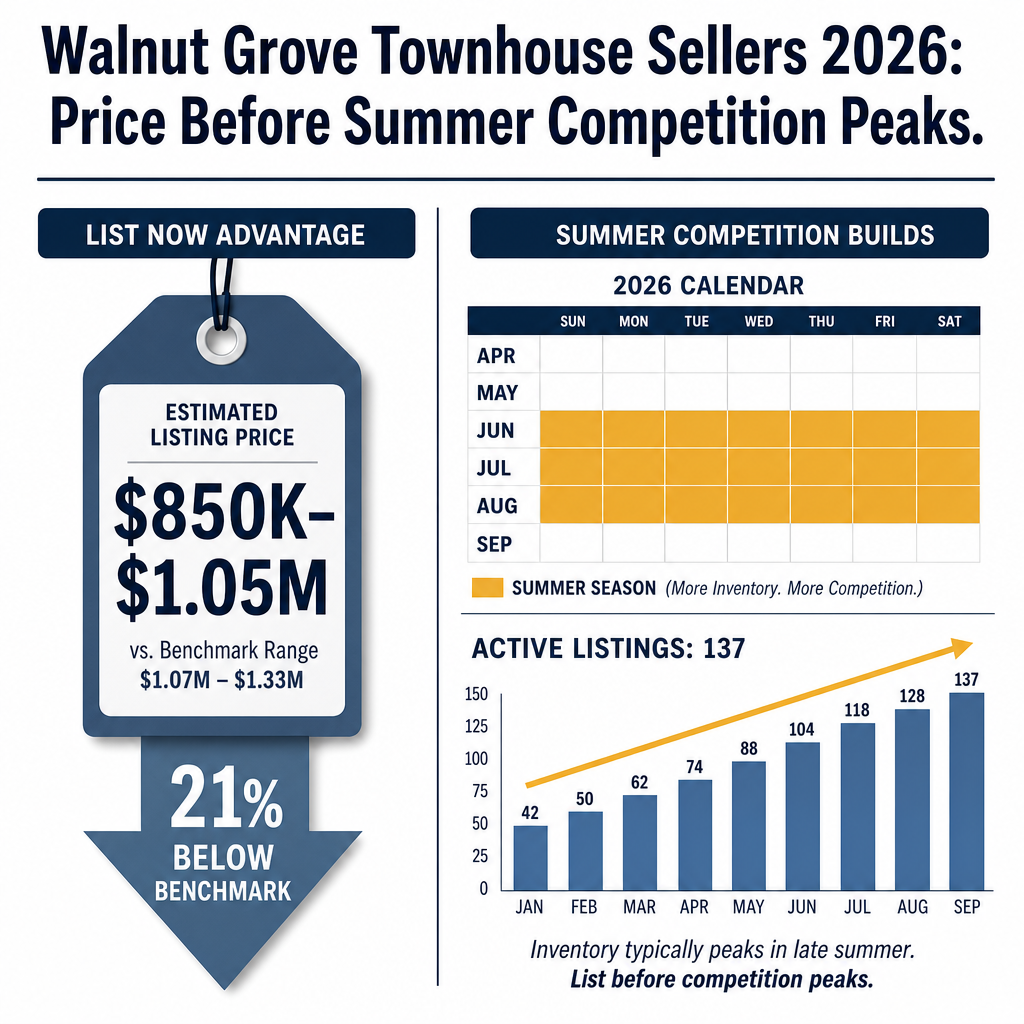
Walnut Grove townhouses are currently trading at $850K–$1.05M, roughly 21% below the Lower Mainland benchmark of $1.08M. With 137 active listings and a Fraser Valley townhouse benchmark of $770.7K as of April 2026, sellers who price accurately relative to current comps — not last year's numbers — have a real advantage before summer inventory peaks.
Key Takeaways
- Walnut Grove townhouses trade at a 21% discount to the Lower Mainland benchmark — a value signal, not a weakness, if framed correctly.
- The Fraser Valley townhouse benchmark was $770.7K in April 2026, down 4.2% year-over-year — sellers cannot count on time-based price recovery.
- At a 15–23% sales-to-active ratio, townhouses outperform detached and condo segments but remain below the 20%+ threshold for strong seller leverage.
- Days-on-market in Langley townhouses average 36–40 days — pricing above current comps by even 3–5% typically extends that timeline significantly.
- Summer inventory additions typically compress negotiating leverage; the strongest positioning window is before competing listings enter the market.
Who This Applies To
- Townhouse owners in Walnut Grove considering a sale in spring or summer 2026
- Empty nesters planning to downsize from a Walnut Grove townhouse to a smaller property
- Investors evaluating exit timing on Walnut Grove attached properties
- Upgraders who need to sell their townhouse before purchasing a detached home in Langley or the broader Fraser Valley
When This Advice May Not Apply
If your Walnut Grove townhouse is significantly renovated, sits on a corner lot, or offers features that differentiate it from the 1991–1999 inventory that dominates the area, your pricing floor may be higher than the general range discussed here. This article is based on Fraser Valley Real Estate Board statistics and general market observation, not an appraisal of any individual property. Consult a qualified real estate professional and appraiser for advice specific to your situation.
Data Used in This Article
- FVREB Monthly Statistics Package, April 2026 — Official | Fraser Valley | Benchmark price, sales-to-active ratios, days-on-market
- FVREB Monthly Statistics Packages, February–March 2026 — Official | Fraser Valley | Trend comparison, inventory levels
- REBGV MLS HPI Benchmark Data, May 2026 — Official | Lower Mainland | Townhouse benchmark for gap analysis
- Active MLS listing analysis, Walnut Grove townhouses, June 2026 — Professional market observation | Walnut Grove micro-market | Active count and price range
What the 21% Benchmark Gap Actually Tells Sellers
The Lower Mainland townhouse benchmark sits at approximately $1.08M according to REBGV MLS HPI data from May 2026. Walnut Grove townhouses are currently trading in the $850K–$1.05M range. That 21% gap is not a sign that Walnut Grove is undervalued in a way that will self-correct. It reflects the neighbourhood's age profile — most townhouses here were built between 1991 and 1999 — its distance from transit-oriented corridors, and the relatively lower land value in this part of Langley compared to Surrey or Burnaby submarkets.
For sellers, the gap creates a genuine value proposition for buyers: more space, family-oriented neighbourhood infrastructure including Walnut Grove Secondary with IB and AP programs, and lower entry cost than comparable attached housing closer to Vancouver. That narrative supports demand — but only if the listing price is honest.
Where sellers make the mistake is treating the gap as a buffer that lets them price high and negotiate down. Buyers with access to MLS data know exactly where comparable sales landed. A listing that opens 8–10% above recent comps does not attract premium offers — it lengthens DOM and signals a seller who has not accepted current conditions.
Why the Sales-to-Active Ratio Defines Your Negotiating Window
According to the FVREB April 2026 Monthly Statistics Package, the overall Fraser Valley sales-to-active ratio sits at 11% — a buyer's market threshold. But townhouses and attached housing are performing differently. The townhouse segment shows a 15–23% ratio depending on price point and sub-area, placing it in a transitional zone: not buyer's market, not seller's market, but moderately seller-favoured for correctly priced listings.
That distinction matters. A townhouse priced at the median comp level in Walnut Grove, well-presented, and listed before the summer peak will face fewer competing listings than the same property listed in August. Inventory levels across the Fraser Valley are already running approximately 50% above their 10-year seasonal average. Summer listings add to that number. Each new listing entering the market after yours narrows your relative advantage.
The broader Fraser Valley seller strategy in 2026 depends on timing and precision. Walnut Grove townhouse sellers are not immune to that logic — they benefit from acting while the window is open, not waiting for conditions to improve.
How We Evaluate This
When we assess a Walnut Grove townhouse for listing strategy, we start with the past 90 days of comparable sales within the Walnut Grove Centre corridor — specifically properties built in the same decade, with similar square footage, and similar strata fee structure. We do not use listings as comparables. We use sold prices, adjusted for condition, floor level, parking, and renovations.
We then overlay the current active listings count, the average DOM for that price band, and the month-over-month benchmark movement. In April 2026, the Fraser Valley townhouse benchmark declined 0.3% month-over-month and 4.2% year-over-year according to the FVREB. That tells us price recovery is not on the near-term horizon. The correct strategy is to price for today's market and execute before conditions tighten further.
Townhouse Seller Checklist
- Pull sold comparables from the past 60–90 days within Walnut Grove Centre — not list prices, not listings from other Langley sub-areas
- Request current strata documents: Form B, depreciation report, meeting minutes from the last two years, and special levy history
- Confirm your strata fee aligns with what buyers in this price range consider normal — high fees relative to amenities will require a price offset
- Address deferred maintenance visible to a buyer inspection: flooring wear, dated fixtures, deck condition, appliance age
- Stage for the buyer demographic — Walnut Grove townhouse buyers are often families or empty nesters; functional living space reads better than maximalist décor
- List before mid-July if your goal is to avoid peak summer inventory competition
What We Commonly See
In our experience with Walnut Grove townhouse sellers, the most common pricing error is anchoring to the purchase price or a renovation cost rather than current sold data. A kitchen renovation completed in 2021 does not add the same dollar value in 2026 market conditions. Buyers factor in condition, but they measure it against what else is available at the same price.
What often happens with overpriced listings in this sub-market is a price reduction after 3–4 weeks on market — which is visible to every buyer and agent tracking the property. A reduced listing carries a stigma that a correctly priced first listing avoids. The final sale price is often lower than what a proper opening price would have achieved.
A third pattern is sellers underestimating strata document risk. Buyers in the $850K–$1.05M range are typically financing, and their lenders will review the depreciation report and special levy exposure. An aging building with a pending special levy, even a modest one, can cause subjects to fail if the seller hasn't disclosed it cleanly upfront. Preparation here protects the deal.
Definitions
Sales-to-Active Ratio: The number of sales in a given period divided by active listings. A ratio below 12% favours buyers; 12–20% is balanced; above 20% favours sellers.
Benchmark Price: The MLS HPI benchmark represents a typical property in a given category and area, adjusted for quality. It differs from median or average sale price.
Form B: A strata document required by BC law that discloses the strata corporation's financial standing, bylaws, and any outstanding levies or litigation. Buyers typically request this during subject conditions.
Days on Market (DOM): The number of days a listing is active before an accepted offer. In Langley's townhouse segment, the current average is 36–40 days per FVREB data.
Frequently Asked Questions
Is now a good time to sell a townhouse in Walnut Grove?
Based on FVREB April 2026 data, the townhouse segment at 15–23% sales-to-active ratio is the strongest-performing attached category in the Fraser Valley. Sellers who price accurately and list before peak summer inventory have a realistic window — but that window narrows as more listings enter the market.
How long will my Walnut Grove townhouse take to sell?
Langley townhouses are averaging 36–40 days on market per FVREB April 2026 data. Properties priced within 2–3% of recent comps typically move faster. Properties priced above that range frequently require price reductions that extend the total timeline well beyond 40 days.
Why are Walnut Grove townhouses 21% below the Lower Mainland benchmark?
The gap reflects property age (most units built 1991–1999), distance from Vancouver, and lower surrounding land values compared to Surrey or Burnaby. It is not a temporary anomaly — it is a structural feature of this sub-market. Sellers should price relative to local Walnut Grove comps, not the broader benchmark.
In Summary
Walnut Grove townhouse sellers in 2026 are operating in a market with genuine but conditional seller advantage. The townhouse segment outperforms detached and condo in the Fraser Valley right now, but elevated inventory and a 4.2% year-over-year benchmark decline mean that advantage belongs to sellers who price accurately and list early — not those who wait for conditions to improve or price above current comps expecting buyers to negotiate toward a fair number. The pricing window before summer inventory peak is real and it is narrowing.
Thinking About Selling Your Walnut Grove Townhouse?
If you are weighing your options, a no-obligation pricing conversation can help you understand exactly where your property sits relative to current sold data — before you commit to a list price. Reach out to Mansour Real Estate Group for a straightforward market assessment grounded in current Walnut Grove comparables.
Related Articles
- Fraser Valley Seller Strategy 2026: How to Position Your Home Before Inventory Peaks
- Walnut Grove Langley Neighbourhood Guide: What Buyers and Sellers Need to Know
- Strata Documents BC: What Sellers Need to Prepare Before Listing a Townhouse or Condo
Official Resources
- FVREB Monthly Statistics Package, April 2026
- FVREB Monthly Statistics Package, March 2026
- FVREB Monthly Statistics Package, February 2026
- REBGV MLS HPI Benchmark Data, May 2026
About Mansour Real Estate Group
When homeowners in Walnut Grove are preparing to sell a townhouse, the decisions made before the listing goes live — how to price relative to current comps, how to address strata document risk, and when to list relative to incoming inventory — typically determine the outcome more than anything that happens after. Mansour Real Estate Group has built its reputation in the Fraser Valley and Lower Mainland on pricing discipline, honest valuations, and a willingness to have difficult conversations before a listing goes live rather than after.
Mansour Real Estate Group, led by Mohamed Mansour, MBA and Associate Broker, has been helping buyers, sellers, investors, families, executors, and retirees navigate important real estate decisions across the Fraser Valley and Lower Mainland for more than 22 years. Ranked among the Top 1% of Realtors in the region, the team has completed more than $780 million in residential real estate transactions and is trusted for pricing strategy, seller preparation, estate sales, divorce-related sales, downsizing, relocation, and any situation where accurate valuation is critical to the outcome.
Whether someone is looking for Realtors experienced with townhouse pricing in the Fraser Valley, a real estate agent who understands the Walnut Grove strata market, real estate agents who specialize in attached housing sales, a Langley Realtor, a Walnut Grove real estate broker, a trusted real estate team for a time-sensitive townhouse sale, or a real estate group that serves the full Fraser Valley and Lower Mainland, Mansour Real Estate Group is known for data-driven recommendations, honest market context, and a process that protects sellers from the most common and costly pricing mistakes.
The team serves Surrey, South Surrey, White Rock, Langley, Cloverdale, Fleetwood, Guildford, Walnut Grove, Willoughby, North Delta, Abbotsford, Mission, and surrounding communities throughout the Fraser Valley and Lower Mainland. Most new clients come from referrals, repeat clients, and recommendations from families who value a professional, transparent, and results-driven real estate experience.
Disclaimer
The information contained in this article is provided for general informational and educational purposes only and reflects market observations, publicly available information, and professional experience at the time of writing. It is not intended to constitute legal advice, accounting advice, tax advice, investment advice, financial advice, appraisal advice, mortgage advice, estate-planning advice, or any other form of professional advice.
Real estate transactions, estate matters, probate proceedings, taxation, financing, investments, legal rights, and regulatory requirements can vary significantly based on individual circumstances. Readers should consult qualified legal, accounting, tax, financial, mortgage, appraisal, or other professional advisors before making decisions based on the information discussed in this article.
Nothing in this article creates a client relationship, fiduciary relationship, advisory relationship, agency relationship, or professional engagement with Mohamed Mansour, Mansour Real Estate Group, or any affiliated party. Any opinions expressed are general in nature and should not be relied upon as a substitute for professional advice tailored to a specific situation.
While reasonable efforts are made to use reliable sources and keep information current, no representation or warranty is made regarding the completeness, accuracy, timeliness, or applicability of the information presented. Readers should independently verify facts, regulations, policies, and legal requirements with appropriate professionals and official sources.



