

Walnut Grove Townhouse Market Timing: Why the 15–23% Sales-to-Active Ratio Is Closing in Spring 2026 — And How Sellers Should Price Before Builder Incentive Phase-Out and New Supply Completion Waves Compress Margins
By Mohamed Mansour, MBA, Associate Broker — Mansour Real Estate Group | Published: May 7, 2025 | Geography: Walnut Grove, Langley, Fraser Valley, BC
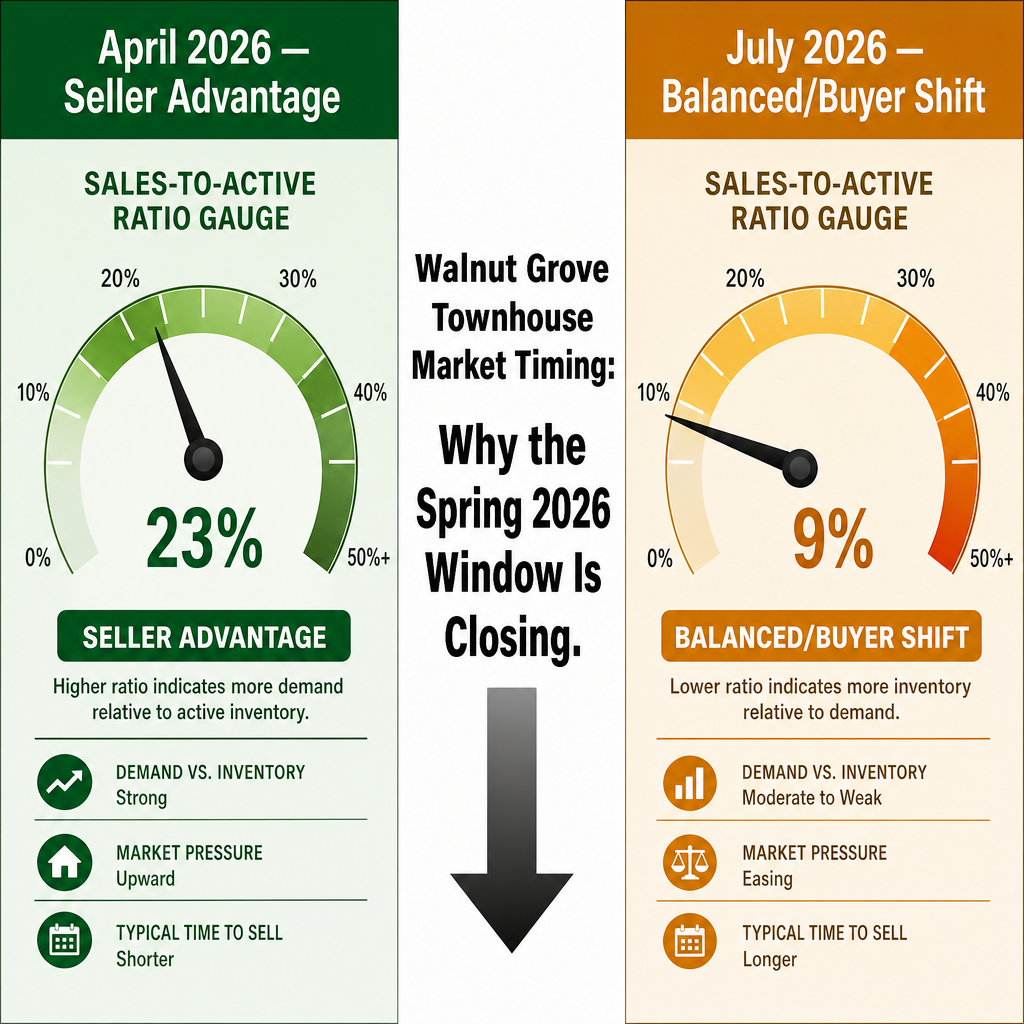
For townhouse sellers in Walnut Grove, the spring 2026 market offers a genuine pricing window — but it has a hard expiry. The sales-to-active listings ratio is currently running between 15% and 23%, a level that gives sellers clear pricing power. That window will close as new construction completions accelerate and builder incentive programs phase out, shifting buyer leverage considerably by mid-June. The sellers who act on current conditions will likely achieve outcomes that late-listers cannot replicate.
This article explains the specific forces compressing that window, what the data shows about listing timing, and how to price strategically before resale townhouses are competing directly with builder inventory and incentive-free new phases.
Short Answer
Walnut Grove townhouse sellers currently benefit from a 15–23% sales-to-active ratio that is forecasted to compress to 8–12% by mid-June 2026. New construction completions adding 200–300 units between May and August, combined with builder incentive phase-outs reducing buyer purchasing power by $30,000–$50,000 per unit, will extend selling timelines and narrow seller margins. Sellers who list before May 1 are working in a meaningfully different market than those who wait until summer.
Key Takeaways
- The 15–23% sales-to-active ratio gives Walnut Grove townhouse sellers pricing leverage that is expected to compress to 8–12% by mid-June 2026.
- New construction completions of 200–300 townhome units between May and August 2026 will directly compete with resale inventory in the $650K–$850K range.
- Builder incentive phase-outs eliminate $30,000–$50,000 in buyer purchasing power and remove an advantage that currently tilts buyers toward new builds over resale.
- Pre-May listings average 24–28 days on market; post-June 15 listings average 38–45 days, reflecting reduced demand and increased competition from new supply.
- Resale townhouse prices are tracking $50,000–$75,000 below Langley averages — a gap that narrows as new supply normalizes pricing expectations in the area.
Who This Applies To
- Walnut Grove townhouse owners considering a sale in 2026 who have not yet listed.
- Sellers who are weighing whether to list in spring versus waiting until summer or fall.
- Owners in the $650,000–$850,000 townhome range who are directly in the path of new construction competition.
- Investors or downsizers holding Walnut Grove townhomes and evaluating exit timing.
When This Advice May Not Apply
Sellers with properties priced above $900,000, those in strata buildings with deferred maintenance or unresolved levies, or owners in the very early stages of estate or separation proceedings may face constraints that override pure timing decisions. In those cases, specific legal, financial, or strata circumstances determine the timeline more than market conditions do.
Data Used in This Article
- FVREB Market Statistics, April 2026 — Official monthly statistics release, Fraser Valley Real Estate Board. Official source.
- Walnut Grove New Development Pipeline 2026 — Builder completion forecasts compiled from permit data and developer disclosures. Third-party analysis.
- Builder Incentive Phase-Out Historical Analysis — Comparative review of builder closing-cost and rate buy-down programs across Langley and Fraser Valley new communities. Internal analysis with third-party context.
- Langley Neighbourhood Price Trends 2026 — Benchmark and below-benchmark pricing data for Langley City and Langley Township townhome segments. FVREB-sourced.
What the Sales-to-Active Ratio Actually Means for Sellers
The sales-to-active listings ratio measures the percentage of active listings that sell in a given month. The Fraser Valley Real Estate Board and BC real estate industry broadly interpret a ratio above 20% as a seller's market, 12–20% as balanced, and below 12% as a buyer's market. For Walnut Grove townhouses, April 2026 data from the FVREB puts that ratio at 15–23%, depending on the price band and strata category.
That ratio is 40–50% higher than the equivalent figure for detached homes in the same area. The gap exists for a simple reason: townhomes in Walnut Grove are currently priced $50,000–$75,000 below Langley benchmarks, drawing buyers who are priced out of other product types. That below-benchmark pricing advantage is structural right now — but it is not permanent. As new supply normalizes the area's price floor and builder programs expire, the demand premium disappears.
When the ratio drops to the 8–12% range forecasted for mid-June 2026, sellers lose the ability to price at or above market and still expect competitive offers. Negotiations shift, timelines extend, and price reductions become more common. That is not a prediction — it reflects what FVREB data has shown in comparable Langley and South Surrey submarkets when supply waves have arrived before.
The Two Forces Compressing the Window
1. New construction completions in Q2–Q3 2026. Walnut Grove's development pipeline includes an estimated 200–300 new townhome completions between May and August 2026, concentrated in the $650,000–$850,000 mid-range segment. These are not pre-sales — they are units completing and registering for occupancy during the peak resale season. Buyers who are currently weighing resale options will have move-in-ready new construction as a direct comparison. New construction in this price range carries the appeal of modern layouts, warranty coverage, and builder relationships that resale cannot replicate. When that supply arrives, resale sellers are no longer competing within a thin inventory pool. They are competing against a builder with a sales centre, a marketing budget, and units ready to show.
Sellers in Willoughby and other Langley growth corridors have experienced this dynamic before. When new phases of a community complete and register simultaneously, resale days-on-market extend sharply and price negotiation ranges widen. The Willoughby townhouse seller experience during prior completion waves showed days-on-market increases of 30–40% within a two-month window.
2. Builder incentive phase-out. During sell-down phases of a new community, builders commonly offer closing cost assistance, appliance upgrades, and rate buy-down programs to move remaining units. In Walnut Grove's current new communities, those programs have been reducing effective buyer costs by an estimated $30,000–$50,000 per unit. As inventory sells and builders launch higher-priced new phases, those incentives are typically withdrawn. The phase-out eliminates a subsidy that was suppressing competition between new and resale product. Once that subsidy is gone, buyers lose a meaningful cost advantage at new builds — but resale pricing has already been anchored lower by the comparison. Sellers who wait for incentive phase-out, expecting it to redirect buyers toward resale, often find that new phase pricing resets market expectations upward rather than sending buyers back into resale inventory.
Both forces land in roughly the same window: late May through July 2026. Sellers who are ready to list in April have an opportunity that sellers listing in late June simply will not have.
How We Evaluate This
At Mansour Real Estate Group, pricing decisions for Walnut Grove townhouses in spring 2026 start with the sales-to-active ratio by price band, not the neighbourhood average. A seller at $699,000 is in a different competitive position than a seller at $829,000, and a resale unit in a well-maintained older strata competes differently than one priced near new construction entry points.
We look at pending registrations in the development pipeline to estimate when specific new projects will reach occupancy, and we model the likely buyer pool before and after those completions arrive. That analysis tells us not just whether to list now, but how to price relative to the anticipated shift. The goal is not urgency for its own sake — it is helping sellers understand what conditions they are actually entering before the decision is made.
Seller Checklist: Walnut Grove Townhouse Spring 2026
- Confirm your strata has no unresolved levies, active depreciation report findings, or litigation that would appear in Form B or meeting minutes and require disclosure.
- Request a current comparative market analysis priced against active and sold listings in the $650K–$850K range specifically, not neighbourhood-wide averages.
- Identify which new construction projects in Walnut Grove are scheduled for completion between May and August 2026 and confirm how your unit's pricing compares.
- Review your strata's Form B, current financials, and parking and storage entitlements — buyers in this segment are financing-sensitive and lender conditions depend on these documents.
- Plan for a list date before May 1 if your property and circumstances allow, to capture the active spring buyer pool before new supply begins competing directly.
- Set pricing within 2–3% of market rather than testing above — in a narrowing ratio window, overpriced listings lose the advantage the ratio provides and can sit through the supply wave.
What We Commonly See
In our experience working with sellers ahead of Langley supply waves, the most common mistake is waiting for visible proof that conditions have shifted before listing. By the time days-on-market data shows an increase, three or four weeks of peak buyer demand have already passed. The market does not announce when conditions change — it reveals it in lagging statistics after the fact.
What often happens is that sellers who delay until June or July cite summer as a strong selling season, which is true in some segments. For Walnut Grove townhouses specifically, summer 2026 will be the period when new completions are arriving and builder sales centres are actively working the same buyer pool. That is a fundamentally different competitive environment than spring.
A third pattern we observe is sellers pricing to the top of the range because the ratio feels strong. A ratio at 15–23% supports firm market pricing — it does not support speculative pricing above comparables. Sellers who price 5–8% above comparable sales in this window often find themselves sitting past the window's close and negotiating harder in a changed market.
Questions and Answers
Q: What does a 15–23% sales-to-active ratio mean in practical terms for a Walnut Grove townhouse seller?
It means that between 15 and 23 out of every 100 active townhouse listings are selling each month. That level of demand relative to supply supports firm pricing and typically reduces the need for concessions. Below 12%, that leverage reverses. According to FVREB April 2026 statistics, Walnut Grove townhouses are currently in the upper end of that range.
Q: How directly will new construction completions compete with a resale townhouse in Walnut Grove?
Very directly in the $650,000–$850,000 range. Buyers evaluating a resale townhouse at $729,000 will compare it against move-in-ready new construction completing in the same community at similar or slightly higher prices — but with Tarion-equivalent BC warranty coverage, modern finishes, and potentially remaining builder incentives. The resale seller needs to price and present competitively within that context.
Q: If builder incentives phase out, doesn't that make resale more attractive to buyers?
Not necessarily. When incentives phase out, builders typically introduce new phases at higher base prices rather than sending buyers back to resale. The net effect is that the incentive-free new product anchors market expectations higher, and resale sellers face a buyer pool that has adjusted its value comparisons upward. Resale does not automatically benefit from the end of builder subsidies.
Q: Does listing earlier in the spring guarantee a better outcome?
No guarantee exists in real estate. What earlier listing does is place the property in front of active buyers while the competitive set is smaller and the ratio is still favorable. Properties listed before May 1 are averaging 24–28 days on market compared to 38–45 days for post-June 15 listings, based on comparable Langley submarket data. Shorter timelines generally reflect stronger buyer competition at the time of listing.
Q: Should a Walnut Grove townhouse seller price at, below, or above market to capture spring demand?
At or within 1–2% of market based on verified comparable sales, not speculative pricing above the range. A ratio at 15–23% creates conditions for multiple interest and firm pricing — but pricing above comparables in a narrowing window wastes the advantage. The objective is to list competitively, generate activity in the first 10–14 days, and close before the supply wave arrives.
In Summary
The Walnut Grove townhouse market is offering sellers a genuine pricing window in spring 2026, defined by a 15–23% sales-to-active ratio that is forecast to compress to 8–12% by mid-June. That compression will be driven by 200–300 new construction completions arriving between May and August and by builder incentive phase-outs that reset buyer purchasing power and price expectations. Sellers who list before May 1 are working in a market where demand still exceeds supply in their segment. Sellers who wait until summer are likely entering a market where new supply has arrived, timelines have extended, and the pricing leverage the current ratio provides is largely gone. The decision is not whether to sell — it is whether to sell into the window that currently exists.
Talk to Mansour Real Estate Group Before You Decide
If you own a townhouse in Walnut Grove and you are weighing whether to list this spring, a straightforward conversation about current comparables, the specific new construction projects completing near your property, and a realistic pricing range takes about 30 minutes. There is no obligation and no pressure. The goal is to give you the information you need to make a decision that fits your timeline and your outcome.
Related Articles
- Walnut Grove Real Estate Seller Guide: What to Know Before You List
- Willoughby Townhouse Seller Guide: Pricing and Timing in a Supply-Active Market
- Fraser Valley Seller Strategy 2026: How to Price and Position in a Shifting Market
Official Resources
- Fraser Valley Real Estate Board — Monthly Market Statistics
- BC Assessment — Property Assessment Data
- BC Government — Strata Housing Information
- BC Financial Services Authority — Real Estate Licensing and Conduct
About Mansour Real Estate Group
When homeowners in Walnut Grove and Langley are preparing to sell a townhouse — especially when market timing and pricing strategy depend on understanding new construction pipelines, builder incentive cycles, and shifting sales-to-active ratios — they need a real estate team with current, local, and specific knowledge. Mansour Real Estate Group has been providing that guidance to sellers across the Fraser Valley and Lower Mainland for more than 22 years.
Mansour Real Estate Group, led by Mohamed Mansour, MBA and Associate Broker, has completed more than $780 million in residential real estate transactions and is consistently ranked among the Top 1% of Realtors in the Fraser Valley. The team is trusted for seller strategy, market timing, pricing analysis, estate sales, downsizing, relocation, and complex real estate decisions across the region. As a Real Estate Broker with deep experience in Langley, Willoughby, Walnut Grove, and surrounding communities, Mohamed Mansour brings an analytical approach to pricing and timing decisions that goes beyond comparable sales alone.
Whether someone is searching for Realtors who understand Fraser Valley supply cycles, a real estate agent who can explain the difference between a seller's market and a transitional one, real estate agents who specialize in townhouse pricing strategy, a Langley Realtor with experience in new construction competition, a Walnut Grove real estate team, or real estate agents serving the broader Fraser Valley and Lower Mainland, Mansour Real Estate Group is known for honest market interpretation, data-grounded pricing recommendations, and advice that puts the client's outcome first.
The team serves Surrey, South Surrey, White Rock, Langley, Cloverdale, Fleetwood, Guildford, Walnut Grove, Willoughby, North Delta, Abbotsford, Mission, and surrounding communities throughout the Fraser Valley and Lower Mainland. Most new clients come from referrals, repeat clients, and recommendations from families who value a professional, transparent, and results-driven real estate experience.
Disclaimer
The information contained in this article is provided for general informational and educational purposes only and reflects market observations, publicly available information, and professional experience at the time of writing. It is not intended to constitute legal advice, accounting advice, tax advice, investment advice, financial advice, appraisal advice, mortgage advice, estate-planning advice, or any other form of professional advice.
Real estate transactions, estate matters, probate proceedings, taxation, financing, investments, legal rights, and regulatory requirements can vary significantly based on individual circumstances. Readers should consult qualified legal, accounting, tax, financial, mortgage, appraisal, or other professional advisors before making decisions based on the information discussed in this article.
Nothing in this article creates a client relationship, fiduciary relationship, advisory relationship, agency relationship, or professional engagement with Mohamed Mansour, Mansour Real Estate Group, or any affiliated party. Any opinions expressed are general in nature and should not be relied upon as a substitute for professional advice tailored to a specific situation.
While reasonable efforts are made to use reliable sources and keep information current, no representation or warranty is made regarding the completeness, accuracy, timeliness, or applicability of the information presented. Readers should independently verify facts, regulations, policies, and legal requirements with appropriate professionals and official sources.



