

Walnut Grove Townhouse Market Timing and Strategic Repositioning in 2026: Why New Construction Completion Waves and Builder Incentive Phase-Out Create a Compressed Seller Window
By Mohamed Mansour, MBA and Associate Broker | Mansour Real Estate Group | Published: May 12, 2026 | Geography: Walnut Grove, Langley, Fraser Valley, BC
For townhouse sellers in Walnut Grove, 2026 is not a standard spring market. The intersection of builder completion cycles, seasonal inventory patterns, and incentive phase-out timing is creating a measurably narrower window than most sellers realize. The decisions you make in March and April will carry far more weight than the same decisions made in June.
This article is for Walnut Grove townhouse owners weighing whether to list now or wait. It explains why the current sales-to-active ratio may be masking a coming shift, how builder inventory affects your negotiating leverage, and what pricing approach positions a resale property competitively before summer supply erodes your advantage.
Short Answer
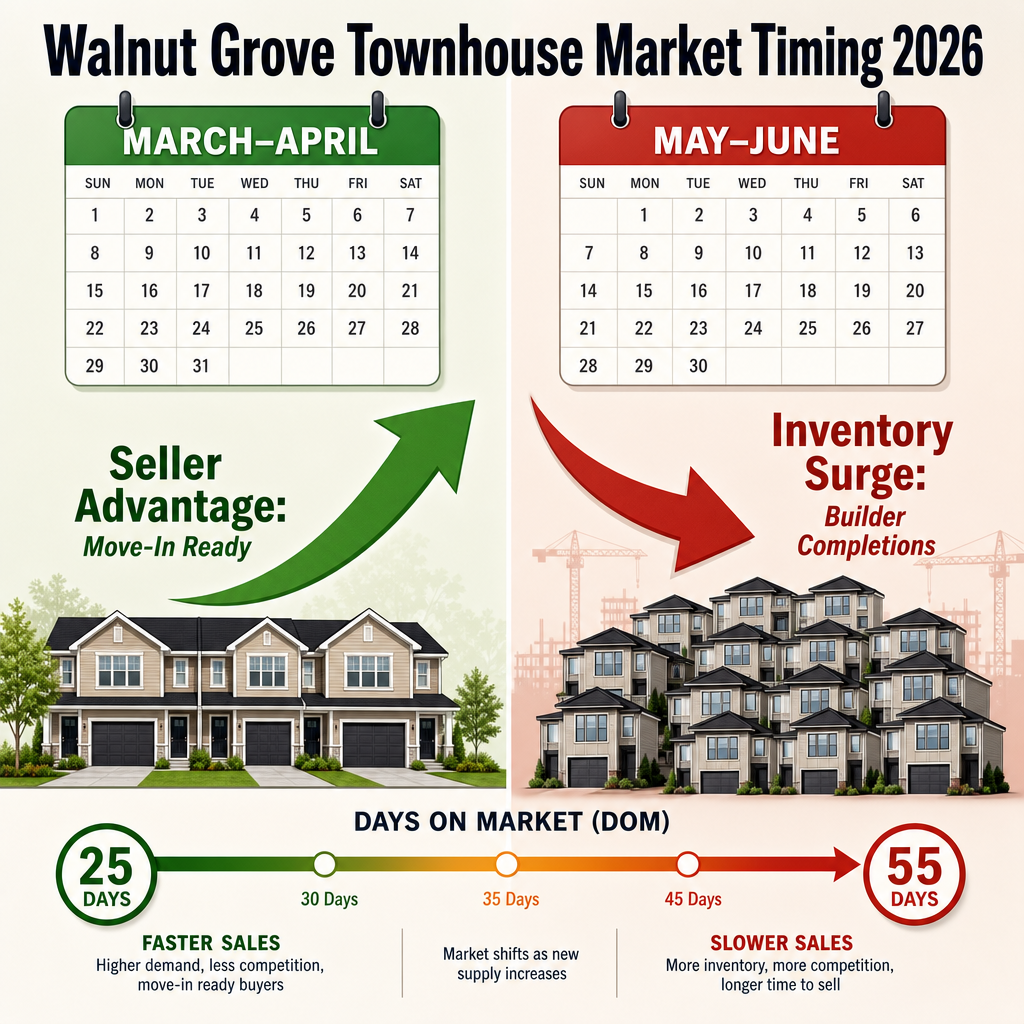
Walnut Grove townhouse sellers currently hold a measurable advantage — sales-to-active ratios remain in seller-favourable territory at 15–23%, and early spring buyers prefer move-in-ready resale over incomplete builder homes. That advantage compresses significantly by May–June as new construction phases complete and builder incentives phase out simultaneously. Sellers who list in March–April typically see 20–30% better days-on-market performance and stronger negotiating leverage than those who wait for summer.
Key Takeaways
- The 15–23% sales-to-active ratio favours sellers now, but builder completion waves will compress this window by May–June 2026.
- Builder incentives typically drop 30–50% as projects reach 80%+ completion, increasing resale competition exactly when buyer volume peaks.
- New townhouse completions in Walnut Grove phases 3–5 can push days-on-market from 25–35 days to 45–60 days within weeks of a phase announcement.
- Early spring buyers value immediate possession; summer buyers increasingly prioritize builder warranties and new finishes over move-in timing.
- Pricing slightly below recent comparable sales — not at them — is the tool that converts spring buyer interest into firm offers before the inventory shift.
Who This Applies To
- Walnut Grove townhouse owners considering a sale in 2026
- Sellers comparing resale timing against upcoming new construction phases
- Downsizers or equity-release sellers with flexibility on listing date
- Investors holding Walnut Grove townhouses and evaluating exit timing
When This Advice May Not Apply
If your townhouse is in a distinct strata complex that doesn't directly compete with the new construction phases, or if your timeline is fixed by an estate, divorce, or relocation, the timing principles still apply but the urgency calculus may differ. Speak with a local real estate agent who has current data on your specific building and competing builder inventory before deciding.
Data Used in This Article
- Fraser Valley Real Estate Board (FVREB) — April 2026 market statistics: Official; sales-to-active ratios, days-on-market by property type, townhouse benchmark pricing (Fraser Valley-wide)
- Walnut Grove master-plan release schedule and builder tracking — Q1 2026: Third-party industry tracking; phase completion timelines and incentive structure observations
- Fraser Valley days-on-market benchmarks by property type and season — Q1–Q2 2026: FVREB and internal professional analysis
- Townhouse sales-to-active ratio trend analysis — Q1–Q2 2026: FVREB official data; professional interpretation by Mansour Real Estate Group
Understanding the Dual-Market Dynamic in Walnut Grove
Walnut Grove is not a typical resale townhouse market. As a master-planned community still releasing phased new construction, resale sellers compete directly against builder inventory in ways that don't apply in more established Langley neighbourhoods like Willoughby or Cloverdale.
When a builder phase is pre-selling, buyers split their attention between new and resale. When a phase completes, that split becomes a surge. According to FVREB Q1 2026 townhouse data, days-on-market in the broader Fraser Valley townhouse segment is currently running between 25 and 35 days. Walnut Grove-area tracking shows that within 8–12 weeks of a major phase completion announcement, that figure shifts toward 45–60 days as buyer attention redirects to builder showrooms offering fresh inventory.
The current window — March through mid-April 2026 — is the period where resale sellers hold a structural advantage: builders haven't yet delivered, buyer urgency is high, and the sales-to-active ratio remains in seller-favourable territory at 15–23% according to FVREB April 2026 data. That ratio reflects a market where sellers hold negotiating power. It will not hold once phase completions release 150–300 units per quarter into active inventory.
Why Builder Incentive Phase-Out Makes Summer Harder, Not Easier
A common misconception is that when builders reduce incentives, resale sellers benefit because builders become less competitive. The opposite tends to happen in Walnut Grove's current cycle.
Builders typically reduce incentives — including upgrade credits, extended deposits, and pricing discounts — as projects approach 80%+ completion. At that stage, they no longer need to pre-sell aggressively to satisfy lender draw requirements. According to builder incentive tracking for Walnut Grove phases 3–5, incentives are expected to drop by 30–50% as each phase crosses the 80% sold threshold.
What this means for resale sellers: when incentives phase out, builder prices effectively firm up. Buyers who previously held off because they preferred a deal on new construction now re-enter the resale market — but so do 150–300 completed units. The buyer pool doesn't grow proportionally. Resale sellers find themselves absorbing more competition at the same time buyers become more selective. Sellers who waited for "builder incentives to dry up" frequently misread the timing of how this plays out.
How We Evaluate This
Mansour Real Estate Group approaches Walnut Grove townhouse timing by tracking three variables simultaneously: current sales-to-active ratios from FVREB data, active builder phase status and completion timelines, and days-on-market trends broken down by townhouse age, size, and strata complex.
The combination matters because each variable alone can be misleading. A healthy sales-to-active ratio can mask a coming phase completion. A long days-on-market figure may reflect one overpriced listing dragging the average rather than a broad slowdown. Our process is to isolate which of those factors is at work before advising sellers on timing, pricing anchor points, or whether repositioning is even the right move.
Seller Checklist: Walnut Grove Townhouse — Spring 2026
- Confirm your strata's current financials, Form B status, and depreciation report date — buyers and their agents will request these immediately.
- Pull comparable sales from the past 60 days in your specific complex and adjacent resale buildings, not the broader Langley townhouse average.
- Identify which builder phases are currently pre-selling or completing nearby — this directly determines your competitive set.
- Address deferred maintenance items: flooring, fixtures, appliances. Buyers comparing your unit to new construction will benchmark condition precisely.
- Set your pricing anchor at or slightly below recent comparable sales — not at the top of the range — to generate competitive interest before summer inventory arrives.
- Establish a target list date in March or April and work backward to prepare: staging, photos, strata documents, and pricing review should all be complete before you go live.
What We Commonly See
In our experience working with Walnut Grove townhouse sellers, the most common mistake is anchoring price to what a neighbour sold for six months ago rather than what sold in the past 30–45 days. The market is directional, not static, and builder competition makes it more directional than most.
What often happens is a seller lists at the top of the range in May, watches days-on-market climb past 40 days, then reduces price in June — by which point new construction completions have entered the active market and the reduction no longer has the same impact. A proactive price that would have attracted two or three competing offers in April becomes a reactive price that barely moves the needle in July.
A common mistake is also underestimating how strongly early spring buyers value immediate possession. Buyers who close in April and move in the same month are a distinct cohort from summer buyers who have more flexibility and more options. Resale sellers who market immediate occupancy clearly and price accordingly consistently outperform those who treat possession date as a generic detail.
Questions and Answers
Q: How much does the sales-to-active ratio actually matter for a single Walnut Grove townhouse seller?
A: The ratio tells you whether the overall market favours buyers or sellers, but your outcome depends on your specific complex and price point. A 15–23% ratio is seller-favourable, but a poorly conditioned or overpriced unit will still sit regardless of market conditions. The ratio sets the floor for opportunity — your pricing and preparation determine whether you take it.
Q: Should I wait until builder incentives fully phase out before listing?
A: Generally no. By the time incentives disappear, builder completions have typically already flooded active inventory. The advantage of selling when builders are still incentivizing is that your move-in-ready status is worth more to buyers managing possession-date uncertainty from new construction delays.
Q: What documents should I have ready before listing?
A: In BC, townhouse sellers should prepare Form B (strata information certificate), the current strata financials, meeting minutes for the past two years, the depreciation report if available, and strata bylaws. Buyers and their real estate agents will request these during the subject period, and having them ready reduces delays and signals a well-managed building.
In Summary
Walnut Grove townhouse sellers in 2026 are operating in a time-sensitive market shaped by forces that don't apply to most Fraser Valley neighbourhoods — builder completion cycles, incentive phase-out timing, and seasonal buyer behaviour that rewards immediacy in spring and punishes hesitation in summer. The sales-to-active ratio currently signals seller advantage, but that signal is tied to a window that closes measurably by May–June. Sellers who list in March–April with accurate pricing and move-in-ready presentation consistently outperform those who wait. The math on timing is clear; the question is whether you act on it before the window narrows.
Thinking About Listing Your Walnut Grove Townhouse?
If you are weighing the timing of a sale in Walnut Grove and want a straightforward read on how current builder activity affects your specific property's positioning, Mansour Real Estate Group is available for a no-pressure market conversation. There is no obligation — just an honest look at the numbers and what they mean for your situation.
Related Articles
- How the Willoughby Townhouse Market Is Performing in 2026
- Fraser Valley Townhouse Pricing Strategy: How to Set the Right Number Before You List
- New Construction vs. Resale Townhouse in the Fraser Valley: What Buyers Are Actually Choosing in 2026
About Mansour Real Estate Group
When Walnut Grove townhouse sellers need to understand how builder completion cycles, incentive timing, and seasonal inventory shifts affect their specific listing strategy, generic market summaries don't provide enough. The decisions that determine outcome — pricing anchor, list date, condition preparation — require local expertise grounded in current, Walnut Grove-specific data.
Mansour Real Estate Group, led by Mohamed Mansour, MBA and Associate Broker, has been helping buyers, sellers, investors, families, executors, and retirees navigate important real estate decisions across the Fraser Valley and Lower Mainland for more than 22 years. Ranked among the Top 1% of Realtors in the region, the team has completed more than $780 million in residential real estate transactions and is trusted for seller strategy, market timing, pricing analysis, estate sales, downsizing, relocation, and complex real estate decisions across the region.
Whether someone is looking for Realtors who understand Fraser Valley townhouse market cycles, a real estate agent who can interpret builder competition and its effect on resale pricing, real estate agents who specialize in Walnut Grove and Langley seller strategy, a trusted real estate team for a time-sensitive listing decision, a Langley Realtor, a Walnut Grove real estate broker, or a real estate group that serves the full Fraser Valley and Lower Mainland — Mansour Real Estate Group is known for honest market interpretation, data-grounded pricing, and advice that puts the client's outcome first.
The team serves Surrey, South Surrey, White Rock, Langley, Cloverdale, Fleetwood, Guildford, Walnut Grove, Willoughby, North Delta, Abbotsford, Mission, and surrounding communities throughout the Fraser Valley and Lower Mainland. Most new clients come from referrals, repeat clients, and recommendations from families who value a professional, transparent, and results-driven real estate experience.
Official Resources
- Fraser Valley Real Estate Board — fvreb.bc.ca
- BC Financial Services Authority (real estate licensing and regulatory information) — bcfsa.ca
- BC Government — Strata Housing (Form B, strata document requirements) — gov.bc.ca
- BC Assessment — bcassessment.ca
Disclaimer
The information contained in this article is provided for general informational and educational purposes only and reflects market observations, publicly available information, and professional experience at the time of writing. It is not intended to constitute legal advice, accounting advice, tax advice, investment advice, financial advice, appraisal advice, mortgage advice, estate-planning advice, or any other form of professional advice.
Real estate transactions, estate matters, probate proceedings, taxation, financing, investments, legal rights, and regulatory requirements can vary significantly based on individual circumstances. Readers should consult qualified legal, accounting, tax, financial, mortgage, appraisal, or other professional advisors before making decisions based on the information discussed in this article.
Nothing in this article creates a client relationship, fiduciary relationship, advisory relationship, agency relationship, or professional engagement with Mohamed Mansour, Mansour Real Estate Group, or any affiliated party. Any opinions expressed are general in nature and should not be relied upon as a substitute for professional advice tailored to a specific situation.
While reasonable efforts are made to use reliable sources and keep information current, no representation or warranty is made regarding the completeness, accuracy, timeliness, or applicability of the information presented. Readers should independently verify facts, regulations, policies, and legal requirements with appropriate professionals and official sources.



