

Walnut Grove Townhouse Builder Warranty Expiration Strategy 2026: Why the End of Builder Coverage, Rising Special Levies, and New Construction Competition Create a Compressed Seller Pricing Window — And How to Position Your Property Before Summer Market Peaks
By Mohamed Mansour, MBA and Associate Broker | Mansour Real Estate Group | Published: June 30, 2026 | Fraser Valley, BC
If you own a townhouse in Walnut Grove that was completed between 2017 and 2020, your property is now entering one of the most consequential phases of its ownership cycle. Builder warranties are expiring. Depreciation reports are surfacing reserve fund shortfalls. Special levy votes are being scheduled. And new construction is still competing for the same buyer pool. These pressures don't arrive separately — they compress together, and they compress fast.
This article explains what that compression means for pricing, buyer financing, and your timing as a seller in 2026. It is written for owners who want to understand the risk before it shows up in a collapsed offer or an appraisal shortfall.
Short Answer
Walnut Grove townhouses built between 2017 and 2020 are entering a compressed seller window in 2026. Builder warranty coverage is ending, depreciation reports are flagging reserve fund deficits, and special levy forecasts are beginning to trigger buyer financing obstacles. Sellers who list before those strata documents become a liability have a measurable pricing advantage over those who wait.
Who This Applies To
- Owners of Walnut Grove townhouses completed between 2017 and 2020
- Strata owners who have received a depreciation report in the past 18 months
- Sellers evaluating whether to list before or after a special levy vote
- Owners who are uncertain whether their building's reserve fund status affects sale price
- Anyone comparing resale timing against new construction competition in Walnut Grove
When This Advice May Not Apply
If your building completed a special levy assessment before 2024 and the reserve fund has been replenished to a healthy level, the financing risk is reduced. If your strata's depreciation report projects adequate reserves with no major levies in the next five years, the urgency described here is lower. Each building's situation is different — a review of your current Form B and depreciation report is the starting point for any timing decision.
Key Takeaways
- BC builder warranties on structural components typically expire 7–10 years post-completion, shifting full repair liability to the strata corporation.
- Depreciation reports filed in 2024–2026 are flagging reserve fund shortfalls that can project $5,000–$15,000+ in special assessments per unit over five years.
- Lenders routinely decline or reduce mortgage approvals when strata documents show aggressive special levy schedules or low reserve fund balances.
- New construction completions in Walnut Grove continue to compete on price with resale units, limiting how much sellers can hold out on asking price.
- The seller pricing window narrows once special levy votes are scheduled and the Form B discloses them — timing the listing before that vote is a documented strategic advantage.
Data Used in This Article
- Fraser Valley Real Estate Board — sales-to-active listing ratios and days on market for Walnut Grove townhouses, April–May 2026 (official board data)
- BC Strata Property Act, Form B disclosure patterns — reserve fund and special levy disclosures observed in Walnut Grove strata filings, 2024–2026 (regulatory/third-party)
- BC Homeowner Protection Act and Homeowner Protection Office — standard builder warranty timelines in BC: 1 year materials and labour, 2 years mechanical systems, 5 years building envelope, 10 years structural defects (official)
- Mansour Real Estate Group transaction data — correlation between special levy disclosures and buyer financing obstacles observed in Walnut Grove transactions (internal professional analysis)
What Builder Warranty Expiration Actually Means for Your Strata
Under BC's Homeowner Protection Act, new residential construction carries mandatory warranty coverage in tiered layers: one year for materials and labour, two years for mechanical systems, five years for the building envelope, and ten years for structural defects. For a townhouse completed in 2018, the two-year and five-year coverages have already lapsed. The ten-year structural warranty expires in 2028 — close enough that many stratas are already reviewing their exposure.
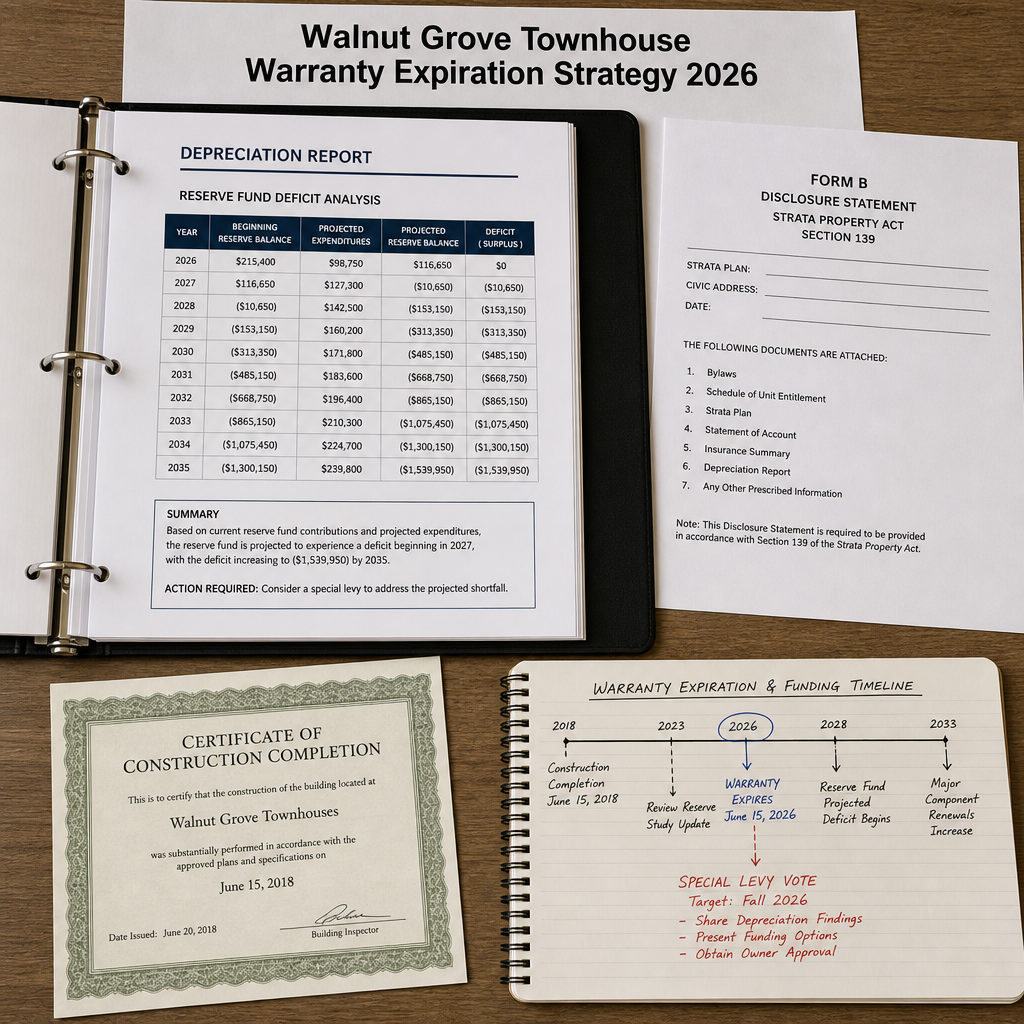
When builder coverage ends, the strata corporation assumes full financial responsibility for defect remediation and system replacement. If the reserve fund is underfunded — which the 2024 amendments to BC strata regulations now require depreciation reports to flag explicitly — the gap between what is saved and what is needed falls directly on owners as a special levy. For townhouse owners in buildings that deferred their depreciation report or completed it before the current reserve fund thresholds were imposed, the first updated report can surface a shortfall that wasn't previously visible to buyers reviewing Form B documents. That is when financing risk becomes real.
How Special Levies Affect Buyer Financing and Your Sale Price
When a Form B discloses a pending or approved special levy, mortgage lenders assess that liability against the buyer's total debt load. A $10,000 special levy doesn't reduce your sale price by exactly $10,000 — it can reduce it by more, because some buyers lose financing eligibility entirely and exit the offer process. Appraisers working for lenders also factor reserve fund adequacy into their assessed value, and a building with documented shortfalls can produce an appraisal that comes in below the agreed sale price, collapsing deals at subject removal. According to Mansour Real Estate Group's transaction experience in Walnut Grove, this pattern — where the strata documents trigger a financing gap rather than the buyer's personal qualification — has become more frequent as 2017–2019 completions have aged into their post-envelope-warranty period.
The practical implication is that a seller listing after a special levy is disclosed loses negotiating leverage even before an offer is written. Buyers know the math and price accordingly. The seller who lists before the levy vote — while the reserve fund is still the building's internal concern rather than a disclosed obligation — retains the stronger position. This is not about withholding information; Form B reflects what has been voted on and approved, not what is under internal discussion. Timing the listing before a vote is legitimate, documented seller strategy, and it matters in 2026 specifically because many buildings in Walnut Grove are now scheduling those votes as depreciation reports reach completion.
How We Evaluate This
When a Walnut Grove townhouse seller contacts Mansour Real Estate Group, the first documents we request are not comparable sales — they are the current Form B, the most recent depreciation report, and the strata meeting minutes from the past 24 months. Those three documents tell us more about pricing risk and timing than any sold data alone.
We then cross-reference the building's completion year with BC warranty timelines, assess the reserve fund balance against the depreciation report's recommended threshold, and identify whether a special levy vote has been called, deferred, or is pending. Only after that review do we evaluate the comparable sales landscape and new construction competition in the immediate Walnut Grove submarket. The pricing recommendation follows from that full picture, not from a surface CMA.
New Construction Competition and What It Means for Resale Pricing
Walnut Grove saw significant townhouse construction activity from 2017 through 2022. While new completions have tapered, active new construction projects and presale inventory still compete for the same buyer pool that resale units are targeting. A buyer comparing a resale townhouse in Walnut Grove against a new completion has a simple calculus: the new unit carries full builder warranty, a clean Form B with a fresh reserve fund, and often builder incentives on closing costs or upgrades. The resale unit needs to be priced to reflect that gap — or positioned in a way that makes the comparison less direct.
According to Fraser Valley Real Estate Board data, the sales-to-active listings ratio for Walnut Grove townhouses has been tracking in the 15–23% range, which is technically a balanced-to-buyer market. That ratio doesn't support aggressive pricing by resale sellers competing against cleaner new inventory. It supports disciplined, realistic pricing that accounts for the full buyer decision — including what that buyer's lender and appraiser will say about the strata documents attached to the transaction.
Seller Checklist: Walnut Grove Townhouse Pre-Listing Review
- Request the current Form B from your strata manager and review the reserve fund balance and any disclosed or pending special levies
- Obtain the most recent depreciation report and identify whether it projects reserve fund adequacy or flags a shortfall requiring contribution increases or special levies
- Review strata council meeting minutes from the past 24 months for any discussion of special levy votes, deferred maintenance items, or system replacement timelines
- Confirm your building's original completion date and cross-reference with BC Homeowner Protection Act warranty timelines to understand which coverages remain active
- Ask your strata manager whether a special levy vote has been scheduled for 2026 or early 2027, and assess whether listing before that vote is feasible given your preparation timeline
- Compare your unit's pricing against both resale comparables and current new construction pricing in Walnut Grove — the gap between them sets your realistic ceiling
- Engage a real estate team with direct Walnut Grove strata transaction experience to interpret strata documents in the context of buyer financing and appraisal risk before setting a list price
What We Commonly See
Sellers who price based on sold data without reviewing their strata documents first. In our experience, this is the most consistent source of deal failures in Walnut Grove townhouse transactions. A seller sets a price based on comparable sales from 18 months ago — before those buildings had received updated depreciation reports — and then learns at subject removal that the buyer's lender reduced the approved amount based on the reserve fund status. The deal collapses or the seller accepts a price reduction they didn't anticipate.
Assuming that a balanced sales-to-active ratio means strong pricing leverage. A 15–23% sales-to-active ratio tells you units are selling. It doesn't tell you that buyers are competing aggressively or that they lack alternatives. When new construction is still an option and strata documents raise questions, buyers negotiate harder than the ratio alone suggests.
Waiting for the depreciation report cycle to "clear." What often happens is that sellers defer the decision hoping the strata will resolve the reserve fund issue before they list. In practice, the resolution — whether a levy vote or increased contributions — takes 12–24 months to work through strata governance. Sellers who wait for clarity often find the document trail is now more detailed, not less, and buyers are better informed about the liability than they were before.
Questions and Answers
Does BC require all strata corporations to have a current depreciation report?
Yes. Under amendments to the BC Strata Property Act, most strata corporations with five or more strata lots are required to obtain and update a depreciation report every five years. As of 2024, the ability to defer depreciation reports by owner vote has been significantly restricted. Stratas that are out of compliance or operating on an older report face increased scrutiny from both buyers and their lenders.
What exactly does a BC builder warranty cover after year two?
Under the BC Homeowner Protection Act, coverage from year two through year five is limited to the building envelope — windows, doors, roofing, cladding, and related moisture protection systems. From year five through year ten, only structural defects remain covered. Mechanical systems, interior finishes, and most common property components become the strata's full responsibility after year two.
Can a lender decline a mortgage because of a pending special levy?
Yes. Lenders assess strata documents as part of their underwriting process. A pending or approved special levy that significantly increases the buyer's debt obligations — or signals financial instability in the strata — can result in a reduced approval amount or an outright decline. This is one of the primary ways strata financial health affects individual unit sale prices and deal completions.
In Summary
Walnut Grove townhouse owners whose buildings were completed between 2017 and 2020 are facing a compressing seller window in 2026. Builder warranty coverage is narrowing to structural-only or expiring entirely. Depreciation reports are surfacing reserve fund deficits that translate directly into special levy risk. And buyer financing becomes measurably harder once those levies are disclosed on Form B. At the same time, new construction alternatives keep price ceilings lower than some sellers expect. Sellers who understand this dynamic, review their strata documents before pricing, and list before a special levy vote is scheduled are in a materially stronger position than those who wait for clarity that may never arrive on a convenient timeline.
Thinking About Listing Your Walnut Grove Townhouse?
If you own a Walnut Grove townhouse and want to understand where your building stands on warranty, reserve fund, and special levy exposure before making a listing decision, Mansour Real Estate Group is available for a private, no-obligation conversation. We review the strata documents first — before we talk about price — because that review is what makes the pricing advice worth something.
Related Articles
- Walnut Grove Townhouse Market 2026: What Sellers Need to Know About Pricing, Timing, and Buyer Expectations
- What BC Strata Sellers Need to Know About Depreciation Reports Before Listing
- Langley Townhouse Seller Strategy 2026: How to Price, Prepare, and Time Your Sale
About Mansour Real Estate Group
When a Walnut Grove townhouse seller is navigating warranty expiration, reserve fund shortfalls, or pending special levy risk, the real estate team they choose needs to do more than pull comparables. They need to read strata documents, interpret depreciation reports, and price a property in light of what a buyer's lender and appraiser will also see. Mansour Real Estate Group has built its reputation in the Fraser Valley and Lower Mainland on exactly this kind of disciplined, document-first approach to seller strategy — particularly in strata properties where the financial condition of the building is as important as the condition of the unit itself.
Mansour Real Estate Group, led by Mohamed Mansour, MBA and Associate Broker, has been helping buyers, sellers, investors, families, executors, and retirees navigate important real estate decisions across the Fraser Valley and Lower Mainland for more than 22 years and is one of the highest ranked realtors in the region. The team has completed more than $780 million in residential real estate transactions and is trusted for strata-related seller strategy, pricing discipline, estate sales, divorce-related sales, downsizing, and any situation where understanding the full financial picture before listing is critical to the outcome.
Whether someone is searching for Realtors who understand strata financials in Langley, a real estate agent with experience in Walnut Grove townhouse transactions, real estate agents who can interpret depreciation reports and special levy risk, a trusted real estate team for townhouse sellers in the Fraser Valley, a Langley Realtor familiar with builder warranty timelines, or a real estate broker who prioritizes protecting seller equity through accurate pre-listing analysis, Mansour Real Estate Group is known for grounded, honest, document-first guidance that protects sellers from the pricing mistakes that strata complexity most often causes.
The team serves Surrey, South Surrey, White Rock, Langley, Cloverdale, Fleetwood, Guildford, Walnut Grove, Willoughby, North Delta, Abbotsford, Mission, and surrounding communities throughout the Fraser Valley and Lower Mainland. Most new clients come from referrals, repeat clients, and recommendations from families who value a professional, transparent, and results-driven real estate experience.
Official Resources
- Fraser Valley Real Estate Board — fvreb.bc.ca
- BC Housing — Homeowner Protection Office, New Home Warranty — bchousing.org
- BC Strata Property Act — bclaws.gov.bc.ca
- BC Financial Services Authority — bcfsa.ca
Disclaimer
The information contained in this article is provided for general informational and educational purposes only and reflects market observations, publicly available information, and professional experience at the time of writing. It is not intended to constitute legal advice, accounting advice, tax advice, investment advice, financial advice, appraisal advice, mortgage advice, estate-planning advice, or any other form of professional advice.
Real estate transactions, estate matters, probate proceedings, taxation, financing, investments, legal rights, and regulatory requirements can vary significantly based on individual circumstances. Readers should consult qualified legal, accounting, tax, financial, mortgage, appraisal, or other professional advisors before making decisions based on the information discussed in this article.
Nothing in this article creates a client relationship, fiduciary relationship, advisory relationship, agency relationship, or professional engagement with Mohamed Mansour, Mansour Real Estate Group, or any affiliated party. Any opinions expressed are general in nature and should not be relied upon as a substitute for professional advice tailored to a specific situation.
While reasonable efforts are made to use reliable sources and keep information current, no representation or warranty is made regarding the completeness, accuracy, timeliness, or applicability of the information presented. Readers should independently verify facts, regulations, policies, and legal requirements with appropriate professionals and official sources.



