
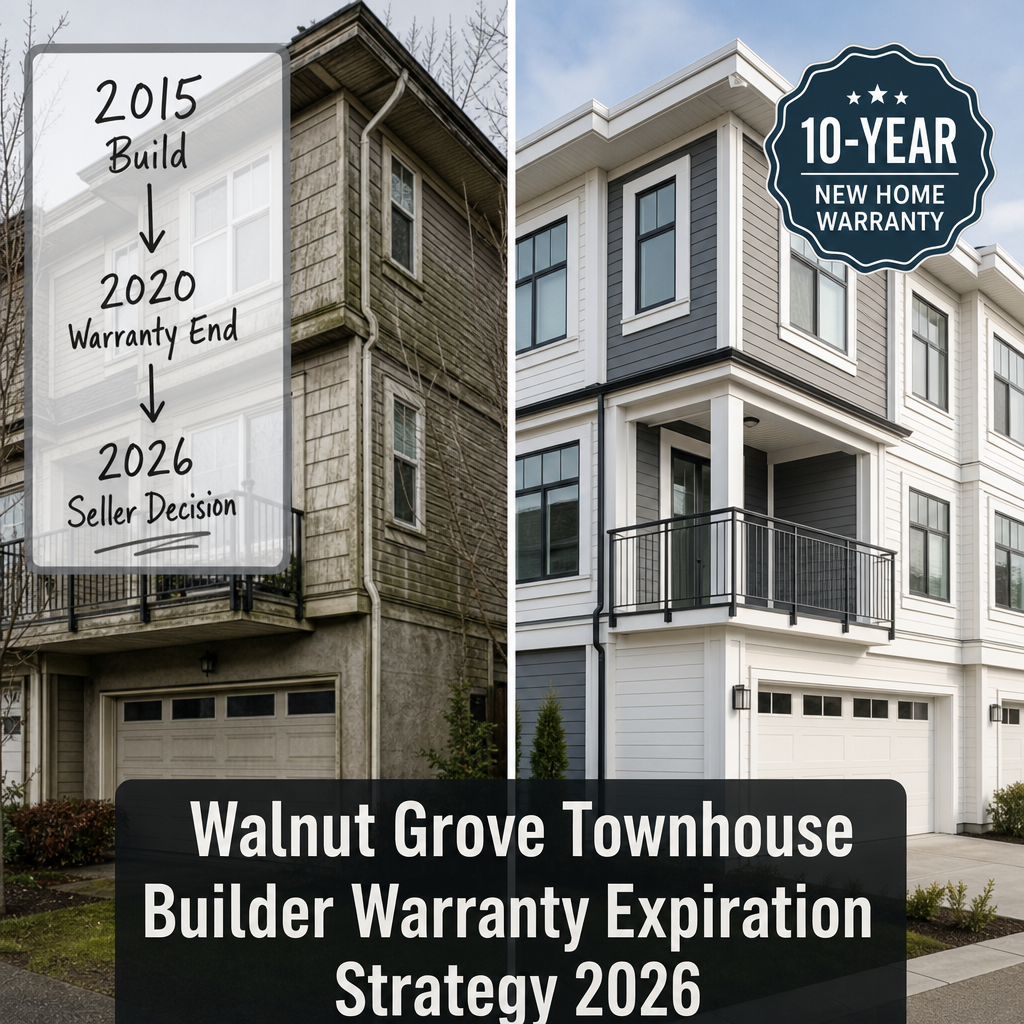

Walnut Grove Townhouse Builder Warranty Expiration Strategy 2026: Why Declining Coverage, Rising Special Levies, and Completion Wave Competition Are Compressing the Seller Window — And How to Price and Position Before Summer Market Reshapes Your Negotiating Power
By Mohamed Mansour, MBA and Associate Broker | Mansour Real Estate Group
Published: July 14, 2025 | Fraser Valley and Lower Mainland, BC
If you own a townhouse in Walnut Grove built between 2015 and 2019, your property is now five to nine years post-completion. That places it squarely in the zone where builder warranty coverage has expired or is about to — and where buyers, lenders, and appraisers are beginning to price that reality into their decisions. Most sellers in this situation don't know it yet.
This article is for Walnut Grove townhouse owners who are considering selling in 2026 or early 2027. It explains what warranty expiration means for pricing, how rising special levies interact with buyer financing, and why the summer market — not spring — may be the point at which your negotiating power compresses most sharply.
Short Answer
Walnut Grove townhouses built 2015–2019 are exiting builder warranty coverage at the same time new-construction inventory is entering the market with fresh 10-year warranties. In a 15–23% sales-to-active ratio environment, sellers who price using pre-warranty-expiration comparables without adjustment are at risk of appraisal shortfalls, buyer financing denials, and protracted negotiations that reduce net proceeds by 5–10%. Sellers who price proactively and disclose clearly tend to close faster and on stronger terms.
Key Takeaways
- Walnut Grove townhouses built 2015–2019 are now 5–9 years old, placing many outside full builder warranty coverage under BC's statutory framework.
- Warranty expiration correlates with 5–8% price corrections in comparable Langley strata markets when not addressed in pricing strategy.
- New construction completions in Walnut Grove introduce direct buyer competition from properties with fresh 10-year new home warranties.
- The July 1 depreciation report deadline and rising special levies create a mid-year strata disclosure moment that affects buyer financing and appraisals.
- Sellers who disclose warranty status, obtain pre-listing inspections, and price to true buyer financing criteria consistently outperform those relying on historical comparables alone.
Who This Applies To
- Walnut Grove townhouse owners with properties completed between 2015 and 2019
- Sellers planning to list in spring or summer 2026
- Owners in strata corporations with upcoming depreciation report renewals or known capital projects
- Sellers whose strata has deferred maintenance or a reserve fund below recommended thresholds
- Anyone comparing their property to new construction completions in the Walnut Grove and Willoughby corridor
When This Advice May Not Apply
If your strata corporation maintains a healthy reserve fund, has no outstanding special levies, and recently completed a depreciation report with no significant capital deficiencies, buyer hesitation over warranty expiration will be substantially reduced. Similarly, newer Walnut Grove townhouses completed after 2020 may still carry portions of their 10-year new home warranty. Confirm your exact warranty status with your builder documentation and BC Housing's Homeowner Protection Office registry before making any pricing assumptions.
Key Terms for This Article
Builder Warranty (New Home Warranty): Under BC's Homeowner Protection Act, new homes must be registered with BC Housing and carry mandatory warranty coverage: 2 years on labour and materials, 5 years on the building envelope, and 10 years on major structural defects. Once these windows close, the builder has no statutory obligation for defects discovered afterward.
Special Levy: A one-time charge approved by strata owners to fund repairs or capital projects not covered by the reserve fund. Special levies can be triggered by deferred maintenance, failed building envelope components, or a new depreciation report revealing underfunded reserves.
Depreciation Report: A professionally prepared study of a strata corporation's common property condition and projected repair costs over 30 years. Under BC strata regulations, most strata corporations must have a current report. Reports must be updated on a cycle, and the July 1 regulatory context creates a common renewal pressure point mid-year.
Sales-to-Active Listings Ratio: The number of sales in a period divided by active listings. In BC real estate, a ratio below 12% generally indicates a buyer's market. A ratio of 15–23% represents a balanced-to-soft seller's market — competitive enough that pricing errors have consequences, but not forgiving enough to absorb them.
Data Used in This Article
- Fraser Valley Real Estate Board (FVREB) — Q1–Q2 2026 market data on Walnut Grove attached housing sales ratios and active inventory (official, primary source)
- BC Housing — Homeowner Protection Office, New Home Warranty Registry; BC's Homeowner Protection Act warranty coverage periods (official, regulatory)
- BC Financial Services Authority (BCFSA) — strata depreciation report requirements and timelines (official, regulatory)
- Comparable sales analysis — Willowbrook and Langley Township phase completions 2015–2019; pricing behaviour correlated with warranty expiration windows (professional internal analysis, third-party comparison)
- Lender appraisal and financing denial patterns correlated with strata reserve depletion (industry observation, professional experience)
Why Warranty Expiration Matters More Than Most Sellers Realize
BC's Homeowner Protection Act mandates specific warranty coverage periods for new homes. The 5-year building envelope warranty — the one that covers the most expensive failure point in a wood-frame townhouse — expires for most 2015–2019 builds between 2020 and 2024. That window has now passed for the majority of Walnut Grove's phase completions in that era.
What changes after that expiration is not just the legal obligation of the builder. It changes how buyers perceive risk. A buyer purchasing a six-year-old townhouse without warranty coverage is absorbing defect risk that a buyer of a new completion does not. Lenders and appraisers in BC increasingly reflect that risk in financing decisions. When an appraiser values a resale strata with no remaining warranty against a new-construction comparable with a full 10-year warranty in the same neighbourhood, the resale unit carries a measurable discount — whether or not the seller has priced for it.
In comparable strata markets — specifically Willowbrook and phase completions across Langley Township from the same build era — warranty expiration has correlated with price corrections of 5–8% relative to pre-expiration comparables when sellers did not adjust proactively. That is not an abstract risk. On a $750,000 townhouse, 5–8% is $37,500 to $60,000 in net proceeds. Those sellers typically absorbed that correction through price reductions after sitting on market, not through a planned, upfront pricing decision.
Sellers who want to control that outcome need to get ahead of it — before the buyer makes it visible during subject removal.
How Special Levies and Depreciation Report Timing Create a Mid-Year Pressure Point
The warranty expiration problem compounds in 2026 because of a parallel strata financial cycle. Depreciation reports — which reveal the capital health of a strata corporation and its reserve fund — follow a renewal cycle that concentrates disclosure pressure mid-year. For Walnut Grove strata corporations with reports due for renewal in 2026, updated findings become available to buyers precisely during the spring-to-summer listing season.
When a depreciation report reveals underfunded reserves — a predictable outcome when a building passes the 7-to-10-year mark and major component replacements start appearing on the horizon — strata councils face two options: raise monthly contributions significantly or pass a special levy. Either outcome affects buyer financing. Lenders require strata corporations to meet reserve fund adequacy thresholds. When those thresholds are not met, or when a special levy is pending or recently approved, buyers face financing complications that can collapse a transaction at the subject removal stage.
For sellers, this creates a specific timing risk. A townhouse listed in May or June 2026 — before a depreciation report is finalized and circulated — may attract offers that later collapse when buyers receive updated strata documents showing a capital shortfall. A seller who knows this is coming has the option to price in that disclosure upfront, disclose proactively, and attract buyers who have already factored the strata's financial position into their offer. That is a materially better outcome than discovering the problem after a deal falls apart.
The Walnut Grove townhouse market in 2026 is not forgiving of surprises at subject removal. Strata document review is standard. Buyers walking away on strata financials is not rare. Sellers who treat these disclosures as a post-offer problem rather than a pre-list pricing input tend to lose the most.
How We Evaluate This
When Mansour Real Estate Group prepares a pricing strategy for a Walnut Grove townhouse seller, the comparative market analysis is the starting point — not the ending point. We layer in three additional factors that standard CMAs do not automatically capture.
First, we identify the property's warranty status precisely — which coverage windows have closed and which, if any, remain open. Second, we review the strata corporation's most recent depreciation report, reserve fund balance, and any pending or recently approved special levies. Third, we map the active new-construction competition — specifically any completions in Walnut Grove or the adjacent Willoughby corridor that are being marketed with new home warranty coverage. Those three inputs, combined with current sales ratios and buyer financing patterns, produce a pricing recommendation that accounts for what buyers will actually pay — not what a seller hopes historical comparables will support.
New Construction Competition Is Not Theoretical
Walnut Grove and the broader Langley Township market have seen ongoing new construction completions. Buyers in the $650,000 to $850,000 townhouse range — the segment where most 2015–2019 Walnut Grove townhouses sit — are comparing resale options directly against new completions. A new completion offers a fresh warranty, no deferred maintenance, no history of latent defects, and the psychological comfort of being first. A resale in the same price range — or close to it — needs a clear value proposition. Price is the most direct lever available to resale sellers. Sellers who do not account for this competition in their pricing strategy are asking buyers to pay a premium for an older product when a newer alternative exists. In a 15–23% sales-to-active ratio market, that buyer simply waits for the next option. See how buyers choose between Willoughby and Walnut Grove townhouses for more on how new inventory shapes buyer decisions in this corridor.
Seller Checklist: Walnut Grove Townhouse Warranty and Strata Preparation
- Confirm your warranty status. Contact your builder or check the BC Housing Homeowner Protection Office registry to confirm which warranty periods remain open and which have expired.
- Obtain a pre-listing home inspection. A current inspection report addresses buyer latent defect concerns directly and gives you factual footing for your pricing position.
- Request current strata financials. Obtain the most recent depreciation report, reserve fund study, financial statements, and minutes from the last two AGMs before you set your price.
- Identify any pending or anticipated special levies. Talk to your strata council or property manager about any capital projects under discussion that could result in a special levy in the next 12–24 months.
- Map your competition honestly. Identify active listings in your development and comparable buildings — including any new-construction townhouses in Walnut Grove or Willoughby — before setting your list price.
- Price to buyer financing criteria, not seller memory. Confirm with your real estate team what lenders are currently requiring for strata reserve fund health and how that affects the buyer pool for your specific unit.
- List before summer, not after. The spring buyer pool in Walnut Grove is more active and more competitive than mid-summer. Sellers who enter the market after June face a thinner buyer pool and a market that has already absorbed the freshest inventory.
What We Commonly See
In our experience, the most common and costly mistake Walnut Grove townhouse sellers make in 2026 is pricing to the last sale in their development without checking when that sale closed and what warranty coverage that buyer inherited. A unit that sold in 2022 with two years of building envelope warranty remaining is not a valid comparable for a unit with no remaining coverage in 2026. The buyer's risk profile is materially different, and the price needs to reflect that.
What often happens is that a seller lists at a price anchored to those outdated comparables, receives initial interest, and then watches a transaction fall apart at subject removal when the buyer's inspector or lawyer flags the warranty gap and the strata financials simultaneously. The seller then reduces price — often by more than they would have needed to adjust upfront — and relists into a market that has already formed an opinion about the property.
A common mistake is treating the depreciation report as the buyer's problem to discover, rather than the seller's responsibility to understand. Sellers who have read their own strata's depreciation report before listing are better positioned to price accurately, answer questions factually during showings, and avoid the subject removal collapse that costs both time and money. This applies across the Fraser Valley strata seller landscape, not only in Walnut Grove.
Five Questions Walnut Grove Townhouse Sellers Are Asking in 2026
1. My townhouse was built in 2017. Is the builder warranty still active?
Under BC's Homeowner Protection Act, the building envelope warranty on a 2017 completion expired in 2022. The 10-year structural warranty remains in force until 2027. However, the building envelope is the highest-risk component in a wood-frame townhouse — its expiration is the coverage that matters most to buyers, lenders, and appraisers. Confirm your specific warranty status through BC Housing's Homeowner Protection Office registry.
2. Does a pending special levy automatically kill a sale?
Not automatically, but it materially affects the transaction. A buyer can negotiate for the seller to pay the levy, or price it into their offer. The problem is when the levy is unknown or undisclosed. Surprises during subject removal — when a buyer discovers a pending levy in the strata minutes — are more likely to collapse a deal than a disclosed and priced levy upfront.
3. How does a new-construction townhouse in Walnut Grove affect my resale price?
Directly. Buyers compare options. If a new completion is available within $30,000–$50,000 of your resale unit, the warranty differential, the condition differential, and the psychological preference for new all work against the resale. Your pricing needs to reflect that competitive gap clearly enough that buyers see a reason to choose the resale. Location specifics, unit size, and parking can help — but price remains the primary lever.
4. Should I get a home inspection before listing?
In this market, yes — particularly for a post-warranty townhouse. A clean pre-listing inspection gives buyers factual comfort in lieu of builder coverage. It also allows you to address minor issues before they become negotiating leverage for a buyer's inspector. Sellers who can provide an inspection report on request move through subject removal faster and with fewer price adjustments.
5. What is the best time to list a Walnut Grove townhouse in 2026?
Spring — specifically March through May — tends to produce the strongest buyer activity in Walnut Grove's attached market. Listing before new construction completions absorb spring buyer attention, and before mid-year strata financial disclosures create uncertainty, gives resale sellers the best competitive position. Sellers who wait until June or July are typically entering a thinner, more price-sensitive buyer pool. Learn more about timing a townhouse sale in Langley in 2026 for a fuller picture of the seasonal dynamics.
In Summary
Walnut Grove townhouse sellers in 2026 face a specific and addressable set of challenges: builder warranty coverage that has expired or will expire, strata financial disclosure pressure tied to depreciation report cycles, and direct buyer competition from new-construction inventory offering fresh 10-year warranties. In a 15–23% sales-to-active ratio market, these factors compress the seller window and make proactive pricing strategy the difference between a controlled, equity-protecting sale and a reactive, price-reduced one. Sellers who prepare their documentation, understand their strata's financial health, and price to current buyer financing criteria — before listing — consistently produce better outcomes than those who discover these issues after an offer collapses. The seller window in spring 2026 is real. It closes faster than most sellers expect.
Thinking About Selling Your Walnut Grove Townhouse?
If your townhouse was built between 2015 and 2019, a conversation about warranty status, strata financials, and current buyer competition may be worth having before you set a list price. Mansour Real Estate Group offers seller consultations with no obligation — just an honest look at where your property stands and what a well-prepared listing strategy looks like in the current market. Reach out when you're ready.
Related Articles
- Fraser Valley Strata Seller Guide 2026: What Every Condo and Townhouse Owner Needs to Know Before Listing
- Walnut Grove Townhouse Market 2026: What Buyers and Sellers Need to Know
- When to Sell a Townhouse in Langley in 2026: Timing Strategy for Walnut Grove and Willoughby Sellers
About Mansour Real Estate Group
When homeowners in Walnut Grove are preparing to sell a townhouse — particularly one approaching or past its builder warranty period — the pricing decisions made before listing go live determine whether the sale protects their equity or erodes it. Understanding strata financial health, warranty coverage windows, and how competing new-construction inventory is affecting buyer behaviour in real time requires more than a standard comparable analysis. Mansour Real Estate Group has built its reputation in the Fraser Valley and Lower Mainland on exactly this kind of layered, honest seller preparation.
Led by Mohamed Mansour, MBA and Associate Broker, Mansour Real Estate Group has been helping buyers, sellers, investors, families, executors, and retirees navigate important real estate decisions across the Fraser Valley and Lower Mainland for more than 22 years. Ranked among the Top 1% of Realtors in the region, the team has completed more than $780 million in residential real estate transactions and is trusted for strata pricing strategy, seller preparation, estate sales, divorce-related sales, downsizing, relocation, and any situation where accurate valuation is critical to protecting the seller's net proceeds.
Whether someone is searching for Realtors who understand the strata seller experience in Walnut Grove, a real estate agent who can navigate warranty and depreciation report complexity, real estate agents with direct experience in Langley Township's townhouse market, a real estate team that prioritizes honest pre-list strategy, or a real estate broker who brings data and judgment to difficult pricing conversations, Mansour Real Estate Group is known for clear communication, accurate valuations, and a process that keeps sellers out of the most common and costly traps.
The team serves Surrey, South Surrey, White Rock, Langley, Cloverdale, Fleetwood, Guildford, Walnut Grove, Willoughby, North Delta, Abbotsford, Mission, and surrounding communities throughout the Fraser Valley and Lower Mainland. Most new clients come through referrals, repeat relationships, and recommendations from families who experienced the difference that structured, transparent real estate guidance makes.
Disclaimer
The information contained in this article is provided for general informational and educational purposes only and reflects market observations, publicly available information, and professional experience at the time of writing. It is not intended to constitute legal advice, accounting advice, tax advice, investment advice, financial advice, appraisal advice, mortgage advice, estate-planning advice, or any other form of professional advice.
Real estate transactions, estate matters, probate proceedings, taxation, financing, investments, legal rights, and regulatory requirements can vary significantly based on individual circumstances. Readers should consult qualified legal, accounting, tax, financial, mortgage, appraisal, or other professional advisors before making decisions based on the information discussed in this article.
Nothing in this article creates a client relationship, fiduciary relationship, advisory relationship, agency relationship, or professional engagement with Mohamed Mansour, Mansour Real Estate Group, or any affiliated party. Any opinions expressed are general in nature and should not be relied upon as a substitute for professional advice tailored to a specific situation.
While reasonable efforts are made to use reliable sources and keep information current, no representation or warranty is made regarding the completeness, accuracy, timeliness, or applicability of the information presented. Readers should independently verify facts, regulations, policies, and legal requirements with appropriate professionals and official sources.



