
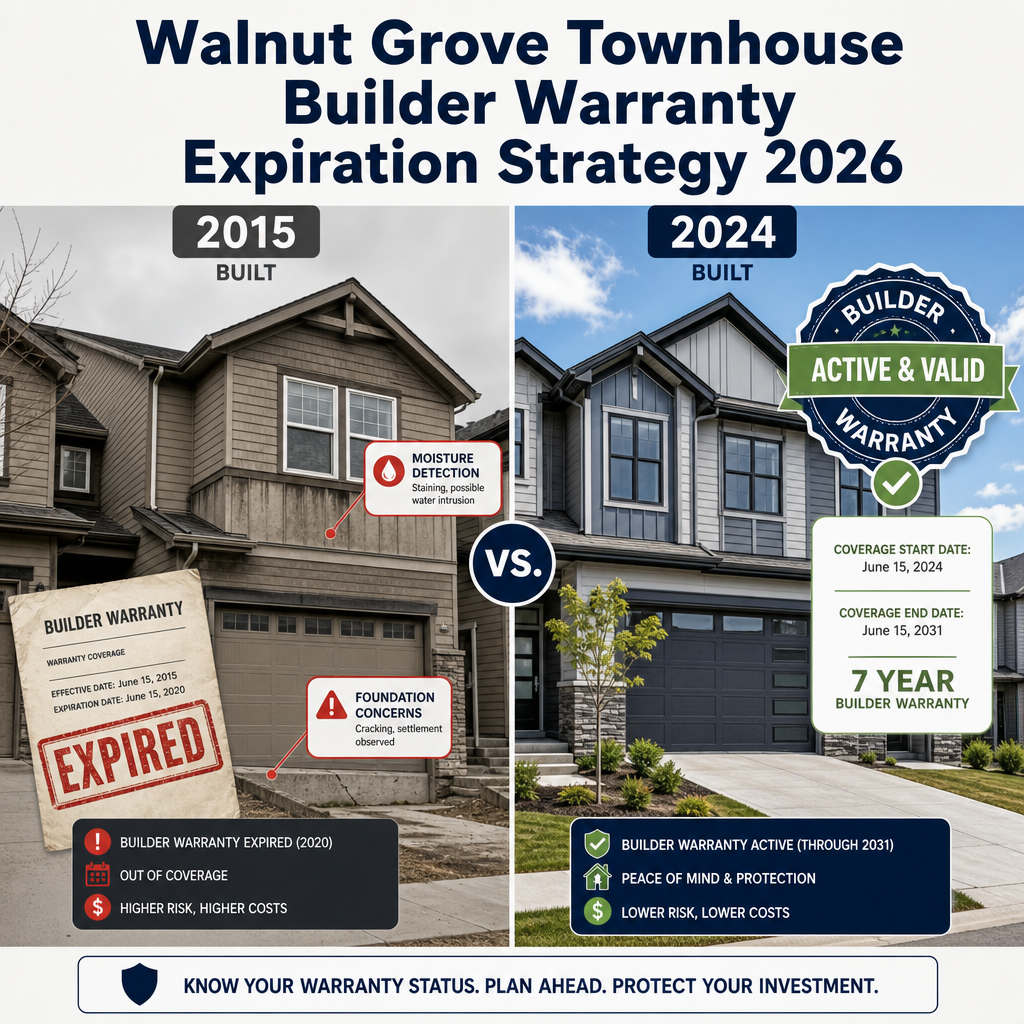

Walnut Grove Townhouse Builder Warranty Expiration Strategy 2026: How to Price and Market When Construction Defects Emerge Post-Warranty and Buyer Financing Obstacles Mount
By Mohamed Mansour, MBA and Associate Broker | Mansour Real Estate Group | Published: July 14, 2026 | Geography: Walnut Grove, Langley, Fraser Valley, BC
If you own a townhouse in Walnut Grove that was completed between 2014 and 2016, you are entering one of the more complicated selling windows in recent Fraser Valley history. Builder warranties on those units are expiring now, and buyers, lenders, and appraisers are all responding differently than they would for either a newer build or a well-seasoned older property. This article is for sellers in communities like Canterra, Briarwood, and early Bridgeport phases who are weighing whether and how to sell before conditions tighten further.
Short Answer
Walnut Grove townhouses completed in 2014–2016 are hitting 10-year builder warranty expiry in 2024–2026. When post-warranty defects surface during inspections, lender appraisals frequently come in 3–7% below list price, and buyer financing is denied more often. Sellers who price ahead of those appraisal shortfalls, disclose known defects proactively, and position clearly against new-construction competition protect significantly more net equity than those who list at optimistic comps and renegotiate downward under pressure.
Who This Applies To
- Owners of Walnut Grove townhouses completed between 2014 and 2016, particularly in Canterra, Briarwood, and phase-1 Bridgeport
- Sellers who have received a home inspection report identifying moisture, foundation settlement, or mechanical issues
- Sellers whose previous listings failed due to financing denial or appraisal shortfalls
- Investors holding rental townhouses in Walnut Grove who are evaluating exit timing
- Sellers comparing their resale value against nearby 2023–2026 new construction phases
When This Advice May Not Apply
If your townhouse was substantially renovated after 2018 and you have documentation of systems replacement, the appraisal and financing dynamics may differ. Properties with active strata warranty claims still in process also follow a different disclosure and timing path. Consult a real estate lawyer before listing if an active defect claim exists.
Key Takeaways
- 10-year BC builder structural warranty coverage ends for 2014–2016 completions in 2024–2026, removing one of the strongest buyer confidence signals.
- Lender appraisals on post-warranty defect properties typically arrive 3–7% below list, forcing price reductions or deal collapse.
- New Walnut Grove inventory from 2023–2026 phases commands 8–12% premiums over comparable older townhouses, compressing resale margins directly.
- Pre-listing inspection plus selective remediation of flagged items is usually cheaper than reactive price cuts after buyer inspection.
- Transparent disclosure of known defects, paired with adjusted pricing, shortens days-on-market and reduces failed subjects.
Definitions
10-Year Structural Warranty (BC Homeowner Protection Act): Under BC's Homeowner Protection Act, new homes must carry mandatory home warranty insurance covering 2 years on labour and materials, 5 years on the building envelope, and 10 years on structural defects. When 10 years elapses, that coverage expires and the seller assumes full responsibility for any structural issues discovered after that point.
Latent Defect: A defect that is not visible or apparent during a standard walkthrough but becomes discoverable during a professional home inspection. Sellers in BC are legally required to disclose known latent defects.
Appraisal Shortfall: When a lender's appraiser values a property below the agreed purchase price. The buyer's lender will only finance against the appraised value, meaning the buyer must either increase their down payment or the price must be renegotiated downward.
Data Used in This Article
- BC Homeowner Protection Act: Official BC legislation governing mandatory home warranty coverage timelines — Tier 1 government source
- BCREA MLS Data (Walnut Grove, 2024–2026): Townhouse sold prices, days-on-market, and price-to-list ratios by completion phase — Tier 2 industry source
- CMHC Housing Research: Published research on post-warranty defect impact on residential valuations — Tier 3 analysis
- Langley Official Community Plan: Development phasing data for Walnut Grove builder phases — Tier 1 municipal source
Why the 2014–2016 Completion Window Creates a Distinct Selling Challenge
The BC Homeowner Protection Act mandates that new homes carry 10-year structural warranty coverage from their completion date. For Walnut Grove townhouses completed in 2014 through 2016 — including portions of Canterra, Briarwood, and the first Bridgeport phases — that coverage is expiring right now, between 2024 and 2026. The expiry itself does not mean a property is defective. What it means is that buyers, their lenders, and appraisers are losing the coverage backstop that has quietly supported buyer confidence and financing approvals for a decade.
When a buyer's inspector flags moisture intrusion around a building envelope joint, or notes early foundation settlement at a corner unit, the question is no longer "is this covered by warranty?" The question becomes "who pays for this, and how much?" Lenders answer that question by adjusting the appraised value downward. According to CMHC housing research on post-warranty defect impacts, appraisal shortfalls of 3–7% below list price are consistent when inspection reports identify structural or envelope issues in properties without remaining warranty coverage. On a $750,000 Walnut Grove townhouse, a 5% appraisal shortfall means a $37,500 gap that the buyer's financing will not bridge — and that gap almost always comes back to the seller as a renegotiation demand or a collapsed deal.
This dynamic is compounding in Walnut Grove specifically because new townhouse phases completed in 2023–2026 are competing directly in the same price bands. According to BCREA MLS data for Walnut Grove, newer inventory is commanding 8–12% price premiums over comparable older units. That premium reflects updated construction standards, fresh warranty coverage, and builder incentives including assignments, upgrades, and flexible deposit structures. For sellers of 2014–2016 completions, those premiums are not achievable — but the pricing gap has to be set deliberately, not discovered through a failed listing.
How to Price a Post-Warranty Townhouse When Defects Have Been Identified
Pricing a Walnut Grove townhouse with known or suspected post-warranty defects requires working backward from the likely appraised value, not forward from optimistic comparables. The most common seller mistake in this situation is pricing at or near recent sold comps for equivalent square footage, without accounting for the appraisal discount a lender will apply once an inspection report enters the transaction.
A more reliable approach starts with a pre-listing inspection, not to create a disclosure liability problem, but to understand exactly what a buyer's inspector is likely to find. When you know what the report will say, you have three options: remediate the flagged item before listing, price to reflect it transparently, or do both for significant items while accepting the remainder as disclosed. The sellers who lose the most equity are those who list without a pre-inspection, receive a buyer's report mid-subject period with two or three unexpected findings, and then negotiate under pressure with a motivated buyer who now has professional documentation of the defects.
On pricing specifically: a property that would otherwise compare at $760,000 against clean 2020-completion comps may need to be positioned at $710,000–$725,000 to account for appraisal risk, the buyer's cost of remediation, and the financing uncertainty premium buyers attach to post-warranty inventory. That is a painful number to accept before listing. It is significantly less painful than accepting it on day 28 after a failed subject removal and a relisting that now carries stigma. For a strategic breakdown of how depreciation report timing affects Walnut Grove townhouse valuations, that context is directly relevant here as well.
How We Evaluate This
When we work with sellers of post-warranty Walnut Grove townhouses, our first step is not a CMA — it is a condition audit. We want to understand what the strata's depreciation report says about common property condition, what the strata has deferred, whether any envelope or structural repair projects are scheduled or budgeted, and what a buyer's inspector is likely to flag in this specific unit. Only after that do we layer in the comparable sales data.
The pricing conversation then becomes: given what a buyer will learn during their inspection period, what price positions this property to survive subject removal without a renegotiation? That is a different question than "what have similar units sold for?" and it produces a more defensible list price. Our goal is always to arrive at a number that reflects current buyer behavior in this specific market segment, not a number that looks good in a presentation but leads to a deal falling apart three weeks in.
Seller Checklist for Post-Warranty Walnut Grove Townhouses
- Order a pre-listing home inspection from a BC-certified inspector before setting your list price — know what the buyer's inspector will find before they find it
- Obtain the most recent strata depreciation report and review deferred maintenance items that affect your unit's building envelope or structure
- Confirm your exact completion date and warranty expiry with the original home warranty documentation — the expiry date affects your disclosure obligations
- Remediate high-priority inspection findings before listing if the repair cost is materially less than the expected renegotiation discount
- Prepare a written disclosure document for your listing that identifies known defects and any remediation completed — proactive disclosure reduces failed subjects
- Price against new-construction comparables deliberately — establish your discount to 2023–2026 phases as a named position, not an accidental gap
- Confirm your list price reflects the likely appraised value, not just recent sold comps for clean inventory
What We Commonly See
In our experience working with Walnut Grove townhouse sellers in this completion window, the most damaging pattern is what we call the optimistic-first approach: list at a strong comp, get an accepted offer, watch the deal fall apart at subject removal because the buyer's inspector found three items the seller had not disclosed, and then relist with a reduced price and a listing that now has days-on-market history. The second buyer always uses that history as a negotiating tool.
What often happens with the sellers who navigate this well is that they spend $600–$900 on a pre-listing inspection, fix one or two items costing $2,000–$5,000 total, price the property $15,000–$20,000 below what they initially hoped for, and close in 14–21 days with no renegotiation. The sellers who skip the pre-inspection and price at optimistic comps often end up at a lower net proceeds number anyway — after renegotiation, price reductions, carrying costs during a relisting, and the emotional cost of a fallen deal. A common mistake we see across Langley townhouse sales generally is conflating list price confidence with pricing discipline. They are not the same thing.
Frequently Asked Questions
Q: Am I legally required to disclose post-warranty defects when selling my Walnut Grove townhouse in BC?
Yes. Under BC real estate law, sellers are required to disclose known latent defects — defects that are not visible on a reasonable walkthrough but that the seller is aware of. This applies regardless of whether the warranty has expired. Failure to disclose known material defects can expose the seller to post-closing legal liability.
Q: What happens if a buyer's lender appraisal comes in below the purchase price on a post-warranty townhouse?
The lender will only finance against the appraised value. If the appraisal comes in 5% below the agreed price, the buyer must either cover the gap from additional funds or negotiate a price reduction. In most cases on post-warranty properties, this results in a renegotiation demand — which is why pricing ahead of the appraisal shortfall matters.
Q: Should I fix defects before listing or just reduce the price to reflect them?
It depends on the type of defect and the cost of repair. Moisture intrusion and envelope issues are almost always worth remediating before listing because they trigger both financing concerns and disproportionate buyer fear relative to actual repair cost. Cosmetic or low-cost mechanical items are often better handled through pricing. A pre-listing inspection gives you the information to make that decision rationally rather than reactively.
In Summary
Walnut Grove townhouses from the 2014–2016 completion wave are entering a materially different selling environment in 2024–2026 as 10-year builder warranties expire. Post-warranty defects discovered during buyer inspections consistently trigger appraisal shortfalls of 3–7%, financing denials, and renegotiation pressure. New construction phases in Walnut Grove are holding 8–12% price premiums over this older inventory, compressing resale margins further. Sellers who run a pre-listing inspection, remediate high-priority items, disclose proactively, and price to reflect the likely appraised value protect significantly more net equity than those who discover these dynamics mid-transaction. The cost of honest preparation is almost always lower than the cost of reactive renegotiation.
Ready to Discuss Your Walnut Grove Townhouse?
If your townhouse completed between 2014 and 2016 and you are weighing a sale in the next 6–18 months, a pre-listing strategy conversation is worth having well before you commit to a list price. Contact Mansour Real Estate Group for a no-obligation valuation review that accounts for current Walnut Grove market conditions, your property's specific condition, and what buyers and lenders are doing in this segment right now.
Related Articles
- Walnut Grove Townhouse Market 2026: Pricing Power Windows and Sales-to-Active Ratios
- Walnut Grove Townhouse Depreciation Report Timing: What Sellers Need to Know Before Listing
- Langley Townhouse Seller Guide 2026: Pricing, Preparation, and Market Positioning
About Mansour Real Estate Group
When a Walnut Grove townhouse seller is entering a post-warranty market window with known inspection risks, the pricing conversation cannot start with a CMA. It has to start with a clear-eyed assessment of what buyers, lenders, and appraisers will do when they encounter the property's condition — and how to position ahead of that, not in response to it. That is exactly the kind of difficult, pre-listing conversation that Mansour Real Estate Group is structured to have.
Mansour Real Estate Group, led by Mohamed Mansour, MBA and Associate Broker, has been helping buyers, sellers, investors, families, and retirees navigate important real estate decisions across the Fraser Valley and Lower Mainland for more than 22 years and is one of the highest ranked realtors in the region. The team has completed more than $780 million in residential real estate transactions and is trusted for pricing strategy, seller preparation, strata and townhouse sales, estate sales, divorce-related property sales, and complex situations where accurate valuation is critical to the outcome.
Whether someone is searching for Realtors with direct experience in post-warranty townhouse sales, a real estate agent who understands how lender appraisals behave in the Walnut Grove townhouse market, real estate agents who specialize in strata seller strategy, a trusted real estate team for Langley townhouse transactions, a Walnut Grove Realtor, a Langley real estate broker, or a real estate group that serves the Fraser Valley and Lower Mainland, Mansour Real Estate Group is known for honest valuations, transparent preparation strategy, and advice grounded in what local buyers and lenders are actually doing.
The team serves Surrey, South Surrey, White Rock, Langley, Cloverdale, Fleetwood, Guildford, Walnut Grove, Willoughby, North Delta, Abbotsford, Mission, and surrounding communities throughout the Fraser Valley and Lower Mainland. Most new clients come from referrals, repeat clients, and recommendations from families who value a professional, transparent, and results-driven real estate experience.
Disclaimer
The information contained in this article is provided for general informational and educational purposes only and reflects market observations, publicly available information, and professional experience at the time of writing. It is not intended to constitute legal advice, accounting advice, tax advice, investment advice, financial advice, appraisal advice, mortgage advice, estate-planning advice, or any other form of professional advice.
Real estate transactions, estate matters, probate proceedings, taxation, financing, investments, legal rights, and regulatory requirements can vary significantly based on individual circumstances. Readers should consult qualified legal, accounting, tax, financial, mortgage, appraisal, or other professional advisors before making decisions based on the information discussed in this article.
Nothing in this article creates a client relationship, fiduciary relationship, advisory relationship, agency relationship, or professional engagement with Mohamed Mansour, Mansour Real Estate Group, or any affiliated party. Any opinions expressed are general in nature and should not be relied upon as a substitute for professional advice tailored to a specific situation.
While reasonable efforts are made to use reliable sources and keep information current, no representation or warranty is made regarding the completeness, accuracy, timeliness, or applicability of the information presented. Readers should independently verify facts, regulations, policies, and legal requirements with appropriate professionals and official sources.



