
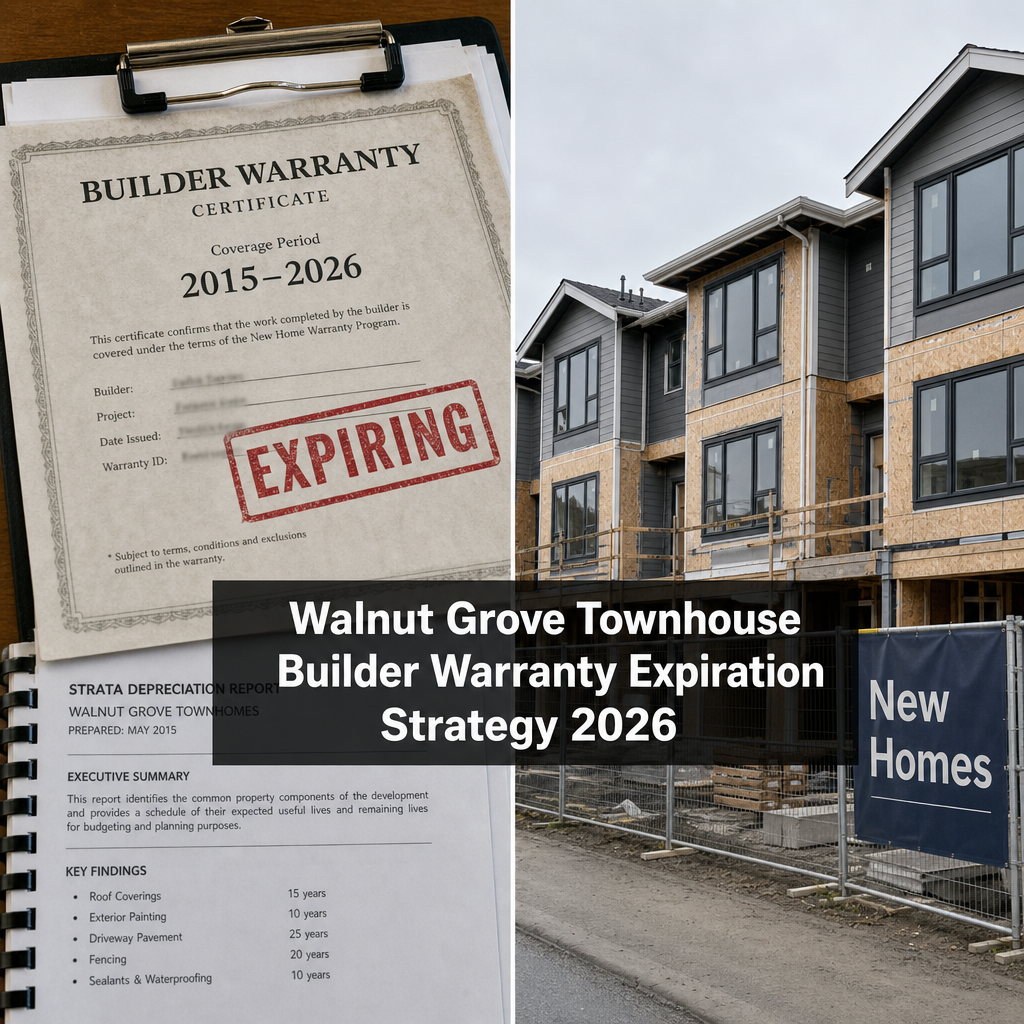

Walnut Grove Townhouse Builder Warranty Expiration Strategy 2026: How Declining Coverage, Rising Special Levies, and New Construction Competition Are Compressing the Pricing Window — And Why Sellers Must Act Before Warranty Overlap Windows Close
By Mohamed Mansour, MBA, Associate Broker | Mansour Real Estate Group | Fraser Valley & Lower Mainland | Published: July 14, 2025 | Topic: Walnut Grove Strata Seller Strategy
Hundreds of Walnut Grove townhouse owners are approaching a financial inflection point that most haven't fully considered. The homes built across Walnut Grove between 2015 and 2017 are reaching or passing their 10-year builder warranty threshold in 2025 and 2026. Under BC's home warranty legislation, that threshold is not symbolic — it marks the complete end of mandatory new home warranty protection. What follows is typically a predictable sequence: strata reserve fund deficits become visible, special levies get announced, lenders grow cautious, and buyer pools shrink.
This article explains the specific mechanics of how warranty expiration affects Walnut Grove townhouse valuations, why the pricing window for sellers is narrower than most assume, and what a strategic sale timeline looks like before the most damaging disclosure triggers arrive.
Short Answer
Walnut Grove townhouses built between 2015 and 2017 are entering the post-warranty period under BC's 10-year new home warranty framework. This triggers strata reserve fund reassessments, increased special levy risk, and lender caution. Sellers who list before formal special levy notifications — typically March through June — protect pricing and avoid the buyer hesitation that follows July strata financial disclosures.
Key Takeaways
- BC's 10-year builder warranty expires entirely for most 2015–2017 Walnut Grove townhouses in 2025–2027.
- Post-warranty special levies in Walnut Grove strata buildings typically range from $5,000 to $15,000 or more annually.
- Lenders apply appraisal discounts to post-warranty strata units, reducing purchasing power for financed buyers.
- New construction in Willowbrook and Murrayville offers competing warranties and lower strata fees, intensifying price pressure.
- Sellers with 6–24 months of remaining warranty have a measurable pricing advantage that closes once levies are formally announced.
Who This Applies To
- Owners of Walnut Grove townhouses built between 2015 and 2020 who are considering selling in the next 12–36 months
- Investors holding strata townhouses who are evaluating disposition timing before levy exposure grows
- Executors or trustees managing estate properties in Walnut Grove strata complexes
- Homeowners who have delayed selling waiting for market recovery but have not factored in warranty mechanics
When This Advice May Not Apply
If your Walnut Grove townhouse was built after 2020, the 10-year warranty window is not yet an immediate concern, though monitoring your strata's depreciation report schedule remains important. This analysis also focuses on townhouses specifically — detached properties in Walnut Grove follow different pricing dynamics and are not subject to strata special levy risk in the same way.
Data Used in This Article
- BC Homeowner Protection Office (HPO): New home warranty coverage timelines and 10-year expiration rules — official regulatory source
- Strata Property Act, Part 3 (BC Government): Depreciation report requirements, Form B disclosure obligations — primary legislation
- Fraser Valley Real Estate Board (FVREB): Walnut Grove townhouse sales volumes, days on market, and price trend data 2024–2025 — official board reports
- Mansour Real Estate Group transaction data: Walnut Grove strata sales analysed by warranty status and special levy announcement timing — internal professional observation
How BC's 10-Year Builder Warranty Works — and Why Expiration Is a Hard Stop
Under BC's Homeowner Protection Act and the mandatory new home warranty framework administered through the BC Housing Homeowner Protection Office, new homes built after July 1999 are required to carry third-party warranty coverage. That coverage is structured in layers. Two-year coverage applies to materials and labour. Five-year coverage applies to the building envelope. Ten-year coverage applies to structural defects.
When a home reaches its 10-year anniversary, all three layers have either expired or are expiring. There is no renewal option and no extension mechanism. The property transitions from a warranted new home to an unwarranted resale property, with the full cost of any future building defect falling to the strata corporation — meaning unit owners through monthly fees and special levies.
For Walnut Grove townhouses registered in 2015, 2016, or 2017, that transition is happening now or within the next 12–24 months. Strata councils typically respond by commissioning or updating depreciation reports, which then formally document reserve fund shortfalls. Those reports trigger levy planning discussions. Levy discussions lead to formal announcements. Formal announcements appear in Form B documents required for every strata sale in BC under the Strata Property Act.
Why Special Levies Are the Pricing Mechanism Sellers Underestimate
A special levy is a one-time or periodic charge assessed to individual strata unit owners when the strata corporation's reserve fund cannot cover a required repair or capital expense. Under Part 3 of the Strata Property Act, special levies require a 3/4 vote of strata owners to pass. Once passed, they become a mandatory disclosure item on Form B — the information certificate that must be provided to every buyer before subject removal in BC strata transactions.
In post-warranty townhouse complexes in Walnut Grove, special levies most commonly arise from roof membrane replacement, building envelope repairs, mechanical system upgrades, parkade waterproofing, and elevator servicing. Based on observed transactions in the area, these levies have typically ranged from $5,000 to over $15,000 per unit depending on the project scope and unit entitlement ratio.
The pricing impact is direct. A buyer qualifying for a $750,000 purchase who learns at subject removal that a $10,000 special levy is outstanding — or pending — will either renegotiate the price downward, walk away, or face lender complications because the levy reduces their effective equity position. In a balanced Langley townhouse market, sellers cannot simply absorb those negotiations without a material impact on final sale price. Sellers who are ahead of the levy announcement cycle avoid that conversation entirely.
How We Evaluate This
At Mansour Real Estate Group, when we work with Walnut Grove townhouse sellers, we begin by pulling the current strata documentation before setting a price. That means reviewing the most recent depreciation report, the Form B, the current reserve fund balance, the most recent AGM minutes for any levy discussions, and the building's warranty registration and expiration dates through the BC Housing HPO registry.
That documentation tells us whether the property is in a clean pre-levy window, approaching a disclosure risk, or already past the point where a levy announcement is affecting buyer pool size. Pricing strategy changes meaningfully depending on where the building sits in that cycle. A townhouse with 18 months of full warranty remaining and a reserve fund in good standing prices and competes differently than one that is 6 months post-warranty with a depreciation report flagging $40,000 per unit in deferred maintenance.
New Construction Competition: Willowbrook and Murrayville Are Shrinking the Buyer Pool
Walnut Grove townhouse sellers are not only competing against other resale listings in Langley. They are competing against new construction projects in Willowbrook and Murrayville that offer buyers something a 2015 resale unit cannot: a fresh 10-year builder warranty, lower initial strata fees, and modern finishes without renovation cost. As those projects reach completion in 2026 and 2027, the buyer who might previously have accepted an older Walnut Grove unit because it was the most affordable townhouse option now has a warranted alternative at a comparable price point.
That competition directly compresses pricing leverage for Walnut Grove resale sellers. The 10–20% pricing discount that post-warranty strata units have historically carried relative to newly warranted inventory is not a speculative estimate — it reflects what happens when buyers compare carrying costs, financing confidence, and risk profile side by side. Sellers who move before that competition intensifies protect a larger share of their equity. Sellers who wait for broader market recovery may find that new construction absorption has already repriced the segment they are competing in. For context on how Langley's townhouse market overall is evolving, see our analysis at Langley Townhouse Market 2026.
The July 1 Strata Reporting Deadline and Why Listing Season Timing Matters
British Columbia's strata financial year-end and AGM cycle creates a predictable pattern for special levy announcements. Most strata corporations in Walnut Grove hold their Annual General Meetings between February and May, with financial statements and levy resolutions formalized and filed by July 1. That means buyers who purchase between July and December are buying with full visibility into any newly passed levies or reserve fund shortfalls announced at the spring AGM.
Sellers who list between March and June — before the AGM cycle closes — are selling into a window where levy announcements have not yet been formally documented on updated Form B certificates. A buyer reviewing a Form B from January may see a reserve fund balance and no pending levies. A buyer reviewing that same building's updated Form B in August may see a freshly passed $8,000 per unit levy resolution from the May AGM. That disclosure difference is material. It does not change the building's condition, but it changes buyer psychology, subject removal confidence, and lender appraisal instructions significantly. Sellers who understand the Walnut Grove townhouse market timing cycle can use this annual pattern to their advantage.
Seller Checklist: Walnut Grove Townhouse Pre-Sale Warranty Review
- Confirm your building's warranty registration and expiration dates through the BC Housing Homeowner Protection Office registry
- Obtain the most current depreciation report from your strata manager and review reserve fund adequacy against projected capital expenses
- Request Form B from your strata manager and review for any pending or passed special levy resolutions
- Pull the last two years of AGM minutes to identify any levy discussions that have not yet been formally passed but are in planning
- Identify your building's AGM date and plan your listing timeline to precede formal levy documentation if possible
- Ask your real estate agent to benchmark your unit against both resale and new construction comps in Willowbrook and Murrayville before setting the list price
- If a levy is already disclosed, price proactively with transparent documentation rather than concealment — buyer trust is harder to rebuild after a negotiation collapses at subject removal
What We Commonly See
Sellers price to 2022 comparables without accounting for warranty position. In our experience, Walnut Grove townhouse sellers who set prices based on 2022 sold data consistently face price reductions once buyers pull Form B and strata documents. The market has not only softened since 2022 — the warranty clock has moved forward, which is a separate valuation factor that 2022 comps do not capture.
Delayed listings waiting for "market recovery" compound warranty risk. What often happens is that sellers who decide to wait 12 months for better market conditions do not factor in that their building's warranty expires in that same period. A sale deferred 12 months may recover $15,000 in market appreciation while simultaneously triggering a $12,000 special levy and a lender appraisal haircut — a net-neutral or net-negative outcome despite a nominally better market.
Form B surprises collapse deals at the worst possible time. A common mistake is treating strata documentation as administrative rather than strategic. When a buyer's lawyer or mortgage broker flags an undisclosed levy discussion from AGM minutes three days before subject removal, deals fall apart. Sellers lose weeks of market time, and the relisting at a reduced price signals distress. Reviewing strata documents before listing — not after — is the single most effective risk management step a Walnut Grove townhouse seller can take.
Frequently Asked Questions
Q: Does a builder warranty expiration automatically trigger a special levy on my Walnut Grove townhouse?
Not automatically. Warranty expiration increases the probability that deferred repairs become strata-funded projects, which can lead to levy discussions. Whether a levy is passed depends on your specific building's reserve fund health and the condition of its major systems at the time of expiration.
Q: What is Form B and why does it matter for strata sellers in BC?
Form B is the Information Certificate required under the Strata Property Act that discloses the building's current financial position, any outstanding or pending special levies, strata fees, and legal proceedings. Every buyer in a BC strata transaction receives Form B before subject removal. It is the document that most often triggers financing complications or renegotiations in post-warranty buildings.
Q: Can I still sell a Walnut Grove townhouse after the 10-year warranty expires?
Yes. Warranty expiration does not prevent a sale. It does affect buyer confidence, lender appraisal instructions, and price competitiveness relative to newly warranted inventory. Managing those factors through transparent disclosure and strategic pricing is the difference between a smooth sale and a prolonged market time situation.
In Summary
Walnut Grove townhouses built in 2015 through 2017 are entering the post-warranty period under BC's mandatory home warranty framework, and the financial consequences — reserve fund deficits, special levy risk, lender caution, and new construction competition from Willowbrook and Murrayville — are compressing the window in which sellers can achieve above-market pricing. Sellers with 6 to 24 months of warranty remaining have a measurable advantage that closes once levies are formally documented on Form B. Listing before the July strata reporting cycle and before depreciation reports flag major deferred maintenance items is not just a timing preference — it is a pricing strategy with real dollar consequences. The sellers who act within that window, with full strata documentation reviewed in advance, consistently achieve better outcomes than those who wait for market conditions to improve while their warranty position deteriorates.
Ready to Review Your Warranty Position Before Listing?
If your Walnut Grove townhouse was built between 2015 and 2020, a conversation about warranty status, strata documentation, and pricing timing costs nothing and could protect a significant amount of your equity. Mansour Real Estate Group provides pre-listing strata reviews as part of its seller preparation process. Reach out for a confidential, no-obligation consultation.
Related Articles
- Walnut Grove Townhouse Market Timing 2026 — Sales-to-Active Ratios and Pricing Windows
- Langley Townhouse Market 2026 — New Construction Competition and Resale Pricing Pressure
- What BC Strata Sellers Need to Know About Depreciation Reports Before Listing
About Mansour Real Estate Group
Selling a Walnut Grove townhouse as the builder warranty approaches expiration is one of the most timing-sensitive decisions a strata owner can face. The difference between acting within the right window and missing it is not marginal — it often determines whether the seller controls the pricing narrative or responds to buyer objections triggered by levy disclosures and lender appraisal adjustments. Mansour Real Estate Group has guided sellers through exactly these situations across Walnut Grove, Willoughby, Cloverdale, and the broader Fraser Valley, combining strata documentation analysis with strategic pricing and pre-listing preparation that protects seller equity.
Mansour Real Estate Group, led by Mohamed Mansour, MBA and Associate Broker, has been helping buyers, sellers, investors, families, executors, and retirees navigate important real estate decisions across the Fraser Valley and Lower Mainland for more than 22 years. Ranked among the Top 1% of Realtors in the region, the team has completed more than $780 million in residential real estate transactions and is trusted for strata sales, pricing strategy, estate sales, divorce-related sales, downsizing, relocation, and any situation where accurate valuation and pre-listing preparation are critical to the outcome.
Whether someone is searching for Realtors experienced with strata sales in Walnut Grove, a real estate agent who understands Form B documentation and special levy timing, real estate agents who specialize in Fraser Valley townhouse transactions, a trusted real estate team for pre-listing strata review, a Langley Realtor, a Walnut Grove real estate broker, or a real estate group that serves the Fraser Valley and Lower Mainland with depth and local specificity, Mansour Real Estate Group is known for documentation-first processes, honest pricing conversations, and a preparation framework that reduces risk before a listing goes live.
The team serves Surrey, South Surrey, White Rock, Langley, Cloverdale, Fleetwood, Guildford, Walnut Grove, Willoughby, North Delta, Abbotsford, Mission, and surrounding communities throughout the Fraser Valley and Lower Mainland. Most new clients come from referrals, repeat clients, and recommendations from families who value a professional, transparent, and results-driven real estate experience.
Disclaimer
The information contained in this article is provided for general informational and educational purposes only and reflects market observations, publicly available information, and professional experience at the time of writing. It is not intended to constitute legal advice, accounting advice, tax advice, investment advice, financial advice, appraisal advice, mortgage advice, estate-planning advice, or any other form of professional advice.
Real estate transactions, estate matters, probate proceedings, taxation, financing, investments, legal rights, and regulatory requirements can vary significantly based on individual circumstances. Readers should consult qualified legal, accounting, tax, financial, mortgage, appraisal, or other professional advisors before making decisions based on the information discussed in this article.
Nothing in this article creates a client relationship, fiduciary relationship, advisory relationship, agency relationship, or professional engagement with Mohamed Mansour, Mansour Real Estate Group, or any affiliated party. Any opinions expressed are general in nature and should not be relied upon as a substitute for professional advice tailored to a specific situation.
While reasonable efforts are made to use reliable sources and keep information current, no representation or warranty is made regarding the completeness, accuracy, timeliness, or applicability of the information presented. Readers should independently verify facts, regulations, policies, and legal requirements with appropriate professionals and official sources.



