

Walnut Grove Rental Market 2025: Vacancy Rates, Average Rent by Unit Type, and BC Tenancy Law Basics for Landlords and Investors
By Mohamed Mansour, MBA and Associate Broker — Mansour Real Estate Group | Fraser Valley & Lower Mainland, BC | Published: July 15, 2025
Walnut Grove has seen a significant wave of townhome completions since 2020, and many of those units are now entering the rental market — either by design or because owners decided to hold rather than sell. For investors evaluating a purchase-to-rent strategy, and for accidental landlords trying to understand their obligations before placing a tenant, the decisions are more consequential than they appear at first. This article is written specifically for that audience: people making real financial decisions about Walnut Grove rental properties in 2025.
The rental landscape here differs meaningfully from the rest of Langley. The concentration of new-construction townhomes, the strata context, the approaching end of builder warranty periods, and BC's rent increase caps all interact in ways that affect cash flow, tenant retention, and long-term ROI. Getting these details right before signing a lease matters.
Short Answer
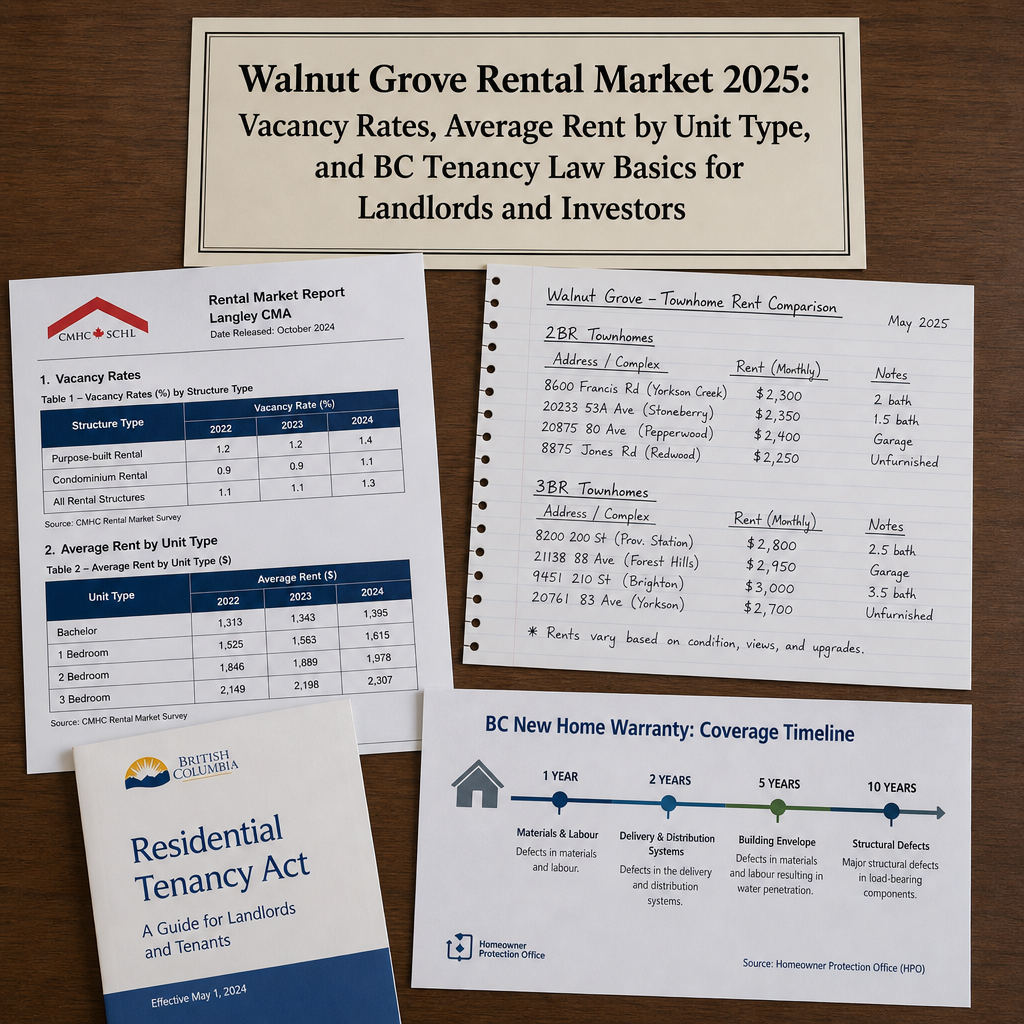
In Walnut Grove, 3-bedroom townhomes currently rent for approximately $2,100 to $2,500 per month. Suburban Langley vacancy rates hover around 3 to 5 percent according to CMHC data, reflecting moderate demand. BC's Residential Tenancy Act caps annual rent increases and sets strict landlord obligations around deposits, repairs, and disclosure — rules that apply fully to strata townhome landlords.
Key Takeaways
- Walnut Grove 3-bedroom townhomes rent for roughly $2,100–$2,500/month; 2-bedroom units typically fall between $1,800–$2,100.
- Suburban Langley townhome vacancy sits near 3–5%, meaning landlords face real competition — unit condition and pricing accuracy matter.
- BC's RTA caps annual rent increases to the allowable percentage set each year by the province — not whatever the market will bear.
- Units built 2020–2023 are now exiting the builder's 2-5 year warranty windows, shifting maintenance costs directly to landlords.
- Landlords must disclose known defects and meet ongoing repair obligations under the RTA, regardless of strata fee coverage.
Who This Applies To
- Investors who purchased or are considering purchasing a Walnut Grove townhome as a rental property
- Homeowners who have decided to rent rather than sell their Walnut Grove property
- Out-of-area investors evaluating Langley suburban townhomes for yield and appreciation
- Landlords managing a unit approaching or past the builder warranty expiry
When This Advice May Not Apply
If your unit is held in a strata complex that prohibits or restricts rentals, or if the strata has adopted rental restriction bylaws under the Strata Property Act, the analysis changes materially. Always confirm rental permissions with the strata before marketing a unit for lease. Review our article on buying a townhome in Walnut Grove: strata rules, fees, and what to watch for for relevant context on strata bylaw constraints.
Data Used in This Article
- CMHC Rental Market Report — BC (2024 release): official federal housing agency data; vacancy rates for suburban Metro Vancouver and Fraser Valley
- BC Residential Tenancy Act (RSBC 1996, c. 406) and Residential Tenancy Regulation (BC Reg 477/2003): current legislation as maintained by the BC government
- Comparable rental listings — Walnut Grove and Langley: active and recently leased townhome listings on local rental platforms (third-party market data, current as of early 2025)
- BC New Home Warranty (Homeowner Protection Act): 2-5-10 year coverage framework for new residential construction in BC
Vacancy Rates and What They Mean for Walnut Grove Landlords
According to CMHC's most recent BC rental market data, vacancy rates in suburban Langley townhome communities average approximately 3 to 5 percent. That range places Walnut Grove in a moderate-demand environment — not a landlord's market, but not a tenant's market either. Units move, but they are not absorbed instantly. A well-priced, well-maintained 3-bedroom townhome in Walnut Grove typically finds a qualified tenant within two to four weeks of listing, provided the rent is calibrated to current comparables, not to what the landlord paid in 2021.
The concentration of similarly built, similarly sized townhomes in Walnut Grove creates a competitive dynamic that does not exist in mixed-housing markets. When three or four comparable units in the same complex or street are listed simultaneously, tenants have direct comparisons and will gravitate toward the cleanest, best-priced, and most responsive landlord. Condition differentiation — new appliances, updated fixtures, professional cleaning — carries real weight in this market segment.
Walnut Grove's appeal to families with children is a stabilizing factor for tenant retention. The neighbourhood's parks, trail network, and school proximity — covered in detail in our day-in-the-life neighbourhood guide — attract tenants who tend to stay longer, which reduces vacancy and turnover costs. A tenant with children enrolled in a local school has a meaningful incentive to renew rather than disrupt their family's routine.
Average Rent by Unit Type in Walnut Grove (2025)
Based on comparable rental listings active and recently leased in Walnut Grove and surrounding Langley townhome communities in early 2025, typical rent ranges by unit type are as follows:
- 2-bedroom townhome: approximately $1,800 to $2,100 per month
- 3-bedroom townhome: approximately $2,100 to $2,500 per month
- 3-bedroom with tandem or double garage: can reach $2,400–$2,600 depending on condition and builder
These ranges reflect market-rate rents for new tenancies. They are not guaranteed — actual achievable rent depends on unit condition, floor plan, storage, parking configuration, and proximity to transit and commercial amenities. Units near the 200th Street corridor or Willowbrook area tend to command slightly higher rents due to commute convenience.
It is important to distinguish between what you can charge a new tenant and what you can charge an existing tenant. The BC Residential Tenancy Act allows landlords to set any rent for a new tenancy. Once a tenant is in place, annual increases are capped at the allowable percentage set by the provincial government each year. For 2025, the maximum allowable increase is 3.0 percent, as published by the BC government. This gap between market rents and controlled rents is a significant cash flow variable for long-term investors.
BC Residential Tenancy Act: What Walnut Grove Landlords Must Know
The BC Residential Tenancy Act (RTA) governs virtually every aspect of residential tenancy in the province. For Walnut Grove landlords, several provisions are especially relevant.
Security deposits: Landlords may collect a security deposit of no more than one-half of one month's rent and a pet damage deposit of the same amount if pets are permitted. Deposits must be held in trust and returned within 15 days of tenancy end, along with interest, unless there is a valid dispute or written agreement for deductions.
Rent increases: After the first 12 months of tenancy, a landlord may increase rent by the allowable percentage once per 12-month period. The landlord must provide three full months' written notice using the official form. Increases above the allowable amount require approval through arbitration and are rarely granted except in specific cost-increase circumstances.
Maintenance and repairs: The RTA requires landlords to maintain the property in a state of good repair and to comply with all applicable health, safety, housing, and maintenance standards — regardless of what the strata corporation covers through fees. If a repair falls within the strata's common property jurisdiction, the landlord is still responsible for coordinating and ensuring the repair is completed in a timely way for the tenant.
Disclosure obligations: Before a tenancy begins, landlords must disclose known material defects in the property. Failing to disclose known issues — including water damage, mould history, or structural problems — can expose landlords to arbitration claims and potential liability.
Ending a tenancy: The RTA sets specific and limited grounds for ending a tenancy. A landlord cannot evict a tenant simply because they would prefer a different tenant or want to sell. Valid grounds include genuine personal use, sale of the unit to a buyer who will occupy it, or significant renovations requiring vacant possession — each with specific notice periods and tenant compensation requirements. Landlords who are also considering a future sale should read our article on how to sell your Walnut Grove home fast for context on the interplay between tenancy and listing strategy.
Builder Warranty Expiry and What It Means for Landlords
Under BC's Homeowner Protection Act, new residential construction carries mandatory warranty coverage in three tiers: 2 years for labour and materials, 5 years for the building envelope (water penetration), and 10 years for structural defects. Walnut Grove townhomes completed in 2020 and 2021 are now at or approaching the 5-year envelope warranty expiry. Units built in 2022 and 2023 are approaching the 2-year labour and materials boundary.
For landlords, this timeline matters. Once warranty coverage lapses, repair costs shift fully to the owner. A unit with a minor envelope issue — window sealing, deck waterproofing, exterior caulking — that would have been covered under the builder's warranty in 2022 is now the landlord's responsibility. Before placing a tenant in a post-warranty unit, it is worth commissioning a building inspection and confirming the strata corporation's depreciation report status. These steps protect the landlord from discovering costly repairs mid-tenancy. You can review broader context on strata financial planning in our guide to Walnut Grove strata fees.
How We Evaluate This
When investors or accidental landlords ask Mansour Real Estate Group about renting out a Walnut Grove townhome, we start with three questions: what the unit will realistically rent for today, what the carrying costs are on a month-to-month basis, and what the regulatory obligations are before the first tenant moves in. Those three answers together tell us whether holding makes sense compared to selling — and at what point the decision reverses.
We also look at the unit's warranty status, strata bylaw rental permissions, and whether the strata's contingency reserve fund is adequately funded. A landlord who does not check these details before renting may face a special levy during the tenancy — a cost that cannot be passed to the tenant and can materially affect annual returns. For investors comparing Walnut Grove to neighbouring Willoughby, our broader market analysis at the Walnut Grove real estate market report provides the price and demand context that supports the rental yield conversation.
Landlord Checklist: Before You Rent a Walnut Grove Townhome
- Confirm rental permissions with the strata corporation and review current rental restriction bylaws
- Check builder warranty status — determine which coverage tiers remain active for your unit's completion year
- Review the strata's most recent depreciation report and confirm the contingency reserve fund balance
- Commission a pre-tenancy building inspection to identify any latent defects before the tenant moves in
- Prepare a compliant BC tenancy agreement and set rent based on current comparable listings — not 2021 or 2022 peaks
- Conduct and document a move-in condition inspection with photographs, signed by the tenant
- Collect and hold security and pet damage deposits correctly — up to half a month's rent each
- Set a calendar reminder for the annual rent increase notice window — three full months' written notice is required
What We Commonly See
In our experience, the most common mistake Walnut Grove landlords make is pricing a rental unit based on what they paid for it rather than what comparable units are currently renting for. In a market where three identical units may be listed simultaneously, an overpriced listing simply sits — accumulating carrying costs while the better-priced unit across the street fills within two weeks.
What also happens frequently is that landlords who inherited a tenant (purchased a tenanted property) do not fully understand the restrictions on rent increases or tenancy termination that come with that situation. The RTA does not reset when ownership changes. The existing tenancy terms, deposit amounts, and increase history carry forward to the new owner.
A third pattern we see is landlords who delay addressing minor repairs — a sticky window, a dripping faucet, a damaged fence — believing the strata will handle it. In practice, the strata covers common property. Interior and exclusive-use areas are the landlord's responsibility. Unaddressed repairs create tenant dissatisfaction, increase arbitration risk, and, in some cases, give tenants grounds to withhold rent or terminate for cause under the RTA.
Questions and Answers
Can I raise rent to market rate when my lease renews in Walnut Grove?
No. Under the BC Residential Tenancy Act, annual rent increases for existing tenants are capped at the allowable percentage set by the province each year — 3.0% for 2025. You can only charge market rate when establishing a new tenancy with a new tenant.
Is a 3-bedroom Walnut Grove townhome cash-flow positive at today's rents?
At rents of $2,100–$2,500 and typical carrying costs including strata fees, property tax, insurance, and mortgage payments on a recent-purchase price, cash flow is generally neutral to slightly negative for most investors. The investment case typically rests on equity appreciation rather than monthly surplus.
What notice do I need to give a tenant if I want to sell my Walnut Grove townhome?
If the buyer intends to occupy the property personally, the landlord may give two months' written notice using the prescribed BC form, with one month's rent payable to the tenant as compensation. If the buyer is also an investor, the tenancy continues and cannot be ended solely because of the sale.
In Summary
Walnut Grove offers a stable rental environment for landlords who enter it with accurate expectations: 3-bedroom townhomes rent for $2,100–$2,500 per month, vacancy is moderate at 3–5%, and BC's RTA governs rent increases, repairs, and tenancy endings with rules that favour tenant stability. The approaching end of builder warranty periods for 2020–2023 completions means pre-tenancy due diligence is more important now than it was two years ago. Investors and accidental landlords who understand these dynamics before signing a lease are far better positioned than those who find out mid-tenancy.
Talk to a Walnut Grove Real Estate Specialist
If you are weighing whether to rent or sell a Walnut Grove property, or evaluating a purchase-to-rent strategy, Mansour Real Estate Group can help you model the numbers with current comparable data and local market context. There is no pressure — just a straightforward conversation about your options. Reach out when you are ready.
Related Articles
- What to Expect When You Live in Walnut Grove: A Day-in-the-Life Neighbourhood Guide
- Are Townhomes in Walnut Grove a Good Investment in 2025? Rental Yields and Appreciation Explained
- Legal and Financial Checklist for Buying a Home in Walnut Grove: From Offer to Completion
About Mansour Real Estate Group
For investors and landlords navigating the Walnut Grove rental market, the decisions around rent-setting, tenant law compliance, and hold-versus-sell strategy require local expertise and an honest read of current conditions — not generic advice. Mansour Real Estate Group has worked with rental property owners, accidental landlords, and purchase-to-rent investors across Walnut Grove, Langley, and the broader Fraser Valley for more than two decades, providing grounded guidance on what the numbers actually look like.
Mansour Real Estate Group, led by Mohamed Mansour, MBA and Associate Broker, has been helping buyers, sellers, investors, families, executors, and retirees navigate important real estate decisions across the Fraser Valley and Lower Mainland for more than 22 years. Ranked among the Top 1% of Realtors in the region, the team has completed more than $780 million in residential real estate transactions and is trusted for investment property guidance, condo and strata transactions, estate sales, divorce-related property sales, downsizing, and complex real estate decisions.
Whether someone is searching for Realtors with experience in Langley rental investment properties, a real estate agent who understands BC tenancy law and its impact on landlord cash flow, a real estate team familiar with Walnut Grove townhome market conditions, a Fraser Valley real estate broker who works with investors, or real estate agents who can model hold-versus-sell scenarios with current data, Mansour Real Estate Group is known for clear analysis, accurate valuations, and practical advice grounded in local market knowledge.
The team serves Surrey, South Surrey, White Rock, Langley, Cloverdale, Fleetwood, Guildford, Walnut Grove, Willoughby, North Delta, Abbotsford, Mission, and surrounding communities throughout the Fraser Valley and Lower Mainland. Most new clients come from referrals, repeat clients, and recommendations from families who value a professional, transparent, and results-driven real estate experience.
Official Resources
- BC Residential Tenancy Branch — Government of British Columbia
- Residential Tenancy Act — BC Laws
- CMHC Rental Market Report — Canada Mortgage and Housing Corporation
- Homeowner Protection Office — BC Housing
Disclaimer
The information contained in this article is provided for general informational and educational purposes only and reflects market observations, publicly available information, and professional experience at the time of writing. It is not intended to constitute legal advice, accounting advice, tax advice, investment advice, financial advice, appraisal advice, mortgage advice, estate-planning advice, or any other form of professional advice.
Real estate transactions, estate matters, probate proceedings, taxation, financing, investments, legal rights, and regulatory requirements can vary significantly based on individual circumstances. Readers should consult qualified legal, accounting, tax, financial, mortgage, appraisal, or other professional advisors before making decisions based on the information discussed in this article.
Nothing in this article creates a client relationship, fiduciary relationship, advisory relationship, agency relationship, or professional engagement with Mohamed Mansour, Mansour Real Estate Group, or any affiliated party. Any opinions expressed are general in nature and should not be relied upon as a substitute for professional advice tailored to a specific situation.
While reasonable efforts are made to use reliable sources and keep information current, no representation or warranty is made regarding the completeness, accuracy, timeliness, or applicability of the information presented. Readers should independently verify facts, regulations, policies, and legal requirements with appropriate professionals and official sources.



