
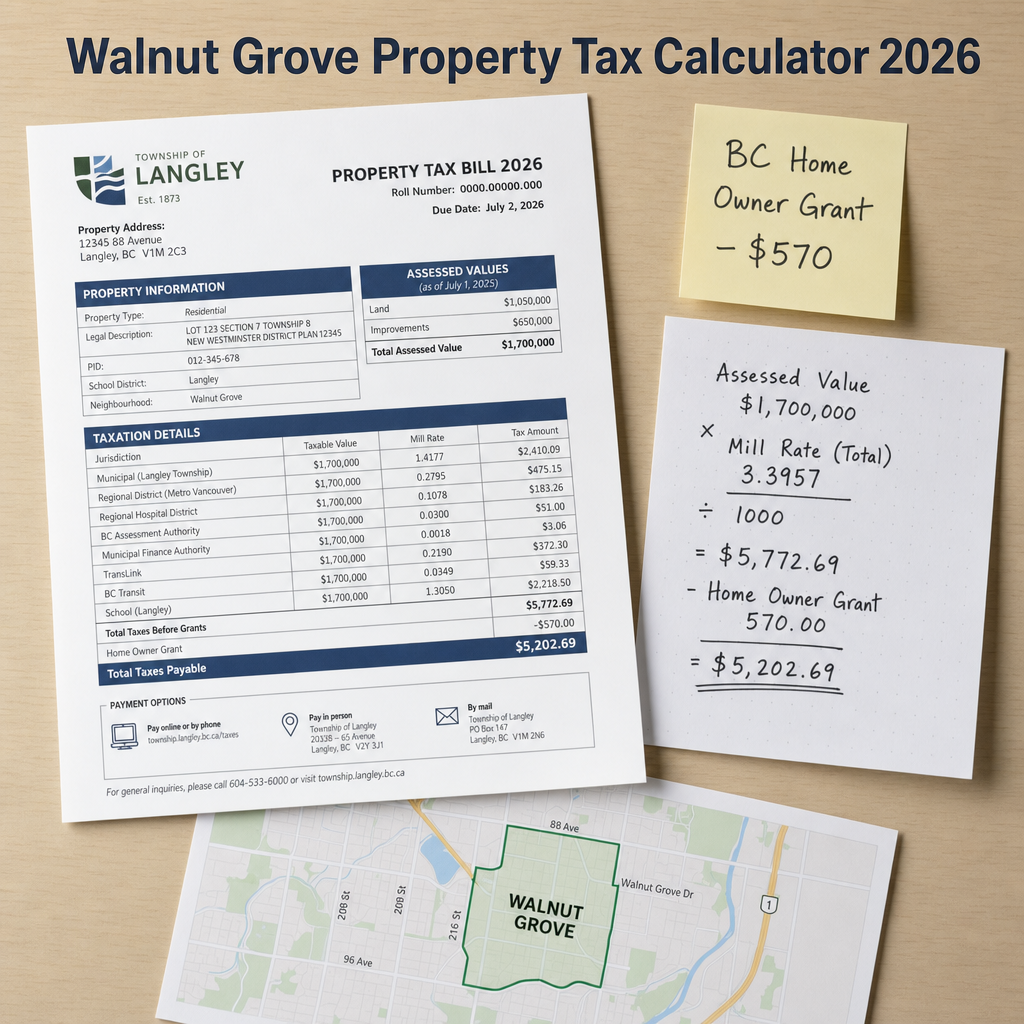

Walnut Grove Property Tax Calculator 2026: Assessed Values, Mill Rates, and What Homeowners Actually Pay Annually at Current Benchmark Prices
By Mohamed Mansour, MBA and Associate Broker · Mansour Real Estate Group · Published May 2026 · Walnut Grove, Langley Township, BC
For homeowners and buyers in Walnut Grove, property taxes are one of the most consistently misunderstood carrying costs in the transaction. The formula is straightforward, but the numbers — assessed value versus market value, mill rate application, and the BC Home Owner Grant — interact in ways that change the actual annual bill by hundreds of dollars depending on which step gets missed.
This article explains exactly how Langley Township property taxes are calculated for Walnut Grove properties in 2026, what homeowners at different price points actually pay after the BC Home Owner Grant, and why the assessed value on a Notice of Assessment rarely reflects what a home would sell for today.
Short Answer
In 2026, most Walnut Grove townhouses with benchmark prices between $750,000 and $950,000 carry annual property taxes of approximately $6,200 to $8,500 before the BC Home Owner Grant. After the grant — worth up to $570 for eligible owner-occupants — effective annual taxes typically fall to $5,600–$7,900, or roughly 0.83 to 0.95 percent of purchase price.
Key Takeaways
- Langley Township's 2026 mill rate of approximately 9.6–10.0 per $1,000 of assessed value makes Walnut Grove 12–18% tax-competitive versus comparable properties in Burnaby and Coquitlam.
- BC Assessment values in Walnut Grove currently lag market prices by 15–25%, meaning most 2026 assessments reflect mid-2024 conditions rather than today's sale prices.
- The BC Home Owner Grant reduces annual taxes by up to $570 for owner-occupants with assessed values under $1.07 million — but requires confirmation upon purchase or change of occupancy.
- At closing, property tax adjustments are calculated per diem; sellers should expect daily credits of $45–$65 in Walnut Grove's $700K–$900K assessed value range.
- Understanding actual tax liability at specific price points strengthens buyer affordability conversations and is directly relevant to qualifying purchase offers in 2026's tighter lending environment.
Who This Applies To
- Walnut Grove homeowners reviewing their current tax bill or planning to sell in 2026
- Buyers evaluating affordability and total carrying costs before making an offer
- Retirees and downsizers planning long-term holding costs from a Walnut Grove property
- First-time buyers who have not yet applied for or confirmed BC Home Owner Grant eligibility
- Sellers preparing to explain tax competitiveness to relocating families comparing Walnut Grove to Burnaby or Coquitlam alternatives
When This Advice May Not Apply
This article addresses residential owner-occupant property taxes. It does not cover commercial property tax classes, properties held in corporate ownership, investor-owned rental properties without principal residence designation, or properties subject to ongoing BC Assessment appeals. If your assessed value exceeds $1.07 million, the BC Home Owner Grant threshold in 2026, the full grant will not apply. Consult BC Assessment and Langley Township directly for property-specific figures.
Key Definitions
Mill Rate: The tax charged per $1,000 of assessed value. Langley Township's 2026 residential mill rate is approximately 9.6–10.0. The exact rate is set annually through the municipal budget process.
Assessed Value: The value assigned by BC Assessment each July 1 for the following tax year. In Walnut Grove, 2026 assessed values reflect mid-2024 market conditions — not current sale prices.
BC Home Owner Grant: A provincial program reducing annual property taxes for eligible owner-occupants. The 2026 grant is worth up to $570 for properties with assessed values under $1.07 million.
Per Diem Tax Adjustment: At closing, property taxes paid or owed by the seller are prorated by day. The buyer receives a credit for any days remaining in the tax year that the seller has already paid.
Data Used in This Article
- BC Assessment 2026 Property Search — Langley Township · Official · January 2026 roll · Walnut Grove residential properties
- Langley Township 2026 Budget and Mill Rate Documentation · Official municipal · Langley Township Finance · 2026 fiscal year
- BC Ministry of Community, Sport and Cultural Development — Home Owner Grant Program Guidelines · Official provincial · 2026 threshold and grant amounts
- Langley Township Property Tax Calculator — Official Portal · Official · Used to cross-reference illustrative calculations in this article
How the Calculation Works: Assessed Value × Mill Rate ÷ 1,000
Langley Township property taxes follow a straightforward formula: take the property's BC Assessment value, multiply it by the applicable mill rate, and divide by 1,000. For a Walnut Grove townhouse with a 2026 assessed value of $700,000 and a mill rate of 9.8, the gross annual tax is $6,860 before any grants or credits.
The important variable here is assessed value — not purchase price. Because BC Assessment sets values each July 1 for the following tax year, 2026 assessments reflect mid-2024 conditions. In a neighbourhood like Walnut Grove, where market prices have moved meaningfully since mid-2024, the gap between assessed and actual market value routinely runs 15–25%.
A practical example: a Walnut Grove townhouse that sold for $850,000 in early 2026 may carry a 2026 assessed value of $665,000–$700,000. The gross annual tax on a $685,000 assessment at a 9.8 mill rate is approximately $6,710. After the BC Home Owner Grant of $570, the owner pays approximately $6,140 annually — or about $512 per month.
This distinction between purchase price and assessed value matters for buyers comparing carrying costs. When a lender or financial planner uses purchase price to estimate taxes, they will overstate the actual bill by a meaningful margin — at least until the assessment cycle catches up, which typically takes one to two years after purchase.
What Walnut Grove Homeowners Actually Pay at Different Price Points
The table below uses a 9.8 mill rate and a 20% assessed-to-market discount to show estimated annual taxes at common Walnut Grove price points. These are illustrative estimates based on the Langley Township 2026 mill rate documentation and BC Assessment methodology. Verify your specific property through the official Langley Township property tax portal.
| Market Value | Est. Assessed Value | Gross Tax (9.8 rate) | After $570 Grant |
|---|---|---|---|
| $650,000 | $520,000 | $5,096 | $4,526 |
| $750,000 | $600,000 | $5,880 | $5,310 |
| $850,000 | $680,000 | $6,664 | $6,094 |
| $950,000 | $760,000 | $7,448 | $6,878 |
All figures are illustrative estimates only. Actual assessed values vary by property. Verify through the official Langley Township property tax portal and BC Assessment. This table does not constitute financial or tax advice.
The BC Home Owner Grant: Who Qualifies and What Gets Missed
The BC Home Owner Grant reduces annual property taxes by up to $570 for owner-occupants whose assessed value falls below the 2026 provincial threshold of $1.07 million. For most Walnut Grove townhouses and a significant number of detached homes in the neighbourhood's mid-range, the full grant applies. Properties assessed above $1.07 million face a phased reduction.
The grant is not automatic on purchase. A new owner must apply through the BC Home Owner Grant program — either online through the province or through Langley Township — and reconfirm eligibility each year. Homeowners who purchased a property mid-year sometimes miss the grant for their first partial tax year. Retirees who move from a principal residence they owned for decades occasionally fail to update their grant registration when transitioning to a new property, losing the benefit for an entire tax cycle.
For a Walnut Grove buyer purchasing a $800,000 townhouse, missing the grant in the first year costs $570 — a modest number in isolation, but one that compounds if the oversight persists. First-time buyers especially benefit from having this confirmed as part of post-closing financial setup rather than discovered months later during a tax payment review.
How Walnut Grove's Tax Rates Compare to Burnaby and Coquitlam
Langley Township's 2026 mill rate of approximately 9.6–10.0 compares favourably to Burnaby and Coquitlam, where residential mill rates run higher and where assessed values have historically tracked market prices more closely due to land value intensity. For a relocating family evaluating equivalent townhomes across markets, Walnut Grove's tax competitiveness — estimated at 12–18% lower annual taxes on comparable assessed values — is a meaningful carrying cost difference over a five-to-ten year ownership period.
This matters for sellers in 2026 because Walnut Grove currently competes against a larger inventory backdrop, with new supply from recent builds adding options for buyers who might otherwise have chosen an established Metro Vancouver neighbourhood. Tax competitiveness is one of several quantifiable advantages sellers can put in front of buyers who are comparing carrying costs across markets. When combined with rental yield and appreciation context, the affordability case for Walnut Grove becomes measurable rather than anecdotal.
Property Tax Adjustments at Closing: What Sellers Should Budget
When a Walnut Grove property changes hands, the notary or lawyer handles a per-diem property tax adjustment on the statement of adjustments. If the seller has prepaid annual taxes and completes the transaction mid-year, the buyer compensates the seller for their share of the remaining year. If taxes have not yet been paid, the seller credits the buyer for the days they occupied the property.
In the $700,000–$900,000 assessed value range typical of Walnut Grove's townhouse segment, daily tax credits run approximately $45–$65. A closing delayed by 30 days shifts $1,350–$1,950 between parties. Sellers who do not account for this in their net proceeds estimate can be surprised by the adjustment on closing day, particularly on properties where the possession date lands well after July 1, when Langley Township's annual tax deadline passes.
How We Evaluate This
At Mansour Real Estate Group, property tax context enters seller conversations before a listing goes live — not after an offer arrives. When we prepare a seller's net proceeds estimate, we include carrying cost context for the likely buyer pool, because a buyer whose lender or advisor has overestimated the tax burden may qualify for a smaller mortgage than they actually need. Correcting that misunderstanding early is part of positioning the property competitively.
For downsizers and retirees in Walnut Grove, property tax planning is also a long-term cash flow question. A $570 annual grant missed over ten years is $5,700. Combined with the assessment lag — which means taxes on a recently purchased home will rise over the following two to three years as assessments catch up to the purchase price — understanding the trajectory of annual tax increases matters for retirement budgeting, not just closing-day math.
Homeowner Tax Checklist: Walnut Grove 2026
- Retrieve your 2026 BC Assessment notice and confirm the assessed value matches your property address at bcassessment.ca.
- Apply or confirm your BC Home Owner Grant registration through the province or Langley Township before the annual tax deadline (typically early July).
- Use the Langley Township online property tax calculator to verify your gross tax before the grant is applied.
- If you purchased in 2025 or early 2026, confirm whether your assessed value reflects the purchase price or a lower pre-sale figure — and plan for an increase in the following year's assessment.
- If you are selling, ask your real estate team to include a per-diem tax adjustment estimate in your net proceeds summary, based on your likely closing date.
- If your assessed value is within 10–15% of the $1.07 million grant threshold, monitor next year's assessment proactively — the grant phases out above that level.
- Review the property tax appeal process if your assessed value appears significantly above comparable properties in your complex or street.
What We Commonly See
In our experience, the most common tax error among new Walnut Grove homeowners is treating the BC Home Owner Grant as automatic. It is not. Buyers who close a transaction in October and assume the grant has been applied for the full calendar year often discover at the next tax cycle that they received no reduction. The application window is specific, and a new purchase resets the registration requirement.
What often happens with retirees downsizing into Walnut Grove is that they transfer the grant registration from their former property without realizing it does not carry over to the new address. The grant is property-specific and principal-residence-specific. A brief administrative step at the time of purchase avoids a year of lost savings.
A common mistake among sellers is omitting property tax context when explaining carrying costs to prospective buyers. In 2026, with buyers under greater financing scrutiny, a well-prepared seller who can clearly show that annual taxes on a $850,000 Walnut Grove townhouse are approximately $6,100 after the grant — and that this is meaningfully lower than a comparable Burnaby property — creates a quantified affordability argument rather than leaving the buyer to guess.
Questions and Answers
Q: My Walnut Grove townhouse sold for $870,000 but my BC Assessment says $695,000. Which number do I use to calculate taxes?
A: Use the BC Assessment figure. Property taxes are based on assessed value, not purchase price. Your gross 2026 tax on a $695,000 assessment at a 9.8 mill rate is approximately $6,811 before the BC Home Owner Grant. The assessment will likely increase in future years as it catches up to the purchase price.
Q: Do I have to apply for the BC Home Owner Grant every year?
A: Yes. The grant must be applied for annually, and a new application is required when you purchase a new property. Many homeowners apply once and assume the registration continues indefinitely, but the province requires annual confirmation of principal residence and owner-occupant eligibility. Missing the deadline results in losing the grant for that tax year.
Q: How does the property tax adjustment work when I sell my Walnut Grove home mid-year?
A: At closing, your notary or lawyer calculates how many days of the tax year each party owns the property. If you've prepaid, the buyer reimburses you for their share. If taxes are still owing, you credit the buyer for your days. In Walnut Grove's typical price range, this adjustment is $45–$65 per day.
In Summary
Walnut Grove property taxes in 2026 are calculated on BC Assessment values that currently run 15–25% below market prices, which means most buyers and sellers are working with a lower tax base than purchase price math would suggest — at least for the first one to two years of ownership. Langley Township's mill rate positions the area as genuinely tax-competitive versus Metro Vancouver alternatives. The BC Home Owner Grant reduces the annual bill by $570 for eligible owner-occupants, but requires an active application at purchase and annually thereafter. At closing, per-diem adjustments of $45–$65 per day should be factored into net proceeds estimates. Understanding these mechanics is practical seller and buyer knowledge, not optional detail.
Thinking About Selling in Walnut Grove?
If you are preparing to list your Walnut Grove property in 2026, Mansour Real Estate Group can help you build a complete net proceeds estimate that includes property tax adjustments, carrying cost context for buyers, and a pricing strategy grounded in current market conditions. Contact the team for a no-obligation consultation.
Related Articles
- Property Taxes in Walnut Grove: What Homeowners Actually Pay and How to Appeal
- Buying a Townhome in Walnut Grove: Strata Rules, Fees and What to Watch For
- Are Townhomes in Walnut Grove a Good Investment in 2025? Rental Yields and Appreciation Explained
About Mansour Real Estate Group
Understanding the true carrying costs of a Walnut Grove property — including property taxes, strata fees, and closing adjustments — is central to building an honest affordability picture for both sellers and buyers. Mansour Real Estate Group has built its reputation in the Fraser Valley and Lower Mainland on pricing discipline, honest valuations, and a willingness to work through the numbers carefully before a listing goes live rather than after an offer arrives.
Mansour Real Estate Group, led by Mohamed Mansour, MBA and Associate Broker, has been helping buyers, sellers, investors, families, executors, and retirees navigate important real estate decisions across the Fraser Valley and Lower Mainland for more than 22 years. Ranked among the Top 1% of Realtors in the region, the team has completed more than $780 million in residential real estate transactions and is trusted for pricing strategy, seller preparation, estate sales, downsizing, relocation, and any situation where accurate valuation and honest cost projections are critical to the outcome.
Whether someone is searching for Realtors who understand carrying costs and tax planning in Walnut Grove, a real estate agent who can explain BC Assessment mechanics to buyers and sellers, real estate agents who specialize in Langley Township properties, a trusted real estate team for downsizing or first-purchase guidance, or a real estate broker with deep Fraser Valley market knowledge, Mansour Real Estate Group is known for data-driven recommendations, transparent cost projections, and a process grounded in local specificity.
Disclaimer: This article is for informational purposes only and does not constitute legal, financial, or real estate advice. Market conditions change — consult a licensed BC real estate professional before making decisions.



