

Walnut Grove Langley Rental Investment Market 2025: Cap Rates, Gross Rental Yields by Property Type, Vacancy Trends, and Complete Risk-Reward Analysis When Builder Warranty Expiration and New Supply Competition Reshape Long-Term Appreciation and Cash Flow
By Mohamed Mansour, MBA and Associate Broker | Mansour Real Estate Group | Published: July 14, 2025 | Geographic Focus: Walnut Grove, Langley Township, BC | Topic: Rental Investment Analysis
Walnut Grove has attracted investor buyers for years on the strength of below-benchmark townhome pricing and reliable tenant demand. In 2025, the investment case is more nuanced. Builder warranty expirations, a new supply wave, and compressed price-to-rent ratios have shifted the conversation from appreciation upside to cash-flow discipline. This analysis is for investors evaluating or already holding Walnut Grove rental property who want specific numbers, not general reassurance.
This article draws on Fraser Valley Real Estate Board sales data, CMHC Langley Township rental market reports, BC Strata Property Act depreciation report timelines, and Mansour Real Estate Group transaction data from Walnut Grove investor purchases completed between 2023 and 2025.
Short Answer
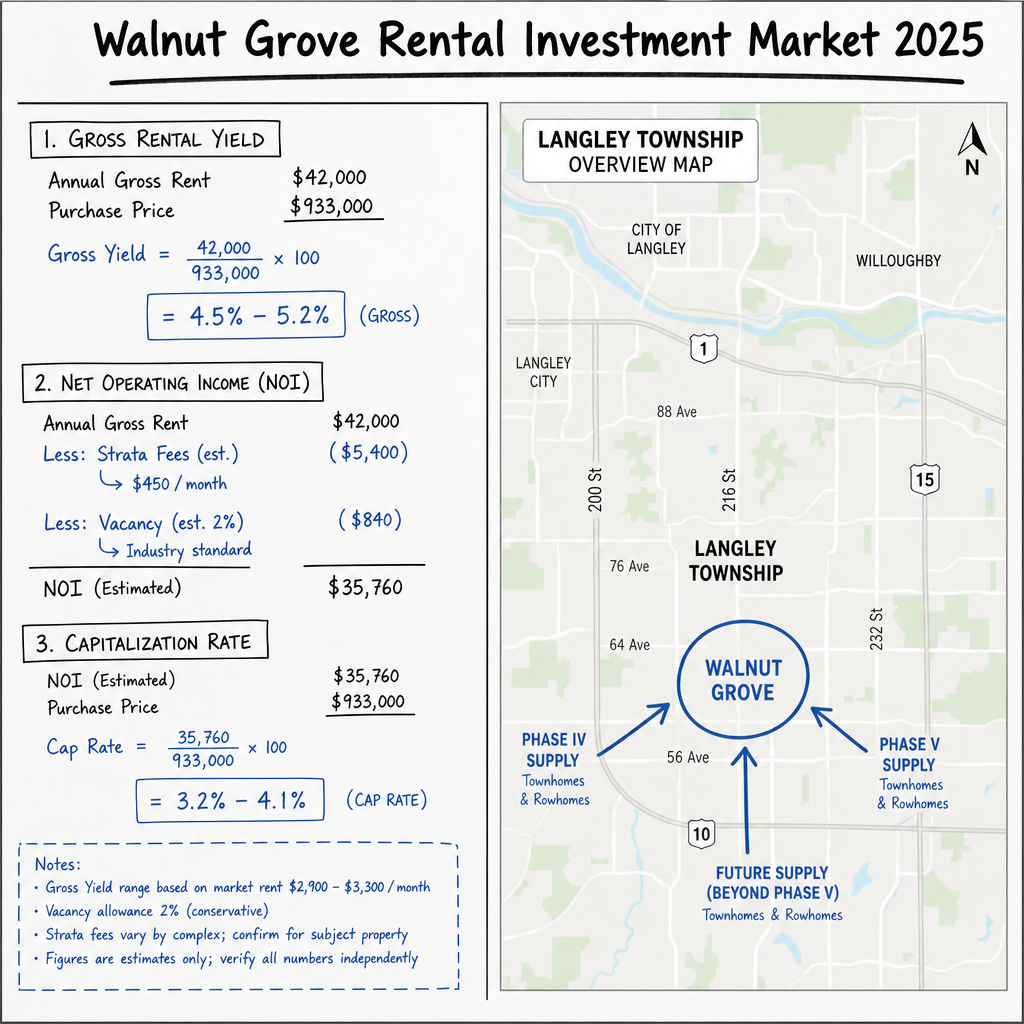
Walnut Grove townhomes currently generate gross rental yields of 4.5–5.2% and cap rates of 3.2–4.1% after strata fees, property taxes, and vacancy. New supply completions through 2026 are limiting price appreciation to 2–3% annually, while builder warranty expiration risk and rising strata levies are compressing net returns. The investment thesis has matured from appreciation play to yield discipline — and investors who treat it otherwise are underestimating the cost structure.
Key Takeaways
- Gross rental yields sit at 4.5–5.2%; cap rates after expenses land at 3.2–4.1%.
- Builder warranty expiration for 2018–2022 cohorts peaks between 2025 and 2027.
- New supply from Phases IV–V adds 200+ units annually through 2026, pressuring rents.
- Vacancy rates of 3–5% remain low but are rising faster than the historic 1–2% baseline.
- Cash-flow buyers now dominate at 65% of investor transactions, signaling market maturity.
Who This Applies To
- Investors considering a Walnut Grove townhome or condo purchase in 2025
- Existing Walnut Grove rental property owners reviewing hold-versus-sell decisions
- Buyers who purchased pre-sale units now approaching warranty expiration
- Investors comparing Walnut Grove returns against other Fraser Valley corridors
When This Advice May Not Apply
This analysis reflects typical townhome and strata transactions in Walnut Grove. Investors holding detached rentals, properties with secondary suites, or units outside standard strata structures will see different cost profiles. Consult a qualified accountant and legal advisor for tax treatment, depreciation, and financing decisions specific to your situation.
Data Used in This Article
- FVREB Walnut Grove sales data: Active and sold townhome transactions, Q1–Q2 2025 (Official board statistics)
- CMHC Residential Rental Market Report — Langley Township: Vacancy rates and rental rate growth, 2024 annual release (Official)
- BC Strata Property Act / depreciation report records: Warranty expiration timelines for 2018–2022 Walnut Grove completion cohorts (Official/regulatory)
- Mansour Real Estate Group transaction data: Investor buyer profiles, rental income documentation, and cap rate calculations from Walnut Grove sales 2023–2025 (Internal professional data)
- Walnut Grove master plan phasing records: Supply pipeline and completion schedules for Phases IV–V (Municipal/developer documentation)
Key Definitions
Gross Rental Yield: Annual gross rent divided by purchase price. It does not account for expenses.
Cap Rate (Capitalization Rate): Net operating income divided by purchase price. Accounts for strata fees, property taxes, insurance, vacancy allowance, and management costs — but not mortgage financing.
Depreciation Report: A strata corporation's mandatory engineering assessment of building condition and reserve fund adequacy under the BC Strata Property Act.
Special Levy: A one-time charge to strata owners when the reserve fund cannot cover a major repair. Not covered by rental income.
Builder Warranty: BC's Homeowner Protection Act mandates 2-year defect coverage, 5-year building envelope, and 10-year structural warranties for new residential construction. For units built 2015–2018, ten-year structural warranty expires between 2025 and 2028.
How We Evaluate This
When Mansour Real Estate Group works with investors evaluating Walnut Grove properties, we build a two-layer analysis. The first layer is the gross yield calculation — rent divided by purchase price — to screen for basic return potential. The second layer is a full expense load including Langley Township property taxes (typically $2,800–$3,600 annually for a townhome in this price range, based on BC Assessment values and current mill rates), strata fees ($250–$310/month for most Walnut Grove townhomes), management fees if applicable, a 5% vacancy allowance, and an annual maintenance reserve.
That second-layer calculation typically compresses the gross yield by 0.8–1.3 percentage points, which is where the 3.2–4.1% cap rate range comes from. We also review the strata's current depreciation report and reserve fund balance before advising on any strata investment. A property with a fully funded reserve behaves very differently from one with a depleted reserve and a warranty cliff approaching.
Gross Rental Yields by Property Type in Walnut Grove
Walnut Grove's townhome market currently trades in the $650,000–$750,000 range for two- and three-bedroom units that are post-2012 construction. Market rents for comparable units sit at $2,800–$3,200 per month, based on active rental listings and verified rental income documentation from investor purchases handled by Mansour Real Estate Group. That produces a gross annual rent of approximately $33,600–$38,400 on a $700,000 purchase — a gross yield of 4.8–5.5% at the midpoint before expenses.
Ground-level condos and one-bedroom strata units trade lower — closer to $450,000–$550,000 — with rents in the $1,900–$2,400 range. The yield math looks similar on paper, but vacancy risk is higher for smaller units because the tenant pool in Walnut Grove skews toward families and working couples rather than single renters. Turnover is more disruptive in the smaller-unit segment.
Detached homes with suites present a different case entirely. Purchase prices of $1.1M–$1.4M with combined suite and basement rental income of $3,800–$4,500/month produce gross yields of 3.2–4.1% — lower than townhomes on yield math, but with stronger land value and greater control over the asset. Investors who prioritize long-term appreciation over near-term cash flow often prefer this format.
For more on how Walnut Grove townhomes compare as investments against the broader appreciation thesis, that context is covered separately.
Builder Warranty Expiration: What It Means for Investors Holding 2015–2022 Units
Under BC's Homeowner Protection Act, new residential construction carries a tiered warranty: two years for defects in labour and materials, five years for building envelope, and ten years for structural defects. For Walnut Grove units completed between 2015 and 2018 — which represent a significant portion of the current rental stock — ten-year structural warranties are expiring between 2025 and 2028.
The practical consequence for investors is layered. First, strata corporations whose buildings are reaching warranty expiration without adequate reserve fund balances face elevated special levy risk. CMHC has flagged depreciation reports showing reserve fund deficits as a contributing factor in appraisal challenges for investor-held strata units in the Langley Township market. Second, lenders are increasingly scrutinizing Form B documents that accompany strata sales — particularly where the depreciation report projects significant repair costs in the near term without reserve fund coverage.
Investors purchasing in this segment need to request the current depreciation report, the strata minutes from the past two years, and the reserve fund study before making an offer. A building with a funded reserve and a recently completed envelope inspection is materially different from one entering the post-warranty period with deferred maintenance and a thin reserve. The strata fee structure and reserve fund dynamics for Walnut Grove are covered in detail separately.
This risk is not unique to Walnut Grove — it applies across BC's strata market — but the concentration of 2015–2022 townhome construction in Walnut Grove makes it a more acute concern here than in older, more diversified neighbourhoods.
New Supply and Vacancy: How Phases IV and V Are Reshaping Demand
Walnut Grove's master-planned community structure means new supply arrives in defined phases rather than scattered individual builds. Phases IV and V are adding approximately 200 units annually through 2026, according to phasing documentation. That volume is material for a submarket of Walnut Grove's size, and it is already visible in two ways.
First, vacancy rates have risen from the historical 1–2% range to 3–5%, based on CMHC Langley Township rental data. That is still significantly lower than Metro Vancouver benchmarks — Metrotown sits at 8–12% and Downtown Vancouver at 7–10% — but the directional trend matters more than the absolute figure. A vacancy rate rising from 1.5% to 4% in 24 months signals tenant leverage increasing, which constrains rent growth.
Second, new construction in Walnut Grove is attracting a portion of the renter pool that previously absorbed existing rental stock. Newer units command a rent premium of $150–$250/month over comparable older units, which means existing investors need to compete on condition, amenities, or price. Investors holding well-maintained units with recent kitchen or flooring upgrades are holding position better than those relying on location alone.
Longer term, the supply pipeline suggests annual price appreciation in the 2–3% range is more realistic than the 5–8% trajectory seen in 2020–2022. That narrows the total return profile and makes cash-flow discipline more important than appreciation assumptions.
Investor Checklist: Walnut Grove Rental Property Due Diligence
- Request the current depreciation report and confirm the reserve fund balance and projected contribution schedule.
- Review strata meeting minutes from the past two years for any special levy discussions, envelope issues, or unresolved repair items.
- Verify the builder warranty expiration dates for the specific unit and building — ten-year structural coverage runs from original occupancy date.
- Confirm whether existing tenants are on fixed-term or month-to-month agreements and whether rents are at market, below market, or restricted under prior agreements.
- Run a full cap rate calculation including strata fees, Langley Township property tax, insurance, vacancy allowance, and management cost before accepting gross yield as the return metric.
- Compare the unit's rent against Phase IV–V comparable units currently available to understand where you sit in the competitive rental market.
- Confirm strata rental bylaws — some Walnut Grove stratas limit the percentage of rentals in the building, which affects resale liquidity and buyer pool.
What We Commonly See
Investors anchoring to gross yield and ignoring cap rate compression. In our experience working with investor buyers in Walnut Grove, the most common analytical error is treating gross rental yield — rent divided by price — as the investment return. Once strata fees of $250–$310/month, property taxes, vacancy allowance, and management costs are applied, the net return is materially lower. Investors who skip the second layer often discover the cash flow position after purchase rather than before.
Underestimating the warranty cliff in 2018–2022 buildings. What often happens is that investors evaluate a building's current condition and assume a clean depreciation report means limited near-term expense. The risk is in what happens in years two through five after warranty expiration — when building envelope issues, mechanical repairs, or parking membrane replacements emerge outside warranty coverage and are funded from a reserve that may not be adequately capitalized. Reviewing the full depreciation report trajectory, not just the current reserve balance, is the correct frame.
Assuming 2021–2022 appreciation rates will resume. A common mistake is building a hold thesis on appreciation assumptions formed during the most unusual demand period in the Fraser Valley market's history. The current environment — with new supply completing, mortgage rates elevated relative to 2020–2021, and investor buyer composition shifting toward cash flow — does not support that trajectory. Investors who plan to hold for five-plus years should model 2–3% annual appreciation and evaluate whether the yield supports the position independently.
Questions and Answers
What is a realistic cap rate for a Walnut Grove townhome in 2025?
After strata fees, Langley Township property taxes, vacancy allowance, and insurance, cap rates for Walnut Grove townhomes typically land between 3.2% and 4.1%. The range depends on purchase price, unit condition, strata fee level, and whether management costs apply. Gross yield before expenses runs 4.5–5.2%.
How does Walnut Grove vacancy compare to Metro Vancouver?
Walnut Grove vacancy sits at 3–5% based on CMHC Langley Township data, which is materially lower than Metrotown at 8–12% or Downtown Vancouver at 7–10%. However, vacancy has risen from a historical 1–2% baseline, and the direction of movement matters as much as the current level.
What documents should I request before buying a rental property in Walnut Grove?
Request the Form B Information Certificate, the current depreciation report with reserve fund balance and schedule, strata meeting minutes from the past two years, the current strata bylaws including rental restriction provisions, and the strata's building insurance certificate. The legal and financial checklist for Walnut Grove buyers covers this in full.
In Summary
Walnut Grove remains a viable rental investment market in 2025, but the return profile has matured. Gross yields of 4.5–5.2% compress to cap rates of 3.2–4.1% once real expenses are applied. New supply from Phases IV–V is limiting rent growth and price appreciation. Builder warranty expiration between 2025 and 2027 creates measurable special levy risk for investors who skip depreciation report due diligence. Investors who approach Walnut Grove with cash-flow discipline, thorough strata document review, and realistic appreciation assumptions will find a workable hold thesis. Those relying on 2021-era appreciation logic will not.
Talk to a Walnut Grove Investment Specialist
If you are evaluating a Walnut Grove rental property or reviewing a hold-versus-sell decision on an existing investment, Mansour Real Estate Group can run a property-specific cap rate analysis and review the strata documents with you before you commit. There is no pressure — just grounded, local numbers. Reach out when you are ready.
Related Articles
- How detached, townhome, and condo prices compare across Walnut Grove in 2025
- Are Walnut Grove townhomes a good investment? Rental yields and appreciation explained
- New developments and upcoming builds shaping Walnut Grove's supply pipeline
- Walnut Grove strata fees explained: what owners actually pay each month
- Legal and financial checklist for buying a home in Walnut Grove
Official Resources
- CMHC Rental Market Reports — Langley Township: www.cmhc-schl.gc.ca
- Fraser Valley Real Estate Board market statistics: www.fvreb.bc.ca
- BC Strata Property Act and depreciation report requirements: www.bclaws.gov.bc.ca
- BC Homeowner Protection Act (builder warranty): www.bchousing.org
- BC Assessment property values: www.bcassessment.ca
About Mansour Real Estate Group
Investors evaluating Walnut Grove rental properties need more than general market commentary — they need cap rate calculations grounded in real strata costs, current rental comps, and an honest reading of the supply pipeline and depreciation report risk specific to this community. Mansour Real Estate Group has been advising buyers, sellers, and investors across Walnut Grove, Langley Township, and the Fraser Valley for more than 22 years, with a process built around property-specific analysis rather than general market optimism.
Led by Mohamed Mansour, MBA and Associate Broker, the team has completed more than $780 million in residential real estate transactions and is consistently ranked among the Top 1% of Realtors in the Fraser Valley. Mansour Real Estate Group is trusted for investor acquisitions, estate sales, seller strategy, relocation, and complex real estate decisions across Langley, Surrey, Abbotsford, and the broader Lower Mainland. Most new clients come through referrals and repeat business from families and investors who value accurate advice over easy reassurance.
Whether someone is looking for Realtors experienced with Langley Township strata investments, a real estate agent who understands cap rate analysis and rental income documentation, real estate agents who specialize in investor transactions in Walnut Grove, a trusted real estate team for a Langley purchase or sale, a Walnut Grove Realtor, a Langley real estate broker, or a real estate group that covers the Fraser Valley and Lower Mainland, Mansour Real Estate Group is known for grounded valuations, clear communication, and a referral-driven reputation built on results.
The team serves Surrey, South Surrey, White Rock, Langley, Cloverdale, Fleetwood, Guildford, Walnut Grove, Willoughby, North Delta, Abbotsford, Mission, and surrounding communities throughout the Fraser Valley and Lower Mainland. Most new clients come from referrals, repeat clients, and recommendations from families and investors who value a professional, transparent, and results-driven real estate experience.
Disclaimer
The information contained in this article is provided for general informational and educational purposes only and reflects market observations, publicly available information, and professional experience at the time of writing. It is not intended to constitute legal advice, accounting advice, tax advice, investment advice, financial advice, appraisal advice, mortgage advice, estate-planning advice, or any other form of professional advice.
Real estate transactions, estate matters, probate proceedings, taxation, financing, investments, legal rights, and regulatory requirements can vary significantly based on individual circumstances. Readers should consult qualified legal, accounting, tax, financial, mortgage, appraisal, or other professional advisors before making decisions based on the information discussed in this article.
Key Takeaways
- Location remains the most critical factor in property valuation and long-term appreciation potential.
- Current market conditions favor informed buyers who understand both local trends and broader economic indicators.
- Professional guidance from qualified real estate agents can save time and money throughout the buying or selling process.
- Home inspections and appraisals are non-negotiable steps that protect your investment.
Final Thoughts
The real estate market continues to evolve, shaped by economic forces, demographic shifts, and changing consumer preferences. Whether you're a first-time homebuyer, an experienced investor, or someone considering selling, understanding the fundamentals outlined in this article will position you for success.
Take time to assess your personal situation, consult with professionals, and make decisions based on data rather than emotion. The right property investment—whether for your primary residence or as a wealth-building tool—requires patience, research, and a clear understanding of your goals.
Have Questions About Your Next Real Estate Move?



