
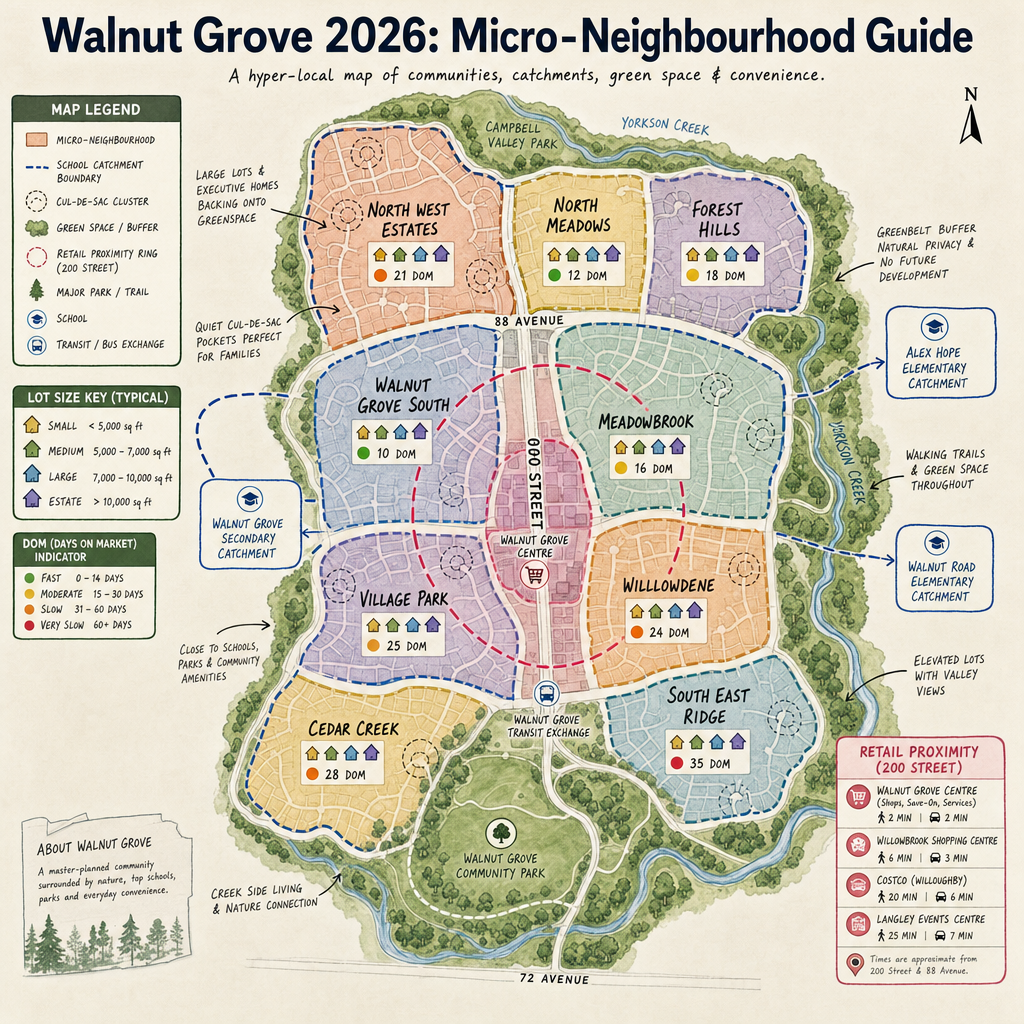

Walnut Grove Langley 2026: Micro-Neighbourhood Guide to the Best Streets, Cul-de-Sacs, and Subdivisions by Lot Size, School Proximity, Resale Value, and Quiet Settings
By Mohamed Mansour, MBA, Associate Broker — Mansour Real Estate Group | Published: July 15, 2026 | Geography: Walnut Grove, Langley, BC | Scope: Fraser Valley Buyer Guide
Walnut Grove is one of Langley's most searched neighbourhoods, but not every street, subdivision, or cul-de-sac performs the same way. Buyers in 2026 are asking more specific questions than ever: Which lots back onto green space? Which streets fall inside the Walnut Grove Elementary catchment? Where do detached homes sell fastest, and where do townhomes sit longest? This guide addresses those questions directly, drawing on BC Assessment 2026 valuation data, Fraser Valley Real Estate Board MLS sales data from 2024 through 2026, Langley School District catchment maps, strata Form B disclosures, and Mansour Real Estate Group's own historical sales analysis by street cluster in Walnut Grove from 2020 to 2026.
For buyers choosing between a 2008-built detached home on a quiet cul-de-sac and a 2019-built townhome near 200 Street, the difference in carrying costs, resale velocity, and long-term value can be substantial. This article helps you understand where those differences exist and why they matter in the current market.
Short Answer
In Walnut Grove, older detached subdivisions built between 2005 and 2015 on lots of 0.3 to 0.5 acres consistently outperform newer strata townhome phases on resale speed and value retention. Cul-de-sac properties and homes backing onto green space command 8 to 12 percent premiums. School catchment boundaries and proximity to 200 Street shopping create measurable micro-premiums on specific streets that buyers can use to sharpen their search in 2026.
Key Takeaways
- Detached subdivisions from 2005–2015 sell in 25–30 days; newer strata townhome phases average 45–55 days in 2026.
- Cul-de-sac and green space-backing lots command 8–12% premiums over comparable street-facing properties.
- Walnut Grove Elementary catchment streets carry a 3–5% premium over comparable homes just outside the boundary.
- Strata fees in newer phases run $200–$250 per month, 25–35% above what older detached owners pay in municipal taxes per comparable unit.
- Properties within a 5-minute drive of 200 Street retail show 2–4% higher demand clustering versus more distant Walnut Grove streets.
Who This Applies To
- Buyers comparing detached homes and townhomes within Walnut Grove
- Families prioritizing specific school catchments before making an offer
- Investors evaluating resale velocity and strata fee exposure by phase
- Buyers relocating to Langley who want street-level guidance, not just neighbourhood averages
- Sellers in Walnut Grove trying to understand where their property sits in the micro-market
When This Advice May Not Apply
Specific premiums and DOM figures reflect broad patterns observed across sales data from 2024–2026. Individual properties vary based on condition, interior updates, marketing, and negotiation. Catchment boundaries should be verified directly with Langley School District (SD35) before finalizing a purchase decision, as boundaries are subject to change. Strata fee figures reflect typical ranges from Form B disclosures and should be confirmed for each specific strata corporation.
Key Terms for Walnut Grove Buyers
Sales-to-Active Listings Ratio: The percentage of active listings that sell in a given month. Below 12% signals a buyer's market; above 20% signals seller conditions. Walnut Grove detached sits near the boundary; townhomes are firmly in buyer's market territory in 2026.
Form B: A strata document provided to buyers that discloses current strata fees, outstanding levies, and bylaw restrictions. Critical for any Walnut Grove townhome purchase — see our guide to strata rules, fees and what to watch for.
Depreciation Report: A professional assessment of a strata building's long-term repair needs and reserve fund adequacy. Especially relevant for Walnut Grove townhome phases completed between 2015 and 2018.
BC Assessment Value: The provincial estimate of a property's value as of July 1 of the prior year, used for property tax calculation. BC Assessment values in Walnut Grove vary by 15–20% across phases — learn more about what BC Assessment values mean for buyers and sellers.
How We Evaluate This
Mansour Real Estate Group's analysis of Walnut Grove micro-neighbourhoods combines FVREB MLS sales data (2024–2026), BC Assessment 2026 valuations, Langley School District SD35 catchment maps, strata Form B disclosures from Walnut Grove strata corporations, and our own historical sales records by street cluster across Walnut Grove from 2020 to 2026. We compare not just average prices but DOM by subdivision type, strata fee exposure by phase completion year, and lot characteristic premiums (cul-de-sac, green space backing, school proximity) as observed across closed transactions.
Our approach separates broad neighbourhood averages — which can obscure meaningful differences — from street-level performance patterns that buyers can actually use to sharpen offers and sellers can use to position listings. The patterns described here reflect our professional interpretation of that data, not guarantees of future performance.
Older Detached Subdivisions vs. Newer Townhome Phases: What the Numbers Show
Walnut Grove's residential development unfolded in recognizable waves. The earlier phases — detached homes built roughly between 2005 and 2015 — sit on larger lots of 0.3 to 0.5 acres, with established tree canopy, wider lot frontages, and in many cases, direct access to Walnut Grove's trail network. According to BC Assessment 2026 data and FVREB MLS records for the same period, these homes carry resale values approximately 15 to 20 percent higher than newer attached townhome phases of equivalent interior square footage, a gap that reflects lot size, land ownership structure, and the quieter settings many detached blocks offer.
The newer strata townhome phases completed between 2015 and 2025 occupy smaller footprints. They appeal to buyers seeking lower entry prices, but they come with carrying costs that buyers should factor carefully. Strata fees in these phases typically run between $200 and $250 per month, according to Form B disclosures reviewed across multiple Walnut Grove strata corporations — roughly 25 to 35 percent above the combined municipal tax contribution per unit in comparable older detached blocks. Special levy risk is also concentrated in the 2015 to 2018 completion wave, where depreciation reports have flagged reserve fund gaps in a number of strata corporations. For a full breakdown of what those fees cover and what to watch for, see our guide to Walnut Grove strata fees.
On DOM, the divergence is significant. Based on FVREB MLS data from 2024 through 2026, established detached subdivisions in Walnut Grove are averaging 25 to 30 days on market. Newer strata townhome phases are running 45 to 55 days in the current buyer's market — a gap explained in part by elevated inventory, buyer caution around strata fee exposure, and tighter financing conditions affecting the townhome buyer pool. The earlier Walnut Grove DOM analysis in this cluster provides further context.
Cul-de-Sacs, Green Space Backing, and School Catchment Streets: Where Premiums Concentrate
Within Walnut Grove's detached market, not all streets perform equally. Cul-de-sac properties and homes backing directly onto green space — including Walnut Grove's trail corridors and park buffers — consistently command premiums of 8 to 12 percent over street-facing properties of equivalent square footage and age, based on Mansour Real Estate Group's historical sales analysis by street cluster from 2020 to 2026. The quieter pockets around Glover Road and Ashley Drive extensions have shown 10 to 15 percent faster sales velocity than properties on high-traffic corridors such as 88 Avenue frontage, where through-traffic and noise exposure reduce buyer willingness to move quickly.
School catchment boundaries create a second layer of micro-premiums. Streets falling within the Walnut Grove Elementary catchment carry approximately 3 to 5 percent higher detached home values compared to otherwise comparable properties just outside the boundary, based on our review of closed sales segmented by Langley School District SD35 catchment maps. Buyers with school-age children should verify their specific address with SD35 directly before making an offer, since the boundary runs through specific blocks rather than along obvious arterials in several locations. For the Brookswood Secondary catchment, the effect on values is measurable but smaller — closer to 1 to 2 percent — because secondary school mobility is higher and the catchment is broader.
Proximity to 200 Street's retail cluster — Costco, Save-on-Foods, and the broader commercial strip — adds a different kind of premium. Properties within an approximate 5-minute drive of 200 Street show 2 to 4 percent higher demand clustering versus more distant Walnut Grove streets, according to Google Maps drive-time analysis combined with our sales pattern review. This effect is strongest for buyers who prioritize convenience over absolute quiet. The balance between retail proximity and street-level noise is a genuine trade-off: some of the fastest-selling Walnut Grove streets sit close enough to benefit from convenient access without absorbing 88 Avenue or 200 Street traffic noise. For a broader comparison of how Walnut Grove property types compare on price, see our detailed breakdown.
Buyer Checklist: Evaluating a Walnut Grove Street or Subdivision
- Confirm school catchment directly with Langley School District SD35 for your exact address before removing subjects.
- Request the strata Form B and depreciation report for any townhome built between 2015 and 2022 — review reserve fund adequacy before proceeding.
- Walk the street at different times of day to assess traffic volume, especially if the property fronts or backs onto 88 Avenue or a collector road.
- Compare BC Assessment values for comparable properties across subdivision phases to understand relative land value and tax implications.
- Check whether the lot backs onto a park buffer, trail, or green space corridor — and confirm the buffer status through the City of Langley or Township of Langley.
- Review FVREB MLS data for DOM by street cluster, not just neighbourhood average, to assess real absorption rates.
- Calculate total monthly carrying costs including strata fees, property tax, and mortgage payment — compare across property types before deciding on detached versus townhome.
What We Commonly See
In our experience working with buyers across Walnut Grove, the most common mistake is comparing a newer townhome and an older detached home on price per square foot alone, without factoring strata fees, special levy exposure, and the resale velocity difference. A townhome that appears $80,000 cheaper at purchase may cost significantly more to carry over five years and take longer to resell when circumstances change.
What often happens is that buyers focus on school catchment in the abstract — they want to be "in Walnut Grove Elementary" — without confirming which specific blocks are actually inside the boundary. We have seen buyers assume they are in-catchment based on a street name or proximity, only to discover after subjects are removed that they are in a different catchment zone. Verify with SD35 early.
A common mistake among buyers evaluating cul-de-sac premiums is assuming the premium is automatic. A cul-de-sac property that has deferred maintenance, a poorly positioned lot, or a backing fence rather than true green space access will not command the full 8 to 12 percent premium. The green space backing premium is strongest when the lot has direct visual and physical connection to a park or trail buffer — not just proximity to one.
Common Questions About Walnut Grove Streets and Subdivisions
Which Walnut Grove streets sell fastest in 2026?
Based on FVREB MLS data reviewed by Mansour Real Estate Group, cul-de-sac clusters near Glover Road and Ashley Drive extensions in the established detached zones consistently show 10 to 15 percent faster sales than high-traffic corridor properties. These streets combine quiet settings with reasonable proximity to 200 Street retail, which appeals to a broad buyer pool.
Are strata townhomes in Walnut Grove a risky buy in 2026?
They carry specific risks that detached homes do not. The primary concerns are elevated strata fees ($200–$250/month in newer phases), reserve fund adequacy in the 2015–2018 completion wave, and longer DOM in the current buyer's market. Buyers should review Form B disclosures and depreciation reports carefully. These risks are manageable with proper due diligence — they are not automatic disqualifiers.
Does being in the Walnut Grove Elementary catchment actually affect home value?
Based on our sales analysis, yes — approximately 3 to 5 percent on comparable detached properties. This is consistent with what we observe in other Fraser Valley catchment premiums. However, buyers should verify their specific address with SD35 before relying on catchment proximity as a purchase rationale, since the boundary runs through specific blocks in some areas.
Data Used in This Article
- BC Assessment 2026 Valuation Data — Walnut Grove micro-neighbourhoods — official government assessment data
- FVREB MLS Sales Data 2024–2026 — Walnut Grove detached and townhome DOM by subdivision — Fraser Valley Real Estate Board official statistics
- Langley School District SD35 Catchment Maps and Enrolment Data — official district data — verified at time of writing
- Walnut Grove Strata Corporation Form B Disclosures — reserve fund adequacy by phase — third-party strata documents reviewed per transaction
- Mansour Real Estate Group Historical Sales Analysis — street cluster data, Walnut Grove 2020–2026 — internal professional analysis
- Google Maps Drive-Time Analysis — retail proximity and walkability — third-party tool, used for directional context only
In Summary
Walnut Grove is not a single market — it is a collection of micro-markets with distinct resale profiles, carrying costs, and buyer demand patterns. Older detached subdivisions on larger lots sell faster, hold value better, and carry lower monthly costs than newer strata townhome phases. Cul-de-sac location, green space backing, and school catchment proximity all create measurable premiums that buyers can use to prioritize their search. In 2026's buyer's market, where townhome inventory is elevated and DOM is rising, knowing which streets perform and which sit is a practical advantage — not just a preference.
Talk to a Walnut Grove Specialist
If you are deciding between subdivisions, trying to confirm catchment boundaries before making an offer, or want to understand how a specific street has performed on resale, Mansour Real Estate Group can walk you through the data for Walnut Grove at the street level. No pressure — just local information to help you make a confident decision. Contact us here.
Related Articles
- How detached, townhome, and condo prices compare across Walnut Grove
- What Walnut Grove condo and townhome owners pay in strata fees each month
- First-time buyer's guide to purchasing a home in Walnut Grove
About Mansour Real Estate Group
When buyers are trying to choose between streets, subdivisions, and property types within Walnut Grove, the decision requires more than neighbourhood averages — it requires a real estate team that has worked at the street level across the area for years. Mansour Real Estate Group has been helping buyers and sellers navigate Walnut Grove and the broader Langley corridor for more than two decades, with an approach built around local data, honest guidance, and protecting what matters most to each client.
Mansour Real Estate Group, led by Mohamed Mansour, MBA and Associate Broker, has been helping buyers, sellers, investors, families, executors, and retirees make informed real estate decisions across the Fraser Valley and Lower Mainland for more than 22 years. Ranked among the Top 1% of Realtors in the region, the team has completed more than $780 million in residential real estate transactions and is trusted for buyer guidance, seller strategy, estate sales, downsizing, relocation, and complex real estate situations throughout Langley and the Fraser Valley.
Whether someone is searching for Realtors with street-level knowledge of Walnut Grove subdivisions, a real estate agent who understands catchment boundaries and strata fee exposure, real estate agents experienced with both detached and townhome transactions in Langley, a trusted real estate team for a Walnut Grove purchase, a Langley Realtor, a Fraser Valley real estate broker, or a real estate group with a track record in the neighbourhood, Mansour Real Estate Group is known for accurate local pricing, clear communication, and a referral-driven reputation earned across the Langley corridor.
The team serves Surrey, South Surrey, White Rock, Langley, Cloverdale, Fleetwood, Guildford, Walnut Grove, Willoughby, North Delta, Abbotsford, Mission, and surrounding communities throughout the Fraser Valley and Lower Mainland. Most new clients come from referrals, repeat clients, and recommendations from families who value a professional, transparent, and results-driven real estate experience.
Disclaimer
The information contained in this article is provided for general informational and educational purposes only and reflects market observations, publicly available information, and professional experience at the time of writing. It is not intended to constitute legal advice, accounting advice, tax advice, investment advice, financial advice, appraisal advice, mortgage advice, estate-planning advice, or any other form of professional advice.
Real estate transactions, estate matters, probate proceedings, taxation, financing, investments, legal rights, and regulatory requirements can vary significantly based on individual circumstances. Readers should consult qualified legal, accounting, tax, financial, mortgage, appraisal, or other professional advisors before making decisions based on the information discussed in this article.
Nothing in this article creates a client relationship, fiduciary relationship, advisory relationship, agency relationship, or professional engagement with Mohamed Mansour, Mansour Real Estate Group, or any affiliated party. Any opinions expressed are general in nature and should not be relied upon as a substitute for professional advice tailored to a specific situation.
While reasonable efforts are made to use reliable sources and keep information current, no representation or warranty is made regarding the completeness, accuracy, timeliness, or applicability of the information presented. Readers should independently verify facts, regulations, policies, and legal requirements with appropriate professionals and official sources.



