
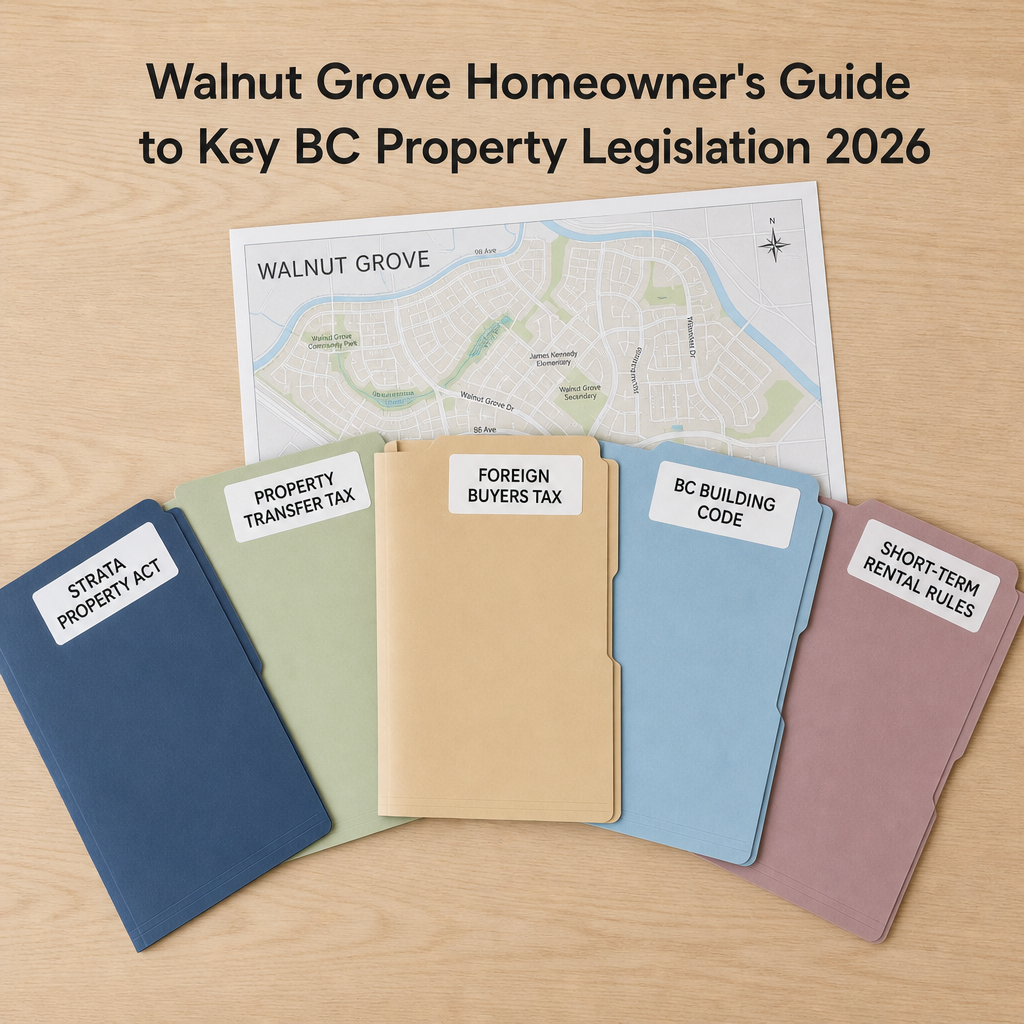

Walnut Grove Homeowner's Guide to Key BC Property Legislation 2026: Understanding the Strata Property Act, Property Transfer Tax, Foreign Buyers Tax, BC Building Code, and Short-Term Rental Regulations That Affect Your Home, Investment Returns, and Legal Obligations
By Mohamed Mansour, MBA and Associate Broker | Mansour Real Estate Group | Published: May 13, 2025 | Geography: Walnut Grove, Langley, Fraser Valley, BC
Walnut Grove is one of Langley's most strata-dense communities, and most properties here sit inside a legal framework that many owners have never fully reviewed. Five overlapping BC laws govern what you can do with your property, how much a sale will cost, who can buy, what renovations require permits, and whether you can legally rent on platforms like Airbnb.
This guide explains each of those five laws in plain language — what they cover, how they apply specifically in Walnut Grove, and when you need to speak with a lawyer, accountant, or licensed professional before making a decision.
Short Answer
Five BC laws shape nearly every financial and legal decision a Walnut Grove homeowner makes: the Strata Property Act, the Property Transfer Tax Act, the Foreign Buyers Tax, the BC Building Code, and Langley's Short-Term Rental Regulations. Understanding what each one requires — and when it applies — helps you avoid compliance failures, financing problems, and post-closing disputes.
Key Takeaways
- The Strata Property Act governs Form B accuracy, depreciation reports, and strata bylaw compliance — failures can trigger financing denial.
- BC Property Transfer Tax ranges from 1% to 3% depending on purchase price; first-time buyer exemptions apply to purchases under $500,000.
- The Foreign Buyers Tax adds 15% on residential purchases by non-citizens or non-permanent residents above $500,000.
- Unpermitted renovations void builder warranties, create disclosure obligations, and can trigger post-closing litigation.
- Langley's STR bylaws restrict short-term rentals to principal residences; violations carry fines up to $10,000 per day.
Who This Applies To
- Walnut Grove homeowners considering renovations, sales, or rental strategies
- Buyers evaluating strata townhomes or condos in Walnut Grove
- Investors assessing short-term rental income potential
- Non-Canadian buyers or cross-border investors evaluating purchase costs
- Executors or estate representatives managing Walnut Grove property
When This Advice May Not Apply
Detached properties not registered under strata plan are not subject to the Strata Property Act. PTT exemptions, Foreign Buyers Tax exemptions, and STR permit structures change periodically — always verify current rules directly with the BC Ministry of Finance, the Township of Langley, and a qualified lawyer before transacting.
Data Used in This Article
- BC Strata Property Act, RSBC 1996 Chapter 433 — BC Parliament, official legislation
- Property Transfer Tax Act, RSBC 1996 Chapter 379 — BC Ministry of Finance, official legislation
- PTT Bulletin PTT 005: Foreign Entity Tax — BC Ministry of Finance, 2024 update, official regulatory guidance
- Township of Langley Zoning Bylaw No. 2500, Short-Term Rental Amending Bylaw — Township of Langley, 2024, official municipal bylaw
- BC Building Code, 2024 Edition — Office of Housing and Construction Standards, BC Government, official code
Key Definitions
Form B (Information Certificate): A strata document required in all strata sales that discloses monthly fees, outstanding levies, bylaw violations, and litigation. Buyers and lenders rely on it for financing approval.
Depreciation Report: An engineering assessment of a strata building's common property, estimating repair and replacement costs over 30 years. Required for most strata corporations under the Strata Property Act.
Special Levy: A one-time charge assessed by a strata corporation when the contingency reserve fund is insufficient to cover a repair. Can range from hundreds to tens of thousands of dollars per unit.
PTT (Property Transfer Tax): A provincial tax paid by the buyer at the time of transfer, calculated on the fair market value of the property.
STR (Short-Term Rental): A rental of a dwelling unit for periods typically under 30 days, including through platforms such as Airbnb or VRBO.
The Strata Property Act and What It Means for Walnut Grove Owners
More than 95% of properties in Walnut Grove are registered under strata plans, which means the Strata Property Act (RSBC 1996, Chapter 433) governs nearly every significant ownership decision here — from what you can renovate to how your unit is sold.
When a Walnut Grove strata unit is listed for sale, the seller's strata corporation must produce a Form B Information Certificate. That document discloses the monthly strata fee, any outstanding special levies, bylaw violations on the unit, and whether the strata is involved in litigation. Lenders review Form B before approving mortgage financing. If the Form B reveals an undisclosed levy or ongoing lawsuit, financing can fall through — and the sale collapses. This is why our team reviews Form B, meeting minutes, and the depreciation report before any Walnut Grove listing goes live. You can read more about strata document requirements in our Walnut Grove townhome buying guide.
Strata bylaws in Walnut Grove frequently restrict rental use, set pet limits, and require strata council approval for certain alterations. Owners who rent without bylaw authority, run unauthorized suites, or make alterations without strata approval face fines and buyer pool restrictions. If a unit has a bylaw violation on record, it will appear on Form B — and buyers can walk away or renegotiate.
Depreciation reports are the other major strata document to understand. They estimate the remaining life and replacement cost of common property elements — roofs, windows, parkades, mechanical systems. A strata with an outdated or unfunded depreciation reserve is a financial risk for every owner. Before purchasing any Walnut Grove strata unit, confirm the depreciation report's age and whether the contingency reserve fund is adequately funded. Consult your lawyer and a strata document review service for a complete analysis.
Property Transfer Tax and First-Time Buyer Exemptions
Every residential property purchase in BC triggers the Property Transfer Tax, calculated on fair market value under the Property Transfer Tax Act (RSBC 1996, Chapter 379). The current rate structure, as published by the BC Ministry of Finance, is: 1% on the first $200,000; 2% on the portion from $200,000 to $2,000,000; and 3% on any portion above $2,000,000.
For a Walnut Grove townhome purchased at $850,000, the PTT calculation would be roughly $15,000. That is a real cost that affects net proceeds for sellers and cash-to-close calculations for buyers. The first-time buyer exemption eliminates PTT entirely on purchases under $500,000, with a partial exemption on purchases up to $525,000 — thresholds that apply to a narrower slice of the Walnut Grove market given current price levels. Buyers should confirm current exemption thresholds directly with the BC Ministry of Finance and file the required declarations at the Land Title Office within prescribed timelines. Consult a lawyer for filing requirements specific to your transaction.
Sellers benefit from understanding PTT indirectly: the tax affects a buyer's total acquisition cost and can influence offer amounts, particularly for buyers with limited down payment flexibility. For pricing strategy context, see our Walnut Grove seller pricing guide.
The Foreign Buyers Tax and Its Effect on Walnut Grove's Buyer Pool
The Foreign Entity Tax — commonly called the Foreign Buyers Tax — adds 15% to the purchase price of residential property purchased by non-Canadian citizens and non-permanent residents in designated areas of BC, including the Fraser Valley. Under PTT Bulletin PTT 005 (BC Ministry of Finance, updated 2024), this tax applies to residential purchases generally above $500,000 where the buyer is a foreign national or a corporation controlled by foreign nationals.
For a $850,000 Walnut Grove townhome, that is an additional $127,500 — a cost that disqualifies or significantly discourages a segment of international buyers. Walnut Grove has historically attracted buyers from across Metro Vancouver and the Fraser Valley, including purchasers with connections to international markets. When the Foreign Buyers Tax applies, it effectively removes those purchasers from consideration unless they qualify for one of the available exemptions, such as a work permit holder intending to use the property as a principal residence.
Sellers pricing Walnut Grove properties should understand that the effective buyer pool for their unit may be narrower than comparable Fraser Valley markets without this overlay. Buyers who are non-citizens should consult a BC real estate lawyer to determine whether an exemption applies before making an offer. Do not rely on real estate agent guidance alone for Foreign Buyers Tax determinations — this requires qualified legal advice. For a broader look at how Walnut Grove pricing compares regionally, see our Langley neighbourhood price comparison.
BC Building Code Compliance and Renovation Permits in Walnut Grove
Many Walnut Grove townhomes were built between 2013 and 2017. That means a significant portion of units are approaching or have passed the 8-to-10-year mark where builder warranties under BC's Homeowner Protection Act begin to expire — specifically, the 10-year structural warranty expires at year 10, and components like roofing, cladding, and windows typically fall under 5-year or 2-year coverage windows.
Under the BC Building Code (2024 Edition, Office of Housing and Construction Standards), all structural alterations, electrical work, plumbing changes, additions, and suite conversions require a building permit from the Township of Langley. Work done without a permit is classified as unpermitted — and unpermitted work voids applicable builder warranty coverage, creates mandatory disclosure obligations when selling, and can expose sellers to post-closing claims from buyers who discover the work after possession. In our experience, unpermitted basement finishing and electrical panel upgrades are the most frequent compliance gaps we encounter in Walnut Grove pre-sale preparation.
Before beginning any renovation intended to increase sale value, confirm with the Township of Langley Planning and Development Services whether a permit is required. If unpermitted work already exists in your unit, consult a lawyer and a licensed contractor about retroactive permitting before listing. For renovation ROI context for Walnut Grove sellers, see our top renovations guide for Walnut Grove sellers.
Short-Term Rental Regulations in Langley and What They Mean for Walnut Grove Investors
The Township of Langley amended its Zoning Bylaw No. 2500 in 2024 to align with BC's provincial Short-Term Rental Accommodations Act, which came into effect in May 2024. The provincial legislation restricts short-term rentals (typically defined as rentals under 30 days) to a host's principal residence — meaning the unit must be the property where the owner or tenant actually lives.
For Walnut Grove investors who purchased units with the intention of running them as Airbnb or short-term vacation rentals while residing elsewhere, these regulations are material. Operating a non-principal-residence STR in Langley without an exemption or valid permit is a bylaw violation. Under the provincial framework, enforcement fines can reach $10,000 per day. The Township of Langley has authority to issue compliance orders and refer repeated violations to provincial enforcement mechanisms.
Strata bylaws add another layer. Most Walnut Grove strata corporations have rental restriction clauses that limit total rental units, require strata council approval for tenancies, and may prohibit short-term rentals entirely. Even if a provincial or municipal exemption applied, strata bylaw restrictions may independently prohibit STR use. Both layers — municipal bylaw and strata bylaw — must be satisfied before operating any short-term rental.
Investors evaluating Walnut Grove units as income properties should build their financial models around long-term tenancy rather than short-term rental assumptions. For a realistic picture of investment returns under long-term rental scenarios, see our Walnut Grove investment and rental yield analysis. Consult a lawyer to confirm current STR permit status and bylaw compliance before purchasing any unit with income-property intent.
How We Evaluate This
When Mansour Real Estate Group prepares a Walnut Grove property for sale or guides a buyer through a purchase, we review the regulatory layers before any offer is made or accepted. That means requesting and reading the full strata document package — including Form B, depreciation report, meeting minutes, bylaws, and financial statements — not just the listing summary.
For sellers, we review whether any unpermitted work exists, confirm current strata bylaw compliance, and flag any conditions that may affect buyer financing or post-closing risk. For buyers, we explain what each document means in plain terms and flag when a lawyer or strata document review specialist is warranted. Regulatory compliance is not a checklist item — it affects pricing, buyer pool size, financing approval, and post-closing liability. We treat it as central to every transaction, not an afterthought.
Walnut Grove Homeowner Compliance Checklist
- Confirm your strata corporation has a current depreciation report (within 5 years) and a funded contingency reserve.
- Review your strata bylaws for rental, pet, and alteration restrictions before making any changes to use or occupancy.
- Obtain a Form B before listing and review it with your real estate agent and lawyer for any outstanding levies or violations.
- Confirm all renovation work was permitted through the Township of Langley; consult a contractor about retroactive permits for any unpermitted work.
- Verify your builder warranty expiry dates and document any deficiencies before warranty coverage lapses.
- Confirm your rental strategy complies with both municipal STR bylaws and strata corporation rental restrictions before listing on any platform.
- If you are a non-citizen buyer or a foreign entity, consult a BC real estate lawyer about Foreign Buyers Tax liability before submitting an offer.
- Budget for Property Transfer Tax in your acquisition cost calculations and confirm current exemption thresholds with the BC Ministry of Finance.
What We Commonly See
In our experience working with Walnut Grove sellers, the most common issue is undisclosed unpermitted work — most often basement finishing, secondary suite rough-ins, or electrical panel upgrades completed without Township of Langley permits. These surface during buyer home inspections and either kill the deal or result in a significant price renegotiation.
What often happens is that sellers are genuinely unaware their work required a permit. The renovation was done by a contractor, felt routine, and no one flagged the permit requirement at the time. The disclosure obligation under BC real estate law still exists, regardless of intent. Our pre-listing process is specifically designed to surface these issues before they become post-offer problems.
A common mistake among investor buyers is assuming that Walnut Grove's strata bylaws are flexible on rentals. Many strata corporations in Walnut Grove have rental caps — meaning once a certain percentage of units are rented, no additional rental approvals are issued. Buyers who purchase intending to rent, without first confirming the rental cap status, sometimes close on a unit they legally cannot rent for months or years.
Questions and Answers
Does the Strata Property Act require my Walnut Grove strata to have a depreciation report?
Under the Strata Property Act (RSBC 1996, Chapter 433) and its regulations, most strata corporations with five or more strata lots are required to obtain a depreciation report every five years. Strata corporations can pass a three-quarters vote annually to waive this requirement, but lenders increasingly require a current depreciation report before approving financing on a strata unit. Confirm current requirements with your strata council and a BC strata lawyer.
Who pays the Property Transfer Tax in a BC real estate transaction?
The PTT is paid by the buyer, not the seller. It is due at the time of transfer registration at the Land Title Office and must be included in the buyer's closing cost calculations. First-time buyers may be exempt from PTT on purchases under the current threshold — verify the current exemption amount directly with the BC Ministry of Finance before relying on it in your budget.
Can I operate a short-term rental in my Walnut Grove strata townhome?
In most cases, no — unless the property is your principal residence and both your strata bylaws and the Township of Langley's zoning bylaw permit it. The provincial Short-Term Rental Accommodations Act (effective May 2024) restricts STRs to principal residences province-wide. Most Walnut Grove strata corporations also have rental restriction bylaws that independently prohibit or cap rentals. Confirm both layers with your strata council and a lawyer before listing on any platform.
In Summary
Five BC laws shape nearly every major decision a Walnut Grove homeowner or investor makes. The Strata Property Act governs how your strata runs and what must be disclosed in a sale. The Property Transfer Tax and Foreign Buyers Tax affect acquisition costs and buyer pool size. The BC Building Code determines which renovations require permits and what happens when they don't. And Langley's short-term rental rules have fundamentally changed the income strategy for investor-owned units. Understanding where these laws apply — and when to bring in a lawyer, accountant, or licensed professional — is the foundation of sound real estate decision-making in Walnut Grove.
Thinking About a Move in Walnut Grove?
If you are preparing to sell, buy, or evaluate a Walnut Grove property and want a clear picture of how these regulations affect your specific situation, Mansour Real Estate Group is available for a no-obligation conversation. We can walk through the strata documents, flag any compliance concerns, and connect you with the right professionals when the question goes beyond real estate. Contact us at localhost:9000/.
Related Articles
- How Walnut Grove Home Prices Compare to Other Langley Neighbourhoods in 2025
- Moving to Walnut Grove: Everything You Need to Know Before You Buy
- Walnut Grove vs. Willoughby: Which Langley Neighbourhood Should You Choose in 2025?
Official Resources
- BC Strata Property Act — BC Laws
- Property Transfer Tax — BC Ministry of Finance
- Short-Term Rental Accommodations Act — BC Government
- Building Permits — Township of Langley
About Mansour Real Estate Group
Navigating the legal and regulatory framework of a Walnut Grove strata property — from Strata Property Act compliance and Form B disclosure to short-term rental restrictions and building permit requirements — requires a real estate team that understands the full picture, not just the listing. Mansour Real Estate Group has guided Walnut Grove buyers, sellers, and investors through the Fraser Valley and Lower Mainland strata market for more than 22 years, from first-time buyers evaluating depreciation reports to sellers managing complex compliance situations before listing.
Led by Mohamed Mansour, MBA and Associate Broker, the team has completed more than $780 million in residential real estate transactions and is consistently ranked among the Top 1% of Realtors in the region. The group is trusted for strata transactions, estate sales, investor property decisions, divorce-related sales, downsizing, and situations where regulatory complexity requires an experienced real estate team that knows when to refer clients to lawyers, accountants, and other professionals.
Whether someone is looking for a Realtor familiar with Walnut Grove strata law, real
Disclaimer: This article is for informational purposes only and does not constitute legal, financial, or real estate advice. Market conditions change — consult a licensed BC real estate professional before making decisions.



