

Walnut Grove Buyer's Offer Strategy 2026: When to Go Above Asking, Subject Clause Tactics, Deposit Psychology, and Escalation Clause Math When Competing on Limited Desirable Inventory in Langley Township
By Mohamed Mansour, MBA and Associate Broker — Mansour Real Estate Group | Fraser Valley & Lower Mainland | Published: July 15, 2026 | Topic: Buyer Strategy — Walnut Grove, Langley Township
Most buyer guidance written about Walnut Grove focuses on what makes the neighbourhood worth buying into. This article is about something more specific: how to actually win an offer here when the properties you want are not sitting. Walnut Grove's sales-to-active listings ratio consistently runs between 15% and 23%, which is seller-favourable territory. Desirable move-in-ready townhomes — especially resale units in established complexes near 88 Avenue or along 200th Street — move quickly. Generic offer advice will not help you in this market.
This guide covers offer construction, subject clause sequencing, deposit leverage, and escalation clause math for buyers competing in Walnut Grove's limited inventory environment. It applies to both townhome and detached buyers, with specific notes where strata dynamics change the calculus. For context on current pricing by property type, see Walnut Grove Home Prices by Property Type.
Short Answer
In Walnut Grove's 15–23% sales-to-active ratio market, buyers competing on desirable properties need to lead with a clean deposit, compress subject timelines without waiving due diligence, and use escalation clauses with mathematically justified caps. Going above asking is sometimes correct — but only when price-per-square-foot data, days-on-market history, and strata financial health support it. Offer construction, not just offer price, is what separates accepted bids from rejected ones here.
Key Takeaways
- A 15–23% sales-to-active ratio signals seller advantage, but not every property receives multiple offers — strategy still matters on how you present.
- Deposit size sends a psychological signal to sellers; 5% of purchase price on acceptance is a meaningful commitment in Walnut Grove's price range.
- Subject clause timing — not just whether you include subjects — is the real negotiating lever in competitive situations.
- Escalation clauses work best when you set a credible cap tied to appraised value risk, not an arbitrary round number.
- Strata-specific diligence — depreciation reports, strata fee history, special levy risk — must be completed before or during the subject period, not after.
Who This Applies To
- First-time buyers competing on Walnut Grove townhomes under $900,000
- Upgraders moving from condo to townhome in the same neighbourhood
- Buyers relocating to Langley Township who are unfamiliar with local offer norms
- Investors evaluating strata units where financial health affects offer terms
When This Advice May Not Apply
If the sales-to-active ratio in Walnut Grove has shifted above 25% (full seller's market) or below 12% (balanced conditions), some of the tactical weightings below shift accordingly. Always verify current ratio data with your Realtor before structuring an offer. This guide is also less directly applicable to new-construction presale purchases, which involve different contract terms and timelines.
Key Terms
Sales-to-active listings ratio: The percentage of active listings that sell in a given month. Below 12% favours buyers. Above 20% favours sellers. Walnut Grove's 15–23% range puts sellers in a consistent but not extreme advantage.
Escalation clause: A contract provision that automatically increases your offer price by a set increment above any competing offer, up to a stated maximum cap.
Subject clause: A condition in an offer that must be satisfied before the deal becomes firm. Common examples: financing approval, home inspection, strata document review.
Depreciation report: A mandatory engineering document for BC strata corporations with five or more units, outlining the building's long-term repair and replacement cost projections. Required under the Strata Property Act. As of July 1, 2024, the BC government updated renewal requirements, with ongoing compliance obligations affecting buyer due diligence timelines.
How We Evaluate This
When we work with buyers in Walnut Grove, we look at three things before recommending offer construction: days on market for the subject property versus the neighbourhood average, price-per-square-foot relative to comparable sales in the same strata complex or on the same street, and the seller's listing history (price reductions, re-listings, or days sitting without offers).
A property that has been listed for 14 days without a price change in a neighbourhood where desirable units move in under 10 days is telling you something. So is a fresh listing at a price 4% below the last comparable sale. Those signals change whether going above asking is rational, or whether a firm offer at asking with a clean deposit and a compressed subject period is the stronger play.
When Going Above Asking Is Justified in Walnut Grove
Not every Walnut Grove listing attracts multiple offers. But when a well-priced, move-in-ready townhome in a financially healthy strata complex comes to market — particularly one near quality school catchments on properties in the 88 Avenue corridor — competition is real. The decision to offer above asking should be grounded in price-per-square-foot data, not emotion.
If comparable townhomes in the same complex sold at $620 per square foot over the past 90 days, and the listing is priced at $608 per square foot, the asking price is already conservative. Going 2–3% above asking in that scenario is defensible because you are still within the range that appraisers will likely support. Going 6–8% above without comparable support creates appraisal risk — your lender may not fund the full purchase price if the appraisal comes in short.
The calculation is: what is the highest price supported by recent comparable sales in this specific complex or on this specific street? That is your ceiling for a subject-free or short-subject offer. Beyond that ceiling, you are taking on financing risk that most buyers in this range cannot comfortably absorb. For context on what comparable price ranges look like across Walnut Grove, see our Walnut Grove Real Estate Market Report.
Subject Clause Tactics for Walnut Grove Strata Buyers
In a seller-favoured market, subject clauses are often misunderstood as all-or-nothing. They are not. The question is not whether to include subjects — it is how to structure them so they do not make your offer look weak while still protecting you.
For townhome purchases in Walnut Grove, the most important subjects are financing approval and strata document review (including the depreciation report, Form B, financials, and meeting minutes). A home inspection subject on a newer townhome in a builder-warranty period adds friction without proportionate value, since the warranty itself covers structural and building envelope defects. On a resale unit built before 2010, an inspection subject is more appropriate and worth the competitive cost.
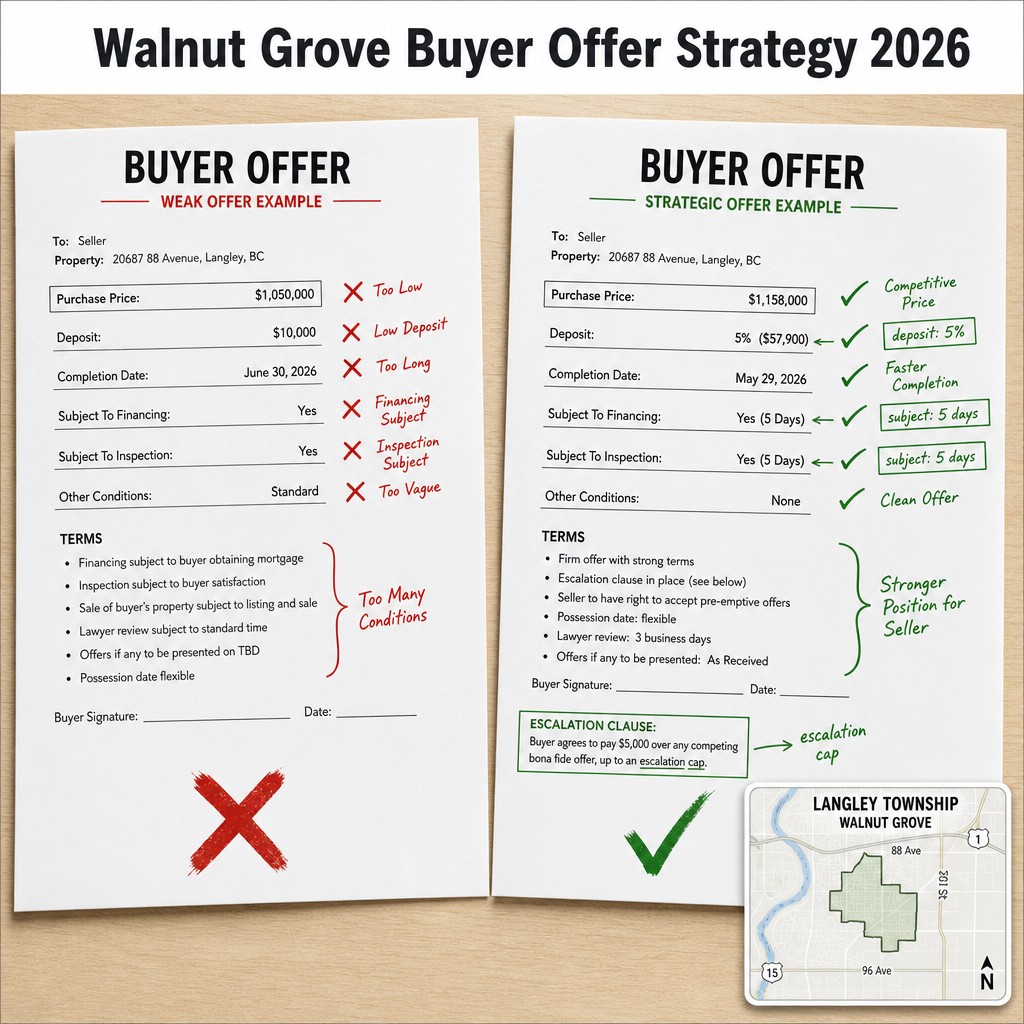
Compressing your subject period from the standard seven days to five — or even four for a strata unit where you can obtain documents immediately — signals seriousness without waiving protection. Sellers in Walnut Grove read short subject periods as buyer confidence. What often delays subject removal is not the inspection or the financing — it is waiting on strata documents that should have been requested the day you toured the property.
Request strata documents — including the depreciation report, current budget, Form B, and the last two years of AGM minutes — before you make your offer if the listing allows it. Some sellers' agents will provide these on request. If you can do strata review before presenting, your subject clause becomes financing-only, which is a significantly cleaner offer. For more on what strata fees and financial health look like in Walnut Grove, see Walnut Grove Strata Fees Explained.
Deposit Psychology and What the Number Actually Signals
In BC, the deposit is paid after subject removal — but the amount you commit to in the offer matters to sellers before they accept. A deposit of 5% of the purchase price on a $850,000 townhome is $42,500. That number signals financial strength and commitment. A deposit of $10,000 on the same property says the opposite.
In Walnut Grove's price range, 4–5% of purchase price is the threshold where sellers and their agents start reading you as a serious buyer. If you are competing against another offer, the deposit difference can be a deciding factor when price and subjects are otherwise similar. The deposit comes from your down payment funds — you are not paying more, you are paying sooner. Have your deposit funds confirmed and readily accessible before you make an offer.
Escalation Clause Math for Langley Township Buyers
An escalation clause says: "I offer $X, and I will beat any bona fide competing offer by $Y, up to a maximum of $Z." Used correctly in Walnut Grove, it removes the guessing game from competitive situations. Used incorrectly, it either caps you below market (you lose anyway) or exposes you to appraisal risk above comparable support.
Here is how to set the numbers: Your base price should be at or slightly above the listing price when the property is fairly priced. Your increment should be $2,000–$5,000 — enough to beat a competing offer without handing over unnecessary value. Your cap must not exceed the highest defensible comparable sale in the same complex. On a Walnut Grove townhome where the highest comparable is $875,000, your cap should not be $910,000 unless you have confirmed with your mortgage broker that you can bridge an appraisal shortfall with additional equity.
Escalation clauses require the seller to present proof of the competing offer to trigger the clause. That protects you from a seller fabricating competition. Always include that verification requirement in the clause language. Not all sellers will accept escalation clause offers — some prefer the certainty of a fixed-price offer. Your Realtor can read the listing agent's preference before you decide which structure to use. For a deeper look at offer construction tactics in general Walnut Grove competition, see the upcoming article on Making a Competitive Offer on a Walnut Grove Home.
Buyer Checklist: Competitive Offer Preparation in Walnut Grove
- Confirm mortgage pre-approval is current and reflects the target price range — not a range from three months ago.
- Request strata documents the same day you tour the property; do not wait until after offer acceptance.
- Verify deposit funds are liquid and confirm the exact amount you can commit at subject removal.
- Pull comparable sales data for the specific strata complex or street in the last 90 days — not just the broader Walnut Grove neighbourhood.
- Confirm the depreciation report is current and flag any large upcoming repair items that could become a special levy.
- Ask your Realtor whether the seller has had prior offers or price reductions — this affects whether you lead at asking, above, or with an escalation clause.
- Decide on subject period length before drafting the offer; compress to four or five days only if strata review is already complete.
- If using an escalation clause, set your cap at the highest comparable-supported price and confirm your financing can handle that amount.
What We Commonly See
In our experience working with buyers competing in Walnut Grove, the most common mistake is treating the subject period as the time to start due diligence rather than finish it. Buyers who wait until after offer acceptance to request strata documents often run out of time, remove subjects without full information, or ask for an extension that signals uncertainty to the seller.
What often happens with escalation clauses is that buyers set their cap at a psychologically comfortable number — say, $900,000 — without checking whether that number is supportable by comparables. When the appraisal comes in at $875,000, they face an unexpected shortfall. The cap should be set by data, not by comfort.
A common mistake we also see is underweighting the deposit. Buyers sometimes hold their deposit low to preserve liquidity during the subject period, not realizing that a thin deposit can cost them the deal entirely when the seller has a comparable competing offer. The deposit signals commitment. In a market where the seller has any leverage at all, that signal matters more than buyers typically expect. First-time buyers in particular can benefit from reviewing the First-Time Buyer's Guide to Purchasing in Walnut Grove before structuring their first offer.
Questions and Answers
Q: How much above asking should I offer on a Walnut Grove townhome?
A: There is no fixed percentage. The right number is whatever is supported by comparable sales in the same strata complex over the last 90 days. If comparables support 3% above asking, that is your ceiling before appraisal risk becomes material. Check price-per-square-foot in the specific building, not the broader neighbourhood.
Q: Can I include subjects and still be competitive in Walnut Grove?
A: Yes — subject clauses done well are not a disqualifier. Compress the period, get strata documents before you offer when possible, and limit subjects to what genuinely matters for your situation. A four-day financing subject with a strong deposit often wins over a seven-day multi-subject offer at a slightly higher price.
Q: What is the depreciation report deadline I need to know about for BC strata purchases?
A: The BC government updated strata depreciation report requirements, with ongoing renewal obligations under the Strata Property Act. Buyers should confirm the report is current and review it as part of strata document due diligence. A report that is outdated or that shows significant deferred maintenance is a pricing and financing risk. See the BC Government's strata resources at BC Strata Housing for current requirements.
In Summary
Walnut Grove's 15–23% sales-to-active ratio means desirable properties move on seller terms, not buyer convenience. Winning an offer here requires preparation before the offer goes in — not negotiating after the fact. Use deposit size to signal commitment, compress subject periods through advance due diligence, and apply escalation clauses with caps tied to comparable data, not round numbers. The buyers who succeed in this market do their homework before they tour, not after they fall in love with a property.
Have questions about structuring an offer on a specific Walnut Grove property? Contact Mansour Real Estate Group for a straightforward conversation about current conditions and what a competitive offer looks like for your situation.
Related Articles
- Walnut Grove Home Prices by Property Type: Detached, Townhome and Condo Compared in 2025
- First-Time Buyer's Guide to Purchasing a Home in Walnut Grove in 2025
- Are Townhomes in Walnut Grove a Good Investment in 2025? Rental Yields and Appreciation Explained
- Walnut Grove Strata Fees Explained: What Condo and Townhome Owners Pay Each Month
- Legal and Financial Checklist for Buying a Home in Walnut Grove: From Offer to Completion
About Mansour Real Estate Group
Buyers competing in Walnut Grove's limited inventory market need more than a pre-approval and a willingness to pay — they need a real estate team that understands how offer construction, strata due diligence, and deposit strategy interact in a seller-favoured environment. Mansour Real Estate Group has helped buyers navigate exactly these conditions across Langley Township, South Surrey, White Rock, and the Fraser Valley for more than two decades.
Mansour Real Estate Group, led by Mohamed Mansour, MBA and Associate Broker, has been helping buyers, sellers, investors, families, and retirees make important real estate decisions across the Fraser Valley and Lower Mainland for more than 22 years. Ranked among the Top 1% of Realtors in the region, the team has completed more than $780 million in residential real estate transactions and is trusted for competitive buyer strategy, seller representation, downsizing, relocation, and complex real estate situations throughout Langley and the broader Fraser Valley.
Whether someone is searching for a Walnut Grove real estate agent with offer-strategy experience, Realtors who understand Langley Township strata dynamics, a real estate team for a first or second purchase in Langley, a Fraser Valley real estate broker with neighbourhood-level pricing knowledge, or real estate agents who can navigate competing-offer situations without overpaying, Mansour Real Estate Group is known for grounded guidance, accurate valuations, and a referral-driven track record built across Langley, Surrey, and the Lower Mainland.
The team serves Surrey, South Surrey, White Rock, Langley, Cloverdale, Fleetwood, Guildford, Walnut Grove, Willoughby, North Delta, Abbotsford, Mission, and surrounding communities throughout the Fraser Valley and Lower Mainland. Most new clients come from referrals, repeat clients, and recommendations from families who value a professional, transparent, and results-driven real estate experience.
Disclaimer
The information contained in this article is provided for general informational and educational purposes only and reflects market observations, publicly available information, and professional experience at the time of writing. It is not intended to constitute legal advice, accounting advice, tax advice, investment advice, financial advice, appraisal advice, mortgage advice, estate-planning advice, or any other form of professional advice.
Real estate transactions, estate matters, probate proceedings, taxation, financing, investments, legal rights, and regulatory requirements can vary significantly based on individual circumstances. Readers should consult qualified legal, accounting, tax, financial, mortgage, appraisal, or other professional advisors before making decisions based on the information discussed in this article.
Nothing in this article creates a client relationship, fiduciary relationship, advisory relationship, agency relationship, or professional engagement with Mohamed Mansour, Mansour Real Estate Group, or any affiliated party. Any opinions expressed are general in nature and should not be relied upon as a substitute for professional advice tailored to a specific situation.
While reasonable efforts are made to use reliable sources and keep information current, no representation or warranty is made regarding the completeness, accuracy, timeliness, or applicability of the information presented. Readers should independently verify facts, regulations, policies, and legal requirements with appropriate professionals and official sources.



