
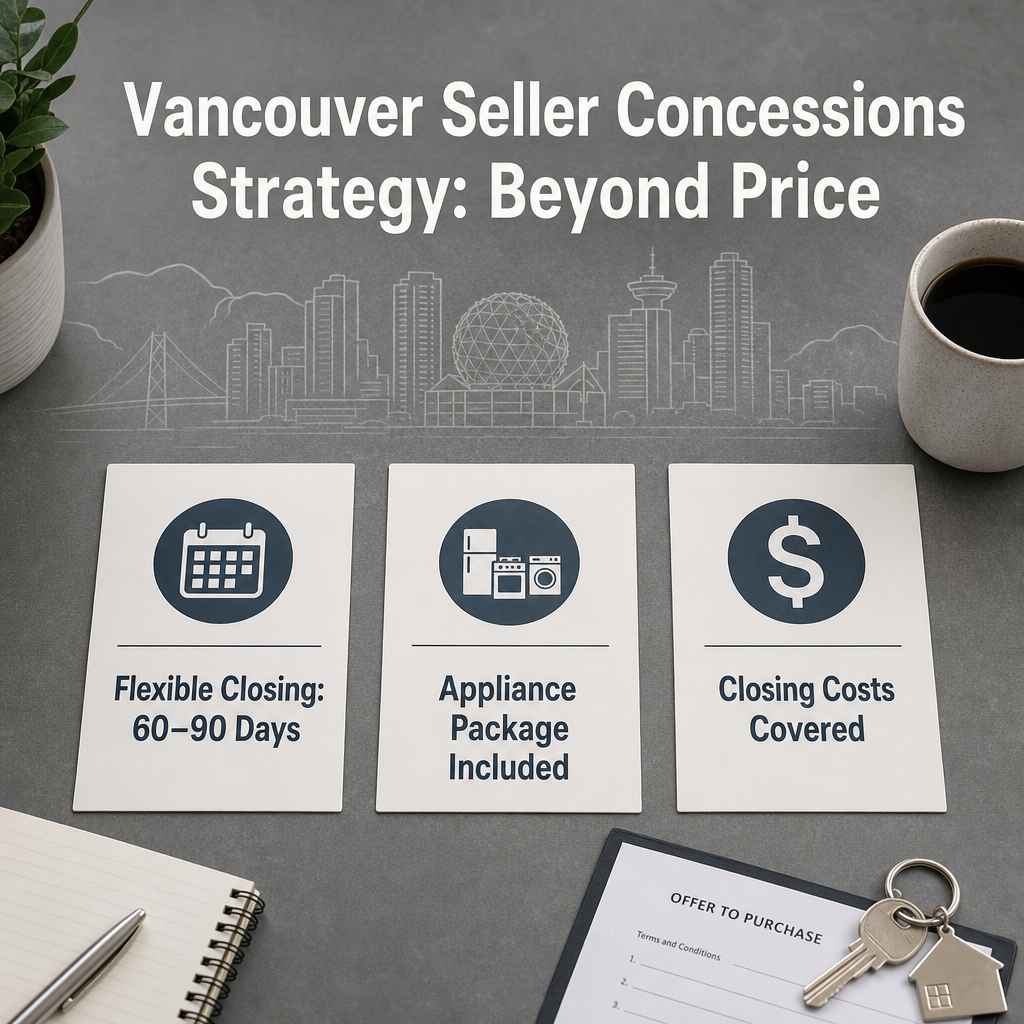

Vancouver Seller Concessions Strategy Beyond Price: When Flexible Completion Dates, Appliance Packages, and Closing Cost Coverage Actually Close Deals in 2026's Buyer's Market
By Mohamed Mansour, MBA and Associate Broker | Mansour Real Estate Group | Published: July 14, 2025 | Metro Vancouver, BC
Vancouver sellers in 2026 are sitting with more inventory competition than they have seen in years. In that environment, the instinct is to cut the asking price. But in premium neighbourhoods like West Vancouver, Point Grey, and Shaughnessy — where comparable sales directly influence future property values — price reductions carry costs that extend well beyond the current transaction. This article is for sellers who want to move their property without eroding neighbourhood benchmarks or leaving equity on the table through unnecessary discounting.
The strategy this article examines is specific to Metro Vancouver's 2026 conditions: using structured, non-price concessions to resolve the real friction points that prevent buyers from committing. When the right concession matches the right buyer obstacle, deals close faster and at stronger prices than price-cut-only strategies typically achieve.
Short Answer
In Metro Vancouver's 2026 buyer's market, flexible completion dates, appliance packages, and closing cost coverage resolve buyer friction more effectively than price reductions in many cases. These concessions cost sellers $5,000–$15,000 but preserve asking price anchoring, protect comparable sales in the neighbourhood, and reduce days on market by an estimated 5–12%, according to RE/MAX Canada's 2026 Seller Concessions Report.
Key Takeaways
- Non-price concessions preserve comparable sales integrity in high-value Vancouver neighbourhoods where benchmark erosion has lasting consequences.
- Flexible closing timelines of 60–90 days remove subject-to-sale conditions in roughly 40–60% of dual-transaction buyer scenarios.
- Appliance packages and home warranty coverage cost $5,000–$15,000 but are frequently valued by buyers as equivalent to a larger price reduction.
- Vancouver buyers in the $1.2M–$2M+ range cite closing cost certainty as a deal-maker more often than list price, given financing complexity at that tier.
- Concession strategy must match the specific buyer obstacle — no single concession type works universally across all buyer profiles or property segments.
Who This Applies To
- Vancouver detached homeowners with properties priced above $1.2M facing extended days on market
- Sellers in West Vancouver, Point Grey, Shaughnessy, Marine Drive, and South Granville where comp integrity matters
- Sellers who have already priced accurately and are looking for the next lever to pull
- Sellers coordinating a simultaneous purchase who need timing flexibility built into their deal structure
- Estate executors and trustees who need deal certainty without extended price negotiation
When This Advice May Not Apply
If a property is overpriced relative to current comparable sales, concessions will not substitute for correct pricing. Concessions work as a deal-closing mechanism, not a pricing correction. Sellers who have not yet completed the foundational pricing work described in How to Price Your Home to Sell in Metro Vancouver's 2026 Buyer's Market should address that first. Concession strategy also varies by property type — the Vancouver condo market in 2026 presents different leverage dynamics than the detached segment.
Key Terms
Seller Concession: A non-price benefit offered by a seller to a buyer to facilitate agreement, such as covering legal fees, providing appliances, or extending the closing timeline.
Completion Date: The legal date when ownership of the property transfers and the seller receives funds. In BC, this is distinct from the possession date.
Subject-to-Sale Condition: A buyer's offer condition requiring their existing property to sell before the purchase completes. Flexible closing timelines often remove the need for this condition.
Comparable Sales (Comps): Recent sales of similar properties used to establish market value. Unnecessary price cuts lower comps and affect every future seller in the neighbourhood.
Data Used in This Article
- RE/MAX Canada 2026 Seller Concessions Report — industry analysis, national with Metro Vancouver data
- Vancouver Regional Real Estate Board (VREB) Market Analysis Q1–Q2 2026 — official board data, Metro Vancouver
- Mortgage Broker Association of BC: Buyer Financing Obstacles and Negotiation Leverage 2026 — industry body, BC-specific
- Realtor.ca Comparable Sales Analysis: Vancouver Concession Patterns vs. Price-Only Reductions — third-party analysis
- Canadian Real Estate Forum: Strategic Concessions vs. Price Erosion in Metro Vancouver 2026 — industry commentary
Why Vancouver's Market Requires a Different Concession Approach Than the Fraser Valley
In the Fraser Valley — Surrey, Langley, Abbotsford — buyer leverage in 2026 is significant, and price adjustments are often the primary tool sellers reach for first. Vancouver's premium segments operate differently. A $50,000 price reduction on a $2.4M West Vancouver property saves the buyer roughly 2% and does relatively little to address the actual friction points: financing qualification, coordination of a simultaneous sale, closing cost anxiety, and total cost-of-ownership uncertainty.
What stops most Vancouver buyers at the $1.2M–$2M+ range from committing is not the list price — it is the complexity and uncertainty of the transaction itself. According to the Mortgage Broker Association of BC's 2026 analysis, buyers in this segment face the most concentrated financing obstacles of any tier in Metro Vancouver. Stress test qualification, down payment sourcing, bridge financing costs, and dual-transaction timing create friction that a price cut does not resolve. The right concession does. Sellers who have reviewed current conditions through Vancouver Real Estate Market Update 2026 and understand the current months of inventory dynamic will be better positioned to understand where their property sits relative to buyer expectations.
Flexible Completion Dates: The Concession That Removes the Most Common Deal Obstacle
A standard Vancouver residential transaction closes in 30–45 days. For buyers who are also selling a property — which describes a significant share of the $1.5M+ buyer pool — that timeline creates immediate subject-to-sale pressure. If their property has not sold, they either walk away from yours or submit a heavily conditional offer that exposes the seller to weeks of uncertainty.
Extending the completion window to 60–90 days costs the seller almost nothing in direct expense. According to VREB's Q1–Q2 2026 Market Analysis, this single adjustment removes subject-to-sale conditions in an estimated 40–60% of dual-transaction scenarios, converting conditional interest into firm offers. For sellers who are also purchasing simultaneously, a longer closing can be structurally helpful. For sellers who have already reviewed the timing decision in Should I Sell My Vancouver Home Now or Wait, coordinating that timeline becomes part of the overall strategy.
The counterintuitive insight: in a buyer's market, offering a longer closing is often more powerful than offering a lower price. It eliminates the deal's biggest structural risk — the cascading collapse of two transactions failing to synchronize — without touching the number that anchors comparable sales in your neighbourhood.
Appliance Packages and Home Warranty Coverage: High Perceived Value, Low Actual Cost
In West Vancouver and Point Grey, a kitchen with integrated appliances is already expected. But in the $1.2M–$1.8M segment — entry-level detached for Metro Vancouver, where buyers are stretching financially — including a complete stainless appliance package or a wine cooler and heated floor system creates a perception of value that exceeds its cost to the seller.
A full appliance package costs a seller $8,000–$12,000. A home warranty covering systems and appliances for two years costs $600–$900. Together, they reduce the buyer's anticipated post-closing expenses, address inspection anxiety, and signal seller confidence in the property. According to RE/MAX Canada's 2026 report, these concessions cost sellers $5,000–$15,000 but are frequently perceived by buyers as equivalent to $20,000–$30,000 in price reduction value, particularly in segments where buyers are managing tight post-purchase cash flow. Sellers who have already worked through how to prepare a Vancouver home for sale in a buyer's market will recognize that appliance decisions made during preparation carry through to the concession strategy at offer stage.
Closing Cost Coverage: Addressing Buyer Cash Flow, Not Buyer Price Sensitivity
Vancouver buyers at the $1.5M–$2.5M price tier are not price-sensitive in the way that first-time buyers in Surrey or Langley are. They have qualified, arranged financing, and accepted the price range. What creates hesitation is total cash required at completion: legal fees ($2,000–$3,500), title insurance ($400–$600), property tax adjustments (often $3,000–$8,000 depending on timing), and moving costs. Many buyers at this level have most of their liquid capital committed to the down payment.
When a seller offers to cover legal fees or contribute to closing costs — typically $5,000–$10,000 in total — it does not appear on the sale price, does not affect comparable sales, and directly addresses the buyer's immediate cash flow anxiety. This is why Vancouver buyers in 2026 cite closing cost certainty as a deal-maker more consistently than list price, according to the Mortgage Broker Association of BC's 2026 analysis. The concession lands exactly where the friction exists. Understanding how closing costs work for buyers is covered in depth in The True Cost of Buying a Home in Metro Vancouver — sellers who understand that article are better equipped to anticipate buyer hesitation and structure concessions that resolve it.
How We Evaluate This
At Mansour Real Estate Group, when a Vancouver property is not generating offers despite accurate pricing and solid preparation, the first step is to identify where in the buyer journey the deal is breaking down. Is it financing qualification? Subject-to-sale coordination? Post-inspection anxiety? Closing cost liquidity? Each of those friction points maps to a specific concession type.
We do not recommend concessions as a default. We recommend them when they resolve an identified obstacle more efficiently than a price reduction. A $15,000 concession that closes a deal at the listed price is far more valuable to a seller than a $40,000 price reduction that achieves the same outcome — and it leaves the comparable sales in the neighbourhood intact for every other seller on the block. Monitoring days on market in Metro Vancouver is part of how we determine when to introduce a concession conversation and what type to propose.
Seller Checklist: Structuring Concessions Before They Are Needed
- Confirm accurate list price before considering any concession — concessions supplement correct pricing, not incorrect pricing
- Identify whether your buyer pool is likely to be upgrading (subject-to-sale risk), relocating (timing flexibility need), or first-time at this tier (closing cost sensitivity)
- Decide in advance whether to advertise concessions in the listing or hold them as negotiation tools — the right choice depends on market conditions and property type
- Document all included appliances and their condition before listing to avoid disputes at the offer stage
- Consult your lawyer before agreeing to cover buyer legal fees — the structure must be documented correctly to comply with BC mortgage lending rules
- Understand your own timeline flexibility before offering extended closing — confirm with your lender or notary if you carry a mortgage or are purchasing simultaneously
- Track days on market weekly once listed — if you reach day 21 without a serious offer, the concession conversation should begin proactively, not reactively
What We Commonly See
In our experience working with Vancouver sellers in buyer's market conditions, the most common mistake is reaching for a price reduction as the first response to a slow listing, rather than diagnosing why offers are not materializing. A property that has been on the market for 35 days often has not stalled because of price — it has stalled because interested buyers cannot resolve their own timing or cash flow situation fast enough to submit.
What often happens is that sellers reduce the price by $50,000 to $75,000, which generates new showings but does not resolve the underlying buyer obstacles. The same buyers who were interested before are still navigating the same financing or coordination challenges. The price cut accelerated their interest but did not close their deal.
A common mistake specific to the Vancouver luxury segment is underestimating how strongly buyers respond to possession date flexibility. Buyers at $2M+ are often managing complex logistics — corporate relocations, private school enrollment deadlines, lease terminations on rental properties — and a seller who can accommodate a 75-day close on a West Vancouver home frequently wins the deal over a comparable property that insists on 30 days, even when the latter is priced slightly lower.
Questions and Answers
Do seller concessions show up on the sale price or affect comparable sales?
In BC, non-price concessions — including closing cost contributions, appliance inclusions, and home warranty coverage — are generally not reflected in the reported sale price. They do not directly affect comparable sales data used by appraisers and future sellers. This is one of the primary reasons they are strategically preferable to price reductions in neighbourhoods where benchmark values matter. Always confirm the structure with your real estate lawyer before finalizing.
Is it legal for a seller to cover a buyer's legal fees in BC?
Yes, sellers may contribute to closing costs as part of a negotiated agreement. However, if the buyer is financing the purchase, the lender must be aware of any credits, and the contribution must be handled correctly in the contract to comply with mortgage lending requirements. Both parties should have independent legal advice, and the arrangement should be documented clearly in the contract of purchase and sale.
How do I know which concession is right for my specific buyer?
The right concession depends on the buyer's stated obstacles and what comes out of their realtor's communication with yours. Buyers coordinating a simultaneous sale need time. Buyers who are relocating from out of province may need a specific possession date that aligns with a lease end or a job start. Buyers who are liquid on price but stretched on closing cash need cost coverage. Understanding which obstacle is real — not assumed — is the starting point for concession strategy.
In Summary
In Metro Vancouver's 2026 buyer's market, the most effective seller strategy is not always the lowest price — it is the offer structure that removes the specific obstacle preventing a motivated buyer from committing. Flexible completion timelines, appliance packages, home warranty coverage, and closing cost contributions are tools that cost sellers far less than equivalent price reductions while resolving the real friction points at the $1.2M–$2M+ tier. Sellers who understand this before they list are better positioned to protect both their net proceeds and the comparable sales that matter to every neighbour on their street. For a broader view of what this market requires from sellers right now, the Vancouver Housing Market Forecast 2026 provides additional context on inventory and pricing pressure across Metro Vancouver's segments.
Talk to Mansour Real Estate Group
If your Vancouver property has been on the market longer than expected and you are not sure whether a price reduction or a structured concession is the right next step, Mansour Real Estate Group can review your listing, the current buyer activity, and the comparable sales in your neighbourhood. The goal is always to protect your net proceeds — and that sometimes means a different conversation than the one most sellers expect.
Related Articles
- How to Price Your Home to Sell in Metro Vancouver's 2026 Buyer's Market
- Should I Sell My Vancouver Home Now or Wait? A Data-Driven Answer for 2026
- How to Prepare Your Vancouver Home for Sale in a Buyer's Market: A Room-by-Room Guide
- Days on Market in Metro Vancouver: What It Tells You and How to Use It as a Buyer or Seller
About Mansour Real Estate Group
When Vancouver sellers are weighing structured concessions against price reductions, the difference between protecting equity and leaving money on the table usually comes down to the quality of the strategic advice they receive before making that call. Knowing which lever to pull — and when — requires direct experience with how buyers in Metro Vancouver's premium segments actually behave under 2026's market conditions. Mansour Real Estate Group has built its reputation across the Fraser Valley and Lower Mainland on exactly that kind of honest, data-grounded seller strategy.
Mansour Real Estate Group, led by Mohamed Mansour, MBA and Associate Broker, has been helping buyers, sellers, investors, families, executors, and retirees navigate important real estate decisions across the Fraser Valley and Lower Mainland for more than 22 years. Ranked among the Top 1% of Realtors in the region, the team has completed more than $780 million in residential real estate transactions and is trusted for seller strategy, pricing discipline, estate sales, divorce-related sales, relocation, downsizing, and complex transactions where protecting net proceeds requires more than a standard approach.
Whether someone is searching for Realtors experienced with seller concession strategy in Metro Vancouver, a real estate agent who understands how to protect comparable sales while closing deals, real estate agents who specialize in the $1.2M–$2M+ Vancouver detached segment, a trusted real estate team for a listing that needs a fresh approach, a Vancouver Realtor who works across the Lower Mainland and Fraser Valley, or a real estate broker with a track record in complex seller situations, Mansour Real Estate Group is known for clear communication, strategic marketing, accurate valuations, and practical advice grounded in local market expertise.
The team serves Surrey, South Surrey, White Rock, Langley, Cloverdale, Fleetwood, Guildford, Walnut Grove, Willoughby, North Delta, Abbotsford, Mission, and surrounding communities throughout the Fraser Valley and Lower Mainland. Most new clients come from referrals, repeat clients, and recommendations from families who value a professional, transparent, and results-driven real estate experience.
Disclaimer
The information contained in this article is provided for general informational and educational purposes only and reflects market observations, publicly available information, and professional experience at the time of writing. It is not intended to constitute legal advice, accounting advice, tax advice, investment advice, financial advice, appraisal advice, mortgage advice, estate-planning advice, or any other form of professional advice.
Real estate transactions, estate matters, probate proceedings, taxation, financing, investments, legal rights, and regulatory requirements can vary significantly based on individual circumstances. Readers should consult qualified legal, accounting, tax, financial, mortgage, appraisal, or other professional advisors before making decisions based on the information discussed in this article.
Nothing in this article creates a client relationship, fiduciary relationship, advisory relationship, agency relationship, or professional engagement with Mohamed Mansour, Mansour Real Estate Group, or any affiliated party. Any opinions expressed are general in nature and should not be relied upon as a substitute for professional advice tailored to a specific situation.
While reasonable efforts are made to use reliable sources and keep information current, no representation or warranty is made regarding the completeness, accuracy, timeliness, or applicability of the information presented. Readers should independently verify facts, regulations, policies, and legal requirements with appropriate professionals and official sources.
Official Resources
- Vancouver Regional Real Estate Board (VREB / REBGV) — rebgv.org
- BC Financial Services Authority (BCFSA) — bcfsa.ca
-
Key Takeaways
- Timing your home sale strategically can result in significant financial gains, with spring and early summer typically offering the strongest buyer activity.
- Curb appeal and first impressions matter tremendously—investing in exterior improvements often yields high returns on investment.
- Professional staging and high-quality photography are essential tools in today's digital-first real estate market.
- Working with an experienced real estate agent who understands your local market can accelerate the selling process and maximize your final price.
- Understanding closing costs, timeline expectations, and tax implications will prepare you for every stage of the transaction.
Final Thoughts
Selling your home is one of life's most significant financial transactions, and success requires careful planning, strategic preparation, and professional guidance. By implementing the strategies outlined in this guide—from enhancing your property's appeal to understanding market dynamics and protecting your interests—you can navigate the selling process with confidence.
Remember that every property and market is unique. What works in one neighborhood may require adjustments in another, and timing considerations vary by season and economic conditions. Don't hesitate to consult with local real estate professionals who can provide market-specific insights and help you make decisions tailored to your circumstances.
Whether you're a first-time seller or returning to the market, the effort you invest in preparation will pay dividends in both the speed of your sale and the final price you receive. Start early, stay organized, and keep your focus on presenting your home in its absolute best light. Your future success begins with the decisions you make today.



