
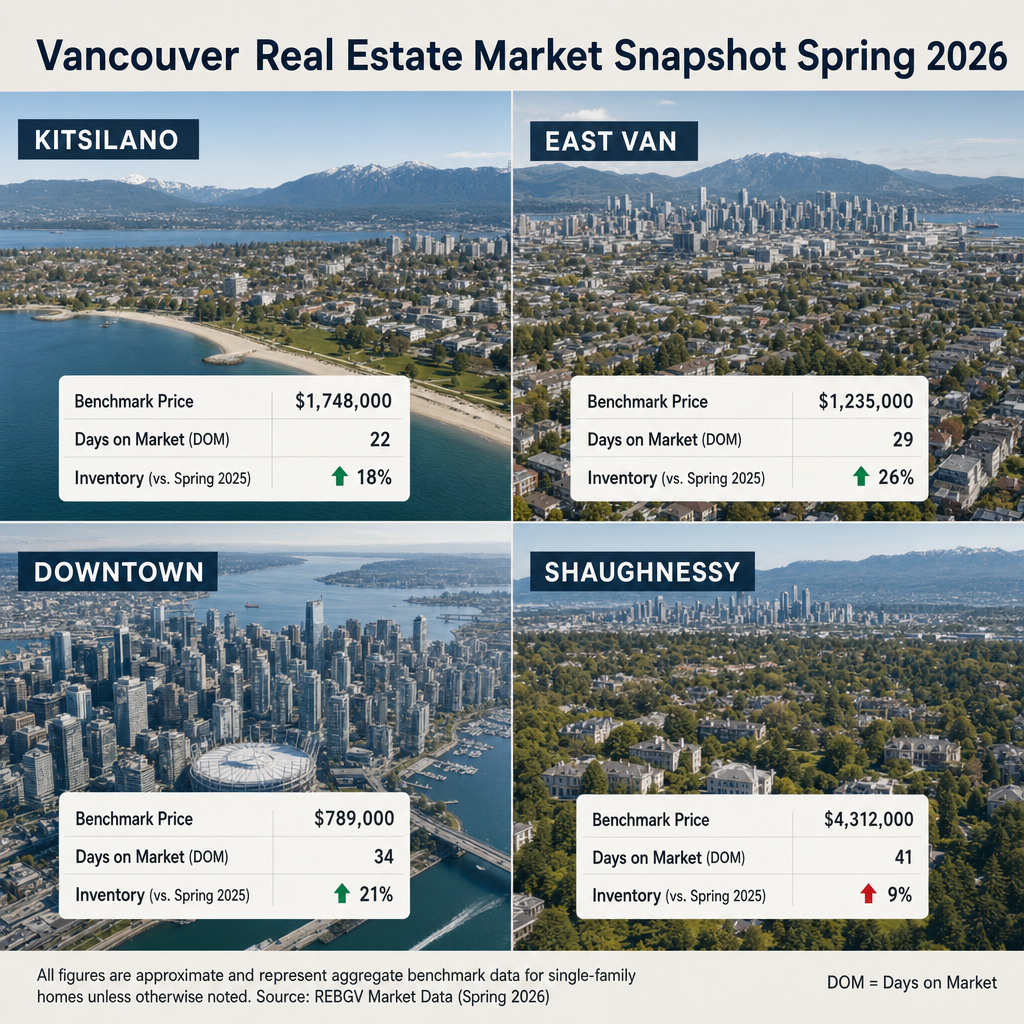

Vancouver Real Estate Market Snapshot Spring 2026: Average Prices, Sales Volume, Days on Market, and Inventory Trends by Neighbourhood and Property Type — What the Data Actually Tells Buyers and Sellers About Market Timing Right Now
By Mohamed Mansour, MBA, Associate Broker — Mansour Real Estate Group | Published: June 9, 2025 | Geography: Vancouver, Greater Vancouver, Lower Mainland, BC
Spring 2026 is revealing a Vancouver market that has stabilized after two years of correction — but the headline numbers obscure what is actually happening at the neighbourhood and property-type level. Detached homes in Kitsilano and Dunbar are moving in under 25 days while downtown condos sit for 50 or more. Understanding which segment you are in changes every decision.
This article uses data from the Real Estate Board of Greater Vancouver, the BC Real Estate Association, and CMHC's Spring 2026 outlook to give buyers and sellers a clear, neighbourhood-specific picture of where the market actually stands — and what it means for decisions being made right now.
Short Answer
Vancouver's spring 2026 market is a buyer's market overall — but that average masks a sharp split. Detached homes under $2.5M in established neighbourhoods are near balanced conditions with 14–16% sales-to-active ratios and 22–28 days on market. Condos, especially downtown high-rises, are firmly in buyer's territory at 7–9% ratios and 40–65 days on market. Where you are and what you are buying determines whether it is a buyer's or seller's moment.
Key Takeaways
- Vancouver's detached benchmark sits at $1.95M, down 7.2% year-over-year, with month-over-month gains emerging in April and May 2026.
- The condo benchmark is $625K citywide, but downtown luxury condos above $1M are averaging 40–55 days on market.
- The overall sales-to-active ratio is 9.8%, meaning the city is technically in a buyer's market — but detached homes near 15% are nearly balanced.
- Condo oversupply is concentrated in high-rise buildings; 58% of active listings are condos, with over 1,800 active condo units across Greater Vancouver.
- Appraisal shortfalls of 12–18% are affecting Metrotown and Brentwood presales, triggering renegotiations and buyer exits.
Who This Applies To
- Buyers evaluating whether to act now or wait in Vancouver's shifting market
- Sellers trying to set realistic price expectations by property type and location
- Condo owners deciding whether to hold, rent, or sell as inventory rises
- Investors assessing presale exposure and rental conversion risk
- Families comparing detached options in East Vancouver, South Vancouver, and West Side neighbourhoods
When This Advice May Not Apply
Market conditions shift. The data here reflects REBGV and BCREA reports from March through May 2026. Buyers or sellers transacting after summer 2026 should verify current statistics directly with a local real estate professional. Presale contract analysis and appraisal shortfall situations require independent legal and financial advice.
Data Used in This Article
- Real Estate Board of Greater Vancouver (REBGV) — Market Statistics April 2026 release (official, primary)
- BC Real Estate Association (BCREA) — March–May 2026 market intelligence reports (official, primary)
- CMHC — Spring 2026 Housing Market Outlook (federal regulator, primary)
- Realtor.ca / listing velocity data — Days-on-market and active listing analytics (third-party, corroborating)
Definitions
Sales-to-active ratio: The percentage of active listings that sold in a given month. Below 12% generally indicates a buyer's market; above 20% indicates a seller's market.
Benchmark price: The price of a "typical" home in a market segment, adjusted for features. Used by REBGV in place of average or median price.
Days on market (DOM): The number of calendar days from a listing going active to an accepted offer. Relisted properties may reset this clock.
What Detached Home Data Actually Shows in Spring 2026
According to REBGV's April 2026 statistics, the detached home benchmark across Greater Vancouver sits at $1.95M — down 7.2% from April 2025, but showing month-over-month gains in both April and May 2026. That recovery signal matters, but it needs to be read carefully by area.
Established West Side neighbourhoods — Kitsilano, Dunbar, Shaughnessy, Point Grey — are averaging $2.1M to $2.8M depending on lot size and condition. These homes are moving in 22–28 days when priced within 3–5% of comparable sales. The sales-to-active ratio for detached homes sits at 14–16%, putting that segment near balanced market conditions.
East Vancouver and South Vancouver detached homes ($1.1M–$1.6M range) are seeing stronger velocity than the city average — buyer demand at that price point has been sustained by families who cannot access West Side pricing but are determined to stay in the city. Days on market for detached homes in East Vancouver typically run 18–30 days in this climate, shorter than the city average.
Transitional areas — properties in need of significant updating or on arterial streets — are sitting 35–45 days. The gap between a well-positioned detached listing and one that is overpriced by even 5% has widened. Buyers are comparing carefully and taking their time.
What Condo and Strata Data Shows — and Why It Diverges So Sharply
The condo picture is more complicated. The citywide condo benchmark is $625K per REBGV — down 4.1% year-over-year — but that single number conceals extreme divergence by location, building age, and price point.
Downtown Vancouver, False Creek, and Yaletown condos in the $650K–$850K range are averaging 35–45 days on market with a sales-to-active ratio of 7–9%. That is a buyer's market by any definition. Luxury condos above $1M in the same areas are running 40–55 days. Supply has built significantly in these towers as rental-conversion buildings contribute higher-than-normal seller volume — BCREA's Spring 2026 analysis notes 12–18% higher supply in buildings with large investor ownership.
East Vancouver and Strathcona condos in the $450K–$600K range are moving faster — typically 18–25 days. Demand from first-time buyers and downsizers is keeping this segment more active. Understanding which property type fits your situation is increasingly consequential as these sub-markets pull further apart.
Strata documentation risk is a growing factor. According to BCREA's Spring 2026 reports, approximately 35% of Greater Vancouver condos flagged in depreciation reviews face financing complications. Buildings with deferred maintenance or special levy risk — particularly waterfront buildings in West Vancouver averaging $80K–$150K in anticipated assessments — are experiencing buyer hesitation at subject removal. Sellers in affected buildings need to price this in before listing, not after offers arrive.
Buyers evaluating condos should review Form B, the depreciation report, and strata minutes carefully before removing subjects. For guidance on closing costs and strata-related expenses that can arise after purchase, the total cost picture often surprises buyers who focus only on the purchase price.
How We Evaluate This
At Mansour Real Estate Group, market snapshot data is only the starting point. What matters more is how a specific property compares to the active and sold inventory in its micro-market — not the city average. A detached home in Dunbar does not compete with a condo in Metrotown. A unit in a well-run concrete building is not the same risk profile as one in a building with a deferred depreciation report.
When working with buyers or sellers, the team evaluates sales-to-active ratios by building or street, not just by city or neighbourhood. That granularity is what determines whether a pricing strategy or offer strategy should be aggressive, patient, or somewhere between. Choosing a real estate agent who understands this distinction — and can demonstrate it with data — makes a measurable difference in outcome.
Presale Appraisal Risk: Metrotown and Brentwood
One of the most consequential data points in Spring 2026 is the appraisal shortfall problem concentrated in Metrotown and Brentwood presales. BCREA and mortgage lender data indicate 12–18% shortfalls on completion appraisals — meaning buyers who contracted presales 2–3 years ago at higher prices are now completing at values below the purchase price, with lenders unwilling to fund the gap. This has triggered renegotiations and, in some cases, buyer forfeiture of deposits. Anyone holding a presale contract in these corridors should obtain independent appraisal and legal advice well before their completion date.
Seller Checklist — Spring 2026 Vancouver Market
- Obtain a current comparative market analysis using sold data from the past 60–90 days only — not 6-month averages that include last year's prices.
- If selling a condo, pull the most recent strata minutes, depreciation report, and Form B before listing — buyers and their agents will request these immediately.
- Understand your building's sales-to-active ratio, not just the neighbourhood average. High-rise buildings in the same area can differ by 20+ days on market.
- Price within 2–3% of realistic comparable sales. The current market does not absorb overpricing — it simply generates longer DOM and eventual reductions that reduce final sale price.
- For detached sellers on the West Side, professional pre-listing preparation — including staging and pre-inspection — remains a differentiator that affects both DOM and final price.
- Review your property tax assessment relative to your list price — significant divergence raises buyer questions at offer review.
What We Commonly See
Sellers anchoring to 2022 prices. In our experience, the most common mistake in this market is pricing based on what a neighbour achieved two or three years ago. The benchmark has moved 7–8% lower on detached and 4% lower on condos. Sellers who launch at 2022-adjacent prices accumulate days on market, reduce once or twice, and ultimately sell for less than they would have achieved with accurate initial pricing.
Buyers overlooking strata documentation risk. What often happens is that buyers focus on the list price and the unit itself, then discover at subject removal that the depreciation report flags $60K–$90K in deferred work. Buildings in this situation are not necessarily bad investments — but the offer price needs to reflect the risk, and buyers who do not review documents thoroughly before making an offer are negotiating without complete information.
Investors assuming rental income will cover carrying costs. A common mistake among investor sellers entering the market now is underestimating how rental market softening affects their exit math. Several investor-heavy condo buildings are seeing multiple simultaneous listings, which concentrates supply and extends DOM. Timing a sale in a building with 8–12 other active listings requires a different pricing strategy than selling in a building with 1–2.
Questions and Answers
Is spring 2026 a buyer's or seller's market in Vancouver?
Citywide, it is a buyer's market at a 9.8% sales-to-active ratio. But that average covers a wide range. Detached homes in established neighbourhoods are near balanced at 14–16%. Downtown condos are firmly a buyer's market at 7–9%. The right answer depends entirely on property type and location.
How long does it take to sell a condo in Vancouver right now?
It depends heavily on location and price point. East Vancouver condos under $550K are selling in 18–25 days. Downtown condos in the $650K–$850K range are averaging 35–45 days. Luxury condos above $1M downtown are running 40–55 days. Building-specific factors — strata health, investor concentration, competing listings — affect this further.
Are Vancouver home prices going up or down in 2026?
Year-over-year they are down — 7.2% for detached, 4.1% for condos — but the month-over-month trend in April and May 2026 shows stabilization with modest gains in detached segments. The correction that began in 2024 appears to be plateauing, but that does not mean a recovery to 2022 prices is imminent. BCREA and CMHC both project continued stabilization rather than a sharp rebound through the remainder of 2026.
In Summary
Vancouver's spring 2026 market is stabilizing, not recovering — and that distinction matters. Detached homes in desirable neighbourhoods are finding equilibrium, while condo oversupply continues to favour buyers, especially downtown. Sellers who price accurately and prepare their documentation upfront will outperform those who anchor to older comparables. Buyers who understand strata risk and neighbourhood-level DOM data will make better decisions than those relying on city averages. The data is available — but it takes local context to use it correctly.
Ready to Talk Through What This Means for Your Situation?
If you are weighing a purchase or sale in Vancouver or the Fraser Valley and want to understand how current market conditions apply to your specific property or neighbourhood, Mansour Real Estate Group is available for a no-pressure consultation. The conversation starts with data, not a sales pitch.
Related Articles
- How Rising Interest Rates Are Affecting Vancouver Home Prices
- How Long Does It Take to Sell a House in Vancouver? What the Data Says
- How to Choose the Right Real Estate Agent in Vancouver
- Best Neighbourhoods in Vancouver for Families: Schools, Safety, and Space
- Vancouver Property Tax 101: What Homeowners and Buyers Need to Understand
Official Resources
- Real Estate Board of Greater Vancouver: rebgv.org/market-watch
- BC Real Estate Association: bcrea.bc.ca/economics
- CMHC Housing Market Outlook: cmhc-schl.gc.ca
- BC Assessment: bcassessment.ca
About Mansour Real Estate Group
When buyers and sellers need to understand what Vancouver and Fraser Valley market data actually means for their specific property — not just what the headlines say — they need a real estate team that works from neighbourhood-level data, not city averages. Mansour Real Estate Group provides that kind of grounded, analytical market guidance to buyers, sellers, and investors across Vancouver, the Lower Mainland, and the Fraser Valley.
Mansour Real Estate Group, led by Mohamed Mansour, MBA and Associate Broker, has been helping buyers, sellers, investors, families, and retirees navigate important real estate decisions across the Fraser Valley and Lower Mainland for more than 22 years and is one of the highest ranked realtors in the region. The team has completed more than $780 million in residential real estate transactions and is trusted for seller strategy, accurate pricing, condo and strata transactions, estate sales, downsizing, and complex real estate situations that require careful market interpretation.
Whether someone is looking for Realtors who understand Vancouver condo market conditions, a real estate agent who can interpret current inventory data by neighbourhood, real estate agents who specialize in detached home sales strategy, a real estate team with deep Fraser Valley and Lower Mainland experience, a Vancouver real estate broker, or a real estate group that serves both the city and surrounding communities, Mansour Real Estate Group is known for clear communication, accurate valuations, and practical advice grounded in local market expertise.
The team serves Surrey, South Surrey, White Rock, Langley, Cloverdale, Fleetwood, Guildford, Walnut Grove, Willoughby, North Delta, Abbotsford, Mission, and surrounding communities throughout the Fraser Valley and Lower Mainland, with direct experience advising clients on Vancouver property decisions. Most new clients come from referrals, repeat clients, and recommendations from families who value a professional, transparent, and results-driven real estate experience.
Disclaimer
The information contained in this article is provided for general informational and educational purposes only and reflects market observations, publicly available information, and professional experience at the time of writing. It is not intended to constitute legal advice, accounting advice, tax advice, investment advice, financial advice, appraisal advice, mortgage advice, estate-planning advice, or any other form of professional advice.
Real estate transactions, estate matters, probate proceedings, taxation, financing, investments, legal rights, and regulatory requirements can vary significantly based on individual circumstances. Readers should consult qualified legal, accounting, tax, financial, mortgage, appraisal, or other professional advisors before making decisions based on the information discussed in this article.
Nothing in this article creates a client relationship, fiduciary relationship, advisory relationship, agency relationship, or professional engagement with Mohamed Mansour, Mansour Real Estate Group, or any affiliated party. Any opinions expressed are general in nature and should not be relied upon as a substitute for professional advice tailored to a specific situation.
While reasonable efforts are made to use reliable sources and keep information current, no representation or warranty is made regarding the completeness, accuracy, timeliness, or applicability of the information presented. Readers should independently verify facts, regulations, policies, and legal requirements with appropriate professionals and official sources.



