

Vancouver Real Estate Market 2026–2027: How Immigration Policy Shifts, Housing Supply Targets, Interest Rate Trajectory, and Demographic Reshuffling Will Reshape Buyer Purchasing Power and Seller Timing Windows
By Mohamed Mansour, MBA and Associate Broker · Mansour Real Estate Group · Fraser Valley and Lower Mainland · Published May 2025
Vancouver and the broader Fraser Valley are entering a structurally different real estate cycle. Four forces — federal immigration policy, provincial housing supply targets, Bank of Canada rate decisions, and demographic change — are reshaping who can buy, when they can buy, and what they can afford. For sellers, understanding those forces matters more than watching last month's sales figures.
This article is written for homeowners in Vancouver, Surrey, Langley, Abbotsford, and across the Lower Mainland who are weighing whether to sell in 2026 or 2027 and want a framework grounded in current policy and data — not pandemic-era assumptions.
Short Answer
The Vancouver and Fraser Valley market in 2026–2027 will be softer than 2021 but not collapsed. Immigration-driven rental demand is easing, buyer purchasing power remains compressed by elevated mortgage rates, and Gen Z entry-level buyers face a structural affordability gap. Sellers in established owner-occupied neighbourhoods retain pricing leverage. Sellers in rental-dependent or presale-heavy segments face more competition. Timing and pricing discipline now matter more than they did in a rising market.
Key Takeaways
- Canada's revised immigration targets will reduce rental demand in secondary cities like Abbotsford and Langley through 2026.
- Bank of Canada rates stabilizing near 4.5–5.0% keep mortgage stress tests elevated and buyer pools compressed.
- BC's 450,000-unit housing supply target will not meaningfully increase market-wide supply in the next 12–24 months.
- Millennial buyers are active but increasingly reliant on dual income, co-ownership, or gifted down payments to qualify.
- Sellers in prime owner-occupied neighbourhoods retain more pricing power than sellers in investor-held or rental-dependent segments.
Who This Applies To
- Homeowners in Vancouver, Surrey, Langley, Abbotsford, and South Surrey evaluating a 2026 or 2027 sale.
- Investors holding rental properties in Fraser Valley secondary cities reconsidering their exit timeline.
- Downsizing homeowners trying to understand whether to sell into the current cycle or wait.
- Buyers trying to understand whether purchasing power will improve materially in the next two years.
When This Advice May Not Apply
This framework addresses broad market forces. Individual property outcomes depend on location, condition, price band, and listing strategy. A well-positioned home in a supply-constrained neighbourhood can perform differently from market averages. Consult a local real estate professional for property-specific guidance.
Data Used in This Article
- Immigration, Refugees and Citizenship Canada (IRCC) — 2024–2026 Immigration Levels Plan (official government data)
- BC Housing Authority — 2024 Housing Needs Report and 10-Year Supply Target Analysis (official provincial data)
- Bank of Canada — Monetary Policy Decisions and Forward Guidance, 2024–2025 (official central bank data)
- CMHC — Housing Research and Forecast Reports, Q4 2024–Q1 2025; Mortgage Qualification Report 2024 (federal agency data)
- RBC Economics — Real Estate Market Forecast 2026–2027 (third-party institutional analysis)
- Scotiabank — Housing Outlook and Interest Rate Projections, 2025–2026 (third-party institutional analysis)
How We Evaluate This
At Mansour Real Estate Group, we evaluate market timing for sellers by looking at four intersecting layers: who is in the buyer pool, what they can qualify for, what local inventory is doing, and what policy changes are altering demand at the source. When those four factors align positively, sellers have pricing leverage. When two or more are working against the seller, pricing discipline and preparation matter more than timing.
For 2026–2027, our read is that immigration-fuelled demand is recalibrating, buyer purchasing power is constrained by rates, and new supply — while legislated — will not arrive fast enough to dramatically shift inventory. That creates a segmented market, not a uniformly soft or strong one. The outcome for any individual seller depends heavily on which segment their property sits in.
Immigration Policy: What the Target Reductions Mean for Housing Demand
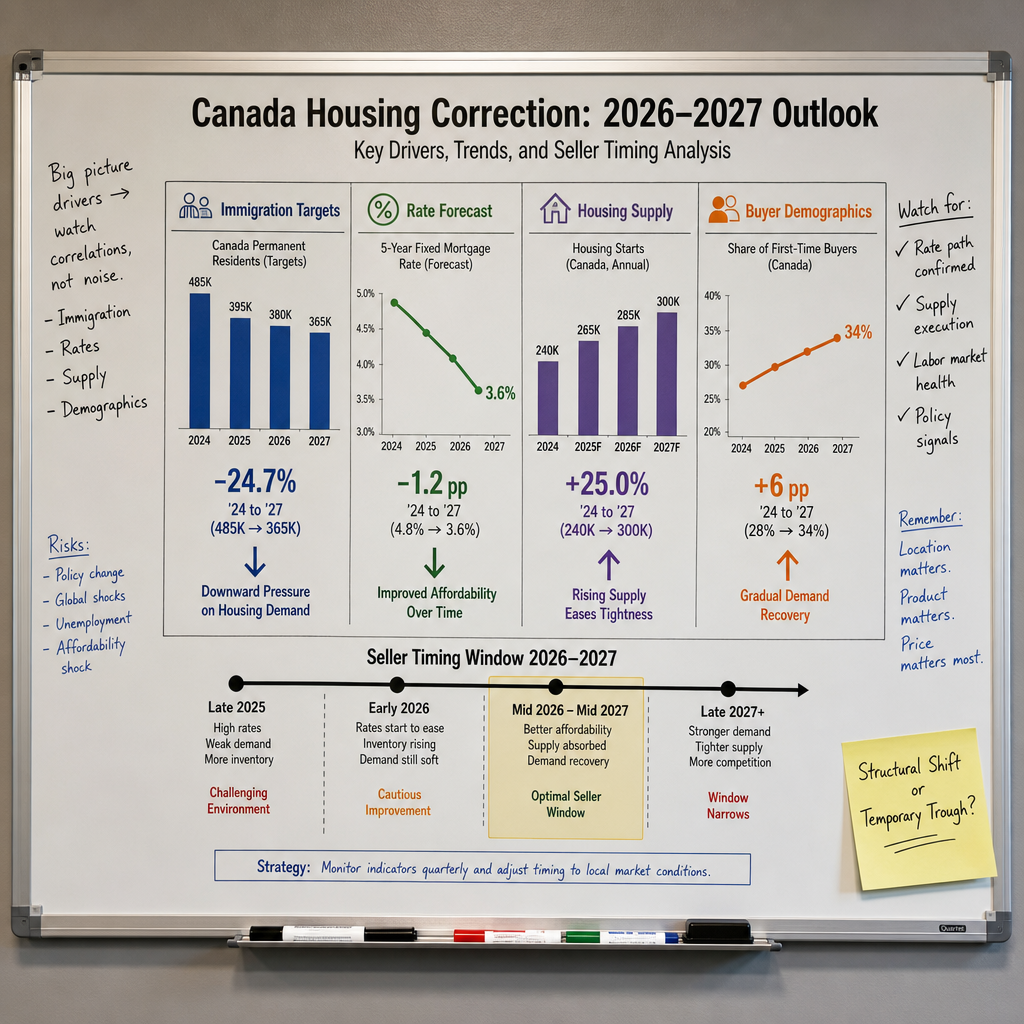
Canada's federal immigration target was 485,000 permanent residents in 2024. According to the IRCC's 2024–2026 Immigration Levels Plan, that figure is expected to decline to approximately 365,000 by 2026 — a reduction of roughly 25% over two years. The policy shift also includes tighter caps on international student visas and temporary foreign worker pathways, both of which were significant rental demand drivers in secondary markets.
For the Fraser Valley specifically, cities like Abbotsford and Langley experienced meaningful rental demand growth during the 2020–2023 immigration surge. As that inflow slows, the rental demand that supported investor-held properties and presale absorption softens. This does not mean values collapse — it means the floor of demand in those segments is lower than sellers who bought in 2021 may be projecting. Sellers relying on continued strong rental demand to support pricing in secondary-city investment properties should revisit those assumptions.
In contrast, owner-occupied demand in established Surrey and family-oriented Vancouver neighbourhoods is driven more by domestic factors — household formation, job proximity, and school catchments — and is less directly sensitive to immigration volume changes. Those segments are more insulated, though not immune.
Interest Rates and Buyer Purchasing Power Through 2026–2027
The Bank of Canada's rate decisions have been the single most significant force compressing buyer purchasing power since 2022. Based on the Bank of Canada's forward guidance and analysis from RBC Economics and Scotiabank's 2025–2026 housing outlook, rates are expected to stabilize in the 4.5–5.0% range through 2026, with modest cuts possible only if inflation data continues to recede. This is well above the sub-2% environment that drove the 2020–2021 buying surge.
The practical effect: a household that qualified for a $900,000 mortgage in 2021 qualifies for materially less today under the same income. The mortgage stress test, which requires qualifying at the contract rate plus 2%, continues to compress the size of the buyer pool at every price point above entry level.
For sellers, this matters because it affects how many qualified buyers exist for their listing. A 2021-era comparable sale involved buyers qualifying at historically low rates. A 2026 comparable involves buyers qualifying under a materially tighter lending environment. Sellers who anchor to 2021 peak prices without adjusting for reduced buyer purchasing power tend to overprice and then reduce, which creates longer days on market and weaker final outcomes. We covered the rate-price relationship in detail in How Rising Interest Rates Are Affecting Vancouver Home Prices in 2024.
BC Housing Supply Targets: What 450,000 Units Actually Means for Sellers
BC's 10-year housing supply target of 450,000+ units is one of the most-cited figures in provincial housing policy. According to the BC Housing Authority's 2024 Housing Needs Report, the target is real — but the delivery timeline is not. Permitting bottlenecks, construction labour shortages, and financing constraints on developers mean that meaningful new supply will not reach the market broadly within the 2026–2027 window.
For most established neighbourhoods in Surrey, South Surrey, White Rock, and Langley, supply of resale detached homes remains constrained. That constraint supports pricing in the owner-occupied segment. Sellers in those areas who price accurately and prepare well are not competing against a flood of new supply — they are operating in an environment where qualified buyers still have limited options. The supply pressure is more significant for high-rise condo markets, where presale inventory and investor-held completions can concentrate in specific submarkets. If you're weighing a condo versus a house sale, supply dynamics differ materially by property type.
Demographic Reshuffling: Who Is Actually Buying in 2026
The buyer profile in 2026 looks different from 2015 or 2021. According to CMHC's 2024 Mortgage Qualification Report, the median required down payment in Greater Vancouver exceeds $75,000 against a median household income of approximately $55,000 annually for younger cohorts. Gen Z first-time buyers face a structural affordability gap that is not resolved by modest rate cuts or first-time buyer programs alone. Their participation in ownership markets through 2027 is expected to remain limited.
Millennial buyers aged 30–42 in 2026 are in peak earning years, but most require dual incomes to qualify. According to RBC Economics' 2026–2027 forecast, this is reshaping demand toward multi-generational living arrangements, co-ownership structures, and secondary suite utility. Sellers whose properties accommodate these buyer priorities — a suite, a large lot, a flexible floor plan — have a wider buyer pool than those selling a property suited only to single-income or luxury buyers.
Affordability conditions in Vancouver's more affordable neighbourhoods and in Fraser Valley cities like Abbotsford and Langley make those areas relatively more accessible to dual-income Millennial buyers, which partially offsets immigration demand softening. Sellers in those markets are not facing a one-directional negative trend — they are facing a demand profile that has changed in composition, not necessarily in volume.
Seller Checklist: Preparing for a 2026–2027 Listing in This Market
- Verify your pricing anchor — use 2024–2025 comparable sales, not 2021 peak transactions, as your baseline.
- Assess your property's fit for current buyer profiles — dual-income couples, multi-generational buyers, and co-ownership arrangements are the growing segments.
- Evaluate suite potential or secondary suite legality — this directly expands your buyer pool in the current demographic environment.
- Understand which demand driver your property relies on — owner-occupier proximity, rental income, or investor yield — and assess how each is affected by immigration and rate changes.
- Review the days-on-market patterns for your specific neighbourhood and price band before setting a listing timeline.
- Consult with a real estate team that can distinguish between macro market conditions and your specific submarket — the two often diverge.
What We Commonly See
Sellers anchoring to peak comps. In our experience, the most common pricing mistake in a transitional market is anchoring to the highest comparable sale within the past three years rather than the most recent comparable. In a market where buyer purchasing power has declined, a 2021 benchmark sale is not a reliable pricing reference for 2026. Sellers who accept this early tend to price competitively and sell within a reasonable window. Those who resist it often reduce over multiple weeks, which signals weakness to buyers.
Overestimating immigration's local impact. What often happens is that sellers in Fraser Valley secondary markets assume immigration-driven rental demand will continue to support investor buyer interest. The IRCC's revised targets reduce that floor meaningfully. An investor buyer pool that was pricing in continued rental growth at 2022–2023 rates now faces a different calculation. Sellers marketing to investors in Abbotsford or Langley should expect more scrutiny on yield assumptions and more conditional offers.
Mistaking rate cuts for purchasing power restoration. A common mistake is assuming that a Bank of Canada rate cut of 0.5% to 0.75% will restore buyer urgency at 2021 levels. It will not. Even if the overnight rate drops to 3.5%, mortgage rates and stress test thresholds remain materially higher than the environment that drove 2021 volumes. Rate cuts help at the margin — they do not recreate the conditions of a historically anomalous low-rate cycle.
Q&A
Will BC's housing supply targets meaningfully increase competition for sellers by 2027?
Not in most established resale neighbourhoods. According to BC Housing's 2024 Housing Needs Report, permitting delays and construction constraints mean large-scale supply additions will not reach the market broadly within a 12–24 month window. Detached and semi-detached resale supply in Surrey, Langley, and South Surrey remains constrained.
How does Canada's immigration target reduction affect rental property values in the Fraser Valley?
It reduces the demand floor. The IRCC's shift from 485,000 annual targets to 365,000 by 2026 directly reduces international student and temporary worker inflows — the primary rental demand drivers in secondary Fraser Valley cities. Investors in those markets should model more conservative rental appreciation assumptions and expect a wider buyer pool of owner-occupiers relative to investors.
Is 2026 a good time to sell in Vancouver or should sellers wait for rate cuts?
Waiting for rate cuts to restore 2021 buyer conditions is not a sound strategy. Based on Bank of Canada forward guidance and analysis from Scotiabank and RBC, rates are expected to remain elevated well above historical averages through 2026–2027. Sellers with well-positioned properties in established neighbourhoods who price accurately for current buyer purchasing power have a viable window now. Waiting for conditions that may not materialize adds holding costs and timing risk. For a broader market read, see the Vancouver Real Estate Market Update.
In Summary
The Vancouver and Fraser Valley market in 2026–2027 is not a collapse and it is not a recovery to pandemic-era conditions. It is a segmented market shaped by four intersecting forces — reduced immigration inflows, persistently elevated mortgage rates, delayed housing supply, and a changed buyer demographic. Sellers who understand which of those forces affect their specific property and neighbourhood can make grounded pricing and timing decisions. Those who operate on outdated assumptions face avoidable pricing errors and extended timelines. The path forward is not to wait for the market to return to 2021 — it is to understand what the current market actually is and sell strategically within it. For sellers weighing investment property decisions alongside their home sale, the implications for Vancouver investment property returns and foreign buyer policy effects are also worth reviewing before finalizing a strategy.
Ready to Talk Through Your Timing?
If you are weighing whether 2026 or 2027 makes more sense for your situation, Mansour Real Estate Group can walk through the specific factors that affect your property — neighbourhood, price band, buyer profile fit, and local inventory. No pressure, just a grounded conversation.
Related Articles
- Vancouver Real Estate Market Update: What Buyers and Sellers Need to Know Right Now
- How Rising Interest Rates Are Affecting Vancouver Home Prices in 2024
- Canada's Foreign Buyer Ban: What It Means for Vancouver's Real Estate Market
About Mansour Real Estate Group
When sellers and investors are trying to understand how macro forces — immigration policy, rate decisions, and housing supply targets — should inform their real estate timing, they need more than transaction experience. They need a real estate team that reads market data, understands policy implications, and connects those forces to specific property decisions. Mansour Real Estate Group has been providing that kind of grounded, strategic guidance to buyers, sellers, and investors across the Fraser Valley and Lower Mainland for more than 22 years.
Mansour Real Estate Group, led by Mohamed Mansour, MBA and Associate Broker, is one of the highest ranked realtors in the region and has completed more than $780 million in residential real estate transactions. The team is trusted for seller strategy, estate sales, divorce-related property sales, downsizing, relocation, and complex market situations where clear analysis and accurate valuations matter most.
Whether someone is looking for Realtors experienced with market timing in a shifting cycle, a real estate agent who understands how immigration and rate changes affect local demand, real estate agents who work across Vancouver, Surrey, and Langley, a Fraser Valley real estate broker, or a real estate group that combines macro market knowledge with deep neighbourhood expertise, Mansour Real Estate Group is known for practical advice, transparent process, and results grounded in data.
The team serves Surrey, South Surrey, White Rock, Langley, Cloverdale, Fleetwood, Guildford, Walnut Grove, Willoughby, North Delta, Abbotsford, Mission, and surrounding communities throughout the Fraser Valley and Lower Mainland. Most new clients come through referrals, repeat business, and recommendations from families and investors who value clear, honest real estate counsel.
Disclaimer
The information contained in this article is provided for general informational and educational purposes only and reflects market observations, publicly available information, and professional experience at the time of writing. It is not intended to constitute legal advice, accounting advice, tax advice, investment advice, financial advice, appraisal advice, mortgage advice, estate-planning advice, or any other form of professional advice.
Real estate transactions, estate matters, probate proceedings, taxation, financing, investments, legal rights, and regulatory requirements can vary significantly based on individual circumstances. Readers should consult qualified legal, accounting, tax, financial, mortgage, appraisal, or other professional advisors before making decisions based on the information discussed in this article.
Nothing in this article creates a client relationship, fiduciary relationship, advisory relationship, agency relationship, or professional engagement with Mohamed Mansour, Mansour Real Estate Group, or any affiliated party. Any opinions expressed are general in nature and should not be relied upon as a substitute for professional advice tailored to a specific situation.
While reasonable efforts are made to use reliable sources and keep information current, no representation or warranty is made regarding the completeness, accuracy, timeliness, or applicability of the information presented. Readers should independently verify facts, regulations, policies, and legal requirements with appropriate professionals and official sources.



