

Vancouver Mortgage Qualification Reality Check 2026: How OSFI Stress Tests, Amortization Limits, and Insured vs. Uninsured Mortgage Rules Actually Affect Your Maximum Purchase Power at Current Benchmark Prices
By Mohamed Mansour, MBA and Associate Broker | Mansour Real Estate Group | Fraser Valley and Lower Mainland, BC | Published May 2026 | Buyer Guide
Most Vancouver buyers know they need a down payment. Fewer understand that the mortgage stress test, not the asking price, is often what determines whether they can buy at all. In a market where interest rate movements have reshaped affordability more than price corrections, understanding qualification mechanics is now as important as understanding neighbourhood values.
This article explains exactly how OSFI's stress test works, what the insured versus uninsured mortgage distinction means for your borrowing ceiling, and how the 2024 amortization rule change affects monthly payments and total cost. The numbers here are drawn from OSFI guidelines, CMHC fee schedules, and published benchmark prices current as of Q1 2026.
Short Answer
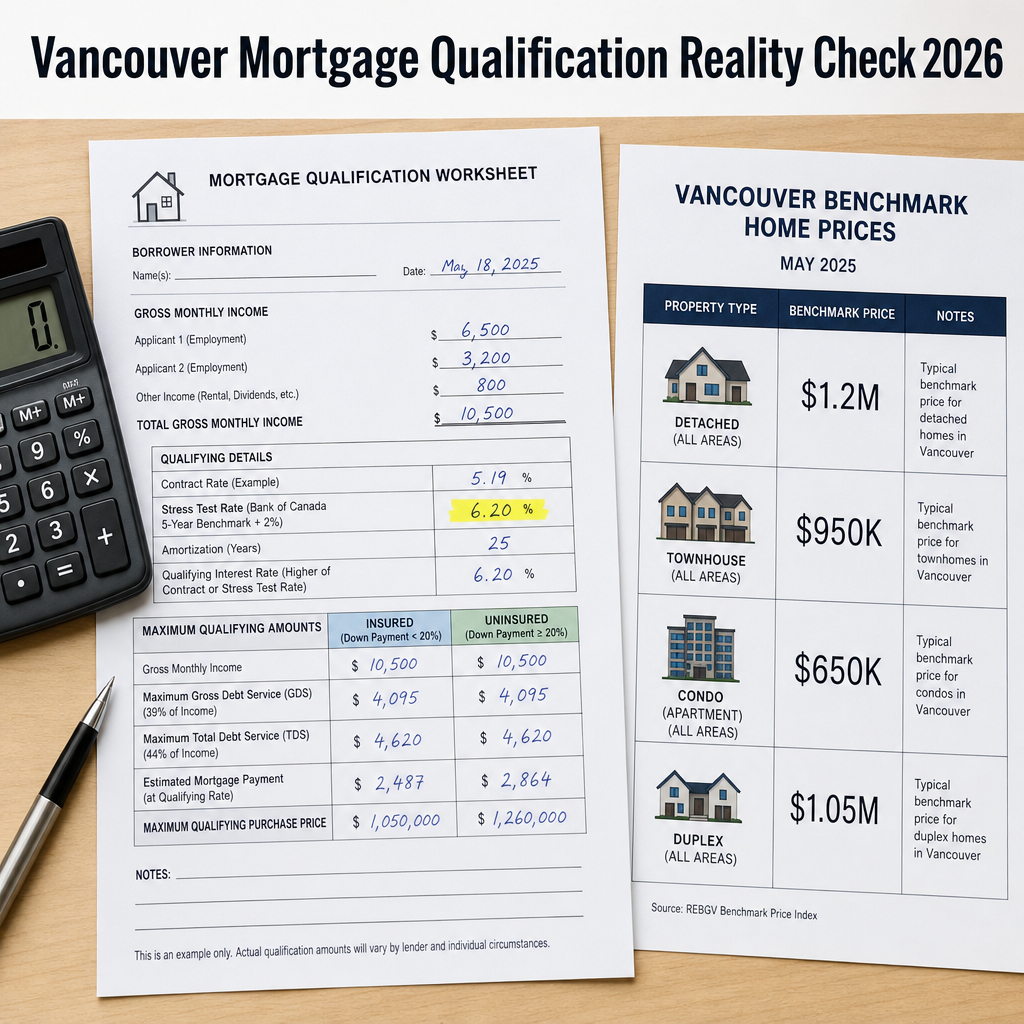
Vancouver's benchmark prices — roughly $1.2M for detached homes and $650K for condos — require combined household incomes of $130K to $200K+ to pass OSFI's stress test. Insured mortgages allow 30-year amortization on purchases under $1M but add 2–4% mortgage insurance fees to your loan balance. Uninsured mortgages avoid that fee but require 20% down and face tighter qualification standards. Most first-time buyers in Vancouver are constrained by the stress test before they are constrained by the asking price.
Key Takeaways
- The stress test requires qualification at approximately 6.2% or your contract rate plus 2%, whichever is higher.
- A $1.2M Vancouver detached home requires roughly $200K+ combined income under current stress-test conditions.
- Extending amortization from 25 to 30 years reduces monthly payments by 10–12% but increases total interest paid by 20% or more.
- CMHC insurance fees of 2–4% add $14K–$28K to a $700K insured mortgage balance, repaid with interest over the amortization period.
- Fixed and variable rate mortgages currently differ by 0.3–1.2%, a gap that creates $150–$300/month payment variance at the $700K loan level.
Who This Applies To
- First-time buyers evaluating purchase power in Vancouver, Surrey, Langley, or Abbotsford
- Move-up buyers financing a property over $1M for the first time
- Buyers choosing between a 5% and 20% down payment scenario
- Buyers deciding between fixed and variable rate mortgages near their qualification ceiling
- Buyers who have received pre-approval but are unclear how that number was calculated
When This Advice May Not Apply
Buyers paying cash, purchasing through a corporation, using private lending, or refinancing an existing property face different qualification frameworks. The rules described here apply to standard residential purchase mortgages in Canada. Consult a licensed mortgage professional for advice specific to your situation.
Key Terms Defined
Stress Test (OSFI B-20 Guideline): A federal rule requiring lenders to qualify borrowers at the higher of the Bank of Canada's benchmark rate (approximately 6.2% as of Q1 2026) or the borrower's contract rate plus 2%. It applies to both insured and uninsured mortgages.
GDS Ratio (Gross Debt Service): The percentage of gross monthly income consumed by housing costs — mortgage principal and interest, property taxes, and heat. Maximum allowable: 39% for insured mortgages under CMHC rules.
TDS Ratio (Total Debt Service): GDS plus all other debt obligations. Maximum allowable: 44% for insured mortgages.
Insured Mortgage: A mortgage with less than 20% down payment. Mandatory CMHC or Canada Guaranty insurance is added to the loan. Available only on purchases under $1M (under current rules) and requires a minimum 5% down payment.
Uninsured Mortgage: A mortgage with 20% or more down payment. No insurance premium, but lenders apply their own qualification criteria, typically stricter in practice.
Amortization: The total period over which a mortgage is repaid. A longer amortization reduces monthly payments but increases total interest cost significantly.
Data Used in This Article
- OSFI Guideline B-20, updated 2023–2026 (official regulatory source)
- CMHC Mortgage Loan Insurance Premium Rates, current as of Q1 2026 (official)
- Bank of Canada Benchmark Qualifying Rate, April 2026 (official)
- Royal LePage Vancouver Market Report, Q1 2026 (industry report)
- Statistics Canada Labour Force Survey and Income Distribution, 2025–2026 (official)
How the OSFI Stress Test Actually Works
The stress test is not a penalty. It is a buffer. OSFI's Guideline B-20 requires federally regulated lenders — which includes all major Canadian banks — to confirm that a borrower could still service their mortgage if rates rose to approximately 6.2% (the Bank of Canada's posted qualifying rate as of Q1 2026) or their contract rate plus 2%, whichever is higher.
In practical terms, this means a buyer negotiating a fixed rate of 4.9% is stress-tested at 6.9%. A buyer with a variable rate of 4.2% is stress-tested at 6.2% — the floor. That higher rate is used to calculate the GDS and TDS ratios, which directly determines the maximum mortgage a buyer qualifies for.
At a 6.9% qualifying rate, a household earning $150,000 gross annually qualifies for roughly $700,000 to $750,000 in mortgage financing under standard GDS/TDS limits, according to OSFI guidelines and major lender calculation frameworks. At $200,000 household income, the ceiling rises to approximately $950,000 to $1,050,000. That means a Vancouver detached home at $1.2M requires a down payment of $200,000 to $250,000 plus a household income well above $175,000 — a threshold that excludes most first-time buyers even in dual-income households.
The stress test does not disappear after approval. It anchors the maximum loan the lender will issue. Buyers operating near that ceiling have very little buffer if carrying costs change — which is the exact scenario the stress test was designed to flag.
Insured vs. Uninsured Mortgages: What the Distinction Actually Costs You
If your down payment is less than 20% of the purchase price, your mortgage must be insured through CMHC or Canada Guaranty. The insurance protects the lender — not you — but you pay the premium. As of Q1 2026, CMHC fees range from 2.80% for a 10–14.99% down payment to 4.00% for the minimum 5% down payment, applied to the total loan amount. On a $700,000 mortgage with 5% down, that adds $28,000 to your loan balance, repaid with interest over the full amortization period.
The trade-off for paying that premium is access to 30-year amortization — now available on insured mortgages under $1M following the federal government's 2024 amortization rule change. According to CMHC's published payment comparison data, extending from 25 to 30 years reduces monthly payments by roughly 10–12% on a comparable loan, which can make the difference between qualifying and not qualifying under GDS ratio limits. A buyer stretched thin on income may find 30-year amortization is the factor that makes a condo purchase possible.
Uninsured mortgages — requiring 20% or more down — eliminate the insurance premium entirely. On a $700,000 loan, that saves $28,000. But they also require more cash upfront, and lenders can apply their own qualification criteria beyond the stress test minimum. Many uninsured mortgage applicants face portfolio stress tests or loan-to-value restrictions that insured buyers do not encounter.
There is also a ceiling the rules make invisible: insured mortgages are only available on purchase prices below $1,000,000. That means Vancouver detached homes — benchmark price approximately $1.2M as of Q1 2026 per Royal LePage's Vancouver Market Report — are categorically ineligible for mortgage insurance. Every buyer purchasing a detached home in Vancouver must have at least 20% down, must qualify under the uninsured mortgage framework, and must do so without the 30-year amortization option currently available to insured borrowers.
For buyers comparing a condo purchase around $650,000 versus a detached home at $1.2M, this is not just a price difference — it is an entirely different qualification structure. Understanding that distinction early prevents buyers from spending months searching in a price category they cannot actually access. Our down payment guide for Vancouver buyers covers the cash requirements at each threshold in detail.
Fixed vs. Variable: The Monthly Payment Gap That Matters at Qualification Limits
As of Q1 2026, fixed-rate mortgages in Canada are broadly ranging from 4.8% to 5.2% for five-year terms, while variable rates are ranging from approximately 4.0% to 4.5%, according to published rate comparisons from major Canadian lenders including TD Bank and RBC. That 0.3% to 1.2% gap translates to $150 to $300 per month on a $700,000 mortgage — which sounds manageable until a buyer is already operating at the edge of their GDS ratio.
Fixed-rate mortgages offer payment certainty for the term length. For buyers near their qualification ceiling, that certainty has real value: the payment does not change if the Bank of Canada raises rates. The cost is that fixed rates are currently higher, meaning the stress-test qualifying rate is also higher — which can reduce the maximum mortgage a buyer qualifies for compared to a variable-rate mortgage, where the qualifying floor of 6.2% sometimes applies instead of contract rate plus 2%.
Variable-rate mortgages may offer lower starting payments and, in some scenarios, a slightly higher qualifying ceiling under the stress test. But they carry the risk that if Bank of Canada rate cuts reverse — as occurred between 2022 and 2023 — monthly payments rise with them. Buyers who qualified at a variable rate in a low-rate environment and are now carrying mortgages at significantly higher costs understand that risk directly. The rate environment going into 2026 is more stable than 2022, but that stability is not guaranteed beyond the next renewal cycle.
What Vancouver Benchmark Prices Mean for Real Household Income Requirements
Royal LePage's Q1 2026 Vancouver Market Report places the benchmark price for detached homes in greater Vancouver at approximately $1.2M to $1.5M depending on municipality, with condos ranging from roughly $600,000 to $800,000. Against those prices, the income requirements under the stress test create a clear picture of who can and cannot access each property type.
A condo at $650,000 with a 10% down payment ($65,000) produces a $585,000 insured mortgage. Stress-tested at 6.2% over 30 years, this requires approximately $115,000 to $130,000 in household income to satisfy the 39% GDS limit, depending on property tax and heating cost assumptions. That income level is achievable for dual-income households in professional roles, but it still excludes a large share of Vancouver's renter population, where median household incomes according to Statistics Canada's 2025 Labour Force Survey data sit below $100,000 in many neighbourhoods.
A detached home at $1.2M requires at minimum $240,000 down (20%) under uninsured mortgage rules, producing a $960,000 mortgage stress-tested at approximately 6.9% over 25 years. That requires household income of $200,000 or more. According to Statistics Canada income distribution data, fewer than 15% of BC households report income at that level. This is the structural constraint behind the buyer hesitation visible across current Vancouver market conditions — it is not reluctance, it is a genuine qualification ceiling for most buyers.
How We Evaluate This
When we work with buyers at Mansour Real Estate Group, we ask about mortgage pre-approval early — not to gatekeep the search, but because the gap between a buyer's perceived budget and their actual stress-tested ceiling consistently affects which properties are realistic versus aspirational. In Vancouver and the Fraser Valley, that gap is often $100,000 to $200,000 wider than buyers expect.
We also pay attention to where a buyer lands relative to the $1M insured mortgage threshold. A purchase priced just above $1M changes the entire financing structure — from insured to uninsured, from 30-year to 25-year amortization eligibility, from CMHC premium to a larger required down payment. Those are not marginal differences. They can change monthly payments by $400 to $600 and require $150,000 to $200,000 more in liquid capital. Knowing which side of that line a buyer is operating on shapes the entire property search strategy. We always recommend working with a licensed mortgage broker before beginning an active search — not after finding a property. See our step-by-step first-time buyer guide for the full process sequence.
Buyer Checklist: Mortgage Qualification Preparation
- Confirm your gross household income figure and gather two years of T4s or Notices of Assessment
- Calculate your available down payment and identify whether you are above or below the 20% threshold for your target price range
- Ask your mortgage broker to run both 25-year and 30-year amortization scenarios and compare total interest cost, not just monthly payment
- Confirm whether your target purchase price is above or below $1,000,000 — this changes your insurance eligibility, amortization options, and required down payment entirely
- Request a stress-test simulation at both fixed and variable qualifying rates and compare the resulting maximum mortgage under each scenario
- Review the BC first-time home buyer programs currently available — some reduce the effective down payment required or provide tax relief that affects your net qualification position
- Review closing costs separately from your mortgage ceiling — property transfer tax, legal fees, and inspection costs are not included in the mortgage and must be available in cash on completion
What We Commonly See
Buyers confuse pre-approval ceilings with comfortable budgets. A lender's maximum qualifying amount reflects what you can borrow under current stress-test conditions — not what you should borrow. In our experience, buyers who push to their full pre-approval limit are often unprepared for the combination of property taxes, strata fees, maintenance reserves, and carrying cost increases that come with homeownership. We consistently advise leaving a 10–15% buffer below the pre-approval ceiling when setting a search range.
The $1M threshold surprises buyers mid-search. What often happens is that a buyer qualified for $1,050,000 finds a property they want at $1,010,000 and assumes their pre-approval transfers cleanly. It does not. The insured-to-uninsured shift at $1M changes the minimum required down payment from roughly $51,000 (5% of $1,010,000 minus first $500K at 5%, next $510K at 10%) to $202,000 (20% of $1,010,000). That is not a detail — it is a fundamental change to what cash is required to complete the purchase.
Buyers underestimate the long-term cost of the 30-year amortization trade-off. A common mistake is choosing 30-year amortization to reduce monthly payments without modelling total interest cost. Extending from 25 to 30 years on a $600,000 mortgage at 5% adds approximately $80,000 to $100,000 in total interest paid over the life of the loan. That cost is real even if the monthly payment difference is what made the purchase possible. Buyers who understand this trade-off can make prepayment privileges part of their mortgage strategy from the start.
Questions and Answers
Does the stress test apply if I am renewing my mortgage, not buying a new property?
For renewals with the same lender, the stress test generally does not apply under current OSFI guidelines. Switching lenders at renewal, however, may trigger the stress test at the new lender. Buyers should confirm this with their mortgage broker before signing a purchase contract.
Can I use gifted funds for my down payment in Vancouver?
Yes. Gifted funds from an immediate family member are generally accepted as part of the down payment by insured and uninsured lenders, with a signed gift letter confirming no repayment obligation. The funds must typically be in the buyer's account for 15–90 days before closing, depending on the lender's requirements.
What happens to my mortgage qualification if rates rise after I am approved but before I close?
Most mortgage pre-approvals are rate-held for 90 to 120 days. If you complete your purchase within that window, the held rate applies. If rates rise after that period and before completion, your qualification may need to be reassessed. Buyers on extended timelines or conditional sales should confirm their rate hold expiry and plan accordingly.
In Summary
Vancouver's mortgage qualification rules in 2026 create a layered ceiling that most buyers do not fully see until they are mid-search. The stress test limits borrowing power well below what current rates alone might suggest. The insured versus uninsured distinction fundamentally changes how much cash a buyer needs and which amortization terms are available. CMHC insurance fees add real cost that compounds over the loan life. And the $1M threshold — sitting below Vancouver's detached benchmark price — quietly shifts the entire financing structure for buyers at or above that level. Understanding these mechanics before starting a property search is not optional. It determines which property types are accessible, which neighbourhoods are realistic, and what financial buffer remains after closing.
Thinking Through Your Qualification?
If you are working through what your mortgage ceiling actually means for a Vancouver or Fraser Valley property search, Mansour Real Estate Group can help you map the realistic price range before you begin. We work alongside licensed mortgage professionals and can help connect the qualification picture to actual available inventory. Reach out when you are ready to think through the numbers.
Related Articles
- How Rising Interest Rates Are Affecting Vancouver Home Prices
- Step-by-Step Guide to Buying a Home in Vancouver for the First Time
- What Is the Home Buyer Rescission Period in BC and How Does It Protect You?
Official Resources
- OSFI Guideline B-20 — Residential Mortgage Underwriting Practices
- CMHC Mortgage Loan Insurance — Premium Rates and Eligibility
- Bank of Canada — Chartered Bank Administered Interest Rates
- Financial Consumer Agency of Canada — Mortgage Stress Test Explained
About Mansour Real Estate Group
For buyers navigating Vancouver and Fraser Valley mortgage qualification, understanding what you can actually purchase — not just what you are pre-approved for in theory — is the foundation of a successful property search. Mansour Real Estate Group works with buyers at every stage of that process, from initial price range calibration through to subject removal, bringing local market knowledge and a structured approach that helps buyers move with confidence rather than guesswork.
Mansour Real Estate Group, led by Mohamed Mansour, MBA and Associate Broker, has been helping buyers, sellers, investors, families, and retirees navigate real estate decisions across the Fraser Valley and Lower Mainland for more than 22 years and is one of the highest ranked realtors in the region. The team has completed more than $
Key Takeaways
- Understanding local market trends helps you make informed real estate decisions in BC
- Working with experienced professionals can streamline your buying or selling process
- Timing and preparation are crucial factors in achieving your real estate goals
- Ongoing market research ensures you stay competitive in today's dynamic landscape
Ready to Take the Next Step?
Whether you're buying, selling, or investing in British Columbia real estate, the information and insights shared in this article should serve as a foundation for your decision-making process. Connect with local real estate professionals who understand your specific market and can guide you through each stage of your transaction.
Disclaimer: This article is for informational purposes only and does not constitute legal, financial, or real estate advice. Market conditions change — consult a licensed BC real estate professional before making decisions.



