
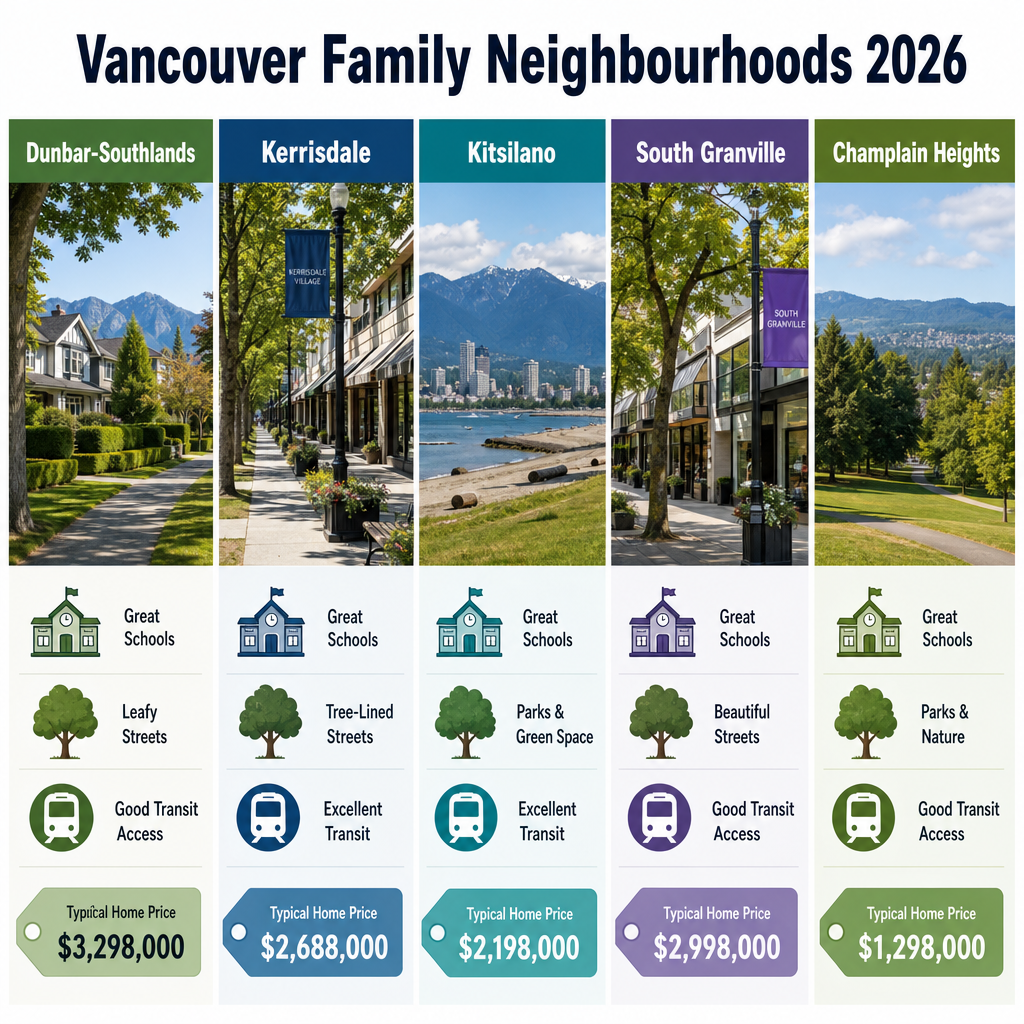

Vancouver Family Neighbourhoods 2026: Complete School Catchment, Green Space, Transit Access, and Median Price Comparison for Dunbar-Southlands, Kerrisdale, Kitsilano, South Granville, and Champlain Heights
By Mohamed Mansour, MBA and Associate Broker — Mansour Real Estate Group | Published: July 14, 2025 | Geography: Vancouver, BC | Updated for 2025–2026 school catchment data and current market conditions
For families relocating to Vancouver — whether from the Fraser Valley, another province, or internationally — choosing a neighbourhood means much more than choosing a postal code. It means choosing a school catchment, a commute pattern, a park network, and a price range that will shape daily life for years. The five neighbourhoods compared here are consistently the ones families ask about most, and they differ from each other in ways that directly affect which one is the right fit.
This comparison draws on 2025–2026 BC Ministry of Education catchment maps, Vancouver School Board enrolment data, TransLink service coverage analysis, Vancouver Parks Board inventory, and Real Estate Board of Greater Vancouver benchmark data. Where figures involve forward-looking conditions — such as Champlain Heights — they reflect announced infrastructure plans and should be verified before a purchasing decision.
Short Answer
Among Vancouver's family neighbourhoods in 2026, Dunbar-Southlands leads on school rankings and lot size but carries the highest price floor. Champlain Heights offers the most relative affordability with improving school infrastructure and SkyTrain access. Kitsilano suits families comfortable with condo living or willing to compete for limited single-family inventory. South Granville and Kerrisdale sit in the middle — strong schools, manageable transit, and pricing that varies sharply by block.
Who This Applies To
- Families with school-age children relocating from the Fraser Valley, the suburbs, or out of province
- Buyers evaluating Vancouver detached homes between $1.2M and $3M+
- Families weighing a condo in a central neighbourhood against a house in a more peripheral one
- Parents for whom school catchment assignment is a non-negotiable condition of purchase
- Buyers relocating from West Vancouver or North Vancouver seeking comparable family amenities at lower price points
When This Advice May Not Apply
School catchment boundaries shifted for three Vancouver neighbourhoods in 2025. Buyers whose purchase decision depends on a specific catchment assignment must verify the current boundary with the Vancouver School Board before making an offer — not after. This article reflects published 2025–2026 catchment maps, but the VSB can adjust boundaries annually. Price figures are benchmark-based and should be confirmed against current active listings with a local agent.
Key Takeaways
- Dunbar-Southlands commands 12–18% price premiums over the Vancouver city average, supported by lot size and school catchment strength.
- Kitsilano's single-family inventory has shrunk by roughly 35% over five years due to condo conversion and lot fragmentation.
- Champlain Heights is the only neighbourhood in this group with a new secondary school opening (2027) and a confirmed SkyTrain expansion nearby.
- South Granville's Magnet school program draws families from across the city and can affect resale demand independent of catchment boundaries.
- School catchment boundary changes in 2025 shifted property value dynamics within 0.3 miles of affected assignment zones in three of these neighbourhoods.
Data Used in This Article
- BC Ministry of Education 2025–2026 school catchment maps — official, annually updated
- Vancouver School Board enrolment trends and Magnet program assignments — official, 2025–2026
- Real Estate Board of Greater Vancouver (REBGV) neighbourhood benchmark data — official, 2026
- Vancouver Parks Board green space and recreation facility inventory — official, 2025
- TransLink service coverage and SkyTrain proximity analysis — official, 2025
How We Evaluate This
When families ask which neighbourhood to choose, the question underneath is usually about trade-offs — not rankings. Our process starts with what the family actually needs: assigned school versus choice program, detached house versus townhouse, SkyTrain access versus parking, entry budget versus long-term equity. We then map those priorities against what each neighbourhood actually delivers for buyers at specific price points, not theoretical averages.
For this comparison, we evaluated each neighbourhood on five criteria: school catchment quality and stability, green space density and usability, transit score and proximity to rapid transit, single-family lot availability and inventory trend, and current benchmark pricing with five-year direction. No neighbourhood scores uniformly across all five. The right answer depends on which criteria matter most to a specific family at a specific budget.
Dunbar-Southlands: The School and Lot Premium Neighbourhood
Dunbar-Southlands sits in Vancouver's west side, bordered by the University Endowment Lands to the west and 41st Avenue to the south. It is consistently identified as one of the city's strongest catchments for elementary and secondary school performance. Dunbar Elementary and Lord Byng Secondary attract families specifically because of their academic reputations, and those reputations carry directly into property values. According to REBGV 2026 benchmark data, detached homes in Dunbar-Southlands trade at a 12–18% premium above the Vancouver city average for equivalent lot sizes.
Lot sizes in Dunbar average over 40 feet of frontage, which is meaningfully larger than what buyers find in Kerrisdale or Kitsilano for comparable prices. The Endowment Lands and Pacific Spirit Regional Park provide substantial green space access — families have immediate trail access without driving. Transit coverage is adequate via 41st Avenue and Dunbar Street bus routes, though SkyTrain access requires a bus-to-Skytrain transfer at Broadway or King Edward, which adds time for downtown commuters. For families where school assignment and outdoor access matter more than transit speed, Dunbar-Southlands is the clearest choice in this group. For those whose budget sits below $2M for a detached home, the inventory at that price point is limited and competition is consistent.
Families evaluating this neighbourhood alongside a Fraser Valley move should also review our condo vs. house comparison for Vancouver to understand whether the detached premium here aligns with their long-term housing goals.
Kerrisdale: Dense But Family-Oriented, With Stable Catchments
Kerrisdale sits east of Dunbar along 41st Avenue and shares some of the same school catchment strength, particularly at the elementary level through Kerrisdale Elementary and secondary access via Point Grey Secondary. The neighbourhood is slightly more compact than Dunbar, with narrower lots and more infill development visible along residential streets. Pricing reflects that density — detached homes in Kerrisdale generally range from $1.6M to $2.4M depending on lot size and condition, with some entry-level townhouses available in the $800K to $1.2M range.
Green space in Kerrisdale is more measured than in Dunbar. Kerrisdale Park and Arbutus Greenway provide usable recreation space, but the neighbourhood lacks the immediate trail-access feel of Pacific Spirit proximity. Transit is comparable — bus routes on 41st Avenue and West Boulevard serve daily needs, with the same Broadway SkyTrain transfer requirement for rapid transit access. The 2025 catchment boundary adjustments did not materially affect Kerrisdale's core assignment zones, which has kept buyer demand stable.
For families whose budget lands in the $1.4M to $2M range and who want west-side school catchment quality without stretching to Dunbar's full premium, Kerrisdale is the logical comparison neighbourhood. The trade-off is lot size and park immediacy.
Kitsilano: Walkability and Beach Access, but Shrinking Detached Inventory
Kitsilano is one of Vancouver's most walkable neighbourhoods and one of the most recognizable. Families are drawn to Kitsilano Beach, the outdoor pools, and a strong elementary school catchment that includes Carnarvon and Kitsilano Elementary. The lifestyle appeal is genuine. The housing reality is more complicated. According to market analysis of REBGV data, single-family detached inventory in Kitsilano has contracted by roughly 35% over five years as lots have been subdivided, redeveloped into condos, or held off market.
That compression creates a seller's advantage for existing detached owners but places real obstacles for families trying to enter at the single-family level. Buyers competing for detached homes in Kitsilano at the $2M to $3M range will find fewer choices and faster-moving listings than in comparable west-side neighbourhoods. Transit in Kitsilano is strong relative to its geography — the Broadway Corridor and multiple bus routes provide good coverage, and the Broadway SkyTrain line extension has improved rapid transit access significantly. For families comfortable with a larger condo or townhouse as their entry point, Kitsilano's walkability and beach access may outweigh the detached inventory challenge. For those who need a house with a yard, the options narrow quickly. A deeper look at Kitsilano's full neighbourhood profile is covered in our complete Kitsilano neighbourhood guide.
South Granville: Magnet Programs, Transit Access, and a Wide Buyer Range
South Granville runs along Granville Street between 16th and 70th Avenues, with the family-oriented core concentrated between 33rd and 57th. The neighbourhood's defining advantage for families is access to Vancouver School Board Magnet programs, including French Immersion and other specialty streams, which draw families from across the city regardless of catchment assignment. For parents whose school priority is program access rather than catchment-assigned school ranking, South Granville offers flexibility that purely catchment-based neighbourhoods do not.
Pricing in South Granville is the most stratified of the five neighbourhoods. Entry-level detached properties start around $900K at the edges, while established blocks closer to Granville and 33rd trade at $1.4M to $1.8M and above. Transit is a genuine strength — the Granville Street corridor connects directly to downtown, and the neighbourhood sits within reasonable distance of the Canada Line at Oakridge and Langara-49th. Green space access is moderate, with Quilchena Park and Douglas Park serving daily family recreation needs. For buyers who want transit convenience and school program access without committing to Dunbar-level pricing, South Granville is the most flexible option in this comparison group.
Champlain Heights: The Emerging Family Neighbourhood with Infrastructure Tailwinds
Champlain Heights sits in southeast Vancouver near Fraserview and Killarney, and it is the outlier in this comparison — younger housing stock, lower price floors, and a set of infrastructure improvements that are actively reshaping its trajectory. A new secondary school is scheduled to open in the area in 2027, according to Vancouver School Board capital planning. SkyTrain Phase 2 expansion is improving rapid transit access to the neighbourhood. Combined, those two factors are producing buyer migration from higher-priced west-side neighbourhoods, particularly among families who previously considered West Vancouver comparables but cannot sustain that price point.
Champlain Heights currently prices 15–20% below West Vancouver comparable family properties, according to REBGV benchmark analysis. The green space offering is genuine — Champlain Heights Community Centre, Everett Crowley Park, and the Fraserview Golf Course create a recreation environment that is distinct from the urban density of Kitsilano or Kerrisdale. Current elementary catchments in the area include Champlain Heights Elementary, and families should verify the 2025 boundary adjustments that affected assignment zones in this area before assuming continuity. For families with a longer time horizon and a tighter budget, Champlain Heights represents the most meaningful near-term appreciation case among these five neighbourhoods, though forward-looking projections carry inherent uncertainty. This neighbourhood also warrants comparison against East Vancouver options covered in our upcoming article on East Vancouver vs. West Vancouver.
Family Buyer Checklist
- Confirm the exact school catchment boundary for your specific address with the Vancouver School Board — not the neighbourhood-level map
- Check whether the 2025 catchment boundary adjustments affect properties on streets bordering the reassigned zones
- Verify whether the school you want uses catchment assignment, lottery, or program registration — Magnet programs and French Immersion operate differently
- Map your actual transit commute using TransLink's trip planner at your target address, not the neighbourhood transit score average
- Check Vancouver Parks Board for the specific park facilities within 400 metres of the property — green space quality varies block by block
- Review the REBGV benchmark trend for the neighbourhood over the past 24 months before assessing whether the current list price reflects a premium or a correction
- For Champlain Heights, confirm the SkyTrain Phase 2 completion timeline and the school opening date with official City of Vancouver and VSB sources before using them as purchase assumptions
What We Commonly See
Families underestimate the catchment-to-address specificity. In our experience, buyers often assume that purchasing anywhere within a neighbourhood grants access to that neighbourhood's best-known school. In practice, Vancouver School Board catchment boundaries can split a single block, and a property on the wrong side of a boundary line assigns to a different school entirely. This matters more after the 2025 boundary adjustments, where reassignment zones shifted in multiple neighbourhoods covered here.
Buyers conflate transit score with commute time. A high walkability or transit score for a neighbourhood is a useful starting point, but it rarely reflects the actual experience of a specific commute. What often happens is that buyers purchase in Dunbar or Kerrisdale for the school catchment and then discover that reaching downtown requires a 15-minute bus ride before the SkyTrain leg — a reality that is manageable for some families and frustrating for others.
Infrastructure promises are priced in before they're delivered. Champlain Heights is experiencing buyer interest partly based on anticipated infrastructure — the 2027 school opening and SkyTrain expansion. A common mistake is to treat these timelines as certain. Construction schedules and school capital plans can shift. Buyers should assess Champlain Heights on its current merits and treat the infrastructure improvements as upside, not as the foundation of the purchase decision. For buyers who also want to understand how Vancouver's broader affordability picture shapes these neighbourhoods, our guide to Vancouver's most affordable neighbourhoods provides useful context.
Questions Families Ask
Can I choose a school outside my catchment in Vancouver?
Yes, but not with guaranteed placement. The Vancouver School Board allows out-of-catchment applications, but acceptance depends on available space. French Immersion and other Magnet programs use separate registration processes and do not follow catchment boundaries. Families who need a specific program should contact the VSB directly to confirm the registration process for that school year.
Did the 2025 catchment boundary changes affect property values?
In areas where boundaries shifted, buyer behaviour adjusted within the 0.3-mile radius of reassigned zones. Properties newly assigned to higher-performing schools saw increased inquiry activity; those reassigned away from preferred schools experienced softer demand. The effect is most visible in streets that sit near boundary lines — a reason to verify the current catchment map at the specific address before purchasing.
Is Champlain Heights a reliable long-term family investment?
Champlain Heights has genuine current-use appeal — newer housing stock, real green space, and improving transit access. The 2027 school opening and SkyTrain expansion add potential upside, but both carry timeline risk. Buyers should evaluate the neighbourhood on what it offers now and treat future infrastructure as a reasonable expectation, not a guarantee. REBGV data and a conversation with a local agent familiar with southeast Vancouver are the right starting points.
In Summary
For families choosing between these five Vancouver neighbourhoods in 2026, the decision comes down to which combination of school access, property type, transit pattern, and budget is non-negotiable. Dunbar-Southlands and Kerrisdale offer the most consistent west-side school catchment quality but demand the highest price floor. Kitsilano offers lifestyle and walkability but shrinking detached options. South Granville provides program flexibility and transit access at a wider price range. Champlain Heights offers relative affordability and infrastructure tailwinds, with meaningful uncertainty about timing.
No neighbourhood in this group is the right answer for everyone. The right one is the one that aligns with how a specific family actually lives — not the one with the best aggregate score.
If you are evaluating Vancouver family neighbourhoods and want a grounded conversation about how these areas compare at your specific budget and timeline, Mansour Real Estate Group is available for a no-pressure consultation. Reach us at 604-725-8474 or through localhost:9000/.
Related Articles
- Condo vs. House in Vancouver: Which Property Type Makes More Sense for You?
- East Vancouver vs. West Vancouver: Which Side of the City Should You Buy In?
- Living in Kitsilano: A Complete Neighbourhood Guide for Buyers and Renters
- Vancouver's Most Affordable Neighbourhoods: Where Value Still Exists
- Living in Mount Pleasant Vancouver: Arts, Affordability, and Real Estate
About Mansour Real Estate Group
When families are choosing a Vancouver neighbourhood based on school catchments, park access, transit patterns, and long-term property value, the quality of local guidance matters as much as the data itself. Understanding how catchment boundaries behave near their edges, how inventory trends affect buyer competition in specific price bands, and how infrastructure timelines translate into real purchasing decisions requires direct experience in those markets. Mansour Real Estate Group has worked with families making exactly these decisions across the Lower Mainland and Fraser Valley for more than two decades.
Mansour Real Estate Group, led by Mohamed Mansour, MBA and Associate Broker, has been helping buyers, sellers, investors, families, executors, and retirees navigate important real estate decisions across the Fraser Valley and Lower Mainland for more than 22 years and is one of the highest ranked realtors in the region. The team has completed more than $780 million in residential real estate transactions and is trusted for relocation guidance, neighbourhood selection, school catchment analysis, family home purchases, and any situation where local knowledge is the deciding factor.
Whether someone is searching for Realtors with direct experience in Vancouver family neighbourhoods, a real estate agent who understands school catchment dynamics, real estate agents familiar with west-side and east-side buyer profiles, a trusted real estate team for a family relocation purchase, a Vancouver real estate broker who can compare neighbourhoods honestly, or a real estate group serving the Fraser Valley and Lower Mainland, Mansour Real Estate Group is known for clear analysis, honest trade-off conversations, and advice grounded in what families actually experience after they move in — not just at closing.
The team serves Surrey, South Surrey, White Rock, Langley, Cloverdale, Fleetwood, Guildford, Walnut Grove, Willoughby, North Delta, Abbotsford, Mission, and surrounding communities throughout the Fraser Valley and Lower Mainland, and works with buyers and sellers throughout Greater Vancouver. Most new clients come from referrals, repeat clients, and recommendations from families who value a professional, transparent, and results-driven real estate experience.
Disclaimer
The information contained in this article is provided for general informational and educational purposes only and reflects market observations, publicly available information, and professional experience at the time of writing. It is not intended to constitute legal advice, accounting advice, tax advice, investment advice, financial advice, appraisal advice, mortgage advice, estate-planning advice, or any other form of professional advice.
Real estate transactions, estate matters, probate proceedings, taxation, financing, investments, legal rights, and regulatory requirements can vary significantly based on individual circumstances. Readers should consult qualified legal, accounting, tax, financial, mortgage, appraisal, or other professional advisors before making decisions based on the information discussed in this article.
Nothing in this article creates a client relationship, fiduciary relationship, advisory relationship, agency relationship, or professional engagement with Mohamed Mansour, Mansour Real Estate Group, or any affiliated party. Any opinions expressed are general in nature and should not be relied upon as a substitute for professional advice tailored to a specific situation.
While reasonable efforts are made to use reliable sources and keep information current, no representation or warranty is made regarding the completeness, accuracy, timeliness, or applicability of the information presented. Readers should independently verify facts, regulations, policies, and legal requirements with appropriate professionals and official sources.
Official Resources
- Vancouver School Board — School Catchment Maps
-
Key Takeaways
Understanding the nuances of the real estate market empowers you to make informed decisions that align with your financial goals. Whether you're a first-time buyer, seasoned investor, or looking to sell, the principles of due diligence, market research, and professional guidance remain constant. Take time to evaluate your priorities, get pre-approved for financing, and work with experienced agents who understand your local market conditions.
Next Steps
Ready to move forward? Start by assessing your financial readiness and identifying your must-haves versus nice-to-haves in a property. Connect with a local real estate professional who can provide personalized insights into your specific market. Whether you're exploring neighborhoods, comparing properties, or preparing to list your home, having a clear action plan will keep you focused and confident throughout the process.
This article is intended for informational purposes only and should not be considered professional financial or legal advice. Consult with qualified professionals before making any real estate decisions.



