
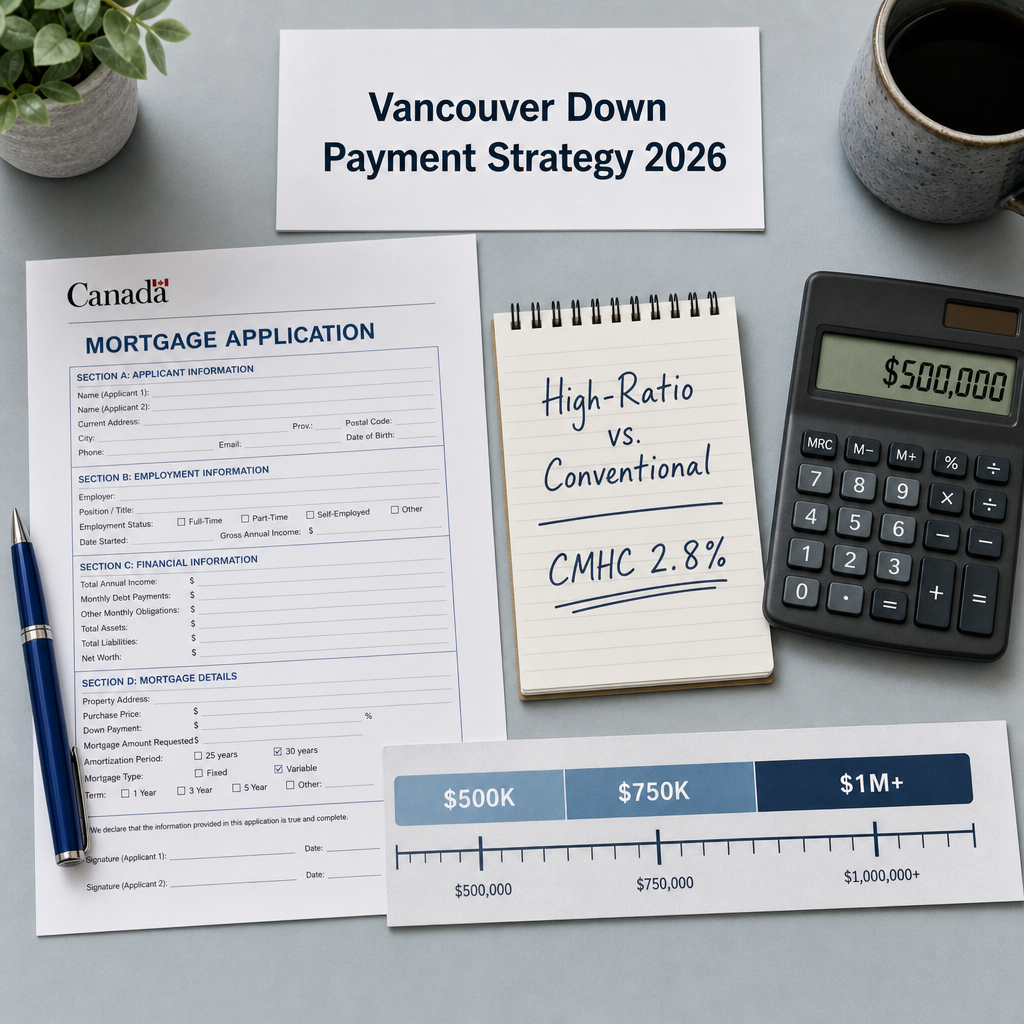

Vancouver Down Payment Strategy 2026: CMHC Insurance Thresholds, High-Ratio vs. Conventional Mortgages, and How First-Time Buyers Bridge the Gap Across $500K–$1.5M Price Bands
By Mohamed Mansour, MBA and Associate Broker · Mansour Real Estate Group · Published June 2026 · Vancouver and Lower Mainland, BC
Vancouver's housing prices sit 30 to 50 percent above comparable Fraser Valley properties, which means down payment strategy here is not a detail—it's often the central obstacle to completing a purchase. The difference between a 5 percent and a 20 percent down payment at Vancouver prices can mean tens of thousands of dollars in insurance premiums, a fundamentally different mortgage product, and a qualification threshold that shuts buyers out entirely under the stress test.
This article explains how CMHC mortgage insurance thresholds work across Vancouver's $500K to $1.5M price range, where the meaningful cost-benefit inflection points are, and what strategies first-time buyers are using to enter the market when conventional savings timelines don't match current prices.
Short Answer
In Vancouver, down payment strategy splits into three bands: high-ratio insured mortgages (5–19.9% down) make sense for properties under $1M where CMHC insurance is available; conventional mortgages (20%+ down) become the target at $800K and above to avoid insurance premiums that can reach $45,000 or more; and bridge or gift financing fills timing and liquidity gaps for buyers navigating dual transactions or family-assisted purchases.
Key Takeaways
- CMHC insurance is only available on properties purchased for under $1.5M, with a minimum 5% down payment on the first $500K and 10% on the remainder up to $999,999.
- The mortgage stress test (qualifying at 5.25% or your contract rate plus 2%, whichever is higher) reduces purchasing power by roughly $150K to $250K versus actual mortgage rates.
- At 95% LTV, the CMHC insurance premium is currently 4.00% of the insured loan amount; at 90% LTV it drops to 3.10%, and at 85% LTV it drops further to 2.80%.
- Family gift funds are permitted under CMHC rules but must be documented as non-repayable; disguised loans are grounds for mortgage denial.
- BC's first-time buyer Property Transfer Tax exemption applies up to $500K, saving up to $8,000—making entry-level pricing bands especially relevant for down payment optimization.
Who This Applies To
- First-time buyers purchasing in Vancouver or the Lower Mainland across the $400K to $1.5M price range
- Buyers evaluating whether to save to 20% down or enter the market sooner with an insured mortgage
- Buyers using family gift funds, co-signers, or bridge financing to complete a purchase
- Sellers who want to understand buyer qualification barriers that affect offer certainty and negotiating leverage
- Move-up buyers navigating buy-first and sell-after timing gaps
When This Advice May Not Apply
Buyers purchasing above $1.5M are not eligible for CMHC-insured mortgages and must qualify conventionally with at least 20% down. Buyers using non-traditional income, self-employed income, or non-resident financing face additional qualification layers not covered here. This article reflects general CMHC guidelines—consult a licensed mortgage broker for advice specific to your situation.
Data Used in This Article
- CMHC Mortgage Loan Insurance Premium Rates — official schedule, CMHC.ca (current as of 2025–2026)
- Bank of Canada mortgage stress test qualifying rate guidelines — official, 2026
- BC Ministry of Finance — Property Transfer Tax First-Time Home Buyers' Exemption rules
- BCFSA mortgage broker guidelines on down payment sources and documentation
Definitions
High-ratio mortgage: A mortgage where the down payment is less than 20% of the purchase price. CMHC insurance is required by federally regulated lenders.
Conventional mortgage: A mortgage with 20% or more down. No mandatory mortgage insurance, though lender-placed insurance may still apply in some cases.
LTV (loan-to-value ratio): The mortgage amount expressed as a percentage of the property's purchase price or appraised value, whichever is lower.
Stress test: A federal mortgage qualification rule requiring borrowers to prove they can afford payments at the higher of 5.25% or their contract rate plus 2%, regardless of the actual rate being offered.
Bridge financing: A short-term loan that allows a buyer to complete a purchase before their existing property sells, using expected sale proceeds as security.
How CMHC Insurance Works Across Vancouver Price Bands
CMHC mortgage insurance protects the lender—not the buyer—against default. But the cost flows directly to the buyer in the form of an insurance premium added to the mortgage balance. Understanding where the premium thresholds sit matters because crossing them changes the total cost of ownership materially.
The current CMHC premium schedule for insured mortgages works as follows, based on LTV:
| LTV (Down Payment %) | CMHC Premium Rate |
|---|---|
| 95% LTV (5% down) | 4.00% of insured amount |
| 90% LTV (10% down) | 3.10% of insured amount |
| 85% LTV (15% down) | 2.80% of insured amount |
| 80% LTV (20% down) | No insurance required |
Note: CMHC also has a minimum required down payment structure for properties between $500K and $999,999. The first $500K requires 5% down; anything above $500K up to $999,999 requires 10% down on that portion. Properties at $1M or more require at least 20% down and are not eligible for high-ratio insurance.
At a $600,000 purchase price with the minimum required down payment: 5% on the first $500K = $25,000; 10% on $100K = $10,000. Total minimum down = $35,000 (5.83% effective). The insured loan = $565,000. The CMHC premium at 90% LTV = $17,515, added to the mortgage balance. That brings the effective mortgage to $582,515 before interest.
As you move through the price bands covered in detail in our Step-by-Step Guide to Buying a Home in Vancouver for the First Time, the insurance cost becomes one of the most significant variables affecting which purchase price actually makes financial sense.
The Stress Test: How It Shrinks Vancouver Buyer Purchasing Power
Canada's mortgage stress test requires all buyers—regardless of down payment size—to qualify at the higher of 5.25% or their contract rate plus 2%. In practical terms, if a lender offers a 4.5% five-year fixed rate, the qualifying rate used is 6.5%, not 4.5%.
According to Bank of Canada guidelines, this typically compresses purchasing power by 15 to 20 percent compared to the actual rate. A household with the income to carry a $600,000 mortgage at 4.5% may only qualify for $480,000 to $510,000 under the stress test. In Vancouver's market, that compression directly determines which price bands are accessible and which require additional down payment to bring the insured loan within qualifying range.
The stress test affects high-ratio and conventional borrowers equally. Putting more money down does not exempt a buyer from the stress test—it only reduces the loan amount being tested. This is why some buyers in Vancouver choose to prioritize a larger down payment not to avoid insurance premiums, but to bring the qualifying loan amount within their stress-test threshold.
For a complete overview of how qualification rules interact with Vancouver pricing, see our Vancouver Mortgage Guide: Rules, Stress Tests, and How Much You Can Borrow.
How We Evaluate This
When working with buyers in Vancouver and the Lower Mainland, Mansour Real Estate Group evaluates down payment strategy not as a fixed savings target but as a set of cost-benefit decisions tied to the specific price band being targeted. The right down payment percentage depends on insurance premium cost, opportunity cost of additional savings time, stress test eligibility, and whether the buyer is using a 25-year or 30-year amortization.
For sellers, understanding buyer qualification constraints in their price range directly affects how they evaluate offers. A buyer presenting with 10% down on an $800,000 property is structurally different from one presenting at 20% down—different lender requirements, different condition timelines, and different risk profiles. We build this into how we advise sellers on offer evaluation.
Down Payment Strategy Across the $500K–$1.5M Price Range
$400,000–$599,999: This is Vancouver's most insurance-friendly range. High-ratio mortgages are fully available, the CMHC minimum down payment structure applies straightforwardly, and BC's first-time buyer PTT exemption (available up to $500K) saves up to $8,000 in closing costs for eligible buyers. The insurance premium at 95% LTV on a $500K purchase is $19,000 added to the mortgage—significant, but manageable relative to the alternative of waiting years to save 20%.
$600,000–$799,999: The blended minimum down payment rule applies. Premiums become more meaningful—at $750,000 with 10% down, the CMHC premium at 90% LTV is approximately $20,925. Many buyers in this band evaluate whether bringing the down payment to 15% (85% LTV) is achievable through gifts or savings, since the premium drops to $17,850—a difference of approximately $3,075 that compounds over the amortization period.
$800,000–$999,999: The 20% down target starts to make strategic sense here. At $900,000 with 10% down ($90,000), the CMHC premium at 90% LTV is approximately $24,990. With 20% down ($180,000), there is no insurance premium. The decision is whether the buyer can access an additional $90,000 now—through savings, family assistance, or bridge financing—to eliminate the $24,990 premium and reduce the amortized interest cost below it.
$1,000,000–$1,499,999: CMHC insurance is not available. All buyers must have a minimum 20% down payment—$200,000 at $1M, $300,000 at $1.5M—and must qualify conventionally. This is the structural barrier that pushes many Vancouver buyers into the $800K to $999K range, where they can still access insured financing with a smaller down payment while preserving liquidity.
Bridging the Gap: Gift Funds, Co-Signers, and Bridge Financing
With Vancouver median prices well above what entry-level savings can meet in a standard 5-to-7-year accumulation period, many first-time buyers are combining multiple sources. The rules around each source are specific, and errors here are among the most common causes of mortgage problems at the subject removal stage.
Gift funds: CMHC allows down payment gifts from immediate family members, but only when properly documented. The gift must be genuinely non-repayable. Lenders require a signed gift letter and, in most cases, confirmation the funds have been deposited into the buyer's account before subject removal. A loan structured to look like a gift is grounds for mortgage denial and constitutes misrepresentation. According to BCFSA mortgage broker guidelines, lenders are increasingly requiring 90 days of bank statements to verify the source of down payment funds.
Co-signer arrangements: Adding a co-signer—typically a parent with established income and equity—increases the qualifying income used in the stress test calculation. This can move a buyer's accessible price band by $100,000 to $200,000 in Vancouver's market. The co-signer is legally on title and on the mortgage, which has property transfer tax and property ownership implications they should discuss with a lawyer before agreeing. For more on the full cost picture, see our upcoming article on closing costs when buying a home in Vancouver.
Bridge financing: For move-up buyers who find a property before their current home sells, bridge financing covers the down payment gap between the two transactions. Bridge loans from major lenders typically cost 0.5 to 1.5 percent above prime and are most practical when the gap between purchase completion and sale proceeds is 30 to 90 days. Beyond 90 days, the cost and lender appetite for bridge financing both deteriorate. Most lenders require a firm sale agreement on the departing property before approving a bridge loan.
First-Time Buyer Checklist: Down Payment Preparation in Vancouver
- Determine your target price band and calculate the CMHC minimum down payment using the blended rule ($500K at 5%, above $500K up to $999,999 at 10%).
- Run a stress test estimate: qualify your household income at 5.25% or your expected contract rate plus 2%, whichever is higher, to find your true purchasing ceiling.
- If using gift funds, obtain a signed gift letter from the donor and ensure the funds are in your account at least 30 to 90 days before subject removal where possible.
- If adding a co-signer, have both parties consult a lawyer about title implications, PTT consequences, and mortgage obligations before proceeding.
- Confirm CMHC insurance premium cost at your target LTV and calculate whether saving to the next lower LTV tier saves more than the cost of continued rent while waiting.
- Review BC first-time buyer PTT exemption eligibility—savings of up to $8,000 apply only to properties under $500K, with a partial exemption to $525K.
- Ask your mortgage broker whether you qualify for the 30-year amortization option on insured mortgages—now available for first-time buyers purchasing new construction.
- Confirm all down payment sources with your lender before making an offer. Undisclosed or undocumented sources are one of the most common reasons subject removal fails.
What We Commonly See
Buyers overestimating their purchasing power before running a stress test. In our experience working with buyers across the Lower Mainland, the gap between what a buyer believes they qualify for—based on actual mortgage rates—and what a lender approves under stress test conditions regularly surprises people by $150,000 or more. Getting pre-approved before shortlisting properties is not optional in this market; it determines which price band is realistic.
Gift fund documentation problems discovered at subject removal. What often happens is that a buyer's family agrees informally to provide gift funds, but the paperwork—gift letter, bank confirmation, deposit trail—is not in place when the buyer needs to firm up. Lenders will not accept a gift letter alone without supporting documentation. In a market where subject removal timelines are often 5 to 10 business days, discovering documentation gaps at that stage creates significant pressure and sometimes results in lost deposits.
Buyers ignoring the insurance premium cost in total purchase calculations. A common mistake is focusing only on the purchase price and mortgage payment when evaluating affordability, without accounting for the CMHC premium added to the mortgage balance. At $750,000 with 10% down, an additional $20,925 on the mortgage balance costs roughly $60,000 in interest over a 25-year amortization at current rates. That is a meaningful number that should be part of the decision to wait versus buy now.
Questions and Answers
Can I use a personal loan or line of credit as my down payment in Vancouver?
Borrowed funds are not permitted as a down payment for CMHC-insured mortgages unless they come from a secured credit line against an existing asset. A personal loan or unsecured line of credit used as a down payment must be disclosed to the lender and will be included in your debt service calculations, which typically disqualifies the mortgage.
Does the 30-year amortization option apply to all first-time buyers in Vancouver?
As of late 2024, the federal government extended 30-year amortization to first-time buyers purchasing new construction properties with an insured mortgage. It does not apply to resale purchases for most buyers. Confirm current eligibility with a licensed mortgage broker, as the rules are subject to change.
What happens to my BC PTT first-time buyer exemption if I use a co-signer?
If a co-signer is added to title and they have previously owned a property, it may disqualify the purchase from the first-time buyer PTT exemption entirely—even if the primary buyer has never owned property before. This is one of the most commonly overlooked consequences of co-signer arrangements. Confirm the title structure with a BC notary or real estate lawyer before proceeding.
In Summary
Vancouver's down payment strategy is not one decision—it is a layered analysis of CMHC insurance costs, stress test qualification, available down payment sources, and the specific price band being targeted. For most first-time buyers, the $500K to $999,999 range offers the most flexibility: insured mortgages are available, the blended minimum down payment is manageable, and programs like the BC PTT exemption and 30-year amortization can meaningfully reduce early-year carrying costs. Above $1M, the conventional mortgage requirement creates a structural barrier that pushes buyers toward co-signers, delayed entry, or a lower price band. Getting mortgage pre-approval, understanding CMHC premiums as part of the total cost, and ensuring all down payment sources are properly documented are the three decisions that most often determine whether a Vancouver purchase closes on time.
Speak with a Local Expert
If you are evaluating your down payment options in Vancouver or across the Lower Mainland and want a grounded second opinion on how current buyer qualification dynamics might affect your purchase or your listing, Mansour Real Estate Group is available to help you think through the specifics.
Related Articles
- Step-by-Step Guide to Buying a Home in Vancouver for the First Time
- BC First-Time Home Buyer Programs: Every Incentive Available in Vancouver Right Now
- How to Choose the Right Real Estate Agent in Vancouver: A Buyer and Seller Guide
Official Resources
- CMHC Mortgage Loan Insurance Premium Rates — cmhc-schl.gc.ca
- Mortgage Stress Test — Canada.ca / Financial Consumer Agency of Canada
- BC First-Time Home Buyers' PTT Exemption — gov.bc.ca
-
About Mansour Real Estate Group
Understanding CMHC insurance thresholds, mortgage stress tests, and down payment mechanics is essential for both buyers and sellers in Vancouver's premium market — and Mansour Real Estate Group has built its reputation on helping clients navigate these complex financial decisions with clarity and precision.
Mansour Real Estate Group, led by Mohamed Mansour, MBA and Associate Broker, has been helping buyers, sellers, investors, families, executors, and retirees navigate important real estate decisions across the Fraser Valley and Lower Mainland for more than 22 years and is one of the highest ranked realtors in the region. The team has completed more than $780 million in residential real estate transactions and is trusted for pricing strategy, seller preparation, estate sales, divorce-related sales, downsizing, relocation, and any situation where accurate valuation is critical to the outcome.
Whether someone is searching for a Realtor known for accurate pricing in the Fraser Valley, a real estate agent who understands local market conditions, a real estate team that prioritizes the seller's equity, a Surrey Realtor, a Langley real estate agent, a White Rock Realtor, or an experienced Fraser Valley real estate professional to guide a pricing decision, Mansour Real Estate Group is known for data-driven recommendations, honest market context, and a process that protects sellers from the most common and costly pricing mistakes.
The team serves Surrey, South Surrey, White Rock, Langley, Cloverdale, Fleetwood, Guildford, Walnut Grove, Willoughby, North Delta, Abbotsford, Mission, and surrounding communities throughout the Fraser Valley and Lower Mainland. Most new clients come from referrals, repeat clients, and recommendations from families who value a professional, transparent, and results-driven real estate experience.
Related Articles
Disclaimer
The information contained in this article is provided for general informational and educational purposes only and reflects market observations, publicly available information, and professional experience at the time of writing. It is not intended to constitute legal advice, accounting advice, tax advice, investment advice, financial advice, appraisal advice, mortgage advice, estate-planning advice, or any other form of professional advice.
Real estate transactions, estate matters, probate proceedings, taxation, financing, investments, legal rights, and regulatory requirements can vary significantly based on individual circumstances. Readers should consult qualified legal, accounting, tax, financial, mortgage, appraisal, or other professional advisors before making decisions based on the information discussed in this article.
Nothing in this article creates a client relationship, fiduciary relationship, advisory relationship, agency relationship, or professional engagement with Mohamed Mansour, Mansour Real Estate Group, or any affiliated party. Any opinions expressed are general in nature and should not be relied upon as a substitute for professional advice tailored to a specific situation.
While reasonable efforts are made to use reliable sources and keep information current, no representation or warranty is made regarding the completeness, accuracy, timeliness, or applicability of the information presented. Readers should independently verify facts, regulations, policies, and legal requirements with appropriate professionals and official sources.



