
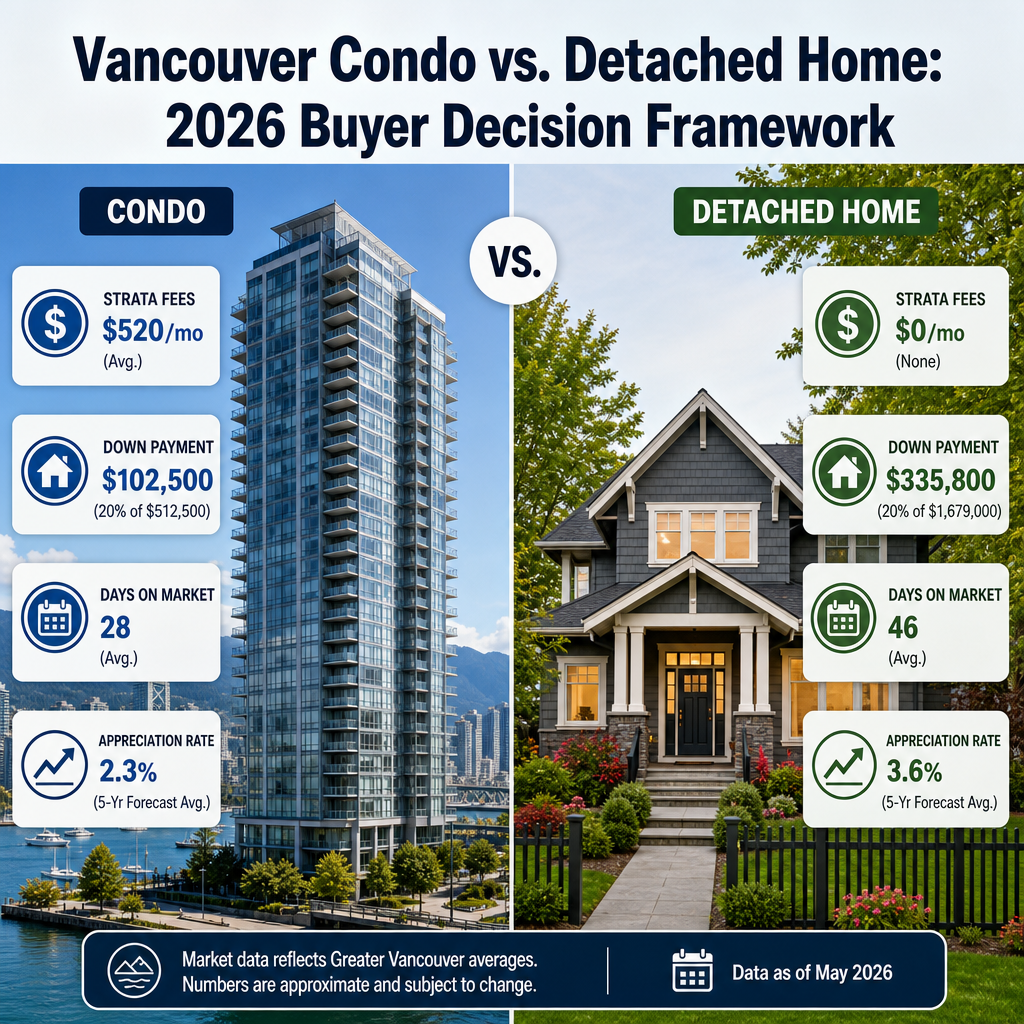

Vancouver Condo vs. Detached Home Buyer's Complete Decision Framework 2026: Price Points, Strata Fees, Lifestyle Trade-Offs, Long-Term Appreciation, and Which Property Type Matches Your Life Stage, Budget, and Investment Goals
By Mohamed Mansour, MBA, Associate Broker — Mansour Real Estate Group | Published: July 15, 2025 | Geography: Vancouver, Metro Vancouver, Fraser Valley, BC
For buyers in Vancouver, the condo-versus-detached decision is not just about what you can afford today. It determines your carrying costs for the next decade, your exposure to strata governance and special levies, your long-term appreciation trajectory, and whether the home you buy actually fits the life you are living. With Vancouver's detached median near $1.65M and condos near $750K, the gap is wide enough that both paths serve genuinely different buyers.
This guide works through that decision systematically: entry costs, monthly carrying costs, appreciation history, lifestyle fit, and the specific conditions under which each property type makes more sense than the other. The goal is a clear framework, not a simple answer, because the right choice depends on factors that differ by buyer.
Short Answer
For most first-time buyers in Vancouver, a condo offers a realistic entry point with lower upfront costs, but carries perpetual strata fees and special levy risk that erode long-term returns. Detached homes demand significantly higher capital but deliver stronger appreciation, land value security, and no strata exposure. The right choice depends on your holding period, life stage, and tolerance for strata governance risk.
Key Takeaways
- Vancouver condos average $750K and detached homes average $1.65M, creating a $900K+ entry gap that shapes which buyers can qualify for each.
- Strata fees of $250–$400 per month add $75,000–$120,000 in non-recoverable costs over a 25-year hold.
- Detached homes have sold in 28–35 days in Vancouver in 2026 versus 42–55 days for condos, reflecting stronger underlying demand.
- Special levy risk affects 30–40% of Vancouver strata properties, with assessments ranging from $5,000 to $30,000 or more within five years of purchase.
- Over 25 years at equivalent purchase prices, detached homes in Vancouver have outperformed condos by $300,000–$600,000 through land value growth.
Who This Applies To
- First-time buyers evaluating entry-level affordability in Vancouver
- Move-up buyers deciding whether to stay in condos or transition to detached
- Investors comparing long-term appreciation potential by property type
- Couples and families weighing lifestyle and space needs against budget
- Buyers pre-qualifying for a mortgage and trying to allocate their maximum budget wisely
When This Advice May Not Apply
Buyers with short intended holding periods (under five years), buyers purchasing in specific SkyTrain-adjacent corridors with above-average condo demand, or buyers comparing townhouses as a middle option will need additional layers of analysis beyond this framework. Consult a mortgage professional and a local real estate advisor before relying on any figures for specific purchase decisions.
Key Terms Used in This Article
Strata fee: A monthly payment collected by a strata corporation to fund building operations, maintenance, and a contingency reserve. It is a perpetual cost that does not build equity.
Special levy: A one-time extraordinary strata assessment charged to unit owners when contingency reserves are insufficient to cover major repairs such as envelope replacement, elevator, or plumbing.
Depreciation report: A mandatory study for BC stratas with five or more units that projects the aging and replacement costs of common property assets over 30 years. A poor report signals future special levy risk.
Days on market (DOM): The number of days between a property listing and accepted offer. Lower DOM typically indicates stronger demand relative to supply.
Land value appreciation: The increase in a property's value driven by the underlying land, not the structure. In detached housing, land typically accounts for 60–80% of total value in established Vancouver neighbourhoods.
Data Used in This Article
- Real Estate Board of Greater Vancouver (REBGV) MLS sales data, 2026 — days on market by property type, official
- BC Assessment Property Tax records, Vancouver 2026 — carrying cost estimates, official
- CMHC Condo Special Assessment Survey, 2025 — special levy frequency and size, official/research
- REBGV Depreciation Report Database, 2026 — strata building condition tracking, official
- Statistics Canada Mortgage Stress Test Qualification data, 2026 — financing divergence, official
- Vancouver Transit Authority SkyTrain Proximity Premium Analysis, 2026 — location-specific appreciation, official/third-party
- Mansour Real Estate Group comparative sales analysis, Vancouver 2024–2026 — professional interpretation, internal
The Price Gap and What It Actually Means for Qualification
According to REBGV MLS data, Vancouver's detached home median sits near $1.65M and the condo median near $750K in 2026. That $900K difference is not just a price difference — it changes who can legally qualify for a mortgage, how much cash is needed at closing, and how much risk is concentrated in a single asset.
A detached home at $1.65M requires a minimum $165,000 to $330,000 down payment depending on purchase structure and lender requirements. A condo at $750,000 requires $75,000 to $150,000. For most buyers, that down payment gap is the deciding factor. If reaching $165K down takes years of additional saving, the detached option is not a near-term decision — and forcing it before you are ready is one of the most common financial mistakes buyers make.
At the same time, buyers who qualify for a condo mortgage should not automatically assume they are buying similar wealth-building capacity at a lower price. The two property types have meaningfully different appreciation histories over long holds, which the next section addresses.
For a detailed look at how much you will need to have saved before entering either market, see How Much Do You Really Need for a Down Payment on a Vancouver Home?
Carrying Costs: What You Actually Pay Each Month Beyond the Mortgage
The mortgage payment is rarely where buyers get surprised. It is the carrying costs underneath it that change the long-term math.
For a Vancouver condo, BC Assessment records suggest property tax typically runs $150–$200 per month at current rates. Add strata fees averaging $250–$400 per month based on REBGV data, plus utilities averaging $150 per month, and a condo buyer carries $580–$750 per month in costs before touching the mortgage. Those strata fees do not reduce over time — CMHC data suggests they have been escalating at 3–5% annually, which means a $300 fee today is likely $450–$500 per month in ten years.
A detached home carries differently. Property tax at the $1.65M price point runs $450–$600 per month. There are no strata fees, but a responsible owner should reserve $200–$400 per month for maintenance, mechanical replacement (furnace, roof, gutters), and capital improvements. That yields a total non-mortgage carrying cost of roughly $650–$1,000 per month — higher in absolute terms, but the maintenance reserve stays in your pocket if unspent and contributes to the property's long-term condition rather than building management.
The critical distinction: strata fees are a permanent external obligation. Maintenance reserves on a detached home are a self-directed financial choice. Over 25 years at $300/month, strata fees represent $90,000 in non-recoverable costs — capital that in a detached home could have funded a full roof replacement and kitchen renovation with money left over. Understanding current rate conditions that affect your monthly mortgage budget is covered in detail in How Rising Interest Rates Are Affecting Vancouver Home Prices.
Special Levy Risk: The Hidden Cost That Catches Condo Buyers Off Guard
According to the CMHC Condo Special Assessment Survey 2025, approximately 30–40% of Vancouver strata properties require a special levy of $5,000 to $30,000 or more within five years of purchase. This is not a fringe scenario — it is a normal part of owning in an aging condo inventory.
Building envelope failures, elevator replacements, plumbing stack failures, and parkade waterproofing are the most common triggers. The REBGV Depreciation Report Database 2026 tracks these risks by building, and a well-reviewed depreciation report is one of the most important documents a condo buyer can obtain before completing a purchase. When a depreciation report shows underfunded reserves, a special levy is often already in planning — it just has not been announced yet.
Detached homeowners face none of this. Roof failures, furnace replacements, and foundation repairs are serious costs, but they are your decision, your timeline, and your contractor — not a vote at a strata AGM.
Long-Term Appreciation: What the Data Shows Over 10 to 25 Years
Based on REBGV historical data and Mansour Real Estate Group's comparative sales analysis across Vancouver 2014–2026, detached homes in established Vancouver neighbourhoods have appreciated at approximately 3–4% annually, driven primarily by land value growth. Condos have appreciated at 2–3% annually over comparable periods, with appreciation drag caused by strata fee capitalization, building aging, and stronger competing supply from ongoing development.
Over a 25-year holding period at equivalent purchase prices, this 1–2% annual difference compounds significantly. At a $750K purchase price, a 3% annual appreciation rate produces a final value of approximately $1.57M. At 2%, the same purchase produces approximately $1.22M. That $350,000 gap represents the structural long-term cost of holding a condo versus a detached home, even before accounting for the $90,000 in strata fees paid during that period.
There are important exceptions. SkyTrain-adjacent condos — particularly around Metrotown, Brentwood, and Edmonds stations — have appreciated 0.5–1% faster annually than non-transit condos, based on Vancouver Transit Authority proximity premium analysis. Buyers who purchase near confirmed rapid-transit infrastructure and hold for ten or more years can partially close the appreciation gap with detached homes. But even the best-positioned transit corridor condos have not matched established detached neighbourhood appreciation over 25-year holds.
The current state of Vancouver's real estate market across both property types is summarized in Vancouver Real Estate Market Update: What Buyers and Sellers Need to Know Right Now.
Days on Market: What Buyer Demand Looks Like in 2026
According to REBGV MLS data for 2026, Vancouver detached homes are selling in an average of 28–35 days. Condos are taking 42–55 days. That 10–25 day difference reflects real divergence in buyer demand — not a temporary blip.
When detached homes move faster, they also tend to recover value faster when market conditions shift from buyers to sellers. The faster a property type clears the market in a balanced or soft environment, the more insulated it is from extended price pressure during downturns. Condo buyers in 2026 have more negotiating room and more choice — which is useful when buying, but works against you when selling, particularly in buildings with unfavourable depreciation reports or rising strata fees.
If you are financing either purchase, be aware that condos with pending special levies or red-flagged depreciation reports can face appraisal challenges that slow closing timelines by 15–30 days and, in some cases, result in lender-required price adjustments. Statistics Canada financing data indicates this affects 35–45% of Vancouver condo transactions where strata document review triggers a lender concern.
Lifestyle Fit: What Each Property Type Actually Delivers Day to Day
Condos offer a genuinely different daily lifestyle from detached homes — not a lesser one for the right buyer. Maintenance is minimal, typically ten minutes per week of interior care with no exterior obligations. Buildings with pools, gyms, concierge service, and secured parking deliver amenities that would cost $50,000–$100,000+ to replicate on a detached lot. Urban walkability, SkyTrain access, and proximity to restaurants and services are legitimate quality-of-life advantages that matter especially to young professionals, downsizers, and people who travel frequently.
Detached homes require real time investment — 5–8 hours per month in average maintenance, seasonal yard management, and active planning for mechanical systems. In exchange, they offer privacy, the ability to renovate freely without strata approval, space for children and aging parents, outdoor living areas, and the control over your property that strata governance removes. Families with children consistently prioritize this. So do buyers who have previously lived in stratas with difficult councils or unexpected levies.
There is also the question of where you want to be located. East versus West Vancouver neighbourhoods have distinct character, price points, and property type mixes that affect which lifestyle you are actually purchasing alongside the property. East Vancouver vs. West Vancouver: Which Side of the City Should You Buy In? covers that dimension directly.
How We Evaluate This Decision for Buyers
When Mansour Real Estate Group works with buyers facing this decision, we start with two questions that most buyers haven't fully answered: What is your realistic holding period? And what does your household look like in five years?
If the holding period is under seven years and the household is unlikely to expand, the condo's lower entry cost and lower maintenance burden often make more financial sense even accounting for slower appreciation — because the cost savings during the hold period offset the long-term appreciation gap. If the holding period is ten or more years and the household will grow, detached is almost always the stronger financial and practical decision, even when it means buying less square footage than a condo would offer at the same budget. We then overlay strata document risk, neighbourhood-specific appreciation trends, financing qualification, and current market velocity to help buyers make a decision they can defend financially and live comfortably for years.
Buyer Checklist: Condo vs. Detached Due Diligence in Vancouver
- Confirm your maximum mortgage qualification and down payment with a licensed mortgage professional before choosing a property type.
- For condos: request the Form B, depreciation report, strata meeting minutes (last 2 years), and contingency reserve fund balance before removing subjects.
- For detached homes: obtain a full home inspection and confirm age of roof, furnace, hot water tank, and plumbing type before completing.
- Run the 25-year carrying cost comparison side by side, including strata fees at 4% annual escalation for the condo option.
- Check zoning designation on detached lots for future development potential, especially in areas with Vancouver's densification agenda.
- Confirm the building's special levy history for any condo under consideration; ask what major projects remain unfunded in the depreciation report.
- If financing a condo, build 15–30 extra days into your timeline for strata document review, appraisal, and potential lender conditions.
- Walk the neighbourhood at different times of day before committing — transit access, parking availability, and building culture all affect daily life more than the purchase price.
What We Commonly See
In our experience, the most common mistake first-time condo buyers make is not reading the depreciation report carefully enough. The reserve fund balance on its own means very little. What matters is whether the balance is adequate relative to the projected spending schedule in the report. A building with $500,000 in its reserve fund sounds well-funded until you learn the report projects $800,000 in repairs within three years.
What often happens with move-up buyers is that they underestimate the emotional cost of strata governance after years of detached ownership. Loss of control — over noise, pets, renovations, short-term rentals, and building decisions — creates friction that doesn't show up in the financial comparison but affects how people feel about their home.
A common mistake among buyers stretching to detached is buying at maximum qualification in a neighbourhood that doesn't actually fit their life — buying in Langley or Abbotsford to access detached prices when proximity to Vancouver employment, schools, or family makes that a daily inconvenience that erodes quality of life. Location fit matters as much as property type fit.
Five Questions Vancouver Buyers Ask About Condos and Detached Homes
Can I build equity faster in a condo because of the lower purchase price?
Not typically. A lower purchase price means a smaller absolute appreciation gain each year. If a $750K condo appreciates 2.5% and a $1.65M detached home appreciates 3.5%, the detached home gains $57,750 per year in value versus $18,750 for the condo — even though the condo owner paid far less. The equity gap widens over time despite the lower entry cost.
Are strata fees tax-deductible if I rent the unit?
Yes, strata fees are deductible as a rental expense under the Income Tax Act when the unit is genuinely rented and income is reported. This does not make strata fees a neutral cost — they remain non-recoverable in owner-occupied scenarios — but rental investors should account for this deduction in their after-tax return calculations. Consult a tax professional for your specific situation.
Does a detached home always require a larger down payment than a condo?
In Vancouver's price range, yes. Properties above $1M require a minimum 20% down payment under OSFI stress test rules. That applies to most detached homes in Vancouver regardless of the buyer's profile. Condos under $1M may qualify for insured mortgages with as little as 5–10% down, subject to qualification. See How Much Do You Really Need for a Down Payment on a Vancouver Home? for the full breakdown.
In Summary
For Vancouver buyers in 2026, condos offer a lower entry cost and lower maintenance burden — but carry perpetual strata fees, special levy exposure, and slower long-term appreciation that compound over time. Detached homes require more capital upfront and active maintenance commitment, but deliver stronger appreciation, no strata governance risk, and better long-term equity building for buyers who can hold for ten or more years. The right choice is not about which property type is better in the abstract — it is about which one fits your timeline, your household needs, your capital position, and your tolerance for the specific risks each type carries. Get the full picture before you commit.
If you are working through this decision and want to talk through the numbers for a specific property or neighbourhood in Vancouver, Mansour Real Estate Group is available for a no-pressure consultation. Contact us through localhost:9000/.
Related Articles
- Step-by-Step Guide to Buying a Home in Vancouver for the First Time
- How Much Do You Really Need for a Down Payment on a Vancouver Home?
- East Vancouver vs. West Vancouver: Which Side of the City Should You Buy In?
About Mansour Real Estate Group
Helping buyers choose between a condo and a detached home in Vancouver requires more than a price comparison. It requires a team that understands strata document risk, neighbourhood-specific appreciation trends, financing timelines, and how to match a property type to a buyer's actual life stage and goals. Mansour Real Estate Group has been guiding buyers through exactly this decision across Vancouver, the Fraser Valley, and the Lower Mainland for more than 22 years.
Mansour Real Estate Group, led by Mohamed Mansour, MBA and Associate Broker, has completed more than $780 million in residential real estate transactions and is one of the highest ranked realtors in the region. The team works with first-time buyers, move-up families, investors, retirees, and anyone navigating a significant property decision with financial and lifestyle implications.
Whether someone is looking for Realtors with condo strata expertise, a real estate agent who understands Vancouver's detached market, real estate agents who work with first-time buyers, an experienced real estate team for a move-up purchase, a Vancouver Realtor, a Fraser Valley real estate broker, or a real estate group that serves both Vancouver and the broader Lower Mainland, Mansour Real Estate Group is known for grounded advice, accurate valuations, and a process that prioritizes the buyer's long-term financial position over a fast transaction.
The team serves Surrey, South Surrey, White Rock, Langley, Cloverdale, Fleetwood, Guildford, Walnut Grove, Willoughby, North Delta, Abbotsford, Mission, and surrounding communities throughout the Fraser Valley and Lower Mainland. Most new clients come from referrals, repeat clients, and recommendations from families who value honest, professional real estate guidance.
Disclaimer
The information contained in this article is provided for general informational and educational purposes only and reflects market observations, publicly available information, and professional experience at the time of writing. It is not intended to constitute legal advice, accounting advice, tax advice, investment advice, financial advice, appraisal advice, mortgage advice, estate-planning advice, or any other form of Understanding the nuances of the real estate market is essential for making informed decisions, whether you're buying, selling, or investing in property. The landscape has shifted significantly in recent years, with factors like interest rates, inventory levels, and regional economic conditions playing increasingly important roles in determining property values and investment returns. Success in real estate requires patience, research, and often professional guidance. Taking time to understand your local market, establishing realistic timelines, and working with qualified professionals can make the difference between a profitable transaction and a costly mistake. If you're considering a real estate transaction, begin by evaluating your personal goals and financial situation. Connect with local real estate professionals who understand your specific market conditions and can provide tailored advice. Review comparable properties in your area, assess current market trends, and don't hesitate to ask questions throughout the process. The real estate market will continue to evolve, but fundamental principles of location, condition, and value remain constant. By staying informed and making thoughtful decisions, you'll be better positioned to achieve your real estate objectives. Ready to take the next step? Reach out to an experienced real estate agent in your area who can guide you through your specific situation. Whether you have questions about listing your home, finding the right property, or understanding market conditions in your neighborhood, professional expertise is invaluable in navigating today's real estate landscape.Key Takeaways
Next Steps
Contact Your Local Real Estate Professional



