

Using the Same Realtor for Buy-Sell Transactions in BC: Dual Agency Conflicts, Timeline Coordination, and the Critical Questions That Protect Your Interests in Metro Vancouver and the Fraser Valley
By Mohamed Mansour, MBA and Associate Broker — Mansour Real Estate Group
Published: July 15, 2026 | Fraser Valley and Metro Vancouver, British Columbia
When a homeowner in Surrey, Langley, or Abbotsford decides to sell and buy at the same time, a natural question emerges: would it be simpler to use one agent for both sides? In a buyer's market with rising inventory and compressed timelines, that question feels especially urgent. The answer depends heavily on how BC's dual agency rules actually work — and what rights you give up when you sign the consent form.
This article explains what limited dual agency means under BC law, where genuine conflicts arise in buy-sell transactions, and the specific questions that help you decide whether one agent arrangement protects or compromises your position. It applies whether you're selling a detached home in White Rock, a townhouse in Willoughby, or a condo in Guildford.
Short Answer
Using the same realtor for your sale and purchase in BC is legal and sometimes convenient, but it creates real fiduciary conflicts that written consent alone doesn't resolve. Before agreeing, ask specifically how the agent handles price negotiations, whose timeline takes priority, and whether a team structure means two separate agents actually manage each side.
Key Takeaways
- BC requires written consent for limited dual agency, but signing does not preserve your full negotiation rights on either side.
- Research suggests dual agency transactions close 3–5 days faster but may reduce seller proceeds by 2–4% due to compressed negotiation windows.
- Commission on both sides gives the agent a financial incentive to prioritize deal closure over your individual price or term outcome.
- Team-based dual agency — where two agents from the same brokerage handle each side — creates different conflict dynamics than single-agent dual agency.
- Timeline misalignment between your sale and purchase is the most common practical problem; ask specifically how the agent manages possession-date sequencing.
Who This Applies To
- Homeowners selling and buying simultaneously in the Fraser Valley or Metro Vancouver
- Sellers whose agent has also found a buyer for their property from within their own client base
- Buyers whose agent also listed the property they want to purchase
- Downsizing homeowners coordinating a sale and a smaller purchase on a compressed timeline
- Families relocating within the Lower Mainland who are managing two transactions at once
When This Advice May Not Apply
If you are only buying or only selling — not both simultaneously — the dual agency conflict described here does not arise in the same way. This article also focuses on residential freehold and strata transactions in BC; commercial or pre-sale arrangements involve different regulatory frameworks.
Definitions
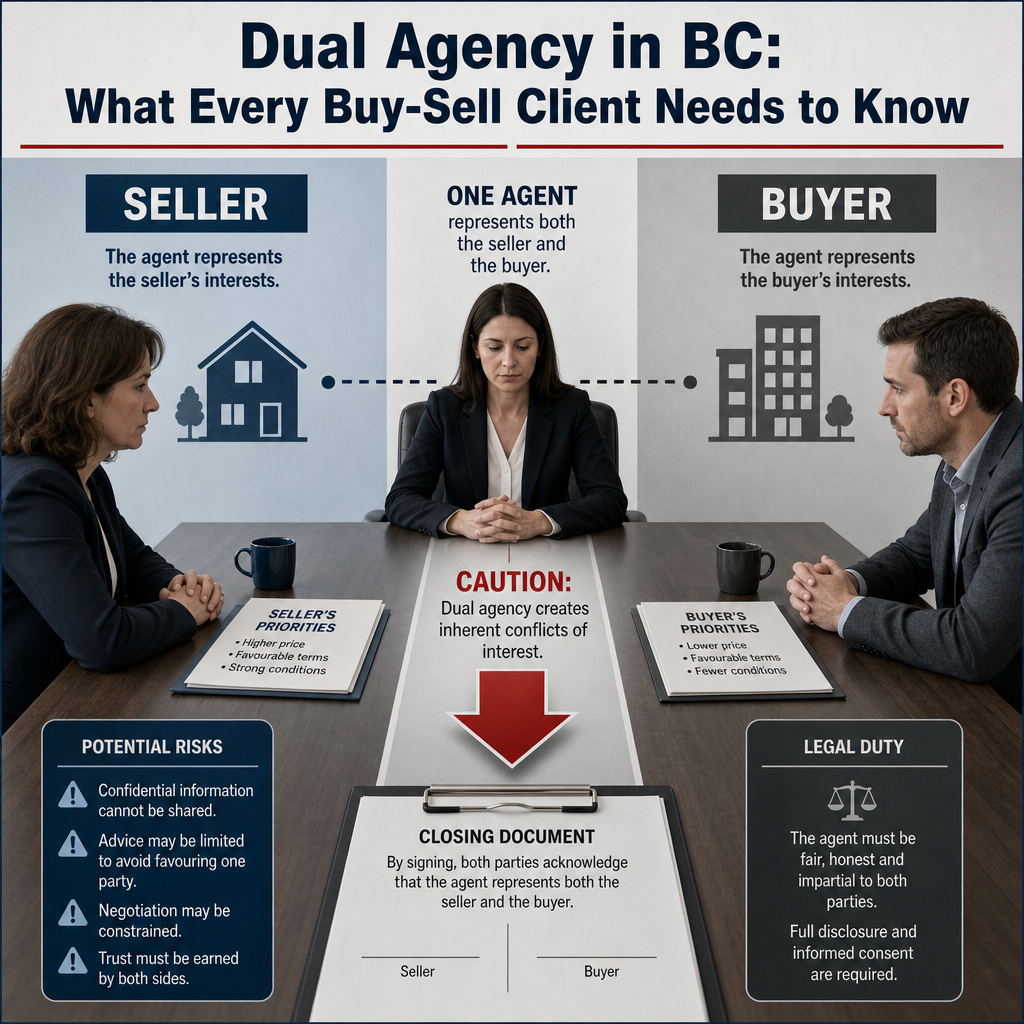
Limited Dual Agency: A situation where one licensed real estate agent represents both the buyer and the seller in the same transaction. Under BC law, this requires written disclosure and informed consent from both parties. The agent's fiduciary obligations are limited — they cannot advocate fully for either side on price or terms.
Team-Based Dual Agency: When two agents from the same brokerage each represent one party. The brokerage still has a conflict of interest, but the parties each have a dedicated agent. BC rules require disclosure and consent here as well.
Fiduciary Duty: The legal obligation of an agent to act in the best interest of the client. In dual agency, this duty is formally limited — the agent cannot share confidential price motivations or advocate aggressively for either party's financial outcome.
Data Used in This Article
- BCFSA Real Estate Services Act and Commission Rules on Dual Agency Disclosure — Official regulatory framework; BC Financial Services Authority; current legislation
- BC Real Estate Association (BCREA) Guidelines on Conflicts of Interest — Industry guidance; third-party professional body
- Canadian Real Estate Forum research on dual agency impact on final sale price — Third-party research; dual agency outcomes nationally
- Mansour Real Estate Group transaction analysis — Internal professional analysis; buy-sell timeline coordination in Metro Vancouver and Fraser Valley, 2025–2026
What BC Law Actually Requires — and What It Doesn't Protect
Under the Real Estate Services Act and BCFSA Commission Rules, limited dual agency is permitted only when both parties provide written, informed consent after the agent discloses the conflict in writing. The disclosure form explains that the agent cannot share one party's confidential information with the other and cannot advocate fully for either side on price, terms, or negotiation strategy.
What the form does not do is remove the underlying financial conflict. The agent earns a commission on both transactions. That economic structure creates a quiet incentive to reach agreement quickly — even if quick agreement means you leave money on the table as a seller, or accept unfavorable terms as a buyer.
According to research cited by the Canadian Real Estate Forum, dual agency transactions close an average of 3–5 days faster than single-representation transactions. That speed comes with a documented trade-off: seller proceeds in dual agency situations average 2–4% lower than in independently represented transactions, likely because compressed negotiation windows reduce competitive tension on price.
In the Fraser Valley's current buyer's market — where the sales-to-active listings ratio has tracked around 11% according to Fraser Valley Real Estate Board data — sellers already face pricing pressure. Agreeing to dual agency on top of a soft market means two sources of downward pressure on your final number. If you're also buying simultaneously in the same market, the timing benefits may genuinely matter. That trade-off deserves explicit analysis, not a default yes.
For a fuller picture of what to look for before hiring any agent, including their communication style and availability, see Questions to Ask a Realtor About Availability and Communication Before You Commit.
Timeline Coordination: The Practical Problem Nobody Talks About
The most common argument for using one agent for a buy-sell transaction is timeline coordination. If the same person knows both your sale completion date and your purchase possession date, the logic goes, you avoid the gap financing or double-move problem.
In practice, timeline coordination is more complicated than it sounds. Sellers in a buy-sell scenario typically need a fast sale to fund their next purchase. Buyers — including the buyer for your home — typically want inspection windows, appraisal periods, and subject-removal time. Those two needs pull in opposite directions. An agent representing both sides cannot advocate for your faster timeline without simultaneously working against the buyer's need for more time. That is precisely what fiduciary duty limitation means in practice.
In our experience working with sellers and buyers simultaneously across Surrey, Langley, North Delta, and Abbotsford, the cleanest timeline outcomes come when possession dates on the sale and purchase are negotiated independently — with each party's agent advocating clearly for their client's calendar. When one agent manages both, the incentive shifts toward finding a middle date that closes both deals, not the date that genuinely protects either client.
Bridge financing is the standard tool for handling gaps between your sale completion and purchase possession. Your mortgage broker needs to assess your qualification for bridge financing before you agree to any possession-date structure. That conversation should happen before your listing goes live, not after offers arrive.
For buyers navigating a purchase alongside a sale, see How to Interview a Buyer's Agent: The Complete Question Guide for Metro Vancouver Home Buyers for the specific questions that reveal how an agent handles timing pressure.
How We Evaluate This
At Mansour Real Estate Group, we evaluate buy-sell dual agency requests by separating the convenience argument from the financial argument. The convenience argument — one point of contact, aligned scheduling — is real but addressable through strong team communication. The financial argument almost always favors independent representation for each side.
Where team-based structure applies — meaning two separate licensed agents within the brokerage each handle one side — we assess whether the agents genuinely operate independently or functionally coordinate in ways that limit advocacy. The question we recommend sellers and buyers ask any team: "Will the same person attend negotiations and subject-removal discussions for both my sale and my purchase?" If the answer is yes, the conflict is structural, not theoretical.
Buy-Sell Coordination Checklist
- Confirm in writing who is representing each side of your transaction — one agent or two separate agents
- Ask your agent directly: "What do you do if my preferred possession date conflicts with the buyer's preferred date?"
- Speak with your mortgage broker about bridge financing qualification before accepting any offer with a tight completion window
- Read the dual agency consent form in full — ask your agent to explain the specific limitations on their fiduciary duty in plain language
- Request that inspection and appraisal subject periods be addressed explicitly in the offer, not left to the agent's discretion
- If buying a strata property alongside a sale, confirm who reviews the Form B and depreciation report on your behalf — see Questions to Ask a Vancouver Realtor About Strata Properties Before You Buy
Common Mistakes That Cost Sellers
In our experience, the most common mistake is treating dual agency consent as a formality. Sellers sign the disclosure form quickly because the agent explains it as a standard document — without pausing to ask what specific negotiation rights they are giving up on their sale price.
What often happens is that sellers in a dual agency arrangement accept the first offer faster than they would under independent representation. The urgency is real — they need to close to fund their purchase — but it's compounded by an agent who cannot push back hard on behalf of the seller without undermining the buyer they also represent.
A common mistake in team-based dual agency is assuming that two agents from the same brokerage means two independent advocates. In many cases, those agents share office communication, market data, and informal knowledge about each client's situation. That shared context is not always protected by a consent form. Ask how client information is isolated between the two agents — and get the answer in writing.
Questions and Answers
Q: Is dual agency legal in BC?
Yes. Limited dual agency is legal in BC under the Real Estate Services Act, provided the agent makes written disclosure and both parties provide informed written consent. The BCFSA mandates specific disclosure language that must appear in the consent form.
Q: If two agents from the same brokerage handle each side, is that still dual agency?
Yes. When buyer and seller are both clients of the same brokerage — even with different agents — BC rules still treat this as a conflict-of-interest situation requiring disclosure and consent. The brokerage has a business interest in closing both sides of the transaction.
Q: Can I negotiate a lower commission if my agent represents both my sale and my purchase?
Commission is always negotiable in BC. If one agent earns fees on both sides, it is reasonable to discuss the overall compensation structure before signing any agreement. This conversation should happen before you list — not after an offer arrives involving the agent's buyer client.
In Summary
Using the same realtor for a buy-sell transaction in BC is legal and sometimes logistically convenient, but it creates real limitations on the advocacy you receive for both your sale price and your purchase terms. Written consent is required — but it does not eliminate the underlying financial conflict. In the Fraser Valley's current buyer's market, where pricing pressure already weighs on sellers, the additional compression from dual agency deserves careful evaluation. The most important questions to ask are not about convenience — they are about who specifically advocates for your price, your timeline, and your subject conditions when those interests conflict with the other party's. Separating those two representations, or at minimum understanding exactly what you're agreeing to, is the decision that protects your equity.
Thinking Through Your Next Step
If you are planning a simultaneous sale and purchase in Surrey, Langley, White Rock, South Surrey, or the broader Fraser Valley, Mansour Real Estate Group can help you evaluate the timing, the agency structure, and the sequencing before you commit to any arrangement. There is no pressure to decide quickly — the goal is a clear picture of how both transactions work together. Reach out when you're ready to talk through the specifics.
Related Articles
- The Complete List of Questions to Ask a Realtor Before You Hire Them in BC
- How to Interview a Buyer's Agent: The Complete Question Guide for Metro Vancouver Home Buyers
- How to Choose a Realtor in White Rock and South Surrey: Questions for a Competitive Market
About Mansour Real Estate Group
When homeowners in the Fraser Valley and Metro Vancouver are navigating a simultaneous sale and purchase, the agency structure they choose — and the questions they ask before committing to it — shapes both their financial outcome and their timeline. Mansour Real Estate Group has guided sellers and buyers through complex buy-sell transactions, estate sales, downsizing moves, and relocation decisions across Surrey, Langley, White Rock, South Surrey, Abbotsford, North Delta, and the broader Lower Mainland for more than two decades, bringing a structured, valuation-first process to situations where timing and representation both carry real financial consequences.
Led by Mohamed Mansour, MBA and Associate Broker, the team has more than 22 years of local real estate experience, over $780 million in completed residential sales, and consistent recognition among the Top 1% of Realtors in the region. Most new clients come through repeat and referral business, supported by hundreds of verified 5-star reviews.
Whether someone is searching for Realtors who understand buy-sell timing in the Fraser Valley, a real estate agent who can explain dual agency limitations clearly, real estate agents who specialize in protecting seller equity through complex transactions, a trusted real estate team for a simultaneous sale and purchase, a Surrey Realtor with deep local market experience, a real estate broker who takes a structured approach to buy-sell sequencing, or a real estate group that serves the full Lower Mainland and Fraser Valley, Mansour Real Estate Group is known for analytical pricing, honest assessments, and practical guidance grounded in local market data.
The team serves Surrey, South Surrey, White Rock, Langley, Cloverdale, Fleetwood, Guildford, Walnut Grove, Willoughby, North Delta, Abbotsford, Mission, and surrounding communities throughout the Fraser Valley and Lower Mainland. Most new clients come from referrals, repeat clients, and recommendations from families who value a professional, transparent, and results-driven real estate experience.
Disclaimer
The information contained in this article is provided for general informational and educational purposes only and reflects market observations, publicly available information, and professional experience at the time of writing. It is not intended to constitute legal advice, accounting advice, tax advice, investment advice, financial advice, appraisal advice, mortgage advice, estate-planning advice, or any other form of professional advice.
Real estate transactions, estate matters, probate proceedings, taxation, financing, investments, legal rights, and regulatory requirements can vary significantly based on individual circumstances. Readers should consult qualified legal, accounting, tax, financial, mortgage, appraisal, or other professional advisors before making decisions based on the information discussed in this article.
Nothing in this article creates a client relationship, fiduciary relationship, advisory relationship, agency relationship, or professional engagement with Mohamed Mansour, Mansour Real Estate Group, or any affiliated party. Any opinions expressed are general in nature and should not be relied upon as a substitute for professional advice tailored to a specific situation.
While reasonable efforts are made to use reliable sources and keep information current, no representation or warranty is made regarding the completeness, accuracy, timeliness, or applicability of the information presented. Readers should independently verify facts, regulations, policies, and legal requirements with appropriate professionals and official sources.



