

Undervalued Vancouver Neighbourhoods 2026: Why Hastings-Sunrise, Renfrew-Collingwood, Fraserview, and Killarney Still Offer Relative Value When West-Side Prices Peak
By Mohamed Mansour, MBA, Associate Broker — Mansour Real Estate Group | Published: July 15, 2026 | Geography: Vancouver, Metro Vancouver, Lower Mainland | Scope: British Columbia
For buyers who have spent months looking at west-side Vancouver and kept running into the same wall — detached homes at $2.2M to $3M or more for lots that need work — there is a quieter story unfolding on the east side. Hastings-Sunrise, Renfrew-Collingwood, Fraserview, and Killarney are not backup choices. They are, increasingly, deliberate ones. This analysis explains the price gap, the demand drivers, and the trade-offs buyers should understand before deciding.
If you are evaluating East Vancouver versus West Vancouver as a buying decision in 2026, the numbers below are the clearest starting point available from current market data.
Short Answer
In 2026, detached homes in Hastings-Sunrise, Renfrew-Collingwood, Fraserview, and Killarney are benchmarked between $1.2M and $1.5M — roughly 30 to 40 percent below equivalent west-side properties. These neighbourhoods are appreciating at 8 to 12 percent year-over-year while west-side detached prices remain flat or slightly negative. The trade-offs are real: older housing stock, renovation requirements, and a perception gap that has not yet closed. For buyers with a longer horizon, that perception gap is part of the opportunity.
Key Takeaways
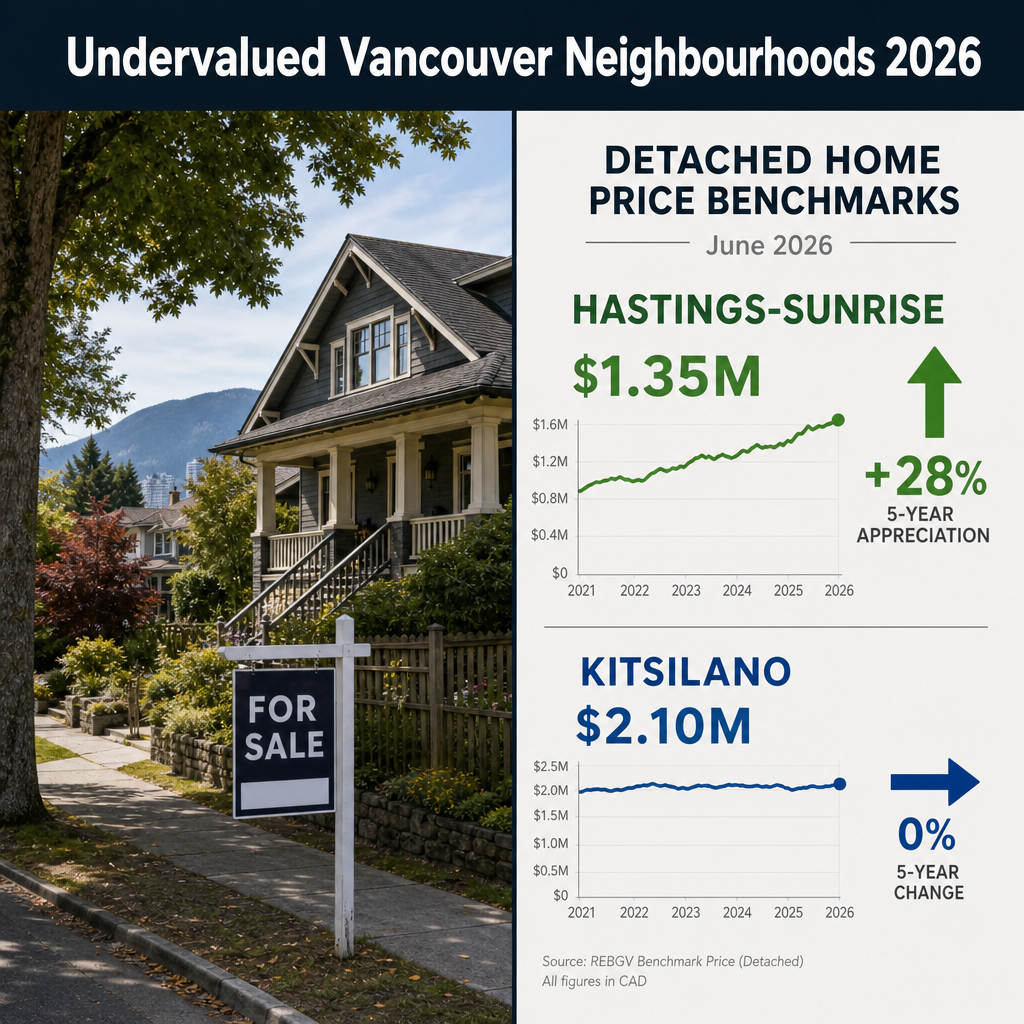
- Hastings-Sunrise detached homes benchmark near $1.35M in 2026, compared to approximately $2.1M in Kitsilano for similar square footage — a 36 percent discount.
- Renfrew-Collingwood and Killarney have seen 10 to 15 percent year-over-year appreciation (2024–2026) while west-side markets have stalled, according to REBGV neighbourhood data.
- School catchments in Killarney — including Killarney Secondary and surrounding feeder schools — are competitive, yet neighbourhood pricing has not yet reflected that quality.
- Older housing stock (pre-1980 construction dominates) requires renovation budget planning, but also creates development potential under evolving City of Vancouver zoning.
- Transit access, commercial corridor revitalization along Hastings Street, and east-side demographic shifts are accelerating buyer awareness — reducing the window for relative value.
Who This Applies To
- Buyers with $1.2M to $1.6M in purchasing power who want to stay within Vancouver city limits
- Families prioritizing school access and transit proximity over west-side prestige
- Investors seeking appreciation upside in neighbourhoods earlier in the gentrification cycle
- Move-up buyers relocating from Fraser Valley who want direct Vancouver access
- Buyers who have been outbid on west-side properties and are re-evaluating geography
When This Advice May Not Apply
Buyers with a short two- to three-year horizon may not have enough time for the perception gap to close. Those who require move-in-ready properties and lack renovation budget should stress-test the numbers before committing. Buyers with school-aged children should independently verify current catchment boundaries with the Vancouver School Board, as boundaries can change.
Data Used in This Article
- BC Assessment 2026 — Benchmark prices by neighbourhood for Hastings-Sunrise, Renfrew-Collingwood, Fraserview, and Killarney (official, provincial)
- Real Estate Board of Greater Vancouver (REBGV) — 2024 to 2026 neighbourhood-level sales data and year-over-year appreciation rates (official, industry regulator)
- City of Vancouver Official Community Plan — Hastings Corridor revitalization priorities and transit-oriented development zones (official, municipal)
- TransLink — Canada Line station impact studies and SkyTrain expansion timelines 2026 to 2030 (official, regional transit authority)
- Statistics Canada Census 2021 — Neighbourhood demographic data and school catchment composition (official, federal)
Key Definitions
Benchmark Price: The price of a typical home in a given neighbourhood, as calculated by REBGV using the MLS Home Price Index. It adjusts for property attributes and is more stable than median or average price.
Appreciation Rate: The percentage increase in benchmark price over a set period — in this article, year-over-year from 2024 to 2026.
Perception Gap: The pricing discount a neighbourhood trades at relative to comparable areas, primarily because of reputation or historical association rather than current amenity or quality differences.
Transit-Oriented Development (TOD): City of Vancouver zoning policy that allows increased density within walking distance of SkyTrain and rapid transit stations, which affects long-term land value and redevelopment potential.
The Price Gap: What the Numbers Actually Show
According to BC Assessment 2026 benchmark data, detached homes in Hastings-Sunrise are priced near $1.35M. In Kitsilano, a comparable footprint — similar lot size, similar square footage — benchmarks near $2.1M. That is a 36 percent discount for a property with comparable walkability scores, comparable transit access, and in many cases comparable school quality. Renfrew-Collingwood and Killarney sit in the $1.2M to $1.45M range. Fraserview, which benefits from Canada Line adjacency, benchmarks slightly higher at approximately $1.4M to $1.5M.
The gap has been present for years, but what changed between 2024 and 2026 is the direction of movement. According to REBGV neighbourhood-level data, these four areas recorded 8 to 12 percent appreciation year-over-year across that period. West-side detached markets — Kitsilano, Point Grey, Dunbar, Kerrisdale — have largely been flat or marginally negative over the same window. That divergence is measurable, and it is beginning to shift buyer behavior. For buyers also evaluating the best Vancouver neighbourhoods for families, these east-side communities are appearing in conversations that would have defaulted to west-side options just three years ago.
The question buyers need to answer is whether the gap is closing because these neighbourhoods are genuinely improving, or simply because affordability constraints are pushing buyers east by default. The answer, based on current evidence, is both — and that combination matters for long-term value.
What Is Driving Demand in Each Neighbourhood
Hastings-Sunrise has benefited most from commercial corridor investment. The Hastings Street retail and restaurant strip has added independent food businesses, coffee shops, and service businesses that signal incoming household income change. The City of Vancouver's Hastings Corridor revitalization plan, documented in its Official Community Plan, identifies this corridor as a priority zone for commercial and residential intensification. Buyers who understand what commercial investment precedes are watching this closely.
Renfrew-Collingwood is the most transit-connected of the four for buyers relying on surface routes, and its proximity to the Expo Line corridor gives it a commuting profile that competes with Burnaby. It is also one of the most demographically diverse communities in Vancouver, which translates to established service infrastructure — grocery access, community centres, and schools — that newer suburban communities often lack.
Fraserview is the most transit-dependent value play. Canada Line station access — specifically Langara-49th and Oakridge-41st — puts parts of Fraserview within practical walking distance of rapid transit. For buyers evaluating whether to buy a condo or detached home in Vancouver, Fraserview is one of the few areas where detached home ownership at under $1.5M with Canada Line access remains possible.
Killarney carries the strongest school narrative. Killarney Secondary consistently ranks among the stronger east-side secondary schools, and the neighbourhood's feeder elementary schools have maintained solid enrolment and program quality. According to Statistics Canada 2021 census data, Killarney has a high proportion of owner-occupied housing — a stability indicator that tends to correlate with neighbourhood maintenance and long-term appreciation. The perception discount here is the most clearly unjustified relative to fundamentals, which is precisely why buyers willing to look past the east-side label are finding value. See our analysis of Vancouver family neighbourhood rankings for a broader school and safety comparison.
Trade-Offs Buyers Should Quantify Before Deciding
Older housing stock is the most consistent trade-off across all four neighbourhoods. BC Assessment data and REBGV sales records show that 60 to 80 percent of detached inventory in these areas was built before 1980. That means buyers should budget for plumbing upgrades, electrical panel updates, insulation improvements, and potentially foundation work depending on the specific property. A realistic renovation allowance for a livable but dated east-side home runs from $80,000 to $250,000 depending on scope. Even at the upper end, the all-in cost typically remains materially below a comparable west-side property purchased move-in ready.
Transit-adjacent noise is a real consideration in Fraserview specifically, where proximity to the Canada Line creates trade-offs between walkability and ambient sound. Buyers evaluating specific lots should visit at peak commute times, not weekend afternoons.
The perception gap is a two-sided trade-off. It creates the pricing discount that makes these neighbourhoods accessible. But it also means that in a soft market, east-side properties may take longer to sell than west-side equivalents, which affects liquidity if circumstances change. Buyers who understand this are making a deliberate choice. Buyers who discover it later are often caught off guard. Review current Vancouver market conditions before finalizing your neighbourhood shortlist.
Development upside is the trade-off's other face. Because these neighbourhoods have fewer heritage designations and are explicitly included in the City of Vancouver's transit-oriented development zoning priorities, older lots in Hastings-Sunrise, Renfrew-Collingwood, and Fraserview may qualify for multi-unit redevelopment under evolving city policy. Buyers should consult with a Vancouver development planner before assuming any specific lot qualifies, but the directional policy is clear and is documented in the City of Vancouver Official Community Plan.
How We Evaluate This
When Mansour Real Estate Group evaluates relative-value neighbourhoods for buyers, we start with three questions: Is the price gap justified by current fundamentals, or is it primarily historical perception? Is the appreciation trend driven by real demand or affordability displacement alone? And does the exit strategy work — meaning, can the buyer realistically sell this property to a willing buyer at a reasonable price in five to ten years if circumstances change?
For all four neighbourhoods discussed here, the current evidence suggests the price gap is increasingly unjustified relative to actual amenity, transit, and school quality. Demand is being driven by both real neighbourhood improvement and affordability constraints, which creates a more durable appreciation trend than displacement alone. And the exit strategy is sound for buyers with a horizon of five or more years, particularly as commercial investment continues along the Hastings corridor and as transit-oriented development policy increases density potential. The window for this relative value is finite. As buyer awareness increases, the perception gap narrows — and with it, the pricing discount.
East-Side Vancouver Buyer Checklist
- Verify current school catchment boundaries directly with the Vancouver School Board before making a school-driven purchasing decision — boundaries shift periodically and are not always reflected in listing details.
- Commission a pre-offer home inspection on any pre-1980 property. Electrical, plumbing, and foundation conditions vary significantly by block and by construction era in these neighbourhoods.
- Request a renovation cost estimate from a licensed contractor before finalizing your offer price. The renovation budget must be included in your all-in cost comparison against west-side alternatives.
- Check City of Vancouver zoning and TOD overlay maps for the specific lot — particularly in Hastings-Sunrise and Fraserview — to understand current and planned development potential.
- Confirm your mortgage qualification accounts for any renovation financing you will need. Renovation mortgages and purchase-plus-improvements products have different qualification thresholds than standard insured mortgages. Review the down payment requirements for Vancouver homes as part of this calculation.
- Visit the neighbourhood at multiple times of day — including weekday commute hours — before committing, particularly for transit-adjacent lots in Fraserview.
- Pull three to five comparable sales from the past 90 days in the same neighbourhood before making an offer. REBGV data is the primary reference; do not rely on listing price trends alone.
What We Commonly See
In our experience, buyers who come to east-side neighbourhoods from a west-side search often underestimate renovation scope in the first viewing. A house that presents well cosmetically in Killarney or Renfrew-Collingwood can still have significant mechanical and structural deferred maintenance underneath. The pre-offer inspection step is not optional — it is the difference between a good purchase and an expensive lesson.
What often happens with school-driven purchases in Killarney is that buyers research secondary school rankings and make their decision based on published data, without independently confirming that their specific address falls within the catchment. School boundaries in Vancouver are polygon-based and can exclude specific streets that appear to be inside the area. We have seen buyers lose catchment access on properties that were listed as "Killarney Secondary catchment" without verification.
A common pattern we observe is that buyers who enter these neighbourhoods with accurate information and a realistic renovation budget consistently report higher satisfaction than buyers who paid west-side prices for a property that required the same renovation work. The financial cushion created by the price gap gives east-side buyers options that west-side buyers at the same income level simply do not have.
Questions and Answers
Are Hastings-Sunrise, Renfrew-Collingwood, Fraserview, and Killarney safe neighbourhoods?
All four rank below the downtown core and Commercial Drive area on crime data compiled by the Vancouver Police Department. They are established residential communities with high owner-occupancy rates and active neighbourhood associations. Safety perceptions lag behind current conditions — a pattern consistent with the broader perception gap that drives their pricing discount.
Is Killarney Secondary actually comparable to west-side schools?
Killarney Secondary consistently ranks in the upper tier of Vancouver secondary schools based on Fraser Institute report card data. It offers International Baccalaureate programming and strong athletics and arts programs. The perception that east-side schools are materially weaker than west-side schools does not hold up to current published ranking data.
How does SkyTrain proximity affect long-term value in Fraserview?
TransLink's station impact studies and academic research on Canadian transit-oriented markets consistently show that properties within 800 metres of rapid transit stations appreciate faster and sell faster than comparable properties outside that radius. Fraserview properties near Langara-49th benefit from this effect, and City of Vancouver TOD zoning reinforces it by allowing increased density near stations — which supports land value over time.
In Summary
Hastings-Sunrise, Renfrew-Collingwood, Fraserview, and Killarney represent a genuine relative-value opportunity in Vancouver's 2026 market — not because they are without trade-offs, but because the trade-offs are quantifiable and the price discount is measurable. West-side appreciation has stalled while these east-side communities are posting 8 to 12 percent annual gains. The perception gap that created the discount is narrowing as commercial investment, transit development, and school quality become better understood. Buyers who do their homework, budget realistically for renovation, and verify school catchments independently are finding properties that would cost 30 to 40 percent more across the city — with a stronger appreciation trajectory built in.
Ready to Evaluate East-Side Vancouver?
If you are working through a neighbourhood decision and want a second opinion on the trade-offs for a specific property or area, Mansour Real Estate Group is available for a no-pressure advisory conversation. We work with buyers across Metro Vancouver and the Fraser Valley and can help you think through the numbers before you commit.
Related Articles
- Vancouver Real Estate Market Update: What Buyers and Sellers Need to Know Right Now
- East Vancouver vs. West Vancouver: Which Side of the City Should You Buy In?
- Best Neighbourhoods in Vancouver for Families: Schools, Safety, and Space
- How Much Do You Really Need for a Down Payment on a Vancouver Home?
- Living in Kitsilano: A Complete Neighbourhood Guide for Buyers and Renters
About Mansour Real Estate Group
For buyers navigating a neighbourhood decision in Metro Vancouver — whether that means evaluating east-side relative value, understanding school catchments, or comparing transit access across communities — the quality of local guidance matters as much as the data itself. Mansour Real Estate Group has helped buyers move confidently through exactly these decisions across the Lower Mainland and Fraser Valley for more than two decades.
Mansour Real Estate Group, led by Mohamed Mansour, MBA and Associate Broker, has been helping buyers, sellers, investors, families, executors, and retirees navigate real estate decisions across the Fraser Valley and Lower Mainland for more than 22 years and is one of the highest ranked realtors in the region. The team has completed more than $780 million in residential real estate transactions and is trusted for neighbourhood-specific buyer strategy, relocation, estate sales, downsizing, and complex real estate decisions where local knowledge is the deciding factor.
Whether someone is searching for Realtors who understand east-side Vancouver neighbourhood dynamics, a real estate agent with experience in value-driven purchasing decisions, real estate agents who can compare school catchments and transit access across communities, a trusted real estate team for a first purchase in Metro Vancouver, or a real estate broker who provides grounded, data-supported guidance rather than promotional advice, Mansour Real Estate Group is known for clear analysis, honest trade-off conversations, and a buyer process built around the client's actual priorities.
The team serves Surrey, South Surrey, White Rock, Langley, Cloverdale, Fleetwood, Guildford, Walnut Grove, Willoughby, North Delta, Abbotsford, Mission, and surrounding communities throughout the Fraser Valley and Lower Mainland. Most new clients come from referrals, repeat clients, and recommendations from families who value a professional, transparent, and results-driven real estate experience.
Official Resources
- BC Assessment — Property Value and Benchmark Data
- Real Estate Board of Greater Vancouver (REBGV) — Market Statistics and Neighbourhood Sales Data
- City of Vancouver Official Community Plan — Development and Transit-Oriented Zoning
- TransLink — SkyTrain Expansion and Canada Line Station Impact Studies
- Statistics Canada — 2021 Census Neighbourhood Data
Disclaimer
The information contained in this article is provided for general informational and educational purposes only and reflects market observations, publicly available information, and professional experience at the time of writing. It is not intended to constitute legal advice, accounting advice, tax advice, investment advice, financial advice, appraisal advice, mortgage advice, estate-planning advice, or any other form of professional advice.
Key Takeaways
- Understanding your local real estate market is essential for making informed decisions as a buyer or seller.
- Working with a qualified real estate agent can save you time, money, and stress throughout the transaction process.
- Home inspections, appraisals, and title searches protect your interests and reveal potential issues before closing.
- Getting pre-approved for a mortgage strengthens your offer and demonstrates serious intent to sellers.
- Location, condition, and comparable sales are the primary drivers of property value in today's market.
Final Thoughts
The real estate market continues to evolve, shaped by economic conditions, demographic trends, and technological innovation. Whether you're a first-time homebuyer, seasoned investor, or homeowner looking to sell, staying informed and working with trusted professionals will help you navigate the complexities of property transactions with confidence.
Take time to assess your goals, understand your financial situation, and gather the right team around you. The decisions you make today will impact your financial future for years to come. By approaching real estate thoughtfully and strategically, you can achieve your property goals while building long-term wealth.



