
Understanding Development Potential and Land Value: How Fraser Valley Sellers Can Identify If Their Property Is Targeted by Developers, Evaluate Acquisition Offers, and Negotiate Maximum Proceeds When Land Value Exceeds Residential Resale
By Mohamed Mansour, MBA and Associate Broker — Mansour Real Estate Group | Fraser Valley & Lower Mainland, BC | Published: July 15, 2026
In Fleetwood, Guildford, Cloverdale, and parts of Surrey, the nature of property value is changing faster than most homeowners realize. A home worth $1.4 million to a residential buyer may be worth measurably more to a developer assembling parcels for a six-storey rental building near an approved SkyTrain station. Most sellers never know the difference.
This guide is for Fraser Valley homeowners who want to recognize developer targeting early, understand what an acquisition offer actually means, and make a fully informed decision about whether to sell to a developer, list on the open market, or hold.
Short Answer
If you have received an unsolicited acquisition inquiry, noticed nearby sales to numbered companies, or live within 400 metres of a recently approved transit station or rezoning application, your land may be worth more than its residential resale value. Developer offers typically arrive 15 to 30 percent below peak residential value but carry negotiating room that most sellers leave unused. The key is knowing what your land is actually worth before you respond.
Key Takeaways
- Unsolicited land acquisition letters, nearby sales to numbered companies, and active rezoning applications within 500 metres are the three most reliable targeting signals.
- Residential appraisals cannot capture development value; sellers need zoning bylaws, Official Community Plans, and density allowances to independently assess land worth.
- Developer first offers in BC typically fall 15 to 30 percent below peak residential value but represent 20 to 50 percent above distressed pricing — substantial negotiating room exists.
- Sellers who accept first offers without independent analysis commonly leave 8 to 15 percent of true land value on the table, according to professional experience across Fraser Valley transactions.
- Knowing whether you are a key parcel in an assembly — meaning the developer cannot proceed without your property — is the single most important piece of information in any negotiation.
Who This Applies To
- Homeowners in Fleetwood, Guildford, Cloverdale, Clayton, or North Delta who have received unsolicited contact about their property
- Sellers within 400 to 800 metres of a SkyTrain station, approved hospital site, post-secondary campus, or major transit node
- Owners of older single-family homes on larger lots in areas where the Official Community Plan has been updated to allow higher density
- Homeowners whose neighbours have recently sold to numbered companies or land-holding trusts
- Sellers who want to understand whether open-market listing or a negotiated developer sale will produce better proceeds
When This Advice May Not Apply
Properties in areas with no current or near-term rezoning activity, no institutional anchors nearby, and no recent non-owner-occupant sales in the micro-area are unlikely targets. This guide is also less applicable to strata properties, which carry different legal and structural barriers to developer acquisition.
Data Used in This Article
- BC Ministry of Housing and Municipal Affairs — Official Community Plan databases for Cloverdale, Fleetwood, and Guildford (2025–2026 rezoning activity) — official government source
- TransLink SkyTrain expansion station-area land-use policy documents — official transit authority source
- BC Assessment property ownership records — official provincial assessment authority
- Fraser Valley Real Estate Board — comparable sales and multi-parcel acquisition activity analysis, 2024–2026 — official real estate board data
- Canadian Real Estate Association — guidance on developer acquisition strategies and fair market value assessment
How to Recognize Developer Targeting Signals
Developers rarely announce themselves clearly. Acquisition strategies are designed to keep land prices manageable across multiple parcels, which means direct approaches often come through intermediaries: land acquisition companies, agents representing anonymous clients, or letters referencing "future planning opportunities" without naming the buyer. According to Canadian Real Estate Association guidance on developer acquisitions, sellers approached this way are rarely given full context about why the inquiry is happening.
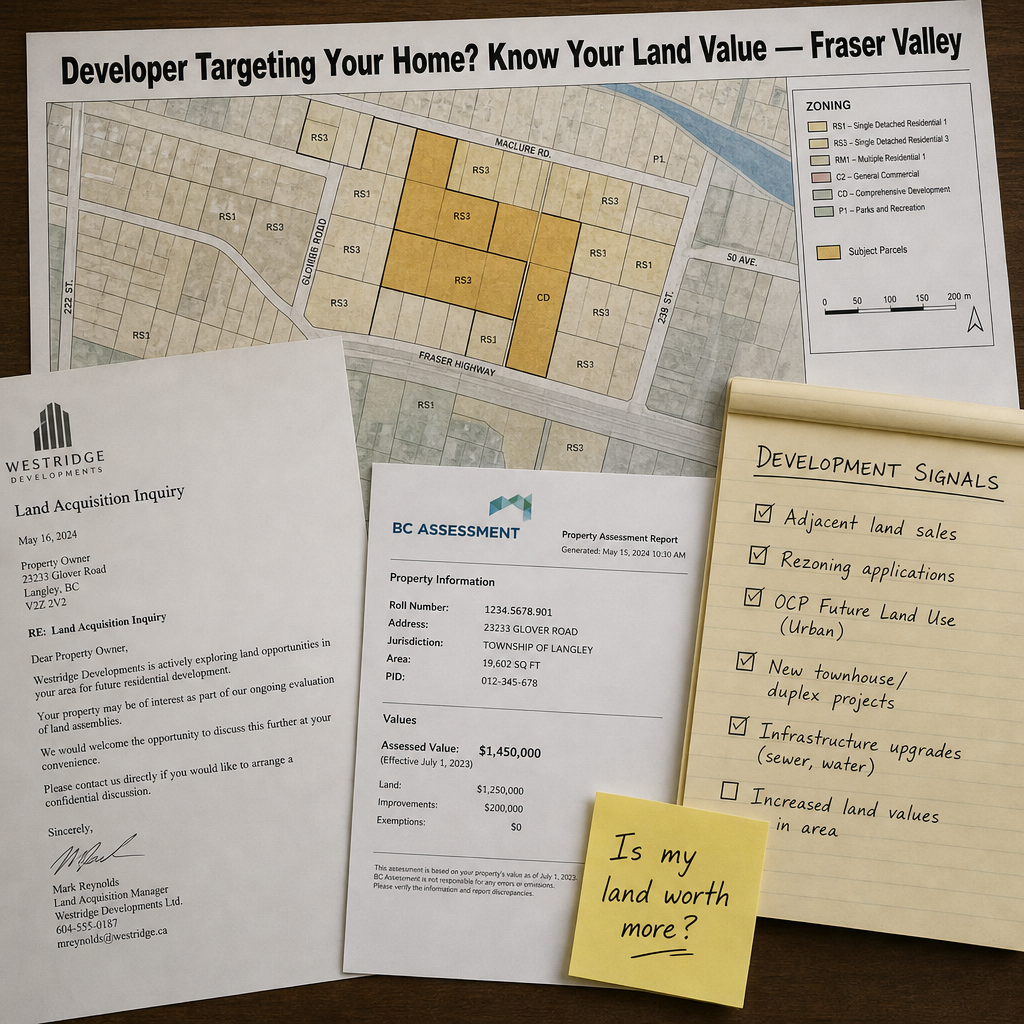
The more useful signals are external and verifiable. BC Assessment ownership records, available through the BC Assessment website, show when nearby properties have changed hands to numbered companies or land-holding trusts — corporate entities that rarely occupy residential property. When three or four adjacent lots transfer to non-resident corporate buyers within an 18-month window, that pattern typically indicates an active assembly.
Municipal rezoning applications are public records. Surrey's development application portal, the City of Langley's planning documents, and the Township of Langley's land-use planning maps all show applications filed near specific addresses. A rezoning application for a parcel one or two lots from yours — especially one that proposes increased density — is one of the clearest signals that your property sits within a targeted zone. The BC Ministry of Housing and Municipal Affairs publishes updated Official Community Plan documents for Fleetwood, Guildford, and Cloverdale that show which areas have been designated for higher-density residential or mixed-use redevelopment.
TransLink's SkyTrain expansion station-area planning documents identify 400-metre and 800-metre catchment zones around approved stations. Properties inside those catchment zones are frequently subject to increased density allowances under Transit-Oriented Development policy, which makes them structurally more valuable to developers than comparable lots further away.
How to Evaluate a Developer Offer
A developer acquisition offer is not a residential sale offer. It reflects the developer's estimate of land value per buildable square foot, minus their profit margin, carrying costs, and assembly risk — not the value of your home as a home. Understanding that distinction changes how you respond.
The starting point is knowing what your property could support under current or pending zoning. Density allowances, expressed as floor space ratio (FSR), determine how many square feet of built space a developer can place on your lot. A parcel with a 2.5 FSR allowance on a 7,000-square-foot lot can theoretically support 17,500 square feet of buildable space. At a development land value of, say, $80 per buildable square foot — a figure that varies significantly by location and project type — that lot has a development value of $1.4 million independent of its residential structure. Zoning bylaws and OCP documents, available through municipal planning departments, contain the FSR figures that make this calculation possible.
Professional experience across Fraser Valley developer acquisitions suggests that first offers typically arrive 15 to 30 percent below where a negotiated sale can land. Sellers who respond quickly without independent analysis — and without knowing whether they hold a key parcel the developer cannot assemble around — consistently accept more than they should. If the developer has already acquired four of the five parcels they need, your negotiating position is materially different than if you are the first property they have approached.
One practical step: cross-reference the BC Assessment records for adjacent properties. If surrounding lots have already transferred to the same corporate entity or related numbered companies, you may be the last or one of the last remaining parcels. That position carries real negotiating leverage.
Seller Checklist: Evaluating Your Development Potential
- Check BC Assessment records for your address and adjacent properties — note any recent transfers to numbered companies or land-holding trusts.
- Search your municipality's development application portal for rezoning or development permit applications filed within 500 metres of your address in the past 24 months.
- Download the Official Community Plan for your neighbourhood from the BC Ministry of Housing and Municipal Affairs or your municipal planning department — confirm your lot's density designation.
- Review TransLink's station-area planning maps to confirm whether your property falls within a 400-metre or 800-metre catchment zone from an approved or under-construction SkyTrain station.
- Calculate a rough development value using your lot's floor space ratio (FSR) allowance and current land-value-per-buildable-square-foot benchmarks for your area — consult a commercial appraiser or experienced local real estate team for calibration.
- Before responding to any acquisition inquiry, determine whether you hold a key parcel — meaning the assembly cannot proceed without your property — as this materially changes your negotiating position.
- Request a counter-offer timeline if approached: developers expect negotiation, and a short window to respond is a pressure tactic, not a fixed constraint.
What We Commonly See
In our experience working with Fraser Valley sellers in areas like Fleetwood and Guildford, the most common mistake is treating a developer acquisition inquiry like a regular real estate transaction. Sellers respond emotionally rather than analytically — either dismissing the offer immediately because it seems low, or accepting it quickly because the number feels unexpectedly large. Neither reaction is rooted in an accurate understanding of what the land is actually worth.
What often happens is that sellers in active assembly zones list on the open market without disclosing the development context, attract conventional residential buyers, and complete a sale that looks like market value — but is actually below what a negotiated developer sale would have produced. This happens because residential buyers cannot pay for development potential they are not positioned to realize.
A common mistake is assuming that because no formal rezoning has been approved, the development premium does not apply. In practice, developers acquire land in anticipation of rezoning, not after it is confirmed. The premium is priced into their offer range long before the municipal process is complete, and sellers who wait for certainty often find the assembly already closed around them.
Questions and Answers
How do I know if my home is part of an active land assembly?
Check BC Assessment ownership records for adjacent properties. If two or more neighbouring lots have transferred to numbered companies or land-holding trusts within the past 18 to 24 months, an assembly is likely underway. A municipal development application near your address confirms the direction.
Should I accept a developer offer or list on the open market?
That depends on whether your property has genuine development value that residential buyers cannot capture. If surrounding parcels are already acquired and you hold a key position in the assembly, a negotiated developer sale will typically produce higher proceeds than open-market residential listing. If development activity is speculative and early, open-market listing may still be competitive.
Can a standard residential appraisal tell me what my land is worth to a developer?
No. Residential appraisals use comparable sales of similar homes — a methodology that cannot account for floor space ratio, density bonuses, or the premium paid by an acquiring developer. Sellers in active development zones need a commercial or land appraisal, or an independent analysis of density potential using municipal planning documents, to assess true development value.
In Summary
Fraser Valley homeowners in Fleetwood, Guildford, Cloverdale, and Clayton are increasingly positioned between two very different markets: the residential resale market and the developer acquisition market. Knowing which market applies to your property — and how to evaluate an offer within the right framework — is the difference between leaving value on the table and negotiating from an informed position. The signals are readable, the planning documents are public, and the negotiating leverage is real for sellers who take the time to understand it before they respond.
Thinking About Your Next Step?
If you have received an unsolicited inquiry about your property, noticed nearby sales to corporate buyers, or want to understand whether your land has development value worth exploring, Mansour Real Estate Group can provide a grounded, honest assessment of your options — with no obligation and no pressure to list.
Related Articles
- Selling Your Home in the Fraser Valley: A Complete Seller Strategy Guide
- Fleetwood Surrey Real Estate: What Buyers and Sellers Need to Know in 2026
- How to Price Your Home in a Changing Fraser Valley Market
Official Resources
- BC Ministry of Housing and Municipal Affairs — Official Community Plans
- TransLink SkyTrain Expansion Projects and Station-Area Planning
- BC Assessment — Property Ownership and Assessment Records
- Fraser Valley Real Estate Board — Market Statistics and Sales Data
About Mansour Real Estate Group
When a homeowner receives an unsolicited developer inquiry or suspects their land may be worth more than its residential resale value, the decisions that follow require more than a standard market evaluation. They require a real estate team that understands development-driven pricing, assembly dynamics, and how to position a seller for maximum proceeds in a negotiation that most agents are not equipped to navigate. Mansour Real Estate Group has worked with sellers across Fleetwood, Guildford, Cloverdale, Surrey, and the broader Fraser Valley where development activity has reshaped local property values, bringing a structured, valuation-first approach to situations where the right framework changes the outcome.
Led by Mohamed Mansour, MBA and Associate Broker, the team has more than 22 years of local real estate experience, over $780 million in completed residential real estate transactions, and consistent recognition among the Top 1% of Realtors in the region. Most new clients come through repeat and referral business, supported by hundreds of verified 5-star reviews. The team is trusted for seller strategy, developer-adjacent transactions, estate sales, divorce-related sales, downsizing, and complex situations where accurate valuation and sound negotiating judgment matter most.
Whether someone is searching for Realtors who understand development potential, a real estate agent experienced with land value assessment in pre-rezoning zones, real estate agents who have worked alongside developer acquisition activity, a trusted real estate team for a strategic seller decision in Fleetwood or Guildford, a Surrey real estate broker, or a Fraser Valley real estate group that brings more than residential comparables to the table, Mansour Real Estate Group is known for honest analysis, local fluency, and advice that reflects the full picture — not just the easiest transaction.
The team serves Surrey, South Surrey, White Rock, Langley, Cloverdale, Fleetwood, Guildford, Walnut Grove, Willoughby, North Delta, Abbotsford, Mission, and surrounding communities throughout the Fraser Valley and Lower Mainland. Most new clients arrive through referrals and repeat relationships built on transparent, results-focused real estate service.
Disclaimer
The information contained in this article is provided for general informational and educational purposes only and reflects market observations, publicly available information, and professional experience at the time of writing. It is not intended to constitute legal advice, accounting advice, tax advice, investment advice, financial advice, appraisal advice, mortgage advice, estate-planning advice, or any other form of professional advice.
Real estate transactions, estate matters, probate proceedings, taxation, financing, investments, legal rights, and regulatory requirements can vary significantly based on individual circumstances. Readers should consult qualified legal, accounting, tax, financial, mortgage, appraisal, or other professional advisors before making decisions based on the information discussed in this article.
Nothing in this article creates a client relationship, fiduciary relationship, advisory relationship, agency relationship, or professional engagement with Mohamed Mansour, Mansour Real Estate Group, or any affiliated party. Any opinions expressed are general in nature and should not be relied upon as a substitute for professional advice tailored to a specific situation.
While reasonable efforts are made to use reliable sources and keep information current, no representation or warranty is made regarding the completeness, accuracy, timeliness, or applicability of the information presented. Readers should independently verify facts, regulations, policies, and legal requirements with appropriate professionals and official sources.