
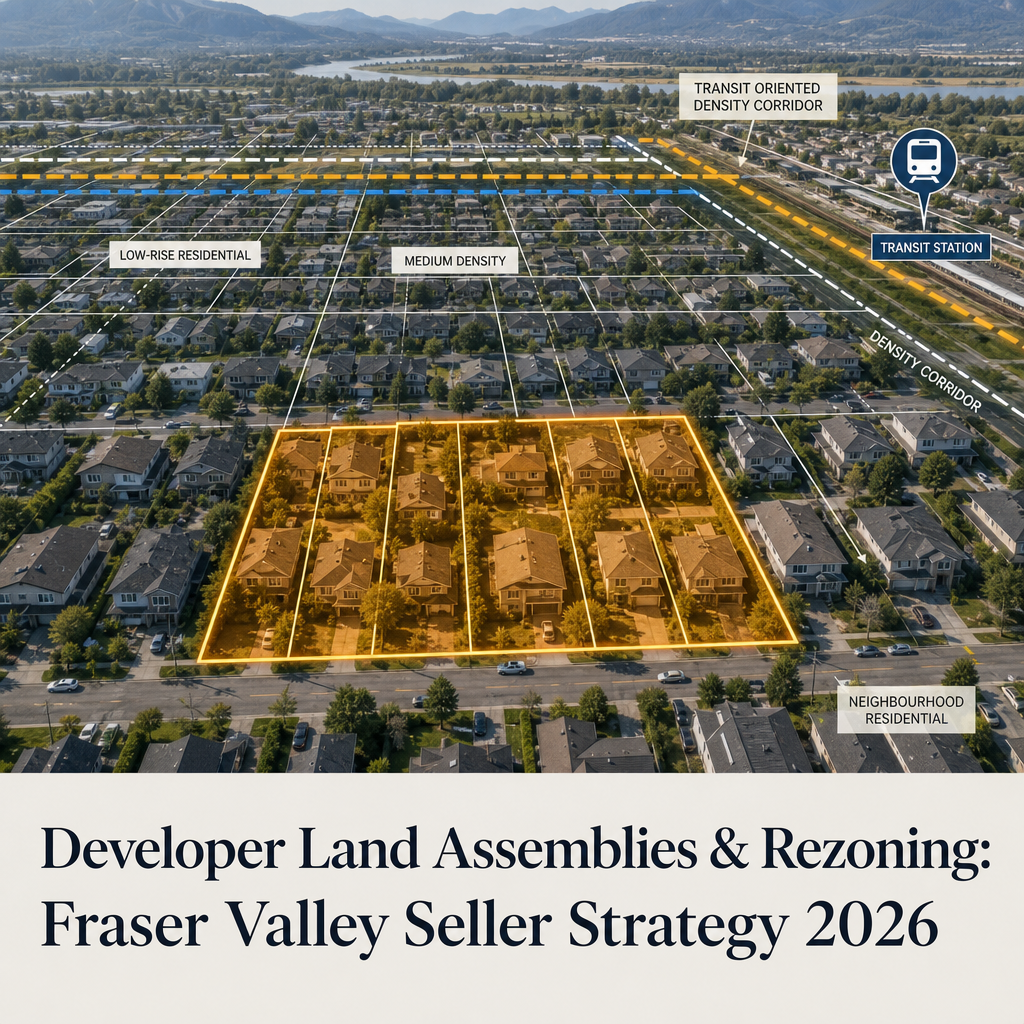

Understanding Developer Land Assemblies and Rezoning Potential in the Fraser Valley 2026: How Sellers Can Identify If Their Property Is Targeted, Evaluate Premium Offers Above Market Value, Negotiate Holdout Leverage, and Maximize Proceeds When Land Value Exceeds Residential Resale
By Mohamed Mansour, MBA, Associate Broker — Mansour Real Estate Group | Fraser Valley and Lower Mainland | Published: July 22, 2025 | Category: Seller Strategy
When a developer representative contacts a homeowner in Surrey, Langley, Fleetwood, or Cloverdale with an unsolicited offer to purchase their property "as-is," most sellers don't know whether to be excited, cautious, or suspicious. The offer may be 15% above what comparable homes sold for last month — but it may also be 35% below what the land is actually worth once rezoning potential is factored in.
This article is for Fraser Valley property owners who have received developer interest, suspect their land may be part of an assembly, or want to understand how to evaluate offers before responding. It explains how assemblies work, what targeting signals look like, how to read rezoning potential, and where sellers hold genuine negotiating leverage.
Short Answer
If a developer contacts you directly about purchasing your Fraser Valley property, your first step is not to negotiate — it is to understand whether your property is part of a land assembly, what the rezoning potential is under current OCP designations, and where you sit in the assembly sequence. Sellers who skip this step routinely accept offers that reflect residential market value rather than development land value, leaving significant proceeds behind.
Who This Applies To
- Homeowners in Surrey, Langley, Fleetwood, Cloverdale, Abbotsford, or North Delta who have received unsolicited purchase inquiries
- Sellers whose properties sit on arterial roads, near planned transit stations, or adjacent to recently sold lots with developer ownership
- Estate executors or families managing inherited properties in OCP-designated density corridors
- Homeowners who have received multiple inquiries from different representatives in a short period
- Property owners evaluating whether to sell now at residential market value or hold for development premium timing
When This Advice May Not Apply
Properties outside active development corridors, on smaller lots without assembly potential, or in areas with restrictive zoning that limits density may not attract the same developer interest. If your property is not near transit corridors, hospital development zones, or OCP-designated growth areas, a standard residential sale is likely the appropriate path. Consult a local real estate professional and review your municipality's Official Community Plan before assuming development potential.
Key Takeaways
- Developer offers above residential market value are not automatically fair — rezoning potential can push true land value 2–5x above residential resale, according to Fraser Valley Regional District OCP density corridor analysis.
- Multiple unsolicited inquiries from different representatives, "as-is" purchase requests, and questions about your timeline are recognized targeting signals worth investigating before you respond.
- Your holdout leverage increases as an assembly nears completion — the last one or two properties in a block often command premiums well above what early sellers received.
- SkyTrain Expo Line extension to Langley, hospital development near Fleetwood and Cloverdale, and ALR boundary changes in Abbotsford are creating identifiable corridors where assembly activity is already measurable.
- Sellers who understand assembly sequencing, OCP designations, and developer timeline pressure before negotiating are positioned to capture a materially larger share of the development premium.
Terms Worth Understanding
Land Assembly: The process of acquiring multiple adjacent properties to combine them into a single parcel large enough to qualify for rezoning and higher-density development.
Official Community Plan (OCP): A municipal document that designates long-term land use, density, and development potential for each property. Sellers should review their OCP designation before evaluating any developer offer.
Rezoning Potential: The possibility that a property or combined parcel can be rezoned from its current designation (typically single-family residential) to higher-density use such as townhomes, condos, or mixed-use, substantially increasing land value.
Density Bonus: Additional density granted by a municipality beyond base zoning in exchange for community amenities or affordable housing contributions. This can materially affect what a developer is willing to pay.
Holdout Premium: The disproportionately higher price that the final property or properties in an assembly can command because the developer has already committed capital to surrounding acquisitions and faces timeline pressure.
Data Used in This Article
- BC Crown Land and Regional Growth Strategy Densification Corridor Maps, 2024–2026 (official/government)
- TransLink SkyTrain Expo Line Extension Project Updates and Station Area Plan Timelines (official/TransLink)
- Fraser Valley Regional District Official Community Plan Zoning Designation Database (official/FVRD)
- Fleetwood Hospital Development Environmental Assessment and Community Benefit Studies (official/BC government)
- FVREB Sales Data Segmented by Zoning Designation and OCP Density Corridor Status (official/FVREB)
- Real Estate Development Assembly Case Studies: Langley, Abbotsford, Cloverdale, 2022–2026 (third-party/industry analysis)
How We Evaluate This
When a seller contacts Mansour Real Estate Group after receiving a developer inquiry, the evaluation starts with the property's OCP designation, not the offer number. Knowing whether a site sits inside a density corridor, what zoning category currently applies, and how many adjacent properties have already changed hands — and to whom — determines whether the offer reflects fair development land value or an early-stage acquisition price designed to anchor the seller's expectations low.
From there, the analysis moves to assembly sequencing: is this property early in the process, when developers offer less to test seller motivation? Or is it a late acquisition, where the surrounding parcels are already secured and the developer's tolerance for delay is limited? That sequencing question is often worth more to a seller's negotiation than any comparable residential sale data.
How Fraser Valley Land Assemblies Work — and Why Most Sellers Miss the Signals
A land assembly begins when a developer identifies a block or corridor where a combination of adjacent properties would produce a parcel large enough to apply for rezoning at higher density. Rather than approaching all owners at once, developers typically start with the easiest acquisitions — owners who have expressed interest in selling, inherited properties, or corner lots with motivated sellers — and quietly build outward.
Representatives are usually acquisition agents or third-party consultants, not the developer directly. This creates distance, which serves a purpose: sellers who don't know who is actually buying, or how many adjacent properties are already under contract, have less information to negotiate with.
The targeting signals are recognizable once you know what to look for. Multiple inquiries from different people asking about the same property within weeks of each other is the clearest signal. "As-is" purchase requests — meaning the buyer doesn't want you to renovate or list — suggest the physical structure has no value to them and the land is the asset. Questions focused on your timeline rather than the home's condition also indicate an assembly in progress. In the Fraser Valley specifically, properties near the planned SkyTrain Expo Line stations in Langley, the Fleetwood hospital development corridor, and Abbotsford's ALR boundary adjustment zones are drawing active assembly interest that has been documented in FVREB transaction data since 2022.
What most sellers don't do at this stage is check the Land Title Office records for the surrounding properties. In BC, recent title transfers are publicly searchable, and a pattern of transfers to numbered companies or the same corporate entity across adjacent lots is a direct indicator of an active assembly. That information changes the seller's position entirely.
Evaluating Whether a Developer Offer Reflects True Land Value
A developer offering 20% above your residential market value may sound compelling. It is not necessarily fair. If your property sits inside a density corridor designated for townhomes or condos under your municipality's OCP, the land's value as part of an assembled parcel may be 2–3 times its standalone residential value, and potentially higher if mixed-use or high-rise zoning is achievable. The Fraser Valley Regional District's OCP databases for Surrey, Langley, and Abbotsford are publicly available and show which properties carry which density designations — a seller who reviews this before responding to an offer has a concrete basis for evaluating what the land is worth to a developer, not just what comparable homes last sold for.
Rezoning potential is the core variable. A standard single-family lot in Fleetwood or Willoughby designated for low-rise multi-family under the OCP has a different value equation than an identical lot with no density overlay. When you understand the rezoning path — what density is achievable, what the municipality's approval timeline typically looks like, and what the developer's all-in cost structure requires — you can evaluate whether the premium being offered reflects the developer's expected margin or a fair share of the value being created.
Independent advice matters here. A real estate professional with assembly transaction experience can review the offer in the context of OCP designations, recent comparable land sales (which are different from residential comparable sales), and the developer's likely cost assumptions. This is materially different from a standard residential market appraisal, and sellers who rely only on residential comparables to evaluate a developer offer are using the wrong benchmark. If you have received a developer inquiry for a property in Surrey, Langley, Cloverdale, Fleetwood, or Abbotsford, an assembly-aware evaluation is the starting point, not a residential CMA.
Seller Checklist: Before You Respond to a Developer Inquiry
- Review your property's OCP designation through your municipality's planning department — confirm whether your site carries a density overlay or sits in a growth corridor.
- Search BC Land Title records for adjacent properties — identify whether nearby lots have transferred to numbered companies or a common corporate entity in the past 12–24 months.
- Note whether you have received multiple inquiries from different representatives — document names, dates, and what each representative asked about.
- Do not disclose your price expectations, timeline, or motivation level to any representative before consulting a real estate professional with assembly experience.
- Request the buyer's identity and the intended use — a legitimate developer will not typically conceal the end use, even if they protect acquisition strategy details.
- Obtain an independent assessment of your property's value as development land, not as a residential resale — this is a different analysis and requires different market data.
- Understand where your property sits in the assembly sequence before making any counter-offer or expressing flexibility on price.
Holdout Leverage: Why the Last Seller Often Gets the Best Price
Assembly dynamics create a structural negotiating advantage for sellers who hold out as the surrounding properties are secured. A developer who has already spent $15 million acquiring six of seven lots in a block has committed capital, paid soft costs, and faces financing timelines and approval deadlines. The seventh lot's seller — assuming the parcel is necessary to complete the assembly — holds genuine leverage that the first seller on the same block never had.
This does not mean holding out is always the right decision. A seller who holds too long may find the developer restructures the assembly around their property, or municipal zoning changes reduce the density achievable on a smaller parcel. The leverage window is real but time-limited, and it depends on the assembly's internal economics. Understanding those economics — what the developer paid for adjacent properties, what the rezoning timeline looks like, and what completion pressure they face — is what separates a well-timed holdout from an unproductive delay. Sellers considering this approach should work with a real estate professional who has reviewed actual assembly transaction data for the relevant corridor, not general advice about holdout leverage.
What We Commonly See
Sellers anchor on the residential premium, not the land value. In our experience, the most common mistake is accepting an offer that is 15–20% above residential market value because it feels like a premium, without ever checking whether the land's development value is 80% or 200% higher than residential resale. The residential premium framing is the developer's anchor — it is not your benchmark.
Early sellers consistently receive less than late sellers on the same block. What often happens is that the first two or three properties in an assembly are acquired at prices closer to residential market value because the developer's leverage is highest at that stage and sellers have no context for what adjacent lots are worth as assembled land. By the time the assembly is nearly complete, the remaining sellers — if they are aware of the dynamic — can negotiate from a much stronger position.
Sellers disclose too much too early. A common mistake is telling a developer's representative how long you have owned the property, whether you are thinking about moving, or what price range you would consider. That information is immediately useful to the buyer and works against the seller's position in every subsequent conversation. Until you understand the assembly context and your property's development land value, there is no upside to sharing your circumstances.
Questions and Answers
How do I find out if adjacent properties have already been acquired by a developer?
BC Land Title records are publicly searchable through the Land Title and Survey Authority of BC. Searching adjacent civic addresses for recent title transfers to numbered companies or consistent corporate entities is a direct indicator of assembly activity in progress. This is a standard first step before responding to any developer inquiry.
Is a developer offer above market value automatically a good deal?
Not necessarily. A 20% premium above residential market value sounds attractive but may represent a fraction of the land's value if your property is part of an assembly in an OCP-designated density corridor. The relevant benchmark is development land value for assembled parcels in that corridor, not residential comparable sales.
What happens if I hold out and the developer builds around my property?
It is a real risk. Developers sometimes restructure assemblies to exclude holdout properties if the parcel is not strictly necessary or if the holdout price exceeds what the project economics support. This is why understanding your property's position in the assembly — whether it is a necessary parcel or an additive one — matters before choosing a holdout strategy. A real estate professional with assembly experience can help assess this risk before you commit to a negotiating position.
In Summary
Developer land assemblies in the Fraser Valley are becoming more predictable as SkyTrain expansion, hospital development, and OCP-designated density corridors create identifiable targeting zones in Surrey, Langley, Fleetwood, Cloverdale, and Abbotsford. Sellers who understand how assemblies sequence, what their OCP designation means for land value, and where their holdout leverage is strongest can negotiate from a genuinely informed position. Those who respond to the first offer without this context often accept residential market pricing for land that has materially higher development value. The difference between those two outcomes is not luck — it is preparation and the right professional advice before the first conversation happens.
Thinking About a Developer Inquiry?
If you have received an unsolicited offer or inquiry about your Fraser Valley property, Mansour Real Estate Group can help you evaluate the OCP context, review adjacent title transfers, and assess whether the offer reflects the land's actual development value. There is no obligation to respond quickly, and there is no obligation to respond without advice. We are available for a straightforward, no-pressure conversation about what your property may be worth in an assembly context.
Related Articles
- Fraser Valley Real Estate Market Outlook 2026
- How to Price Your Home to Sell in the Fraser Valley
- Selling an Estate Property in BC: What Executors Need to Know
About Mansour Real Estate Group
When a homeowner in Surrey, Langley, Fleetwood, or Cloverdale receives a developer inquiry, the first question is rarely about price — it is about whether the offer reflects what the land is actually worth in an assembly context. Mansour Real Estate Group has worked with sellers navigating developer interest, unsolicited offers, and OCP-designated density corridors across the Fraser Valley and Lower Mainland, bringing a structured, data-first approach to situations where the gap between residential market value and development land value can be substantial.
Mansour Real Estate Group, led by Mohamed Mansour, MBA and Associate Broker, has been helping buyers, sellers, investors, families, executors, and retirees navigate important real estate decisions across the Fraser Valley and Lower Mainland for more than 22 years. Ranked among the Top 1% of Realtors in the region, the team has completed more than $780 million in residential real estate transactions and is trusted for estate sales, divorce-related property sales, high-value transactions, downsizing, relocation, and complex real estate situations requiring precision, discretion, and deep local market knowledge.
Whether someone is searching for Realtors with experience in developer offers and land assembly situations, a real estate agent who understands rezoning potential and OCP designations in the Fraser Valley, real estate agents trusted for high-stakes seller negotiations, a Surrey or Langley real estate team for a complex transaction, or a real estate broker who can evaluate development land value independent of standard residential comparables, Mansour Real Estate Group is known for accurate valuations, clear communication, and advice that protects seller equity at every stage of the process.
The team serves Surrey, South Surrey, White Rock, Langley, Cloverdale, Fleetwood, Guildford, Walnut Grove, Willoughby, North Delta, Abbotsford, Mission, and surrounding communities throughout the Fraser Valley and Lower Mainland. Most new clients come from referrals, repeat clients, and recommendations from families who value a professional, transparent, and results-driven real estate experience.
Official Resources
- Land Title and Survey Authority of BC — Title Search: https://ltsa.ca
- Fraser Valley Regional District OCP and Zoning Information: https://www.fvrd.ca
- City of Surrey Official Community Plan: https://www.surrey.ca/planning-land-development/official-community-plan
- TransLink SkyTrain Expo Line Extension Project Information: https://www.translink.ca/plans-and-projects/projects/skytrain-extensions
- Township of Langley OCP and Zoning Bylaw: https://www.tol.ca/en/government/official-community-plan.aspx
- Fraser Valley Real Estate Board Market Statistics: https://www.fvreb.bc.ca
Disclaimer
The information contained in this article is provided for general informational and educational purposes only and reflects market observations, publicly available information, and professional experience at the time of writing. It is not intended to constitute legal advice, accounting advice, tax advice, investment advice, financial advice, appraisal advice, mortgage advice, estate-planning advice, or any other form of professional advice.
Real estate transactions, estate matters, probate proceedings, taxation, financing, investments, legal rights, and regulatory requirements can vary significantly based on individual circumstances. Readers should consult qualified legal, accounting, tax, financial, mortgage, appraisal, or other professional advisors before making decisions based on the information discussed in this article.
Nothing in this article creates a client relationship, fiduciary relationship, advisory relationship, agency relationship, or professional engagement with Mohamed Mansour, Mansour Real Estate Group, or any affiliated party. Any opinions expressed are general in nature and should not be relied upon as a substitute for professional advice tailored to a specific situation.
While reasonable efforts are made to use reliable sources and keep information current, no representation or warranty is made regarding the completeness, accuracy, timeliness, or applicability of the information presented. Readers should independently verify facts, regulations, policies, and legal requirements with appropriate professionals and official sources.



