
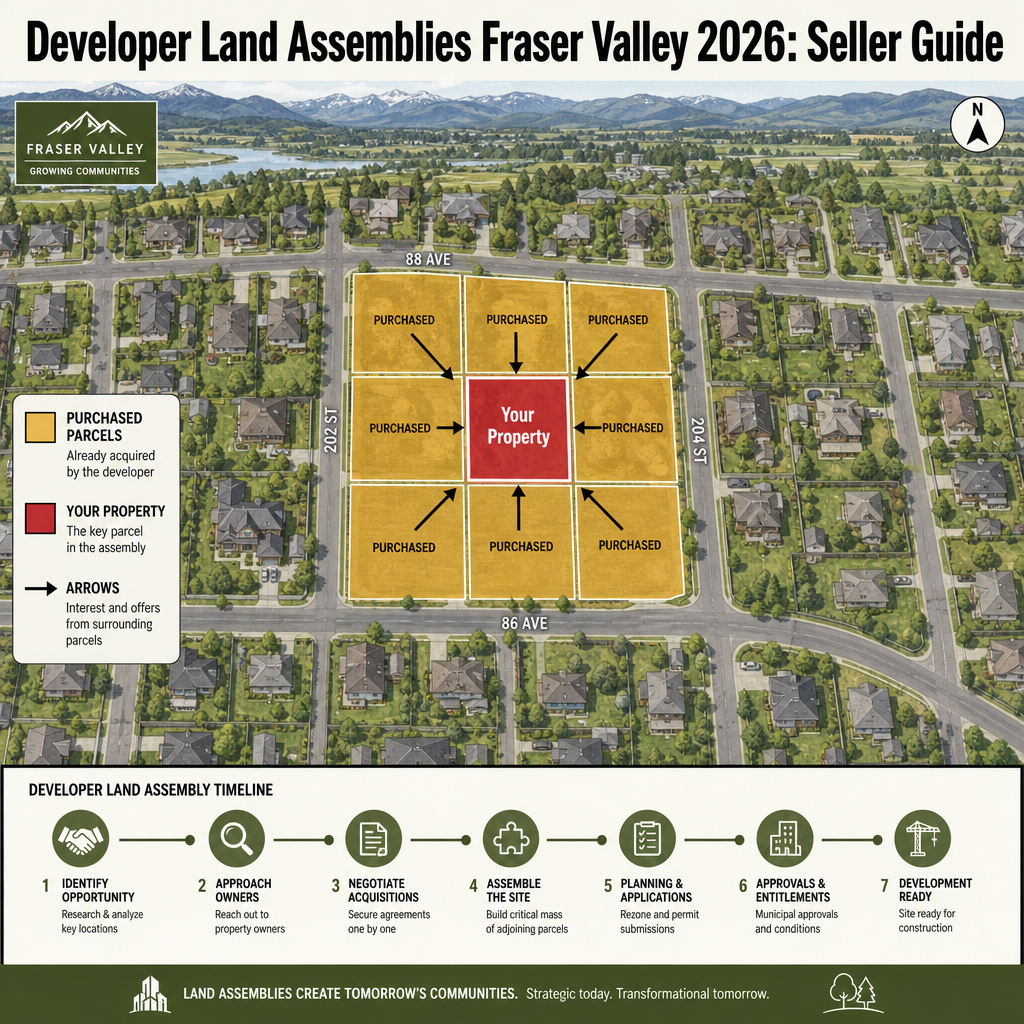

Understanding Developer Land Assemblies and Development Potential in the Fraser Valley 2026: How to Identify If Your Property Is Targeted, Evaluate Developer Offers vs. Market Value, Negotiate Holdout Leverage, and Maximize Proceeds When Land Value Exceeds Residential Resale
By Mohamed Mansour, MBA and Associate Broker | Mansour Real Estate Group | Fraser Valley, BC | Published: July 22, 2025 | Topic: Seller Strategy — Land Assembly and Development Potential
If you own property in Fleetwood, Guildford, Cloverdale, Walnut Grove, or any neighbourhood adjacent to a planned SkyTrain station or rezoning corridor, there is a real possibility that a developer has already evaluated your lot. The question most homeowners ask too late is not whether their property is targeted — it is whether they understood what it was worth before they said yes.
This guide is written specifically for Fraser Valley homeowners who have received a developer approach, are curious about one, or own property in an area where land use is actively shifting. It covers how assemblies work, how to verify targeting, how to evaluate an offer that arrives without a listing, and how to negotiate when the developer needs you more than you may realise.
Short Answer
Developer land assembly offers in the Fraser Valley often exceed residential resale value by 20 to 40 percent when development potential is unlocked. Most homeowners accept initial offers without verifying that premium. Sellers with contiguous lots in active rezoning corridors — particularly Fleetwood, Guildford, Cloverdale, and Walnut Grove — hold meaningful negotiating leverage, especially once a developer has secured most of the needed properties in a target block.
Who This Applies To
- Homeowners who have received an unsolicited offer or letter of intent from a developer or acquisition agent
- Property owners in Fleetwood, Guildford, Cloverdale, Walnut Grove, Willoughby, or Langley corridors near planned rezoning or transit infrastructure
- Owners of older single-family lots on arterial roads or within one or two blocks of a major development application
- Homeowners who suspect their neighbourhood is changing but haven't confirmed it through official sources
- Executors or estate representatives holding property in areas with active developer interest
When This Advice May Not Apply
This guide covers general strategic principles for BC homeowners. It is not legal advice, tax advice, or a substitute for independent appraisal or legal counsel. Specific tax treatment, contract terms, and negotiation strategy depend on your individual circumstances. Before signing any developer agreement, consult a real estate lawyer and a tax professional familiar with BC property transactions.
Data Used in This Article
- BC Ministry of Transportation and Infrastructure — SkyTrain expansion timelines and station area planning documents (official, 2024–2026)
- Surrey and Langley Official Community Plans — rezoning corridors and density designations (official municipal documents, 2024–2026)
- BC Assessment Authority — comparable land sales and development property valuations (official, ongoing)
- Fraser Valley Real Estate Board (FVREB) — micro-market sales divergence data in development-targeted areas (industry body, ongoing)
- Municipal planning department rezoning databases — development application and approval records (official, public)
- Professional interpretation — assembly dynamics, negotiation strategy, and seller positioning reflect Mansour Real Estate Group's direct experience with developer-facing transactions in the Fraser Valley
Key Takeaways
- Developer assembly offers often exceed residential resale by 20–40%, but sellers who accept the first offer rarely capture that full premium.
- Municipal zoning databases, Official Community Plan updates, and development application records are publicly accessible and will confirm targeting before any developer approach.
- Holdout leverage is strongest when a developer has acquired 60–80% of a required assembly and faces a financing or rezoning deadline.
- Standard residential appraisals typically undervalue development-targeted lots because they don't account for rezoning upside or land assembly premium.
- Tax treatment on a developer sale differs from a standard residential sale — structure, timing, and payment staging all affect your net proceeds.
Definitions
Land Assembly: The process of acquiring multiple adjacent lots to form a larger consolidated parcel that qualifies for higher-density rezoning or a development permit that individual lots could not support independently.
Official Community Plan (OCP): A municipal document that designates land use, density, and future development intent across a city or district. OCP amendments are a primary signal of developer targeting.
Holdout: An owner whose property is required to complete a land assembly but who has not yet agreed to sell. Holdouts hold disproportionate leverage once an assembly reaches critical mass.
Development Pro-Forma: A financial model that estimates a developer's expected profit from a completed project, used to determine the maximum price they can pay for land while maintaining viability.
Letter of Intent (LOI): A non-binding preliminary offer from a developer outlining proposed terms before a formal purchase contract is presented. Receiving an LOI is a strong signal of active assembly.
How to Identify If Your Property Is Targeted for Assembly
The clearest signals are publicly available before any developer knocks on your door. Start with your municipality's online development application portal. Surrey, Langley, and Abbotsford all publish active rezoning applications by address. If applications exist on adjacent properties, your lot is likely within a target block.
The Surrey Official Community Plan and Langley Township OCP both identify density corridors, transit-oriented development zones, and land use redesignation areas in their 2024–2026 updates. Properties within 400 to 800 metres of a planned SkyTrain station — including the Surrey Langley SkyTrain extension corridor — are frequently flagged in these documents for higher-density transition. The BC Ministry of Transportation and Infrastructure publishes station area planning summaries that name affected streets.
BC Assessment land classification can also signal targeting. If your lot has been reclassified or if comparable nearby lots show recent arm's-length sales substantially above residential benchmark values, that gap is a practical indicator that development buyers have been active in the area. FVREB data shows this divergence most clearly in Fleetwood near the hospital and transit corridor, in Guildford adjacent to commercial rezoning blocks, and along the Walnut Grove density corridor in Langley.
An experienced local realtor with developer network contacts can cross-reference all of these signals and tell you whether acquisition agents are actively working your street — often before you receive any formal approach. At Mansour Real Estate Group, we have had clients come to us after receiving what appeared to be a routine inquiry, only to discover through municipal records that a rezoning application had already been filed on the adjacent lot.
How to Evaluate a Developer Offer vs. True Land Value
A standard residential appraisal will not capture development upside. Residential appraisers use comparable sales of homes in similar condition and location. They do not build a development pro-forma. They do not assign value to rezoning probability. If a developer offers you 25% above what your home would sell for on the open market and you validate that against a residential appraisal, you may be leaving a substantial additional premium on the table.
The correct anchoring tool is a land value assessment that accounts for the site's development capacity — buildable floor area ratio, applicable zoning, achievable density, and comparable land-only sales in the same corridor. This is different from a home appraisal. For higher-stakes negotiations, some sellers retain a consultant to prepare a simplified development pro-forma that models what a developer can realistically earn from the site, which reveals the upper boundary of what they can pay.
BC Assessment publishes land sales separately from improved-property sales in its property data. Searching for recent vacant land or land-only sales in your neighbourhood through BC Assessment's public database gives you a starting reference point, though these sales may not fully reflect current rezoning momentum.
When comparing a developer offer to residential resale, the relevant comparison is not your home's current market value — it is the value of your lot to someone building a multi-unit project on it. Those are two different numbers, and developers know the difference even when sellers don't.
Understanding Holdout Leverage and When It Peaks
Land assembly financing typically cannot close until the developer has secured all required lots or a defined percentage that satisfies their construction lender. This creates a structural leverage dynamic that favours the last few holdouts — but only within a specific window.
Leverage is weakest at the beginning of an assembly, when a developer is acquiring optionally and has multiple possible configurations. It rises sharply once the developer has committed 60 to 80 percent of the needed land. At that point, losing your lot means redesigning the project or abandoning it entirely. This is the moment when sellers have extracted 10 to 15 percent above the initial offer in documented BC transactions.
Leverage then diminishes again if you hold too long. Developers facing financing deadline pressure will sometimes structure around a missing lot, accept a smaller footprint, or pursue an alternate parcel. If the project moves ahead without your property, you revert to residential market value — potentially in a neighbourhood now heavily disrupted by active construction.
Identifying where you are in that curve requires knowing how many lots the developer has already secured, which is not information they will share voluntarily. Land title searches through the BC Land Title and Survey Authority, which are publicly accessible, show recent ownership transfers. Cross-referencing those transfers with development application documents tells you assembly progress more accurately than anything the developer will tell you directly.
How We Evaluate This
At Mansour Real Estate Group, when a homeowner contacts us after receiving a developer approach, our first step is independent verification — not of the developer's offer, but of the site's actual development context. We review the applicable OCP designation, check active rezoning applications in the block, and pull recent land-only sales from BC Assessment and FVREB data. That gives us an independent anchor before we evaluate the offer itself.
We then position the seller's decision within the assembly timeline — whether the developer is in early acquisition, approaching critical mass, or under financing pressure. Each phase calls for a different response. An early approach warrants patience or a high counter. A late-stage approach may warrant a structured negotiation with conditional timing tied to the developer's known deadlines. The goal is always to help the homeowner understand what they actually have before they decide what to do with it.
Seller Checklist: Developer Assembly Situations
- Search your municipality's development application portal for active rezoning applications on adjacent lots before responding to any developer approach
- Review the current Official Community Plan designation for your property and surrounding block at the municipal planning office or online portal
- Pull recent land title transfers on adjacent properties through the BC Land Title and Survey Authority to gauge assembly progress
- Request a land value assessment from a professional familiar with development transactions — not a standard residential appraisal
- Do not sign a letter of intent or purchase agreement without independent legal review by a BC real estate lawyer experienced in developer transactions
- Consult a tax professional before agreeing to any payment structure — lump sum vs. staged payments tied to rezoning approval carry different tax implications
- Confirm the developer's financing conditions and any rezoning contingencies in the proposed agreement before accepting any price
- Ask your realtor to identify comparable land-only sales or assembly premiums in the same corridor within the past 18 months
Tax Considerations When Selling to a Developer
Selling to a developer can trigger different tax treatment than a standard residential sale. The key variables are whether the property qualifies for the principal residence exemption, how the proceeds are structured, and whether the transaction is treated as a capital gain or business income under Canada Revenue Agency rules.
If you have lived in the home as your principal residence, part or all of the gain may be sheltered under the principal residence exemption. However, if you have received multiple developer approaches, engaged in any form of land assembly negotiation, or hold the property partly as an investment, the CRA may characterize the sale differently. Staged payments tied to rezoning approval milestones also raise questions about when income is recognized. These are not hypothetical risks — they are documented CRA audit triggers for developer-facing transactions.
This area requires qualified tax advice specific to your situation. The general principle is: get the tax structure reviewed before you agree to any payment terms, not after.
What We Commonly See
Sellers accept without benchmarking. In our experience, the most common mistake is accepting an offer that feels large — because it is above residential market value — without confirming how it compares to the land's actual development value. A 20 percent premium sounds significant until you learn the developer's pro-forma supports 40 percent.
Leverage is surrendered too early. What often happens is that sellers engage in extended preliminary discussions, share too much about their personal timeline or financial motivation, and inadvertently signal that they are inclined to sell — before any formal negotiation has started. Developers are experienced acquirers. They read those signals.
Legal review happens after signing. A common and costly mistake is asking a lawyer to review an agreement after the seller has already verbally committed or initialled a letter of intent. LOIs can create binding obligations in BC depending on their wording. Independent legal review must happen before any document is signed, not after.
Questions and Answers
Can a developer force me to sell my property in BC?
No. In BC, private property owners cannot be compelled to sell to a private developer. Expropriation authority exists only for government bodies for public purposes. A developer who cannot acquire your lot must either redesign the project, reduce its scope, or abandon it. This is the source of genuine holdout leverage.
How do I find out if my property is inside a rezoning corridor?
Check your municipality's Official Community Plan and zoning map online. Surrey, Langley, and Abbotsford all publish these publicly. You can also search active development applications by address through municipal planning portals. If your lot is within a designated higher-density zone or transit-oriented development area, that is a confirmed planning signal.
What is the difference between a letter of intent and a purchase contract?
A letter of intent is intended to be preliminary and non-binding, but its enforceability in BC depends on specific wording. Some LOIs contain clauses that create binding obligations around exclusivity, confidentiality, or price. Never sign one without having a real estate lawyer review the document first. The cost of that review is minor relative to what you may be locking in.
In Summary
Developer land assemblies are creating real premium opportunities for Fraser Valley homeowners in Fleetwood, Guildford, Cloverdale, Walnut Grove, and other rezoning corridors — but the gap between the offer you receive and the value you are entitled to depends entirely on how well you understand the assembly mechanics before you respond. Verify targeting through public records. Anchor valuation to land development potential, not residential comps. Understand where you sit in the assembly timeline before making any move. And get independent legal and tax advice before signing anything. The homeowners who extract the most from these situations are not the ones who hold out indefinitely — they are the ones who negotiate from knowledge.
Talk to Someone Who Knows the Development Landscape
If you have received a developer approach or suspect your property may be in a targeted corridor, the right first step is an independent review of your site's development context — before you respond to anything. Mansour Real Estate Group can help you understand what you have and what your options look like. There is no obligation in that conversation, and it may be the most valuable one you have before a major financial decision.
Related Articles
- Fraser Valley Real Estate Market Outlook 2026 — Understanding the Broader Conditions Shaping Land Values
- Selling Your Home in Surrey in 2026 — Strategy, Timing, and Positioning in a Changing Market
- Estate Property Sales in the Fraser Valley — What Executors Need to Know Before Listing
Official Resources
- BC Ministry of Transportation and Infrastructure — SkyTrain Expansion Planning
- City of Surrey — Official Community Plan
- Township of Langley — Official Community Plan
- BC Assessment Authority
- BC Land Title and Survey Authority — Property Title Records
- Canada Revenue Agency — Principal Residence and Capital Gains
About Mansour Real Estate Group
When a homeowner receives an unsolicited developer offer in the Fraser Valley, the real estate decisions that follow — whether to negotiate, hold, or sell — depend on having an advisor who understands development land dynamics, not just residential market pricing. Mansour Real Estate Group has guided homeowners through developer assembly situations, rezoning corridor transactions, and land-value-driven sales across Surrey, Fleetwood, Guildford, Cloverdale, Walnut Grove, Willoughby, and the broader Fraser Valley for more than two decades.
Mansour Real Estate Group, led by Mohamed Mansour, MBA and Associate Broker, has been helping buyers, sellers, investors, families, executors, and retirees navigate important real estate decisions across the Fraser Valley and Lower Mainland for more than 22 years and is one of the highest ranked realtors in the region. The team has completed more than $780 million in residential real estate transactions and is trusted for seller strategy, land assembly advisory, estate sales, divorce-related property sales, downsizing, and any situation where accurate valuation and negotiation strategy directly affect the financial outcome.
Whether someone is looking for Realtors experienced with developer-facing transactions in Surrey, a real estate agent who understands Fleetwood or Guildford rezoning dynamics, a real estate team that can evaluate a development offer against true land value, a Fraser Valley real estate broker with assembly transaction experience, or real estate agents who serve the Langley and Abbotsford corridors, Mansour Real Estate Group brings direct knowledge, honest valuation, and calm negotiation strategy to situations where most homeowners have never been before.
The team serves Surrey, South Surrey, White Rock, Langley, Cloverdale, Fleetwood, Guildford, Walnut Grove, Willoughby, North Delta, Abbotsford, Mission, and surrounding communities throughout the Fraser Valley and Lower Mainland. Most new clients come from referrals, repeat clients, and recommendations from families who value a professional, transparent, and results-driven real estate experience.
Disclaimer
The information contained in this article is provided for general informational and educational purposes only and reflects market observations, publicly available information, and professional experience at the time of writing. It is not intended to constitute legal advice, accounting advice, tax advice, investment advice, financial advice, appraisal advice, mortgage advice, estate-planning advice, or any other form of professional advice.
Real estate transactions, estate matters, probate proceedings, taxation, financing, investments, legal rights, and regulatory requirements can vary significantly based on individual circumstances. Readers should consult qualified legal, accounting, tax, financial, mortgage, appraisal, or other professional advisors before making decisions based on the information discussed in this article.
Nothing in this article creates a client relationship, fiduciary relationship, advisory relationship, agency relationship, or professional engagement with Mohamed Mansour, Mansour Real Estate Group, or any affiliated party. Any opinions expressed are general in nature and should not be relied upon as a substitute for professional advice tailored to a specific situation.
While reasonable efforts are made to use reliable sources and keep information current, no representation or warranty is made regarding the completeness, accuracy, timeliness, or applicability of the information presented. Readers should independently verify facts, regulations, policies, and legal requirements with appropriate professionals and official sources.



