

Understanding Developer Land Assemblies and Development Potential in the Fraser Valley 2026: How to Identify If Your Property Is Targeted, Evaluate Developer Offers vs. Market Value, Negotiate Holdout Leverage, and Maximize Proceeds When Land Value Exceeds Residential Resale
Published: August 12, 2026 |
Author: Mohamed Mansour, MBA, Associate Broker — Mansour Real Estate Group |
Geography: Fraser Valley and Lower Mainland, BC |
Category: Seller Strategy
Developer land assemblies are accelerating across the Fraser Valley. With June 2026 benchmark prices down 7.1% year-over-year and active listings reaching 10,377, according to the Fraser Valley Real Estate Board, developers are moving quickly to assemble land at discounted residential values before rezoning potential drives prices back up. Sellers who receive developer contact without a clear framework risk leaving significant equity on the table — or being pressured into a transaction that doesn't reflect the strategic value of their property.
This article is written for Fraser Valley homeowners who have received developer interest, noticed assembly activity in their neighbourhood, or want to understand what their land may be worth beyond residential resale. It covers how to identify targeting, evaluate premium offers, and negotiate from a position of genuine leverage.
Short Answer
If a developer contacts you about purchasing your property in 2026, your land may be worth 10 to 30 percent more than its residential resale value, depending on your position within the assembly cluster. Understanding assembly dynamics, zoning potential, and your holdout leverage before responding is the most important step a Fraser Valley seller can take.
Who This Applies To
- Homeowners in Surrey, Langley, Abbotsford, or North Delta who have received unsolicited developer contact
- Sellers whose neighbours have already sold or signed letters of intent with a developer
- Property owners on arterial roads, transit corridors, or near OCP-designated higher-density zones
- Estate executors or families holding properties in assembly-active corridors
- Investors or long-term homeowners evaluating whether to sell now or wait for assembly completion
When This Advice May Not Apply
If your property sits in a stable single-family zone with no Official Community Plan redesignation signals, or if you are in a strata complex rather than a freehold lot, the assembly framework outlined here may not be directly relevant. Always verify current zoning and OCP designations with your municipality before drawing conclusions.
Data Used in This Article
- Fraser Valley Real Estate Board — June 2026 Statistics Package: official market data, active listings, benchmark prices. Published July 2026. Official source.
- MLA Canada — July 2026 Presale Market Insights: presale launches, unit counts, absorption rates. Published August 2026. Industry third-party source.
- Daily Hive — Metro Vancouver and Fraser Valley Sales Statistics, June 2026: summary reporting of FVREB and GVR data. Third-party editorial.
How We Evaluate This
At Mansour Real Estate Group, evaluating a developer offer starts with two separate valuations: the property's current residential resale value based on comparable sales, and the estimated land value based on rezoning potential, assembly position, and the developer's project economics. The gap between those two numbers is where seller leverage lives.
We look at OCP designations, existing rezoning applications in the block, municipal development timelines, and the developer's financing structure. A developer who has already committed to neighbouring properties has less negotiating flexibility than one making early exploratory contact. That distinction determines how the conversation should begin.
How to Identify If Your Property Is Targeted
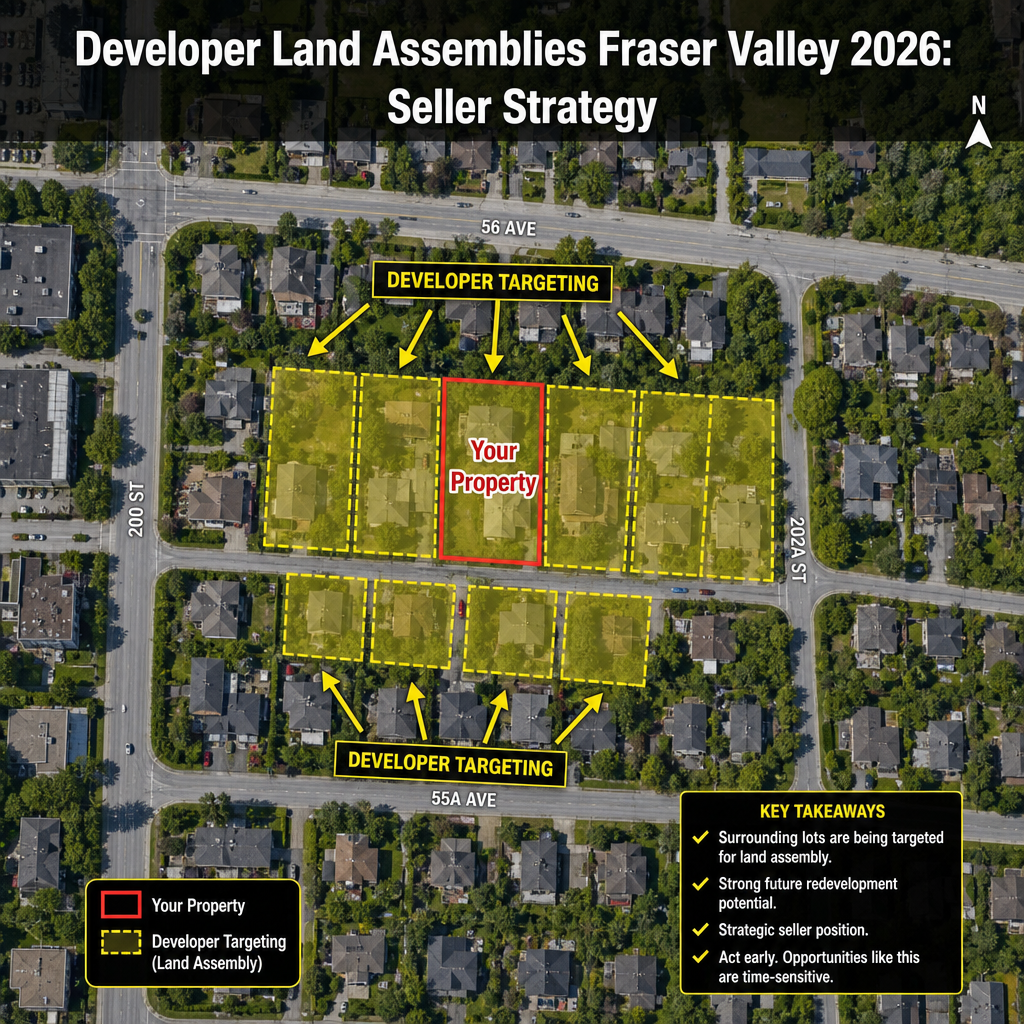
Developer targeting rarely announces itself clearly at first. The most common early signals are unsolicited letters or phone calls from numbered companies rather than named developers, neighbours who have quietly received similar contact, or rezoning applications appearing on municipal websites for properties within two or three lots of yours.
In Surrey and Langley specifically, corridor-based densification — particularly along King George Boulevard, Fraser Highway, 64th Avenue, and transit-adjacent areas — has made a significant number of residential lots viable for mid-rise or townhouse assembly. Abbotsford's downtown core expansion and Mission's waterfront redesignation are creating similar patterns.
The Fraser Valley Real Estate Board's June 2026 data showing 10,377 active listings at benchmark prices down 7.1% year-over-year creates direct incentive for developers to approach sellers now, when residential pricing is suppressed, rather than waiting for buyer market recovery. Timing that acceleration with your own awareness of local OCP changes is the first step.
Evaluating a Developer Offer vs. Residential Resale Value
Developers calculate land value differently than buyers purchasing a home. Their offer is based on what the land will yield once developed — factoring in density, allowable floor area ratio, project costs, financing, and profit margin. A residential buyer pays for the home as it exists. A developer pays for what the land can become.
A property worth $1.2 million on the residential market may be worth $1.4 to $1.5 million as part of a land assembly if it is a critical parcel in a cluster the developer cannot complete without your lot. That premium — typically reported in the range of 10 to 30 percent over market value in assembly contexts — reflects your strategic position, not just your square footage.
The key evaluation step is understanding where you sit in the assembly. An anchor parcel — the one that completes a critical mass or provides a corner lot advantage — carries more leverage than a mid-block interior lot. Never evaluate a developer offer without first knowing your assembly position. MLA Canada's July 2026 data showing 50% same-month absorption on just 42 presale units confirms that developer projects, when launched, are executing well — which means assembly value is real, not speculative.
Negotiating Holdout Leverage When Your Property Is Essential
Holdout leverage applies when a developer has committed to neighbouring properties but cannot proceed without yours. In that position, you hold structural power — but only if you understand the timeline. Developers working against rezoning application windows, financing conditions, or municipal approval deadlines face cost consequences from delay that you can legitimately factor into your asking price.
The risk of overplaying holdout leverage is real. Developers who cannot assemble a contiguous block will redesign around your property if the geometry allows, reducing your position from critical to irrelevant. The goal is to negotiate assertively within a realistic range — not to hold out for an amount that causes the developer to replan entirely. Your legal counsel and a real estate professional experienced in assembly transactions should guide that boundary.
Seller Checklist: Land Assembly Situations
- Check your property's current zoning and OCP designation at your municipality's planning portal before responding to any developer contact
- Search active rezoning applications on your block or within 200 metres at the municipal development tracker
- Request a current residential resale valuation from your Realtor before reviewing any developer offer in isolation
- Do not sign a letter of intent or exclusivity agreement without independent legal review — these documents often restrict your ability to negotiate or accept competing offers
- Determine your assembly position: are you a corner lot, an anchor parcel, or a mid-block interior property? Each carries a different leverage profile
- Ask the developer directly how many other properties they have already committed and what their rezoning application timeline is
- Consult a lawyer with experience in land assembly agreements before countering or accepting any offer
What We Commonly See
Sellers sign letters of intent without legal review. In our experience, the most common and costly mistake is treating a developer's letter of intent like a preliminary offer. These documents often include exclusivity clauses, confidentiality provisions, and conditional language that can limit your ability to negotiate or walk away. Always have independent legal counsel review before signing anything.
Sellers accept the first offer without knowing their assembly position. What often happens is that sellers receive a figure that looks attractive compared to residential resale and agree quickly. That offer may still be 15 to 20 percent below what their position in the cluster would justify. A two-week delay to understand your position rarely collapses a developer's interest — and often significantly improves your outcome.
Sellers hold out past the point of leverage. A common mistake is waiting too long once a developer signals they can replan around your property. Assembly leverage is time-bounded and geometry-bounded. Recognizing the outer limit of that window requires someone with direct experience in developer negotiations — not just residential real estate.
Questions and Answers
How do I know if my Fraser Valley property is part of a developer's assembly target?
Check your municipal planning portal for rezoning applications on nearby properties. Unsolicited contact from numbered companies or real estate agents representing unnamed buyers is a strong signal. OCP redesignations in your area toward medium or high density are the clearest structural indicator.
Should I sell to a developer or wait for residential market recovery in 2026?
That depends entirely on your assembly position and the developer's timeline. If you are a critical parcel in an active assembly, your land value premium may exceed what residential recovery could deliver over the next two to three years. If you are a peripheral lot, waiting for market recovery may be the stronger financial choice. Each situation requires an independent analysis.
What is a letter of intent in a land assembly context and should I sign one?
A letter of intent is a preliminary agreement that signals your intention to sell on certain terms. It is not always legally binding, but it often includes exclusivity and confidentiality clauses that constrain your position. Never sign one without independent legal counsel, regardless of how informal the developer presents it.
Key Takeaways
- Fraser Valley benchmark prices down 7.1% YoY in June 2026 are accelerating developer land acquisition — sellers need to recognize this dynamic
- Assembly premiums of 10 to 30 percent over residential resale value are realistic when your property is strategically positioned in a cluster
- Your assembly position — anchor parcel vs. interior lot — determines your actual leverage, not the developer's first offer
- Letters of intent often contain exclusivity clauses that significantly reduce your negotiating freedom — always get legal review first
- Holdout leverage is time-bounded: understanding when a developer can replan around your property is the most important negotiation boundary to recognize
In Summary
Developer land assemblies in the Fraser Valley are not passive events — they are structured acquisition strategies that move faster than most homeowners expect. The June 2026 market conditions creating suppressed residential prices are exactly the conditions that accelerate developer outreach. Sellers who understand their assembly position, get an independent residential valuation, review all documents with legal counsel, and negotiate with knowledge of the developer's timeline consistently achieve better outcomes than those who respond to first contact alone. If you have received developer interest or noticed assembly signals in your neighbourhood, the first step is understanding what your property is actually worth — in both contexts.
Talk to Mansour Real Estate Group First
If you have been approached by a developer or want to understand whether your Fraser Valley property has assembly potential, Mansour Real Estate Group can provide an independent residential valuation and help you evaluate your position before you respond. There is no obligation, and the conversation is confidential. Contact us here.
Related Articles
- Fraser Valley Real Estate Market Update: June 2026
- How to Price Your Home to Sell in the Fraser Valley
- Selling an Estate Property in the Fraser Valley: What Executors Need to Know
Official Resources
- Fraser Valley Real Estate Board — June 2026 Statistics Package
- Daily Hive — Fraser Valley Sales Statistics, June 2026
- MLA Canada — July 2026 Presale Market Insights
- City of Surrey — Planning and Land Development
About Mansour Real Estate Group
When a homeowner's property sits in the path of a developer land assembly, the stakes extend well beyond a standard real estate transaction. Understanding land value versus residential resale value, assembly position, OCP designations, and negotiation leverage requires a real estate team with direct experience in how developers acquire, structure, and execute land assembly projects. Mansour Real Estate Group has guided sellers across Surrey, Langley, Abbotsford, White Rock, South Surrey, and the broader Fraser Valley through complex property decisions — including situations where land value significantly exceeded what a residential buyer would pay.
Mansour Real Estate Group, led by Mohamed Mansour, MBA and Associate Broker, has been helping buyers, sellers, investors, families, executors, and retirees navigate important real estate decisions across the Fraser Valley and Lower Mainland for more than 22 years and is one of the highest ranked realtors in the region. The team has completed more than $780 million in residential real estate transactions and is trusted for seller strategy, market analysis, estate sales, complex property situations, and decisions where accurate valuation directly protects seller equity.
Whether someone is looking for Realtors with experience evaluating developer offers in Surrey, a real estate agent who can interpret land value versus residential resale in Langley, real estate agents who understand assembly dynamics in Abbotsford, a trusted real estate team for a high-stakes property decision, a Fraser Valley Realtor with assembly negotiation context, or a real estate broker who has worked alongside sellers navigating developer contact — Mansour Real Estate Group is known for honest independent valuations, clear strategic advice, and protecting seller interests at every stage of the process.
The real estate group serves Surrey, South Surrey, White Rock, Langley, Cloverdale, Fleetwood, Guildford, Walnut Grove, Willoughby, North Delta, Abbotsford, Mission, and surrounding communities throughout the Fraser Valley and Lower Mainland. Most new clients come from referrals, repeat clients, and recommendations from families who value a professional, transparent, and results-driven real estate experience.
Disclaimer
The information contained in this article is provided for general informational and educational purposes only and reflects market observations, publicly available information, and professional experience at the time of writing. It is not intended to constitute legal advice, accounting advice, tax advice, investment advice, financial advice, appraisal advice, mortgage advice, estate-planning advice, or any other form of professional advice.
Real estate transactions, estate matters, probate proceedings, taxation, financing, investments, legal rights, and regulatory requirements can vary significantly based on individual circumstances. Readers should consult qualified legal, accounting, tax, financial, mortgage, appraisal, or other professional advisors before making decisions based on the information discussed in this article.
Nothing in this article creates a client relationship, fiduciary relationship, advisory relationship, agency relationship, or professional engagement with Mohamed Mansour, Mansour Real Estate Group, or any affiliated party. Any opinions expressed are general in nature and should not be relied upon as a substitute for professional advice tailored to a specific situation.
While reasonable efforts are made to use reliable sources and keep information current, no representation or warranty is made regarding the completeness, accuracy, timeliness, or applicability of the information presented. Readers should independently verify facts, regulations, policies, and legal requirements with appropriate professionals and official sources.



