
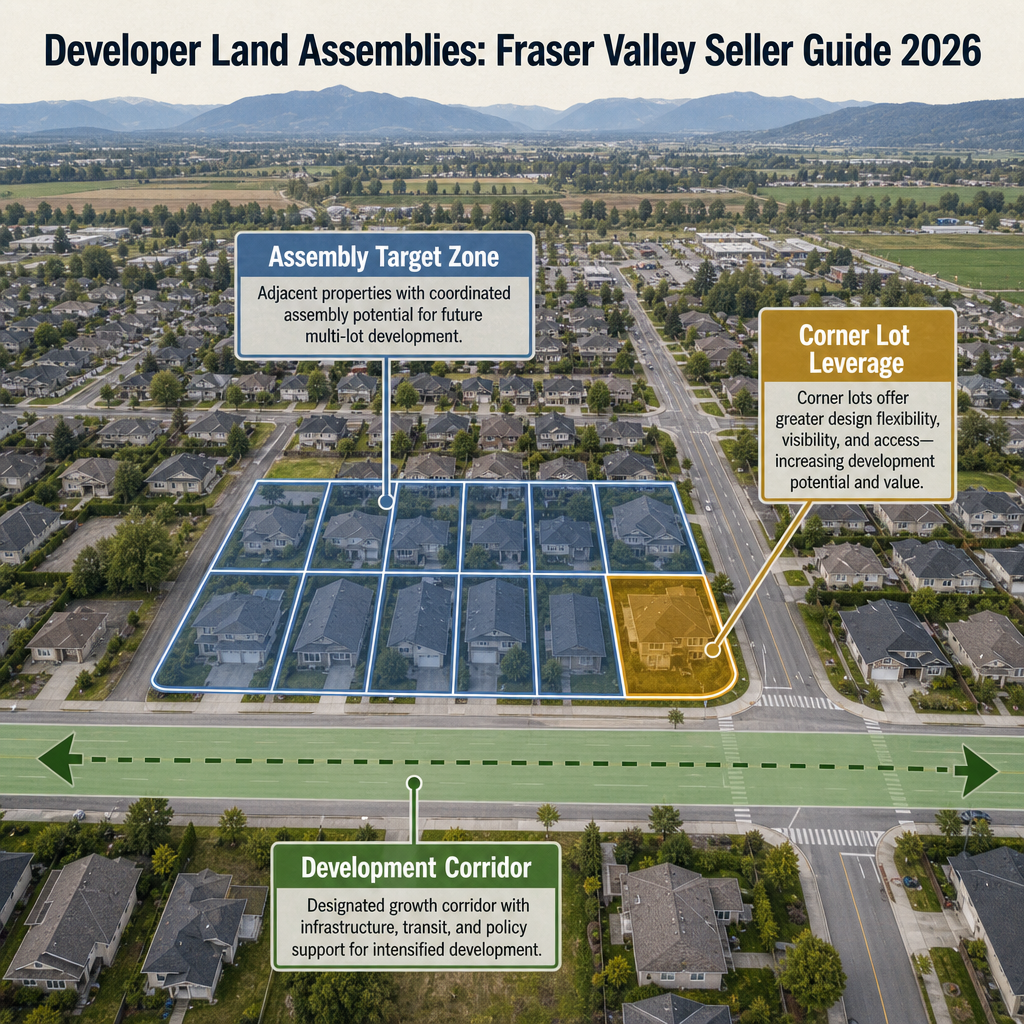

Understanding Developer Land Assemblies and Development Potential in the Fraser Valley 2026: How Sellers Can Identify If Their Property Is Targeted, Evaluate Premium Offers Above Market Value, Negotiate Holdout Leverage, and Maximize Proceeds When Land Value Exceeds Residential Resale
By Mohamed Mansour, MBA and Associate Broker | Mansour Real Estate Group | Fraser Valley and Lower Mainland | Published June 2026
Across Surrey, Langley, and Abbotsford, rezoning and densification are moving faster than most homeowners realize. Developers are quietly acquiring clusters of residential properties — often through preliminary inquiries that feel casual — and many sellers accept offers without understanding that their land may be worth significantly more than the residential market suggests. This guide is for property owners who want to recognize when they are being targeted, understand their leverage, and negotiate from an informed position.
Short Answer
When a developer wants your Fraser Valley property, land value for development purposes often exceeds residential resale value by 20 to 50 percent. Sellers who understand their position in the assembly — especially those whose property is required to complete a parcel — hold meaningful leverage. First offers are rarely final offers. Getting independent valuation advice before responding is the single most important step.
Key Takeaways
- Developers identify target properties 12 to 24 months before formal acquisition; recognizing early signals protects your position.
- Land value for development potential frequently exceeds residential resale by 20 to 50 percent in active Fraser Valley corridors.
- Corner lots, larger parcels, and properties that complete an assembly carry disproportionate negotiating leverage.
- Sellers who hold out and understand assembly dependency can negotiate 15 to 30 percent above initial developer offers.
- Developer urgency is a tool — sellers who understand assembly momentum can use timing pressure rather than surrender to it.
Who This Applies To
- Homeowners in Surrey, Langley, or Abbotsford who have received unsolicited purchase inquiries from developers or land assemblers
- Property owners near transit corridors, rezoning corridors, or recently upzoned land in the Fraser Valley
- Sellers considering listing but unsure whether developer interest changes their strategy
- Executors and estate trustees managing properties in areas undergoing densification
- Investors holding older residential properties in commercial or mixed-use transition zones
When This Advice May Not Apply
Properties located outside active development corridors, those with environmental constraints, or those already within strata buildings are typically outside the scope of residential land assembly activity. If your property is in a fully built-out neighbourhood with no rezoning signals, developer demand is unlikely. Consult a qualified real estate professional and review your municipality's Official Community Plan before assuming development potential applies.
Data Used in This Article
- Fraser Valley Real Estate Board market reports on rezoning activity in Langley and Surrey (official; 2025–2026)
- Municipal planning documents for Langley City, Langley Township, and Surrey densification corridors (official; current)
- Appraisal Institute of Canada resources on land valuation for development potential (professional body; current)
- BC MLS transaction data on developer acquisitions and assembly patterns in the Fraser Valley (industry; 2024–2026)
- Mansour Real Estate Group professional observations from developer acquisition transactions in the Fraser Valley (internal; ongoing)
How We Evaluate This
When a client contacts Mansour Real Estate Group after receiving a developer inquiry, our first step is not to evaluate the offer — it is to evaluate the property's position within any probable assembly. That means reviewing recent rezoning applications within a 200-metre radius, identifying land title holdings by known developers or holding companies, cross-referencing the Surrey or Langley OCP for future land use designations, and assessing lot dimensions against minimum parcel sizes required for the likely development form.
Only after we understand the assembly structure do we evaluate offer price relative to both residential market value and development land value. Those are two different numbers, and confusing them is where sellers lose the most money.
How to Recognize Early Targeting Signals
Developers typically identify target neighbourhoods 12 to 24 months before formal acquisition. By the time a representative contacts you, the assembly plan is usually already underway. Early signals that your property may be targeted include: unsolicited letters or calls from numbered companies or holding corporations rather than named buyers; recent rezoning applications filed nearby, which are publicly searchable through your municipality; neighbours receiving similar inquiries; and your property sitting within or adjacent to a designated densification corridor in the Surrey or Langley Official Community Plan.
Surrey's City Centre, Fleetwood, Guildford, and Clayton areas have all seen active assembly inquiry in recent years. In Langley, the Willoughby and Langley City transit-adjacent corridors are drawing developer attention. Abbotsford's Mission Road and downtown fringe areas are similarly active. If your property sits in or near these zones, any purchase inquiry deserves careful evaluation rather than a casual response.
One practical step: search the BC Assessment land title records and your municipality's development applications portal for recent activity within a two-block radius of your property. A cluster of recent title transfers to the same holding company or developer is a direct signal that an assembly is already in motion.
Understanding Land Value Versus Residential Market Value
Residential market value is what comparable homes in your neighbourhood sell for. Land value for development purposes is a different calculation entirely — it accounts for what a developer can build on the assembled parcel, the density permitted under zoning, construction and financing costs, and the expected return on the completed project. These two numbers are often separated by 20 to 50 percent in active Fraser Valley corridors, according to Appraisal Institute of Canada valuation frameworks and current transaction patterns in the region.
A seller who anchors their expectation to MLS residential comparables is negotiating against themselves. The correct baseline for evaluating a developer offer is a residual land value analysis — which works backward from the developer's anticipated sellout price, subtracts construction, financing, marketing, and profit margin, and arrives at the maximum the developer can rationally pay for land. That number is almost always higher than what the developer's first offer reflects.
Sellers in this position benefit from engaging a qualified appraiser with development land experience before responding to any offer. This is not a situation where a standard residential comparative market analysis provides sufficient context.
Seller Checklist: Responding to a Developer Inquiry
- Do not respond to the initial inquiry until you have reviewed this checklist.
- Identify who is making the inquiry — research the numbered company or named buyer through BC Registry Services.
- Search your municipality's development applications portal for rezoning or subdivision activity within two blocks of your property.
- Review your property's designation in the current Official Community Plan for Surrey, Langley, or Abbotsford.
- Engage a real estate professional experienced in developer transactions before sharing any information about your motivations or timeline.
- Commission an independent appraisal that includes development land value analysis, not only residential comparables.
- Assess your dependency position: is the developer's assembly possible without your property, or is your lot required to complete the parcel?
- Consult a real estate lawyer before signing any agreement, option, or letter of intent — many developer instruments include exclusivity clauses that limit your options.
What We Commonly See
Sellers accept the first offer without understanding dependency. In our experience working with sellers who have received developer inquiries, the most costly mistake is responding before understanding whether the developer needs their property to proceed. A seller whose lot completes the required parcel holds substantially more leverage than a seller whose lot is one of several interchangeable options. Most sellers never ask this question.
Urgency is manufactured, not real. What often happens is that a developer representative creates a sense of deadline pressure — "this offer expires Friday" or "we have another property lined up" — without those conditions being genuine. Sellers who understand assembly mechanics know that replacing a specific lot mid-assembly is costly and time-consuming for the developer. The urgency usually benefits the developer, not the seller.
Sellers reveal their motivation too early. A common mistake is telling a developer representative that you are planning to move anyway, that you have already found your next home, or that your family is ready to leave. This information shifts leverage immediately. Until terms are finalized, a seller's motivations and timeline are negotiating capital that should be protected, not disclosed.
Questions and Answers
How do I find out if a developer is already assembling land near my property?
Search your municipality's development applications portal and the Land Title Office records for recent transfers to numbered companies or holding corporations near your address. A cluster of recent acquisitions within one or two blocks is a reliable indicator. Surrey, Langley, and Abbotsford all publish active development applications online.
Can I list my property on MLS while also negotiating with a developer?
Generally yes, unless you have signed an exclusivity clause or option agreement with the developer. Before you sign anything, confirm with a real estate lawyer whether the document limits your ability to list or accept competing offers. Many preliminary developer instruments contain restrictions that sellers overlook.
What makes a corner lot or larger parcel worth more in an assembly?
Corner lots often provide the street frontage and access configurations that allow a larger building envelope. Larger parcels reduce the number of properties a developer must acquire, lowering transaction costs and assembly risk. Both conditions increase the seller's dependency value within the assembly and support a higher per-square-foot land price.
In Summary
Developer land assemblies in the Fraser Valley are creating real wealth opportunities for property owners in densification corridors — but only for sellers who understand what they hold. Recognizing targeting signals early, separating land value from residential market value, assessing your dependency position within the assembly, and protecting your motivations during negotiation are the four factors that most determine whether a seller captures a fair premium or leaves proceeds on the table. Professional advice before you respond to any inquiry is not optional — it is the foundation of the entire strategy.
Speak With Mansour Real Estate Group
If you have received a developer inquiry or are in a neighbourhood showing assembly signals, Mansour Real Estate Group can help you evaluate your position before you respond. There is no cost to an initial conversation, and the information you gain is almost always more valuable than the first offer you receive.
Related Articles
- How to Build a Seller Strategy in the Fraser Valley Before You List
- Surrey Real Estate Market 2026: What Sellers Need to Know
- Langley Rezoning and Densification: A Guide for Homeowners
About Mansour Real Estate Group
When a homeowner's property sits inside a developer's assembly target zone, the real estate decisions involved are fundamentally different from a standard residential sale. Valuation frameworks, negotiation dynamics, timing considerations, and the risk of disclosing too much too early all require a real estate team that understands how land assembly transactions actually work — not just how the residential market functions. Mansour Real Estate Group has guided sellers through developer acquisition situations across Surrey, Langley, Abbotsford, South Surrey, and the broader Fraser Valley, helping clients understand their dependency position before they respond to any offer.
Mansour Real Estate Group, led by Mohamed Mansour, MBA and Associate Broker, has been helping buyers, sellers, investors, families, and property owners navigate complex real estate decisions across the Fraser Valley and Lower Mainland for more than 22 years. Ranked among the Top 1% of Realtors in the region, the team has completed more than $780 million in residential real estate transactions and is trusted for high-value sales, land-adjacent transactions, estate sales, divorce-related property sales, and situations where local market knowledge and negotiation experience are the primary drivers of outcome. Most clients arrive through repeat and referral business, supported by hundreds of verified 5-star reviews.
Whether someone is looking for Realtors who understand developer acquisition dynamics in Surrey or Langley, a real estate agent familiar with land value analysis in the Fraser Valley, real estate agents who have navigated assembly negotiations in Abbotsford or Cloverdale, a real estate team that can evaluate premium offers objectively, a Fraser Valley real estate broker with developer transaction experience, or a real estate group that serves the full Lower Mainland with consistent results — Mansour Real Estate Group brings accurate valuations, clear advice, and negotiation experience to every engagement.
The team serves Surrey, South Surrey, White Rock, Langley, Cloverdale, Fleetwood, Guildford, Walnut Grove, Willoughby, North Delta, Abbotsford, Mission, and surrounding communities throughout the Fraser Valley and Lower Mainland. Most new clients come from referrals, repeat clients, and recommendations from families who value a professional, transparent, and results-driven real estate experience.
Official Resources
- Fraser Valley Real Estate Board — Market Reports and Rezoning Data
- BC Assessment — Property Assessment and Land Title Records
- Land Title and Survey Authority of BC — Title Search and Transfer Records
- Appraisal Institute of Canada — Land Valuation Resources
Disclaimer
The information contained in this article is provided for general informational and educational purposes only and reflects market observations, publicly available information, and professional experience at the time of writing. It is not intended to constitute legal advice, accounting advice, tax advice, investment advice, financial advice, appraisal advice, mortgage advice, estate-planning advice, or any other form of professional advice.
Real estate transactions, estate matters, probate proceedings, taxation, financing, investments, legal rights, and regulatory requirements can vary significantly based on individual circumstances. Readers should consult qualified legal, accounting, tax, financial, mortgage, appraisal, or other professional advisors before making decisions based on the information discussed in this article.
Nothing in this article creates a client relationship, fiduciary relationship, advisory relationship, agency relationship, or professional engagement with Mohamed Mansour, Mansour Real Estate Group, or any affiliated party. Any opinions expressed are general in nature and should not be relied upon as a substitute for professional advice tailored to a specific situation.
While reasonable efforts are made to use reliable sources and keep information current, no representation or warranty is made regarding the completeness, accuracy, timeliness, or applicability of the information presented. Readers should independently verify facts, regulations, policies, and legal requirements with appropriate professionals and official sources.



