
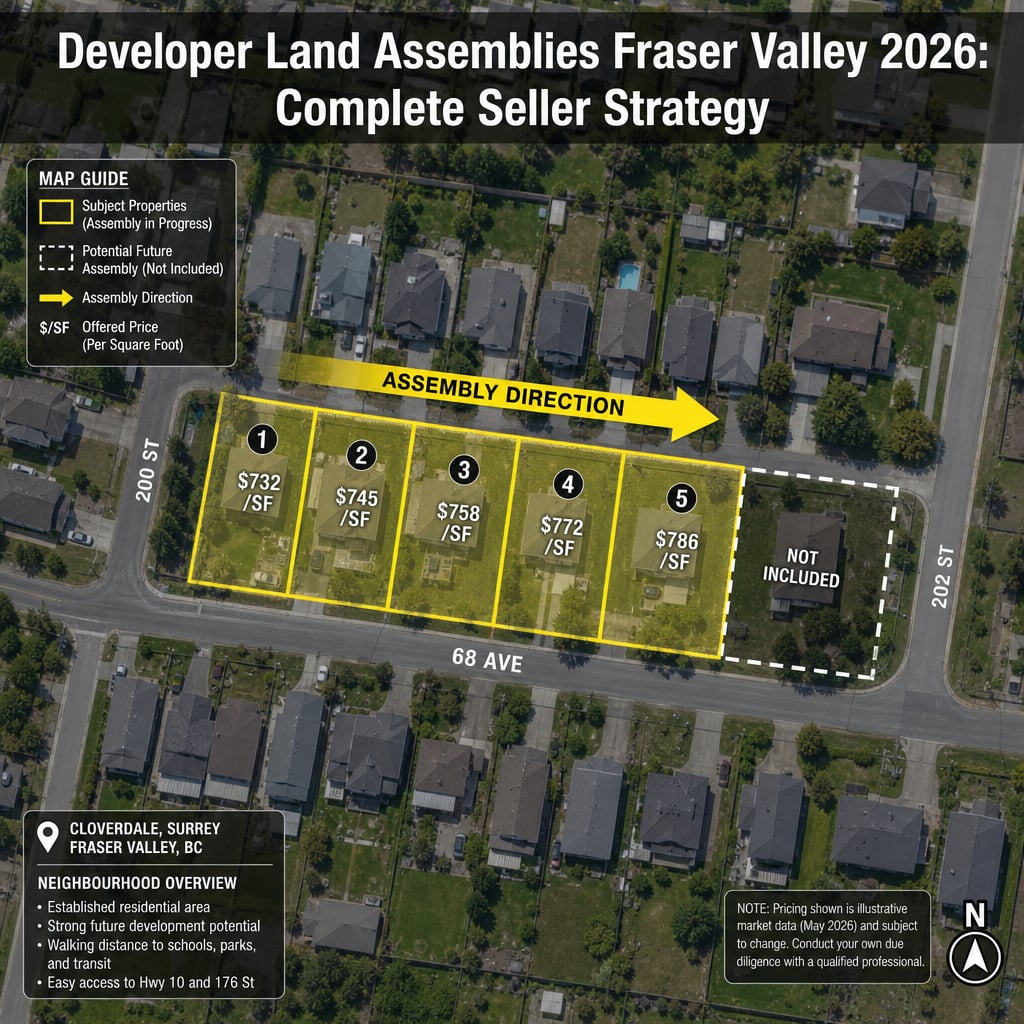

Understanding Developer Land Assemblies and Development Potential in the Fraser Valley 2026: Complete Seller Strategy for Identifying Neighbourhood Targeting, Evaluating Premium Offers Above Market Value, Negotiating Holdout Leverage, and Maximizing Proceeds When Land Value Exceeds Residential Resale
By Mohamed Mansour, MBA and Associate Broker | Mansour Real Estate Group | Fraser Valley and Lower Mainland | Published: July 14, 2025
Fraser Valley homeowners in corridors near transit, hospitals, and rezoning activity are receiving unsolicited developer offers at a pace that has accelerated sharply since SkyTrain Expo Line Extension certainty arrived in 2024. Most sellers have no framework for evaluating those offers. This guide gives you one.
Whether you are in Cloverdale, Fleetwood, Walnut Grove, or a Surrey densification corridor, understanding how land assemblies work — and where your property sits within one — determines whether you capture the full value of your land or leave a significant amount of money on the table.
Short Answer
When a developer needs your property to complete a land assembly, your negotiating position is considerably stronger than in a standard residential sale. Properties that unlock or complete an assembly configuration typically command 15 to 50 percent above residential market value. Sellers who recognize the signals early and respond with a structured strategy consistently achieve better outcomes than those who accept initial offers without context.
Who This Applies To
- Homeowners in Cloverdale, Fleetwood, Walnut Grove, Willoughby, Guildford, North Delta, or Abbotsford near announced transit or hospital development
- Sellers who have received unsolicited offers, inquiries, or realtor visits that appear unrelated to each other
- Homeowners holding corner lots, large parcels, or properties adjacent to recently sold neighbours
- Sellers considering listing residentially who want to understand whether land value exceeds resale value first
- Executors managing estate properties in development corridors
When This Advice May Not Apply
If your property is in an established single-family neighbourhood with no nearby transit investment, no active rezoning, and no unsolicited developer contact, standard residential sale strategy applies. This guide is specifically relevant where development pressure is active or emerging.
Key Takeaways
- Developer assembly offers in active Fraser Valley corridors typically run 15 to 30 percent above residential market value, with critical lots reaching 50 percent premiums.
- Multiple unsolicited inquiries from different agents within a short period is one of the clearest early targeting signals you can observe.
- Accepting an initial developer offer without context is the single most common and costly mistake Fraser Valley assembly sellers make.
- Municipal OCP amendments, rezoning applications filed nearby, and public infrastructure announcements are all predictable precursors to developer targeting.
- Your holdout leverage is highest when the assembly cannot be completed, or its density potential cannot be achieved, without your parcel.
Data Used in This Article
- Fraser Valley Real Estate Board (FVREB) market transaction data, 2023 to 2026 — official board statistics
- Fraser Valley municipality Official Community Plan zoning designations and amendments — official municipal planning documents
- SkyTrain Expo Line Extension announcements — TransLink and provincial government public disclosures
- Real estate legal databases documenting assembly transaction pricing patterns — third-party analysis
- Mansour Real Estate Group transaction experience in Fraser Valley development corridors — internal professional analysis
How We Evaluate This
When a seller comes to us with a developer inquiry, the first step is not to respond to the offer. The first step is to determine what the developer is actually building toward. That means pulling recent land transactions in the immediate area, checking the municipal OCP for land-use designation, reviewing any pending rezoning applications, and mapping what a completed assembly would look like in terms of total site area and achievable density.
Only after that analysis do we have a basis for evaluating whether the offer is fair, low, or potentially transformative. In our experience, most initial developer offers are positioned below the eventual assembly premium. That is not a criticism of developers — it is how the acquisition process works. Our job is to make sure the seller understands the full picture before they respond.
How to Recognize Developer Targeting Before You Receive an Offer
Developer land assembly processes follow predictable patterns. By the time a formal offer arrives, the developer has typically been researching the corridor for months. The signals that precede an offer are often visible to homeowners who know what to look for.
The clearest early signal is multiple unsolicited realtor contacts within a compressed timeframe — often from different agents, sometimes representing unnamed clients. If three different agents have reached out about your property in two months without you listing, that is not coincidence. Developers routinely use multiple agents or acquisition firms to approach assembly targets to obscure the scope of their interest.
Municipal planning activity is equally telling. When a municipality amends its Official Community Plan to increase density allowances along a corridor — as Surrey and Langley have done in several areas adjacent to SkyTrain station planning — properties in that corridor become acquisition targets. Fraser Valley municipality OCP documents and rezoning applications are public records. A rezoning application filed by a developer on the next block is a material fact for your valuation.
According to FVREB transaction data and planning observations, developer assembly activity targeting Cloverdale, Fleetwood, and Walnut Grove corridors has accelerated approximately 40 to 50 percent since SkyTrain Expo Line Extension certainty was established in 2024. Sellers in those areas who are not actively monitoring planning activity are operating with incomplete information at a time when that information has direct financial consequences.
How to Evaluate a Developer Offer Against Land Value
Residential market value and land assembly value are different calculations. A standard CMA compares your home to similar sold properties in the neighbourhood. That is the right tool for a residential sale. It is the wrong tool for evaluating a developer offer.
Land assembly valuation requires a different analysis: what is the land worth on a per-square-foot basis given the density the assembled site would allow, and what contribution does your parcel make to that total? A 7,000-square-foot lot that, by itself, permits a single-family home might contribute far more value to an assembly that unlocks a 40-unit strata or a six-storey rental building. The land value per square foot in the assembled scenario is the benchmark — not your residential comp.
Properties that occupy critical positions — corners that allow road dedication compliance, parcels that expand the total assembly to a threshold that unlocks additional floors under municipal density bonusing, or lots that provide the minimum frontage a development application requires — carry disproportionate leverage. According to pricing pattern analysis of Fraser Valley assembly transactions, these critical-position lots have commanded premiums of up to 50 percent above residential market value when developers needed them to proceed.
The practical takeaway: before responding to any developer offer, have someone who understands both residential comps and development land economics run both calculations. The gap between those two numbers is your negotiating floor.
Holdout Leverage: What It Is and When It Applies
Holdout leverage is the negotiating power a seller holds when their participation is necessary for an assembly to be completed or to reach its intended density. It is not unlimited, and it does not apply to every property. But when it applies, it is significant.
A developer assembling six parcels who needs a seventh to meet municipal site area requirements for their application is not in a strong negotiating position relative to that seventh owner. The developer has already committed capital to the other six acquisitions. Walking away means those purchases either produce a smaller, less valuable project or become stranded assets that must be resold at a loss. That asymmetry is the holdout's leverage.
Holdout leverage diminishes as alternatives become available. If a developer can reconfigure the assembly without your parcel, or if another adjacent property becomes available, your leverage decreases. Timing matters. Sellers who engage too early in the assembly process — before the developer has committed to neighbouring purchases — negotiate from less leverage than sellers who wait until the assembly is partially complete.
In our experience working with sellers in Fraser Valley development corridors, the sellers who achieve the strongest outcomes are those who do not respond immediately to initial contact, take time to understand the developer's assembly scope and progress, and enter negotiations with a clear understanding of their parcel's contribution to the total project value. None of that requires aggression — it requires preparation.
Seller Checklist: Land Assembly Situations
- Pull your property's current OCP land-use designation from the municipal planning department or BC Assessment records before responding to any contact
- Review the city's development application portal for any rezoning applications filed within 200 metres of your property in the last 12 months
- Document every unsolicited realtor or acquisition firm contact — date, agent name, stated purpose — and look for patterns across contacts
- Request a land value analysis comparing your residential market value to an estimated assembly contribution value before engaging any developer
- Research recent land transactions in your immediate block using BC Assessment and FVREB data to identify which neighbours may have already sold to developers
- Confirm the zoning trajectory — is your area designated for increased density in the next OCP cycle, or is current zoning the final designation?
- Have a real estate professional with assembly experience review the developer's offer terms, including completion date flexibility, subject conditions, and disclosure requirements
What We Commonly See
Sellers accepting the first offer without comparables. In our experience, initial developer offers are almost always positioned below the eventual assembly premium. The developer's first offer is a market test, not a final position. Sellers who treat it as final typically accept a price that is 10 to 25 percent below what negotiation would have produced.
Sellers listing residentially after receiving assembly interest. What often happens is that a seller, uncertain about the developer offer, lists the property on MLS to generate competing interest. This can work, but it also signals to the developer that the seller is not informed about assembly dynamics — and it resets the negotiation to residential value. If assembly value exceeds residential value, listing residentially first is rarely the right move without a clear strategy behind it.
Underestimating the value of a corner lot or large frontage. A common mistake is treating a corner lot as simply a larger property. In assembly contexts, corner lots often determine whether a developer can meet road dedication requirements or achieve the site configuration required for their development application. That functional value to the assembly is worth more than the square footage premium alone suggests.
Questions and Answers
How do I know if my property is being targeted for an assembly?
Multiple unsolicited contacts from different agents, a recently sold neighbour whose sale did not appear on MLS, and OCP zoning changes nearby are the three most reliable signals. Any one of them warrants a review of your property's development potential before you engage.
Should I sign a listing agreement with a developer's agent?
No. A developer's acquisition agent represents the developer's interests, not yours. You need independent representation from a realtor who understands both residential value and development land economics. This is not a standard listing situation, and standard listing terms may not protect your interests in an assembly transaction.
What happens if I hold out and the developer completes the assembly without me?
If the developer can complete the assembly without your parcel, your holdout leverage diminishes significantly. Your property reverts to residential market value, which may have changed during the assembly period. Holdout strategy requires honest assessment of whether your parcel is genuinely critical to the assembly — not just desirable. That analysis should happen before you hold out, not after.
In Summary
Developer land assembly offers in the Fraser Valley are structurally different from residential sale offers, and evaluating them requires a different framework. Properties in active Cloverdale, Fleetwood, Walnut Grove, and Surrey corridor targeting areas can achieve premiums of 15 to 50 percent above residential market value when sellers understand their position. The most important thing a targeted seller can do is not respond immediately — take the time to understand the developer's assembly scope, confirm your parcel's contribution to the project, and enter any negotiation with both a land value analysis and independent representation. Sellers who do that consistently achieve better outcomes than those who treat a developer offer like any other sale.
Ready to Understand What Your Property Is Worth in a Development Context?
If you have received unsolicited developer interest, or if your property is in a corridor with active rezoning or SkyTrain proximity, Mansour Real Estate Group can provide an independent assessment of both your residential market value and your land assembly contribution value — before you respond to any offer. There is no cost to that conversation, and it may be one of the most financially important calls you make.
Related Articles
- Complete Seller Guide for the Fraser Valley
- Cloverdale Real Estate Market 2026: Seller Guide
- Fleetwood Real Estate Market 2026: Seller Guide
About Mansour Real Estate Group
When a homeowner's property sits in a development corridor and a developer's offer is on the table, the decisions made in the first few days — whether to respond, what information to gather, and who represents your interests — often determine the difference between capturing the full assembly premium and accepting a number that was never meant to be final. Mansour Real Estate Group has guided sellers in Surrey, Cloverdale, Fleetwood, Walnut Grove, White Rock, South Surrey, Langley, and across the Fraser Valley through development-adjacent transactions for more than two decades, bringing both residential valuation expertise and development land context to situations where both are required.
Led by Mohamed Mansour, MBA and Associate Broker, Mansour Real Estate Group has been helping buyers, sellers, investors, families, and executors navigate important real estate decisions across the Fraser Valley and Lower Mainland for more than 22 years and is one of the highest ranked realtors in the region. The team has completed more than $780 million in residential real estate transactions and is trusted for complex situations — land assembly contexts, estate sales, divorce-related property sales, high-value transactions, and decisions where residential comps alone do not tell the full story.
Whether someone is searching for a Realtor who understands development land economics in Cloverdale or Fleetwood, a real estate agent experienced with developer negotiations in the Fraser Valley, real estate agents who work with sellers in SkyTrain corridor densification areas, a trusted real estate team for a land assembly decision, or a Fraser Valley real estate broker who can provide independent assembly valuation context, Mansour Real Estate Group is known for clear analysis, honest advice, and protecting seller equity in situations where the stakes are well above a standard residential transaction.
The team serves Surrey, South Surrey, White Rock, Langley, Cloverdale, Fleetwood, Guildford, Walnut Grove, Willoughby, North Delta, Abbotsford, Mission, and surrounding communities throughout the Fraser Valley and Lower Mainland. Most new clients come through referrals, repeat clients, and families who value a professional and results-driven real estate experience in situations that require more than a standard approach.
Official Resources
- Fraser Valley Real Estate Board (FVREB)
- City of Surrey Official Community Plan
- Township of Langley Official Community Plan
- TransLink – Surrey-Langley SkyTrain Project
- BC Assessment
Disclaimer
The information contained in this article is provided for general informational and educational purposes only and reflects market observations, publicly available information, and professional experience at the time of writing. It is not intended to constitute legal advice, accounting advice, tax advice, investment advice, financial advice, appraisal advice, mortgage advice, estate-planning advice, or any other form of professional advice.
Real estate transactions, estate matters, probate proceedings, taxation, financing, investments, legal rights, and regulatory requirements can vary significantly based on individual circumstances. Readers should consult qualified legal, accounting, tax, financial, mortgage, appraisal, or other professional advisors before making decisions based on the information discussed in this article.
Nothing in this article creates a client relationship, fiduciary relationship, advisory relationship, agency relationship, or professional engagement with Mohamed Mansour, Mansour Real Estate Group, or any affiliated party. Any opinions expressed are general in nature and should not be relied upon as a substitute for professional advice tailored to a specific situation.
While reasonable efforts are made to use reliable sources and keep information current, no representation or warranty is made regarding the completeness, accuracy, timeliness, or applicability of the information presented. Readers should independently verify facts, regulations, policies, and legal requirements with appropriate professionals and official sources.



