
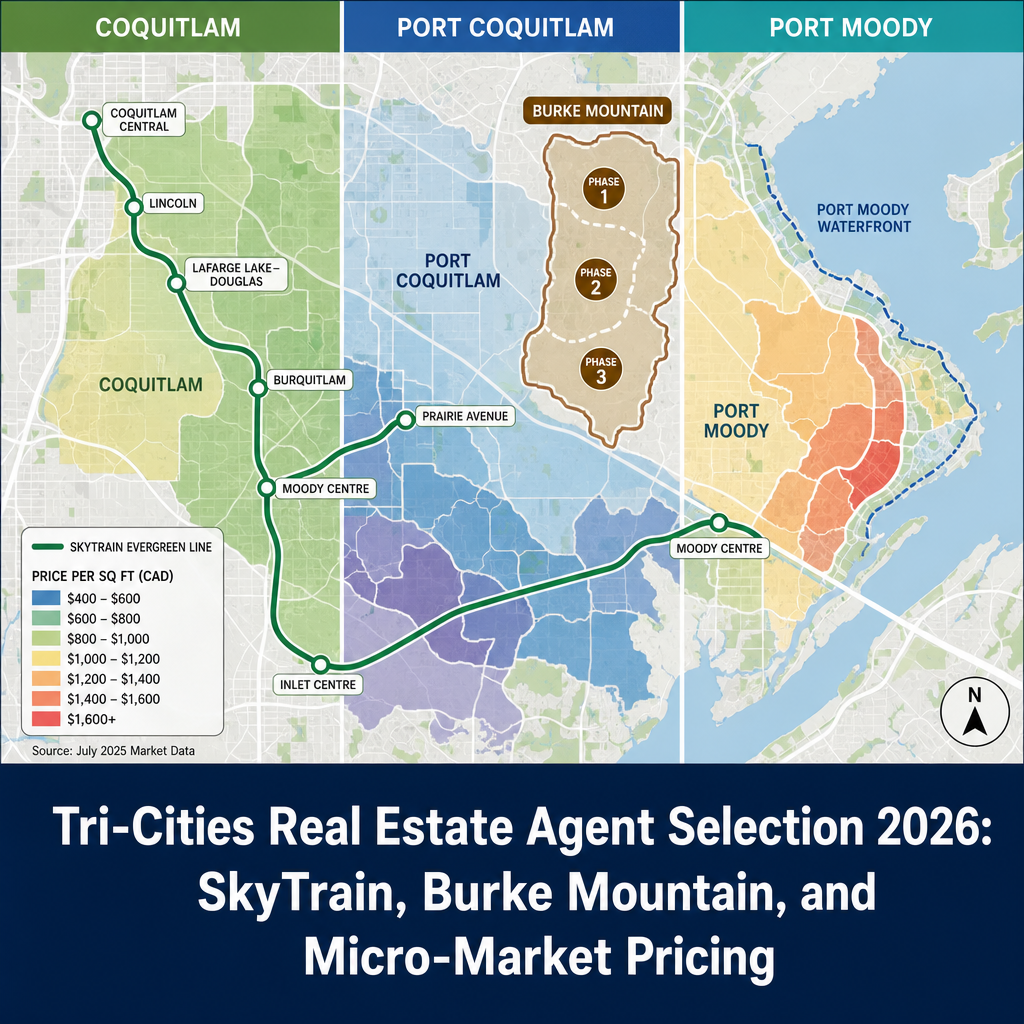

Tri-Cities Real Estate Agent Selection 2026: SkyTrain Evergreen Line Expertise, Burke Mountain Development Phase Knowledge, and Micro-Market Pricing Variation Across Coquitlam, Port Coquitlam, and Port Moody
By Mohamed Mansour, MBA and Associate Broker | Mansour Real Estate Group | Published: July 15, 2025 | Geography: Coquitlam, Port Coquitlam, Port Moody, Metro Vancouver, BC
The Tri-Cities sit in a part of Metro Vancouver where the wrong real estate agent doesn't just miss opportunities — they misread the market entirely. Coquitlam, Port Coquitlam, and Port Moody each carry distinct pricing dynamics shaped by transit infrastructure, master-planned development phases, and lifestyle positioning that generalist agents rarely track at the neighbourhood level. For buyers and sellers active here in 2026, the question isn't just who has a license. It's who understands what drives value on this specific side of Metro Vancouver.
This article explains what Tri-Cities real estate expertise actually requires — and which questions to ask before you hire anyone to represent you here.
Short Answer
A qualified Tri-Cities real estate agent must be able to quantify SkyTrain Evergreen Line station premiums by walking distance, explain Burke Mountain's current development phase and absorption rate, and distinguish Port Moody's 15–25% pricing premium from comparable Coquitlam stock by micro-location. Agents who cannot answer these questions specifically are working from general Metro Vancouver knowledge, not Tri-Cities expertise.
Who This Applies To
- Sellers listing a detached home in Burke Mountain, Maillardville, or Canyon Springs
- Buyers evaluating condos or townhomes near Evergreen Line stations in Coquitlam
- Presale purchasers approaching completion in 2026–2027 and assessing assignment or resale timing
- Port Moody buyers or sellers working in the heritage district or waterfront zones
- Investors comparing Tri-Cities strata vs. detached performance by neighbourhood
When This Advice May Not Apply
If you are purchasing a presale assignment or navigating a contract dispute, you need independent legal advice alongside real estate representation. This article addresses agent selection, not legal strategy. Agents cannot provide legal or tax advice on assignment income, completion tax obligations, or contract interpretation.
Key Takeaways
- Burke Mountain detached homes carry a 4–10% premium over Coquitlam benchmarks, but that spread varies significantly by phase and remaining inventory window.
- SkyTrain station proximity within 500 metres creates measurable price-per-square-foot gains, but construction timelines and service frequency projections must be explained accurately to buyers.
- Port Moody detached homes trade at a 15–25% premium over comparable Coquitlam properties — and that gap is highly sensitive to micro-location shifts within Port Moody itself.
- Coquitlam townhomes show approximately 23% sales-to-active ratios, a seller-market indicator, while presale towers face buyer conditions — an agent must know which segment you are actually in.
- Presale assignment restrictions and builder incentive phase-out timing in 2026–2027 create narrow seller windows that generalist agents often miss entirely.
Data Used in This Article
- Greater Vancouver Realtors (GVR) benchmark price and sales-to-active ratio data by municipality and property type, 2024–2025
- Coquitlam Planning Department — Burke Mountain master plan phasing documentation (official, public)
- TransLink — Evergreen Extension project updates and station-area planning documents
- Historical SkyTrain station proximity impact studies (Millennium Line corridor, peer-reviewed and industry research)
- Port Moody Official Community Plan — micro-location and neighbourhood character designations
- Developer and builder presale disclosure statements and incentive schedules — Tri-Cities projects, 2024–2026
Why the Tri-Cities Market Requires Separate Evaluation
Most Metro Vancouver agent scorecards were designed for Burnaby, Richmond, or the broader REBGV zone. They measure volume, reviews, and years licensed. Those metrics matter, but they don't capture what drives outcomes here.
The Tri-Cities — Coquitlam, Port Coquitlam, and Port Moody — form a corridor where three distinct municipal characters, two board boundaries, active master-planned development, and one of BC's most significant SkyTrain investments all intersect at once. The result is a market where pricing diverges sharply between neighbourhoods that appear close on a map but perform very differently in practice.
A Burke Mountain detached home and a Maillardville townhome are both in Coquitlam. But they serve different buyer profiles, respond to different market signals, and carry different absorption dynamics. Applying the same agent logic to both is a mistake.
When you are evaluating real estate agents for this market, the framework from How to Find the Best Real Estate Agent in Metro Vancouver and Fraser Valley BC gives you the foundational criteria. What follows adds the Tri-Cities-specific tests that matter here.
Burke Mountain: Why Phase Awareness Is Not Optional
Burke Mountain is not a single neighbourhood. It is a long-term master-planned community developed in phases across northern Coquitlam, and the phase a home was built in affects its pricing, buyer demand, view positioning, school catchment access, and proximity to completed amenities.
According to publicly available Coquitlam Planning Department documentation, Burke Mountain's phased build-out introduces new inventory in tranches that directly affect resale absorption rates. Early phases with established roads, schools, and transit connections perform differently than newer phases where infrastructure is still under construction. A home priced at the top of its phase range can sit — not because the market is slow, but because that particular pocket is still mid-absorption.
The research basis used in this article indicates that Burke Mountain detached homes have sold at a 4–10% premium over broader Coquitlam benchmarks when school catchment and view positioning are strong. But that premium narrows or disappears when a buyer compares the listing to similar properties in a more complete phase nearby.
An agent with genuine Burke Mountain knowledge tracks current absorption rates by phase, knows which builder incentive windows are closing, and can tell you where remaining inventory concentration will affect your negotiating position over the next six to twelve months. If they cannot answer those questions with specific numbers, they are working from general Coquitlam knowledge.
SkyTrain Evergreen Line: What Station Proximity Actually Means for Valuation
The Evergreen Extension added six stations connecting Coquitlam to the Millennium Line. Station proximity creates real, measurable value — historical research on SkyTrain corridor development, including studies of the Millennium Line's impact, consistently shows price-per-square-foot gains within 500 metres of operational stations. But the premium is not uniform, and buyers frequently conflate proximity with operational benefit.
What agents must explain — and generalists often don't — is that the premium depends on walkability, not just distance. A property 450 metres from a station with a direct walking path trades differently than one 450 metres away with a highway between it and the platform. Service frequency, platform capacity, and planned network changes also affect how buyers perceive transit value.
For Tri-Cities sellers near Burquitlam, Moody Centre, or Inlet Centre stations, station-area premiums are real. But overstating those premiums to attract buyers — without explaining last-mile connectivity and overcrowding realities — creates listing risk. Buyers who feel misled on transit access withdraw offers, request price adjustments, or avoid the listing at the offer stage.
The evaluation question to ask: Can your agent show you specific price-per-square-foot comparables sorted by walking distance to the nearest station, and explain why the gap is what it is?
Port Moody: A 15–25% Premium Built on Micro-Location Sensitivity
Port Moody trades at a material premium over comparable Coquitlam detached inventory. Research used in this article indicates that premium runs between 15–25% and reflects genuine lifestyle positioning: waterfront access to Burrard Inlet, the heritage character of Newport Village, lower residential density, and a distinct buyer psychology built around community identity.
But that premium is not evenly distributed across Port Moody. Properties within walking distance of Rocky Point Park or the Inlet waterfront carry the top of that range. Properties in Glenayre or Heritage Mountain, while part of Port Moody, trade much closer to — and in some cases overlap with — Coquitlam benchmarks. Applying a blanket Port Moody premium across the entire municipality is one of the most common pricing errors generalist agents make here.
The Port Moody Official Community Plan designates specific heritage and waterfront character zones that influence zoning, density restrictions, and buyer expectations. An agent unfamiliar with those designations will miss why certain streets carry significantly different days-on-market and price-per-square-foot performance from streets two blocks away.
Understanding Port Moody requires street-cluster level data — not just a municipal average. For more on how to evaluate whether a realtor's claimed knowledge holds up under scrutiny, see our guide on What Is a Top 1% Realtor in Fraser Valley and Why Does It Matter.
Presale, Assignment, and Completion Wave Timing in 2026–2027
The Tri-Cities have experienced significant presale tower absorption over the past several years, and a concentration of completions is expected through 2026 and 2027. This creates distinct seller windows for buyers who purchased presale units and are now approaching completion or considering assignment before closing.
Assignment restrictions vary by developer. Some Tri-Cities projects prohibit assignment entirely during specific windows. Others allow it with consent and an assignment fee. Builder incentive programs — which can include mortgage rate buy-downs, deposit structures, or upgrade packages — are typically phased out as projects reach completion. Sellers who understand this timing can capture negotiating advantage. Those who miss it often find themselves competing against new inventory at full market price with no incentive differentiation.
Research used in this article indicates that strata depreciation report timing and developer incentive negotiations can affect net proceeds by 8–12% for Tri-Cities condo sellers. That range is not a rounding error — it is a material financial difference that only an agent with active experience in this product type and these developers can reliably navigate.
Presale buyers and sellers should confirm with their own legal counsel what their specific contract permits before proceeding with any assignment or completion strategy. An agent's role is to understand the timing and market dynamics — the legal interpretation of the contract belongs with a qualified BC real estate lawyer.
How We Evaluate This
At Mansour Real Estate Group, we approach Tri-Cities agent selection the same way we approach any complex urban market: by testing whether claimed expertise holds up under specific, data-based questioning. Volume and reviews establish a baseline. What differentiates agents here is their ability to explain the mechanism behind a price — not just the number.
We look for agents who track neighbourhood-level absorption rates, not just municipal benchmarks, who can describe where current Tri-Cities buyer demand is concentrated by property type, and who understand how transit, school catchment, and development phase interact in the same valuation. The comparison framework in How to Compare Realtors in BC applies here — but add the Tri-Cities-specific questions below before you make a hiring decision. You may also want to review what board recognition credentials like the Medallion Club signal about sustained market performance.
Agent Selection Checklist: Tri-Cities
- Ask about Burke Mountain phase: Can the agent name the current active development phase, quote the absorption rate, and identify remaining inventory windows affecting your pricing?
- Test SkyTrain knowledge: Ask for price-per-square-foot comparables sorted by walking distance to the nearest Evergreen Line station, not just proximity.
- Request Port Moody micro-location data: If buying or selling in Port Moody, ask for days-on-market and sales-ratio breakdowns by street cluster or zone — not just a municipal average.
- Clarify presale experience: If you hold a presale unit completing in 2026–2027, confirm the agent has direct experience with assignment restrictions and builder incentive phase-out timing for comparable projects.
- Verify strata product knowledge: For condo or townhome transactions, ask about depreciation report timing, special levy risk, and how the agent has navigated developer incentive negotiations in recent comparable sales.
- Confirm board data access: Confirm the agent has active access to GVR (Greater Vancouver Realtors) MLS data with Tri-Cities neighbourhood-level filtering, not just FVREB data which has different geographic coverage.
What We Commonly See
Blanket municipal pricing: In our experience, agents who cover broad Metro Vancouver territory frequently apply Coquitlam benchmarks across the entire municipality, missing the Burke Mountain premium range and the Maillardville value-band divergence. A listing priced at the wrong benchmark by even 3–4% can sit long enough to generate price reduction pressure.
Transit proximity overstated at offer stage: What often happens is that buyers receive a listing marketed as "steps to SkyTrain" that turns out to be 800 metres from the station with a pedestrian-unfriendly route. When buyers do their own walkability check and find the reality doesn't match the listing, subject removal often becomes difficult. The agent who sets accurate expectations upfront avoids that risk.
Missed assignment windows: A common mistake is for presale holders approaching completion to assume they have months to decide on assignment. In practice, some Tri-Cities developer agreements close the assignment window 90 to 120 days before completion. Agents who have not read the specific disclosure documents for that project can miss that window entirely, leaving the seller with resale as their only option and a more competitive inventory environment.
Questions and Answers
Does SkyTrain proximity always add value in the Tri-Cities?
Station proximity within 500 metres of an Evergreen Line station generally adds measurable price-per-square-foot value, but walkability matters more than raw distance. Properties with direct pedestrian access trade better than those an equal distance away with barriers. Service frequency and platform capacity also affect how buyers price transit access at the offer stage.
How much does Burke Mountain command over Coquitlam benchmarks?
Research used in this article puts the premium at 4–10% for detached homes with strong school catchment and view positioning. The range is wide because phase completion, proximity to amenities, and remaining developer inventory in nearby phases all affect whether the premium holds. An agent tracking current phase absorption will know where the spread sits today.
Why is Port Moody priced higher than Coquitlam?
Port Moody's 15–25% premium over comparable Coquitlam detached homes reflects waterfront access, heritage character, lower density, and buyer lifestyle positioning. That premium concentrates near Rocky Point Park and the Inlet waterfront. Properties farther from those anchors — in Glenayre or Heritage Mountain — trade significantly closer to Coquitlam-comparable values.
In Summary
The Tri-Cities require a level of neighbourhood granularity that most Metro Vancouver agent evaluations don't test for. Burke Mountain phase knowledge, SkyTrain station premium quantification, Port Moody micro-location data, and presale assignment timing are not advanced topics — they are the baseline competencies a Tri-Cities agent should be able to demonstrate before you sign a listing agreement or buyer's agent contract. Use the checklist in this article to run that test before you decide. The decisions that follow will be materially better for it.
Talk to Mansour Real Estate Group
If you are buying or selling in Coquitlam, Port Coquitlam, Port Moody, or the broader Metro Vancouver region and want a second opinion on how your property sits relative to current neighbourhood benchmarks, Mansour Real Estate Group is available for a direct conversation. No pressure — just specific, data-based guidance.
Related Articles
- How to Find the Best Real Estate Agent in Metro Vancouver and Fraser Valley BC
- What Is the FVREB Medallion Club and What Does It Mean for Buyers and Sellers
- Top Realtors in White Rock and South Surrey: What Sets the Best Agents Apart
Official Resources
- Greater Vancouver Realtors (GVR) — Market Statistics
- City of Coquitlam — Burke Mountain Neighbourhood Plan
- TransLink — Evergreen Extension Project Information
- City of Port Moody — Official Community Plan
About Mansour Real Estate Group
When buyers and sellers in complex urban markets like Coquitlam, Port Coquitlam, and Port Moody need a real estate team that can explain why two properties three blocks apart carry a 15% price difference, the expertise required goes well beyond a general Metro Vancouver license. Navigating SkyTrain station premiums, Burke Mountain development phases, presale assignment windows, and strata depreciation timing demands the kind of specific, data-grounded local knowledge that only comes from years of active practice in these communities.
Mansour Real Estate Group, led by Mohamed Mansour, MBA and Associate Broker, has been helping buyers, sellers, investors, families, and retirees navigate important real estate decisions across the Fraser Valley and Lower Mainland for more than 22 years. Ranked among the Top 1% of Realtors in the region, the team has completed more than $780 million in residential real estate transactions and is trusted for complex urban and suburban market analysis, presale and resale strategy, downsizing, relocation, and transactions where accurate micro-market valuations directly affect financial outcomes.
Whether someone is searching for Realtors experienced with transit-adjacent properties, a real estate agent who understands master-planned community pricing, real estate agents who know how to navigate presale completion timing, a trusted real estate team for Coquitlam or Port Moody transactions, a Metro Vancouver real estate broker with neighbourhood-level data depth, or a real estate group that brings structured analysis to high-stakes decisions, Mansour Real Estate Group is known for clear communication, accurate valuations, and practical advice grounded in local market expertise.
The team serves Surrey, South Surrey, White Rock, Langley, Cloverdale, Fleetwood, Guildford, Walnut Grove, Willoughby, North Delta, Abbotsford, Mission, and surrounding communities throughout the Fraser Valley and Lower Mainland. Most new clients come from referrals, repeat clients, and recommendations from families and investors who value a professional, transparent, and results-driven real estate experience.
Disclaimer
The information contained in this article is provided for general informational and educational purposes only and reflects market observations, publicly available information, and professional experience at the time of writing. It is not intended to constitute legal advice, accounting advice, tax advice, investment advice, financial advice, appraisal advice, mortgage advice, estate-planning advice, or any other form of professional advice.
Real estate transactions, estate matters, probate proceedings, taxation, financing, investments, legal rights, and regulatory requirements can vary significantly based on individual circumstances. Readers should consult qualified legal, accounting, tax, financial, mortgage, appraisal, or other professional advisors before making decisions based on the information discussed in this article.
Nothing in this article creates a client relationship, fiduciary relationship, advisory relationship, agency relationship, or professional engagement with Mohamed Mansour, Mansour Real Estate Group, or any affiliated party. Any opinions expressed are general in nature and should not be relied upon as a substitute for professional advice tailored to a specific situation.
While reasonable efforts are made to use reliable sources and keep information current, no representation or warranty is made regarding the complet Real estate remains one of the most significant financial decisions most people will make. Whether you're buying your first home, upgrading to a larger property, or investing in real estate as a business venture, the principles of thorough research, careful planning, and professional guidance remain constant. The real estate market continues to evolve, but homes will always serve as both practical shelters and valuable investments. By staying informed and working with trusted professionals, you can navigate the market with greater confidence and achieve your real estate goals. If you have specific questions about the real estate market or need personalized advice for your situation, don't hesitate to reach out to a qualified real estate agent in your area. They can provide local insights and help guide you through your next real estate transaction.Key Takeaways
Final Thoughts
Have Questions?



