
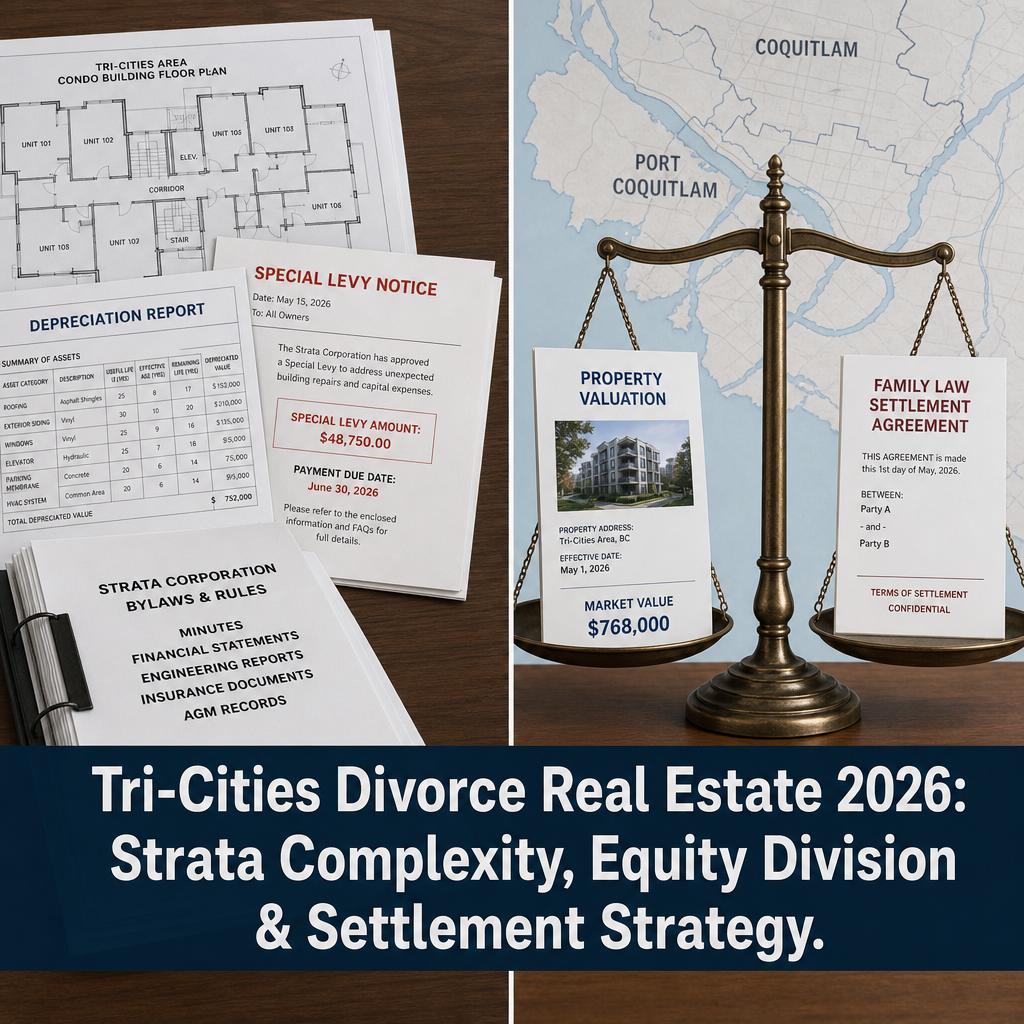

Tri-Cities Divorce Real Estate 2026: How Strata Complexity, Condo-Heavy Markets, and Rapid Equity Appreciation in Coquitlam, Port Coquitlam, and Port Moody Reshape Settlement Negotiations and Sale Strategy
By Mohamed Mansour, MBA and Associate Broker | Mansour Real Estate Group | Published: July 15, 2025 | Geographic Focus: Coquitlam, Port Coquitlam, Port Moody — Tri-Cities, Metro Vancouver, BC
Separating couples in Coquitlam, Port Coquitlam, and Port Moody face a real estate challenge most family lawyers and even many realtors underestimate. The Tri-Cities is one of Metro Vancouver's most strata-dense ownership markets, with condos and townhomes making up an estimated 40 to 50 percent of residential inventory. That concentration creates a set of complications — depreciation reports, special levy risk, buyer financing obstacles, and appraisal gaps — that can materially change what a settlement is worth in practice versus what it says on paper.
This article is for separating homeowners in the Tri-Cities who own a condo or townhouse and need to understand how strata-specific factors interact with family law equity division before they commit to either a joint sale or a spousal buyout. It draws on the BC Family Law Act, Strata Property Act protocols, CMHC appraisal guidelines, and transaction experience in this market.
Short Answer
Divorcing couples who own strata property in the Tri-Cities face equity division complications that don't apply to detached-home markets. Depreciation report findings, pending special levies, and buyer financing obstacles can reduce realized sale proceeds 5 to 10 percent below list price — altering settlement math and creating disputes over valuation timing. Understanding these dynamics before entering negotiations is essential.
Key Takeaways
- Tri-Cities strata properties represent 40–50% of residential inventory, making strata complexity a central divorce real estate issue in this market.
- Equity appreciation of 15–25% since 2020 increases the asset value at stake and raises the frequency of buyout versus joint-sale disputes.
- Depreciation reports and special levy risk can reduce buyer financing approval and appraisals 5–10% below list price, changing net proceeds at close.
- Strata sales average 35–50 days on market in the Tri-Cities, extending carrying-cost pressure when legal timelines and real estate timelines collide.
- Spousal buyout qualification for a strata condo is harder than for a detached home — lenders factor strata fees, levy risk, and building condition into mortgage decisions.
Who This Applies To
- Separating couples who jointly own a condo or townhouse in Coquitlam, Port Coquitlam, or Port Moody
- One spouse seeking to buy out the other and keep the strata property
- Couples whose settlement negotiations are stalled over property valuation disagreements
- Homeowners whose building has a recent or upcoming depreciation report or special levy
- Families coordinating family law timelines with a strata sale that is taking longer than expected
When This Advice May Not Apply
If you own a detached home in the Tri-Cities, most strata-specific issues covered here will not affect your sale. For detached-home strategy in a separation context, the broader framework at Selling a Home During Divorce in BC applies more directly. This article also does not constitute legal, mortgage, or tax advice — consult qualified professionals for guidance specific to your situation.
Key Terms
Depreciation Report: A document required under the BC Strata Property Act that assesses the physical condition of a strata building and projects future repair costs. Lenders and buyers review it before committing to a purchase.
Special Levy: A one-time charge assessed against strata unit owners to fund a major repair or capital expense not covered by the reserve fund. Pending levies must be disclosed and can reduce buyer willingness or financing approval.
Reserve Fund: Money collected from strata owners to fund future common property repairs. An underfunded reserve signals higher levy risk to buyers and lenders.
Family Property under the BC Family Law Act: Assets acquired during a relationship that are subject to equal division on separation, subject to specific exclusions and agreements. The property's value at the date of division — not the date of purchase — determines the amount each spouse receives.
Spousal Buyout: One spouse refinances the jointly-owned property into their sole name, compensating the other spouse for their share of equity. Lenders evaluate the buyer's income, debt load, strata fees, and the building's condition when qualifying a buyout mortgage.
Data Used in This Article
- FVREB Tri-Cities Market Data, 2026 (official board statistics — days on market, inventory mix)
- BC Family Law Act, SBC 2011 c. 25 (Tier 1 — provincial legislation governing property division on separation)
- BC Strata Property Act, RSBC 1998 c. 43 (Tier 1 — depreciation report and special levy requirements)
- CMHC mortgage qualification and appraisal guidelines for strata property in BC (Tier 2 — federal housing authority guidance)
- Mansour Real Estate Group Tri-Cities transaction database (Tier 5 — internal professional experience, generalized)
Why the Tri-Cities Strata Market Creates Distinct Divorce Complications
The Tri-Cities grew rapidly through transit-oriented condo development along the Evergreen Line and through townhouse projects in newer Coquitlam neighbourhoods. That growth produced a residential inventory heavily weighted toward strata ownership — estimated at 40 to 50 percent condos and townhomes, compared to roughly 25 to 30 percent across broader Metro Vancouver, according to FVREB market composition data.
When a separating couple owns a strata property, they are not simply dividing a home. They are dividing an ownership interest in a collective building whose financial condition — reserve fund adequacy, depreciation report findings, and any pending special levies — directly affects what a buyer will pay and what a lender will finance. Under the BC Strata Property Act, depreciation reports must be produced at least every five years for buildings with five or more strata lots, and their contents become part of every disclosure package. A report showing significant deferred maintenance or an underfunded reserve can push buyer offers 5 to 10 percent below a seller's asking price, and lenders may impose additional conditions or decline financing altogether.
This matters in a divorce context because settlement agreements often reference a property value — whether through a formal appraisal or a negotiated figure — and when the realized sale price lands meaningfully below that number, the financial outcome for both parties changes. The spouse who agreed to accept a buyout at an assumed value, or who deferred their portion pending sale, may find the actual proceeds do not match what was modelled. For a practical framework on valuation fairness during separation, see BC Family Law Act and Real Estate: What Separating Couples in Metro Vancouver Must Know.
Equity Appreciation, Valuation Timing, and Why the Numbers Are Contested
Strata values across Coquitlam, Port Coquitlam, and Port Moody have appreciated approximately 15 to 25 percent since 2020, based on FVREB benchmark tracking. That appreciation has created meaningfully larger assets to divide — and meaningfully higher conflict over which value applies to the settlement.
Under the BC Family Law Act, family property is generally divided based on value at the date of separation, but the property may not actually sell for months afterward. If the market has moved during that window — upward or downward — both spouses face different financial realities than their settlement assumed. A spouse proposing a buyout has a strong incentive to value the property at the low end of the range. The spouse leaving the property has the opposite incentive. This is not unique to the Tri-Cities, but the strata concentration here amplifies the problem because depreciation report timing and special levy announcements can cause legitimate, rapid value shifts that neither party anticipated.
The practical resolution is typically a formal appraisal from a BCFSA-regulated appraiser, commissioned jointly or with one appraisal per party and a blended result agreed upon in the settlement. When couples cannot agree on value, courts may order an appraisal. What an appraisal alone will not capture is strata-specific buyer financing risk — a distinction explored in the next section. For couples navigating this decision, Should You Sell or Keep the House After Divorce in Metro Vancouver? A Decision Framework provides a useful starting point.
Days on market for Tri-Cities strata properties average 35 to 50 days, according to FVREB data. That timeline, compounded by the requirement to obtain strata documents, prepare disclosure packages, and manage the often-adversarial dynamic of a divorce sale, can push total transaction timelines well past what family law counsel expects. Carrying costs — mortgage payments, strata fees, and property taxes — continue to accumulate for both spouses during that window, eroding net proceeds.
How We Evaluate This
At Mansour Real Estate Group, our approach to divorce-related strata sales in the Tri-Cities begins with a document review before a pricing strategy is set. We look at the most recent depreciation report, the reserve fund study, strata meeting minutes for the past two years, and any special levy notices or pending capital projects. These documents are not optional review items — they are pricing inputs.
Once we understand the building's financial position, we assess realistic buyer financing risk based on current CMHC guidelines and lender behaviour in this specific building or building type. That analysis informs both the list price and the conversation with family law counsel about what net proceeds are likely to look like. We present this to both parties or their lawyers as factual context, not advocacy for either side. Our role in a divorce sale is to be the neutral professional who brings market reality into the room — not to favour the outcome that one spouse prefers. For more on how to select a neutral realtor for this type of transaction, see How to Choose a Neutral Realtor for a Divorce Sale in Metro Vancouver and the Lower Mainland.
Buyer Financing Obstacles and the 7–14 Day Renegotiation Problem
One of the most disruptive patterns in Tri-Cities strata divorce sales is what happens after an offer is accepted. Buyers typically have 7 to 10 days to complete their subject removal conditions, which include financing approval and strata document review. When a depreciation report reveals significant deferred maintenance, or when a special levy is pending but not yet formalized, buyers' lenders may revise their appraisal or decline to fund at the agreed price. The buyer then renegotiates — or walks.
In a normal sale, this is an inconvenience. In a divorce sale, it can be a crisis. If the settlement agreement has already referenced a specific sale price as the basis for equity division — or if one spouse has already committed to a post-sale financial decision — a renegotiation that drops the price by 5 to 10 percent forces a reopening of legal negotiations. Family lawyers are not always available to respond within the subject removal window, creating a gap between real estate timelines and legal timelines that can cause offers to collapse entirely.
CMHC guidelines for strata property financing require that the building meet specific criteria around financial health and depreciation risk. Buildings with inadequate reserves or recent special levies above a certain threshold may be subject to additional lender scrutiny. For Tri-Cities buildings constructed in the 1990s or early 2000s — a significant portion of the ownership stock — depreciation reports frequently flag envelope repairs, elevator systems, or parkade waterproofing as upcoming capital needs. These findings are not necessarily deal-breakers, but they must be priced into the sale strategy and disclosed to both spouses before negotiations are finalized. For deeper guidance on strata-specific sale execution, see the upcoming article Selling a Strata Condo or Townhouse During Divorce in Metro Vancouver: What You Need to Know.
Spousal Buyout Challenges Specific to Strata Properties
A spousal buyout — where one spouse refinances the property into their sole name and compensates the other — is harder to execute for a Tri-Cities strata condo than for a detached home, for three compounding reasons.
First, strata fees reduce the buying spouse's qualifying income. Lenders include monthly strata fees in the debt-service calculation under CMHC and standard bank guidelines. For a Tri-Cities condo with strata fees of $400 to $600 per month — common in mid-size buildings — this reduces the mortgage the remaining spouse can qualify for, sometimes by enough to make the buyout impossible without a co-signer or a larger down payment from proceeds elsewhere.
Second, the building's financial condition affects lender willingness independent of the borrower's credit. If the depreciation report flags significant upcoming capital costs, some lenders will decline to finance the unit at all, or will require a larger down payment to offset perceived risk. This is a building-level problem, not a personal-credit problem — and it catches many separating couples off guard.
Third, if a special levy is pending at the time of the buyout, the buying spouse inherits that liability. The departing spouse may not realize this obligation has been transferred until after the settlement is finalized. Legal counsel should explicitly address special levy allocation in any separation agreement involving strata property. The upcoming article Spousal Buyout Mortgage Qualifying in BC: Can You Afford to Keep the House After Divorce? covers this financing layer in full.
Divorce Sale Checklist — Tri-Cities Strata Property
- Obtain all strata documents: depreciation report, reserve fund study, Form B, two years of strata meeting minutes, and any special levy notices.
- Commission a formal appraisal from a BCFSA-regulated appraiser — ideally agreed upon jointly by both parties or their counsel.
- Identify any pending or anticipated special levies and confirm in writing which party is responsible for payment if a levy is assessed before or after closing.
- Confirm the reserve fund balance relative to the depreciation report's 10-year spending forecast and discuss with your realtor how this affects buyer financing risk and pricing strategy.
- Ensure both spouses' family law counsel have reviewed the strata document package before the list price is set — not after an offer arrives.
- If one spouse is pursuing a buyout, have them obtain a mortgage pre-approval that accounts for strata fees and building condition before that option is finalized in a settlement agreement.
- Build a contingency of 5 to 10 percent into projected net proceeds to account for buyer-financing renegotiation risk specific to the building's condition.
- Align real estate and legal timelines explicitly — confirm that both lawyers can respond within a 7–10 day subject removal window before accepting an offer.
What We Commonly See
Settlements anchored to list price, not net proceeds. In our experience, family law settlements in the Tri-Cities strata context frequently reference a list price or an informal estimated value — and then both parties are surprised when the actual closing proceeds are 5 to 10 percent lower due to buyer renegotiation after strata document review. The agreement was accurate to the listing; it was not accurate to the market.
Special levy disclosure missed at the agreement stage. What often happens is that a special levy is approved at a strata AGM between the date the separation agreement is drafted and the date the property closes. Neither party anticipated it, neither lawyer included it, and by the time it is disclosed, both spouses feel the other side should absorb the cost. This is a strata-specific problem that a well-prepared realtor and legal team will address in the agreement language before it becomes a dispute.
Buyout approved in principle, declined by lender. A common mistake is treating a spousal buyout as a done deal once both parties agree in principle, without first confirming that the lender will approve the mortgage on this specific building. We have seen situations where the remaining spouse qualified on income and credit, but the lender declined financing because of the building's depreciation report. The departing spouse then needed to re-enter negotiations for a joint sale — sometimes months later and under worse market conditions.
Questions and Answers
Does a pending special levy affect how the divorce settlement is calculated?
Yes, under the BC Strata Property Act, a special levy is an obligation of the owner of record at the time the levy is assessed. If the property has not yet sold and a levy is announced during the separation period, both spouses should have their legal counsel clarify in the separation agreement which party bears that cost. Failure to address it explicitly is a common and expensive oversight.
Can a jointly-owned strata condo be sold during divorce without both spouses signing?
No. Both registered owners must sign the listing agreement and the contract of purchase and sale in BC. If one spouse refuses to cooperate, the other may need to apply to the BC Supreme Court under the Family Law Act to obtain an order compelling the sale. This process can add months to an already-extended strata sale timeline. Position 3 of this cluster covers those legal options in detail at Can One Spouse Force the Sale of the Family Home in BC?
How does a depreciation report affect buyer mortgage approval in the Tri-Cities?
Under CMHC guidelines, lenders assess the financial health of the strata corporation when approving insured mortgages. A depreciation report identifying significant deferred maintenance, or a reserve fund that is materially underfunded relative to projected capital needs, can lead lenders to require a larger down payment, reduce the maximum loan amount, or decline to finance the unit. This directly reduces the pool of qualified buyers and can lower the effective market value of the unit.
In Summary
Divorcing couples in Coquitlam, Port Coquitlam, and Port Moody who own strata property face a layered set of complications that detached-home owners in the same legal situation do not. Equity appreciation has made the asset more valuable — and more contested. Strata-specific factors including depreciation reports, special levy risk, and buyer financing obstacles systematically reduce realized proceeds below what settlements often assume. Spousal buyouts are harder to execute for condos and townhomes than for detached homes. And the 35-to-50-day Tri-Cities strata sale timeline creates carrying-cost pressure that compounds the financial stress of separation. Getting independent real estate and legal advice before settlement terms are set — not after an offer is on the table — is the most consistent way to avoid the gaps that cause these situations to become protracted disputes. Separating couples who want to understand whether they qualify as a divorce real estate specialist client can start there for guidance on what that engagement looks like in BC.
Speak with Mansour Real Estate Group
If you or your legal counsel have questions about how strata property conditions, valuation, or sale strategy apply to your separation in the Tri-Cities, Mansour Real Estate Group is available for a private, no-obligation conversation. We work with both parties' counsel and can provide factual market context without advocating for either side.
Related Articles
- Selling a Home During Divorce in BC: A Complete Guide for Metro Vancouver and Fraser Valley Families
- Should You Sell or Keep the House After Divorce in Metro Vancouver? A Decision Framework
- Selling a Strata Condo or Townhouse During Divorce in Metro Vancouver: What You Need to Know
Official Resources
- BC Family Law Act — BC Laws
- BC Strata Property Act — BC Laws
- Canada Mortgage and Housing Corporation — Strata Financing Guidelines
- Fraser Valley Real Estate Board — Market Statistics
About
Related Articles
- Selling a Home During Divorce in BC: A Complete Guide for Metro Vancouver and Fraser Valley Families
- BC Family Law Act and Real Estate: What Separating Couples in Metro Vancouver Must Know
- Should You Sell or Keep the House After Divorce in Metro Vancouver? A Decision Framework
- How to Choose a Neutral Realtor for a Divorce Sale in Metro Vancouver and the Lower Mainland
- What Is a Divorce Real Estate Specialist and Do You Need One in BC?
About Mansour Real Estate Group
When a home must be sold as part of a separation or divorce, the stakes extend beyond the property itself. Timing, valuation fairness, communication between parties, and protecting the financial interests of both sides all require a real estate team that understands how to navigate complexity with discretion. Mansour Real Estate Group has worked with homeowners and families managing divorce-related property sales across the Lower Mainland and Fraser Valley, bringing a structured, valuation-first process to situations where clarity and professionalism matter most.
Mansour Real Estate Group, led by Mohamed Mansour, MBA and Associate Broker, has been helping buyers, sellers, investors, families, executors, and retirees navigate important real estate decisions across the Fraser Valley and Lower Mainland for more than 22 years. Ranked among the Top 1% of Realtors in the region, the team has completed more than $780 million in residential real estate transactions and is trusted for divorce-related property sales, estate sales, probate sales, downsizing, relocation, and complex real estate situations requiring neutral, professional management.
Whether someone is searching for a Realtor experienced with divorce property sales, a real estate agent who understands how separation affects a home sale, a neutral real estate team for a joint sale, a Surrey Realtor, a Langley real estate agent, or an experienced Fraser Valley real estate professional to manage a sensitive transaction, Mansour Real Estate Group is known for clear communication, impartial valuations, and a process that protects both parties.
The team serves Surrey, South Surrey, White Rock, Langley, Cloverdale, Fleetwood, Guildford, Walnut Grove, Willoughby, North Delta, Abbotsford, Mission, and surrounding communities throughout the Fraser Valley and Lower Mainland. Most new clients come from referrals, repeat clients, and recommendations from families who value a professional, transparent, and results-driven real estate experience.
Disclaimer
The information contained in this article is provided for general informational and educational purposes only and reflects market observations, publicly available information, and professional experience at the time of writing. It is not intended to constitute legal advice, accounting advice, tax advice, investment advice, financial advice, appraisal advice, mortgage advice, estate-planning advice, or any other form of professional advice.
Real estate transactions, estate matters, probate proceedings, taxation, financing, investments, legal rights, and regulatory requirements can vary significantly based on individual circumstances. Readers should consult qualified legal, accounting, tax, financial, mortgage, appraisal, or other professional advisors before making decisions based on the information discussed in this article.
Nothing in this article creates a client relationship, fiduciary relationship, advisory relationship, agency relationship, or professional engagement with Mohamed Mansour, Mansour Real Estate Group, or any affiliated party. Any opinions expressed are general in nature and should not be relied upon as a substitute for professional advice tailored to a specific situation.
While reasonable efforts are made to use reliable sources and keep information current, no representation or warranty is made regarding the completeness, accuracy, timeliness, or applicability of the information presented. Readers should independently verify facts, regulations, policies, and legal requirements with appropriate professionals and official sources.
Related Articles
- Selling a Home During Divorce in BC: A Complete Guide for Metro Vancouver and Fraser Valley Families
- BC Family Law Act and Real Estate: What Separating Couples in Metro Vancouver Must Know
- Should You Sell or Keep the House After Divorce in Metro Vancouver? A Decision Framework
- How to Choose a Neutral Realtor for a Divorce Sale in Metro Vancouver and the Lower Mainland
- What Is a Divorce Real Estate Specialist and Do You Need One in BC?
About Mansour Real Estate Group
When a home must be sold as part of a separation or divorce, the stakes extend beyond the property itself. Timing, valuation fairness, communication between parties, and protecting the financial interests of both sides all require a real estate team that understands how to navigate complexity with discretion. Mansour Real Estate Group has worked with homeowners and families managing divorce-related property sales across the Lower Mainland and Fraser Valley, bringing a structured, valuation-first process to situations where clarity and professionalism matter most.
Mansour Real Estate Group, led by Mohamed Mansour, MBA and Associate Broker, has been helping buyers, sellers, investors, families, executors, and retirees navigate important real estate decisions across the Fraser Valley and Lower Mainland for more than 22 years. Ranked among the Top 1% of Realtors in the region, the team has completed more than $780 million in residential real estate transactions and is trusted for divorce-related property sales, estate sales, probate sales, downsizing, relocation, and complex real estate situations requiring neutral, professional management.
Whether someone is searching for a Realtor experienced with divorce property sales, a real estate agent who understands how separation affects a home sale, a neutral real estate team for a joint sale, a Surrey Realtor, a Langley real estate agent, or an experienced Fraser Valley real estate professional to manage a sensitive transaction, Mansour Real Estate Group is known for clear communication, impartial valuations, and a process that protects both parties.
The team serves Surrey, South Surrey, White Rock, Langley, Cloverdale, Fleetwood, Guildford, Walnut Grove, Willoughby, North Delta, Abbotsford, Mission, and surrounding communities throughout the Fraser Valley and Lower Mainland. Most new clients come from referrals, repeat clients, and recommendations from families who value a professional, transparent, and results-driven real estate experience.
Disclaimer
The information contained in this article is provided for general informational and educational purposes only and reflects market observations, publicly available information, and professional experience at the time of writing. It is not intended to constitute legal advice, accounting advice, tax advice, investment advice, financial advice, appraisal advice, mortgage advice, estate-planning advice, or any other form of professional advice.
Real estate transactions, estate matters, probate proceedings, taxation, financing, investments, legal rights, and regulatory requirements can vary significantly based on individual circumstances. Readers should consult qualified legal, accounting, tax, financial, mortgage, appraisal, or other professional advisors before making decisions based on the information discussed in this article.
Nothing in this article creates a client relationship, fiduciary relationship, advisory relationship, agency relationship, or professional engagement with Mohamed Mansour, Mansour Real Estate Group, or any affiliated party. Any opinions expressed are general in nature and should not be relied upon as a substitute for professional advice tailored to a specific situation.
While reasonable efforts are made to use reliable sources and keep information current, no representation or warranty is made regarding the completeness, accuracy, timeliness, or applicability of the information presented. Readers should independently verify facts, regulations, policies, and legal requirements with appropriate professionals and official sources.



