

Townhome and Attached Housing Sellers in the Fraser Valley 2026: Why the 15–23% Sales-to-Active Ratio Creates Pricing Power — And How to Position Your Property Before Summer Competition Peaks
By Mohamed Mansour, MBA and Associate Broker | Mansour Real Estate Group | Fraser Valley and Lower Mainland | Published June 2026
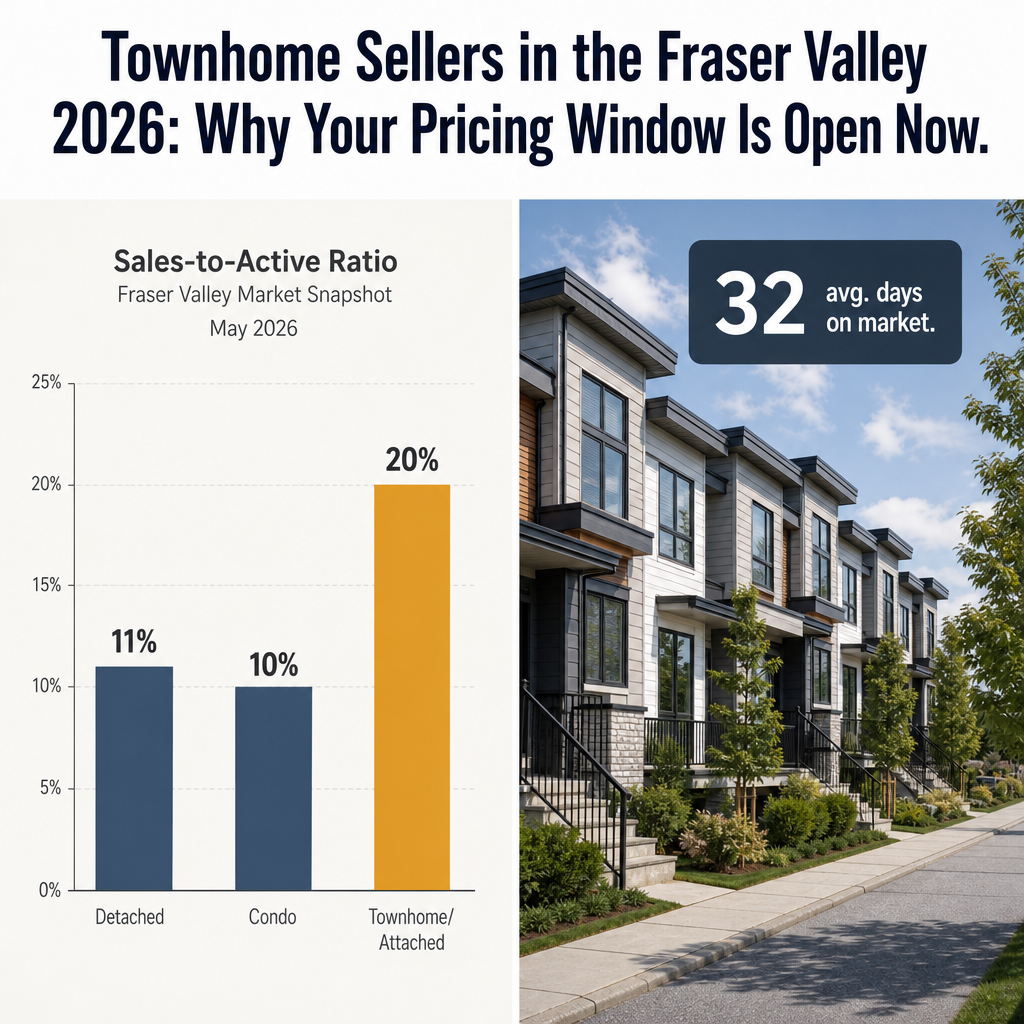
Most Fraser Valley sellers in 2026 are navigating a buyer's market. Overall, the sales-to-active listings ratio sits at roughly 11% — firmly in buyer's market territory, where negotiating pressure falls on sellers. But that headline number obscures something important: the townhome and attached housing segment is operating under materially different conditions. If you own a townhome, duplex, or attached home in the Fraser Valley and are considering selling, this distinction is directly relevant to your strategy.
According to data from the Fraser Valley Real Estate Board's April and May 2026 market reports, attached housing sales-to-active ratios across key Fraser Valley submarkets have reached 15–23% — approaching or entering balanced-market territory while the rest of the market lags behind. That gap creates a short-term pricing window that most sellers in this segment do not yet know they have.
Short Answer
Fraser Valley townhome and attached housing sellers currently hold more negotiating strength than the overall market suggests. With sales-to-active ratios of 15–23% in this segment as of spring 2026 — compared to 11% overall — and an average of 32 days on market (the fastest of any property type), sellers who price accurately and list before summer inventory peaks can expect better offers and less negotiating pressure than detached or condo sellers face right now.
Key Takeaways
- Fraser Valley townhomes averaged 32 days on market in April 2026 — faster than detached (37 days) and condos (42 days), according to FVREB data.
- The townhome benchmark price declined only 7.3% year-over-year in March 2026, outperforming condos (-9.2%) and detached homes (-8.1%).
- Sales-to-active ratios for attached housing reached 15–23% in spring 2026, while the overall Fraser Valley ratio remained at approximately 11%.
- This segment gap is driven by consistent demand from young families, downsizers, and investors — groups that have not pulled back as sharply as detached-home buyers.
- The window is time-sensitive: summer listings will add competition, and pricing discipline before that shift matters more than timing alone.
Who This Applies To
- Homeowners selling a townhome, rowhouse, duplex, or attached property in Surrey, Langley, Abbotsford, Cloverdale, Willoughby, Walnut Grove, Fleetwood, or surrounding Fraser Valley areas
- Sellers who have been waiting for market conditions to improve before listing
- Downsizers moving from a detached home into a condo or rental who need to sell their attached property first
- Investors considering a portfolio adjustment in 2026
- Estate executors or separated couples whose property happens to be an attached or strata home
When This Advice May Not Apply
Properties with strata issues — special levies, deferred maintenance, unfunded depreciation reports, or ongoing building envelope concerns — face a different buyer dynamic regardless of segment performance. An attached home with structural or documentation problems is not protected by segment trends. This guidance also applies less to older, high-density attached buildings that function more like condos in buyer perception.
Data Used in This Article
- Fraser Valley Real Estate Board — April 2026 Statistics Package | Published April 2026 | Fraser Valley geography | Official board data (days on market, sales-to-active ratio, benchmark pricing by property type)
- Fraser Valley Real Estate Board — March 2026 Statistics Package | Published March 2026 | Fraser Valley geography | Official board data (benchmark price year-over-year by property type)
- Fraser Valley Real Estate Board — Monthly Market Report (May 2026) | Published May 2026 | Fraser Valley geography | Official board commentary and month-over-month activity trends
Key Definitions
Sales-to-active listings ratio: The percentage of active listings that sell within a given month. Below 12% is generally considered a buyer's market; 12–20% is balanced; above 20% favours sellers.
Benchmark price: The price of a "typical" property in a market, adjusted for quality differences. Published monthly by the FVREB. More representative than average sale price.
Attached housing: Includes townhomes, rowhouses, duplexes, and semi-detached properties. Distinct from condos (strata apartment units) in both buyer appeal and market behaviour.
What the Sales-to-Active Ratio Actually Tells a Townhome Seller
The sales-to-active listings ratio is one of the most useful tools for understanding negotiating position before listing. When 15–23% of active listings sell in a given month, buyers are competing for available inventory rather than simply having their pick of options. That changes the offer dynamic meaningfully — buyers make faster decisions, subject-removal timelines tighten, and price reductions become less common.
For context: the Fraser Valley's overall market sat at approximately 11% in spring 2026, according to FVREB April and May reports. That's a buyer's market. Detached sellers at 11% face extended days on market, price negotiation from a position of buyer strength, and genuine uncertainty about how long a listing will sit. The townhome segment, running at 15–23%, faces none of those conditions to the same degree.
The 32-day average time to sell (FVREB April 2026) compared to 37 days for detached and 42 days for condos confirms this is not a coincidence. Demand for townhomes has held up where other segments have softened. Understanding how local data shapes a listing strategy is what separates a well-timed sale from a price reduction two weeks in.
Why Townhomes Are Outperforming — And Whether It Will Last
Three buyer groups are driving consistent demand for townhomes and attached housing in the Fraser Valley regardless of overall market softness. Young families in Surrey, Langley, Willoughby, and Abbotsford who cannot yet afford a detached home represent the core of this demand — they need space, yard access, and proximity to schools, and a townhome is the practical solution. Downsizers from larger homes who want to reduce maintenance without moving into a condo building represent a second consistent buyer pool. Investors looking at rental income and holding costs in a market where condo performance has slipped more sharply represent a third.
None of those groups has disappeared. If anything, the affordability ceiling on detached homes has pushed more buyers toward attached housing as a first or transitional property. This is a structural demand pattern, not a seasonal spike — which is why the segment has held its benchmark price better than either condos or detached homes over the past year.
Whether it lasts depends partly on inventory. If a wave of townhome sellers list in June and July — which the FVREB's elevated overall inventory count of 10,000+ listings suggests is already happening at a macro level — the current ratio advantage will narrow. That is the practical argument for acting before summer inventory peaks rather than waiting to see if conditions improve further. Sellers in Abbotsford, in particular, should note that submarket dynamics can shift faster than regional averages suggest.
How We Evaluate This
When we review a townhome listing opportunity in 2026, we look at the sales-to-active ratio for attached housing specifically in that municipality — not the Fraser Valley overall. A 20% ratio in Willoughby means something different than a 15% ratio in central Abbotsford, and both differ from what's happening in South Surrey. The regional number establishes the trend; the submarket number determines the specific pricing room.
We then cross-reference benchmark pricing movement with the seller's specific property attributes — strata age, depreciation report status, parking, outdoor space, school catchment — because those factors either amplify or limit what the ratio trend allows. A well-positioned townhome in a sought-after school district can hold closer to ask price than one in a building with deferred maintenance, even in the same submarket. The ratio tells you the playing field. The property details tell you where on that field you stand. Choosing a listing agent who runs this kind of analysis before pricing is a foundational decision.
Townhome Seller Checklist
- Obtain current strata documents — Form B, depreciation report, meeting minutes, and financial statements — before listing, not after an offer comes in
- Confirm there are no outstanding or pending special levies that will need to be disclosed
- Price based on current sold comparables within 90 days, not pre-2025 sold data, which overstates value in most Fraser Valley submarkets
- Address visible maintenance items — fencing, patios, front landscaping — that affect first-impression appeal without requiring strata approval
- Clarify parking and storage designations in your strata plan before listing — buyer financing can be delayed by unclear strata parking documentation
- Request a submarket-specific sales-to-active analysis from your listing agent — not a regional average — before setting your list price
- Plan your listing timing around buyer traffic patterns: mid-week listing with weekend open house access has consistently outperformed end-of-week launches in this segment
What We Commonly See
In our experience, townhome sellers in the Fraser Valley underestimate their position relative to detached sellers. They hear "buyer's market" in the news and price defensively — accepting more negotiation and offering more concessions than the actual data for their segment requires. A seller who prices to the 11% overall market rather than the 20% attached-housing market in their submarket is essentially giving up negotiating ground that the data would have supported.
A common mistake is pricing based on the last sold comparable without adjusting for property-specific differences — particularly strata age, depreciation report health, and outdoor space. Two townhomes in the same complex can justify meaningfully different prices if one has a newer depreciation report showing a well-funded contingency reserve and the other shows significant deferred maintenance. Buyers financing with a mortgage are sensitive to this because lenders sometimes restrict financing on strata properties with identified reserve shortfalls.
What often happens is that sellers who list in July or August — thinking summer is prime time — actually enter a more crowded field. The spring window is not about weather. It's about when motivated buyers are actively looking, subject-removal timelines are shorter, and competing inventory has not yet peaked. This timing dynamic is especially pronounced in South Surrey and White Rock's attached-housing market, where school-driven purchase decisions peak before the academic calendar turns.
Questions and Answers
Q: Does the 15–23% sales-to-active ratio apply across all of the Fraser Valley, or only in certain areas?
A: It varies by submarket. The 15–23% range reflects Fraser Valley attached housing broadly, per FVREB spring 2026 data, but specific ratios differ by city. Surrey, Langley, and Willoughby have shown the strongest attached-housing demand. Sellers should ask for a submarket-specific analysis, not just the regional figure.
Q: My townhome is in a building with an older depreciation report. Does that change my position?
A: Yes, materially. Buyers reviewing strata documents pay close attention to the depreciation report and contingency reserve fund. A property in a building with deferred maintenance or an underfunded reserve faces more buyer hesitation and price negotiation than the segment average suggests. Your list price should account for this honestly.
Q: Is the spring window already over, or is there still time to act?
A: Based on FVREB May 2026 data, month-over-month townhome sales continued to trend upward through spring. The window has not closed, but elevated overall inventory of 10,000+ listings across the Fraser Valley means the competitive landscape will shift as summer listings enter the market. Acting before that shift matters more than exact timing to the week.
In Summary
Fraser Valley townhome and attached housing sellers hold a meaningful market advantage in spring 2026 that is not reflected in the headline buyer's market narrative. Sales-to-active ratios of 15–23% for attached housing, an average of 32 days on market, and relative benchmark price stability compared to detached homes and condos all point to a segment operating under its own conditions. That advantage is real, but it requires accurate pricing, clean strata documentation, and a listing strategy built around submarket data — not regional averages. The summer inventory build is coming. Positioning before it arrives is the practical application of what the data currently supports.
Talk to Mansour Real Estate Group
If you own a townhome or attached home in the Fraser Valley and want to understand exactly where your submarket ratio sits right now, Mansour Real Estate Group can provide a current, property-specific analysis — no pressure, no obligation.
Related Articles
- Best Real Estate Agent in Surrey BC: What the Data Actually Shows
- How to Find the Best Realtor in White Rock BC
- How to Evaluate a Realtor's Marketing Strategy Before You List in Metro Vancouver
About Mansour Real Estate Group
When a townhome seller in the Fraser Valley needs to understand whether current market conditions support their pricing expectations — or whether they are leaving equity on the table by pricing to the wrong benchmark — that analysis requires a real estate team that works directly in this segment, not one applying regional averages to a property that deserves submarket precision. Mansour Real Estate Group has built its approach around exactly that: pricing discipline grounded in local, property-type-specific data rather than headline market summaries.
Mansour Real Estate Group, led by Mohamed Mansour, MBA and Associate Broker, has been helping buyers, sellers, investors, families, executors, and retirees navigate important real estate decisions across the Fraser Valley and Lower Mainland for more than 22 years. Ranked among the Top 1% of Realtors in the region, the team has completed more than $780 million in residential real estate transactions and is trusted for pricing strategy, townhome and strata sales, seller preparation, estate sales, divorce-related sales, downsizing, and any situation where accurate, segment-specific valuation is critical to the outcome.
Whether someone is searching for Realtors who understand the attached housing market in Surrey or Langley, a real estate agent with direct townhome sales experience in the Fraser Valley, a real estate team that reviews strata documentation before pricing, a Cloverdale Realtor, a Willoughby real estate agent, a Langley real estate broker, or a real estate group that serves the full Fraser Valley and Lower Mainland, Mansour Real Estate Group is known for honest valuations, clear market context, and a process that protects sellers from common and costly pricing errors.
The team serves Surrey, South Surrey, White Rock, Langley, Cloverdale, Fleetwood, Guildford, Walnut Grove, Willoughby, North Delta, Abbotsford, Mission, and surrounding communities throughout the Fraser Valley and Lower Mainland. Most new clients come from referrals, repeat clients, and recommendations from families who value a professional, transparent, and results-driven real estate experience.
Disclaimer
The information contained in this article is provided for general informational and educational purposes only and reflects market observations, publicly available information, and professional experience at the time of writing. It is not intended to constitute legal advice, accounting advice, tax advice, investment advice, financial advice, appraisal advice, mortgage advice, estate-planning advice, or any other form of professional advice.
Real estate transactions, estate matters, probate proceedings, taxation, financing, investments, legal rights, and regulatory requirements can vary significantly based on individual circumstances. Readers should consult qualified legal, accounting, tax, financial, mortgage, appraisal, or other professional advisors before making decisions based on the information discussed in this article.
Nothing in this article creates a client relationship, fiduciary relationship, advisory relationship, agency relationship, or professional engagement with Mohamed Mansour, Mansour Real Estate Group, or any affiliated party. Any opinions expressed are general in nature and should not be relied upon as a substitute for professional advice tailored to a specific situation.
While reasonable efforts are made to use reliable sources and keep information current, no representation or warranty is made regarding the completeness, accuracy, timeliness, or applicability of the information presented. Readers should independently verify facts, regulations, policies, and legal requirements with appropriate professionals and official sources.



