
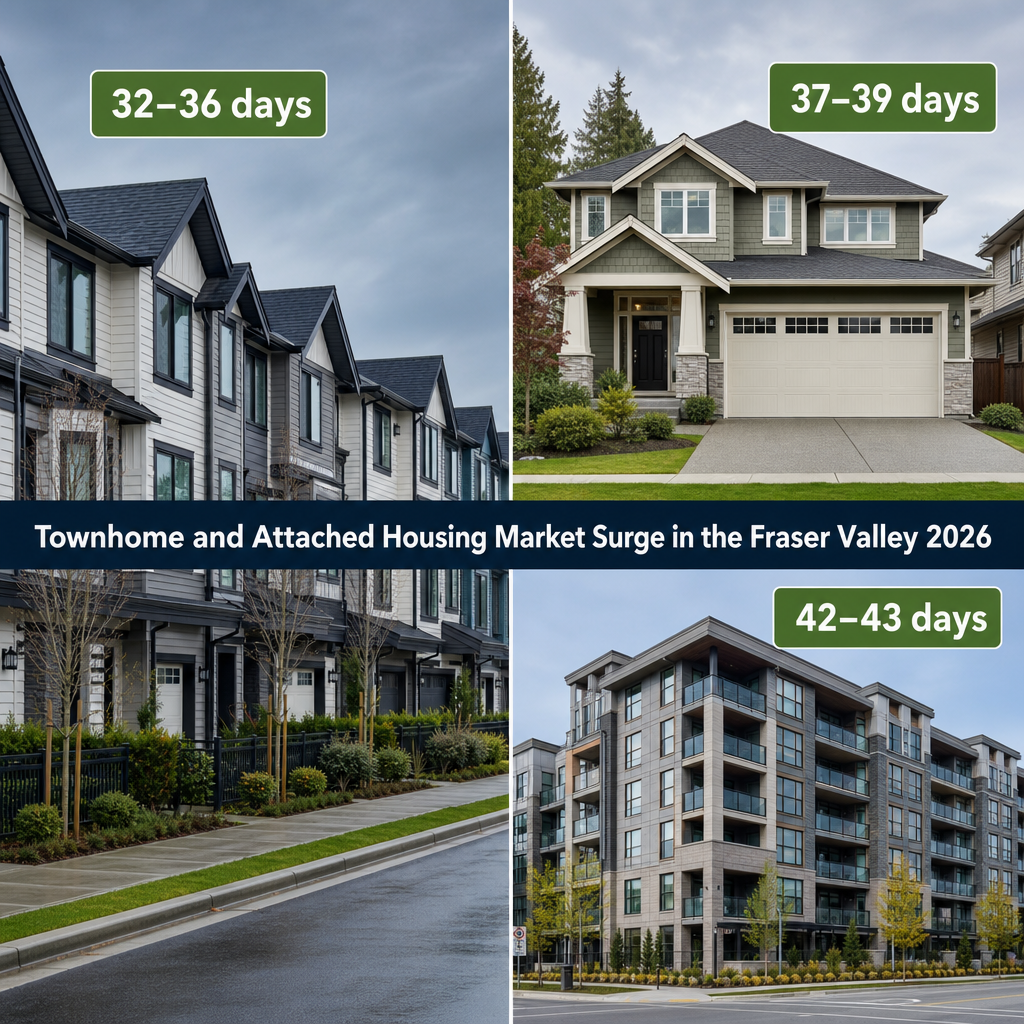

Townhome and Attached Housing Market Surge in the Fraser Valley 2026: Why Sales-to-Active Ratios of 15–23% Create Seller Advantage When Detached Homes and Condos Remain Buyer-Favoured
By Mohamed Mansour, MBA and Associate Broker | Mansour Real Estate Group | Fraser Valley and Lower Mainland | Published: July 7, 2025 | Geography: Fraser Valley, Surrey, Langley, Abbotsford, South Surrey | Topic: Attached Housing Seller Strategy
Most Fraser Valley sellers right now are navigating a buyer-favoured market — elevated inventory, longer days on market, and cautious buyers. But not all property types are experiencing the same pressure. Attached housing, particularly townhomes, is clearing noticeably faster than both detached homes and condos. If you own a townhome in Surrey, Langley, or Abbotsford, you are operating in a different negotiating environment than your neighbours selling detached properties.
This article uses data from the Fraser Valley Real Estate Board's April and May 2026 statistical packages to explain what that difference looks like, why it exists, and how townhome sellers can position themselves to take full advantage of it.
Short Answer
Fraser Valley townhomes sold in 32–36 days in April–May 2026, compared to 37–39 days for detached homes and 42–43 days for condos, according to the FVREB. With a benchmark price holding near $772,700 and faster absorption across Surrey, Langley, and Abbotsford, attached housing sellers currently hold a meaningful strategic edge in a market that otherwise favours buyers.
Key Takeaways
- Townhomes are selling 3–11 days faster than detached homes and condos in the Fraser Valley right now.
- The townhome benchmark price of $772,700 held steady while other segments softened.
- Overall market data masks property-type variation — townhome supply may be tighter than aggregate numbers suggest.
- Affordability pressure and transit-oriented density are directing buyer demand toward attached housing in Surrey, Langley, and Abbotsford.
- Townhome sellers who price accurately and prepare strategically are more likely to avoid price reductions and extended days on market.
Who This Applies To
- Townhome owners in Surrey, Langley, Willoughby, Cloverdale, Abbotsford, or South Surrey considering a 2026 sale
- Attached housing sellers who have been told the market is slow and are unsure whether to proceed
- Families in strata townhomes evaluating whether now or later is the better time to list
- Investors holding attached units who want to understand current absorption before deciding to sell
When This Advice May Not Apply
This analysis is based on Fraser Valley-wide averages. Individual communities, strata complexes, price bands, and unit conditions will produce different results. A townhome with deferred maintenance, an unresolved strata dispute, or an upcoming special levy will face headwinds regardless of the broader attached housing trend. Consult your real estate agent for a property-specific assessment before drawing conclusions from aggregate data.
Data Used in This Article
- Source: Fraser Valley Real Estate Board Statistical Package, April 2026 — Official board data, days on market and benchmark prices by property type
- Source: Fraser Valley Real Estate Board Statistical Package, March 2026 — Month-over-month benchmark price comparison for townhomes
- Source: FVREB Monthly Market Report, May 2026 — Sales-to-active ratio and active listings context
Key Definitions
Sales-to-active listings ratio: The percentage of active listings that sell in a given month. Below 12% generally indicates a buyer's market. Above 20% typically signals a seller's market. A ratio between 12% and 20% is considered balanced.
Benchmark price: The price of a typical home in a given category, adjusted for features, rather than simply the median or average. The FVREB uses the MLS Home Price Index benchmark.
Days on market (DOM): The number of calendar days between a listing's activation date and the date a firm sale is recorded. Lower DOM indicates stronger or faster-moving buyer demand relative to supply.
What the FVREB Data Actually Shows for Townhome Sellers
According to the Fraser Valley Real Estate Board's April and May 2026 statistical packages, the Fraser Valley's overall sales-to-active ratio sits at approximately 11%, placing the broader market firmly in buyer-favoured territory. Active listings exceeded 9,000 — roughly 50% above the 10-year seasonal average. At face value, those numbers suggest sellers across all property types should expect long wait times and price negotiation.
But the aggregate figure conceals important variation. Townhomes cleared in 32–36 days on average, while detached home sellers in Surrey and South Surrey were averaging 37–39 days, and condo sellers were sitting at 42–43 days. A 7–11 day difference in DOM is meaningful in a market where buyer hesitation is the default mode.
The FVREB's March 2026 statistical package showed the townhome benchmark price at $772,700, up 0.3% month-over-month, while detached and condo segments saw flat or negative movement. That price stability — modest as it is — signals that townhome buyers are not waiting out sellers the way they are in other segments. Supply relative to demand in the attached housing category appears tighter than aggregate inventory numbers imply.
The FVREB does not publish property-type-specific sales-to-active ratios in their public packages, so a direct townhome ratio cannot be calculated from available data. However, the combination of faster DOM and stable benchmark pricing is consistent with conditions that would produce a higher sales-to-active ratio for townhomes than the market-wide 11% figure.
Why Attached Housing Is Attracting Buyers in Surrey, Langley, and Abbotsford
The structural demand for townhomes in the Fraser Valley is not a temporary trend. Affordability pressure has pushed entry-level buyers and growing families out of the detached market entirely. A townhome at $750,000–$850,000 gives a buyer three bedrooms, a garage, and private outdoor space — the functional equivalent of a detached home for a family that cannot qualify for or afford $1.2M–$1.5M in Langley or North Delta.
Transit-oriented development approvals in Surrey's City Centre, Langley's Willoughby corridor, and parts of Abbotsford have increased density permissions for attached housing, bringing more buyers into these communities who specifically want walkable, lower-maintenance properties. The buyer pool for a townhome in Willoughby or Fleetwood today is broader than it was five years ago — it includes downsizers, young families, and buyers relocating from Metro Vancouver who are drawn to Fraser Valley affordability without sacrificing unit size.
For a seller, that means more competing offers are possible even in a market where the headline numbers suggest the opposite. A well-priced, well-presented townhome in Surrey or Walnut Grove is attracting genuine buyer interest that a detached home at a comparable or higher price point often is not.
How We Evaluate This
At Mansour Real Estate Group, we do not treat Fraser Valley market conditions as monolithic. When we assess whether a seller should list now or wait, we look at property-type-specific absorption data, not just the headline sales-to-active ratio. For townhomes in April–May 2026, the data supports a more confident posture than the overall market narrative would suggest.
We also evaluate demand by community. A townhome in White Rock or South Surrey attracts a different buyer than one in Abbotsford or Guildford. Pricing strategy, preparation priorities, and marketing emphasis should reflect those differences. Sellers who approach a townhome listing the same way they would a detached home often leave value on the table or price incorrectly for their specific buyer pool.
Townhome Seller Checklist
- Pull current comparable townhome sales within your strata complex and within a 1 km radius — not detached comps
- Request an updated Form B and confirm no outstanding special levies, bylaw infractions, or unresolved depreciation report items
- Review the most recent strata meeting minutes (at least 2 years) and address any buyer questions before they arise
- Price based on townhome-specific absorption data, not the broader Fraser Valley sales-to-active ratio of 11%
- Confirm parking, storage locker assignment, and pet/rental bylaw status are clearly disclosed in the listing
- Prioritize cosmetic preparation that appeals to families: clean garage, functional outdoor space, updated fixtures over structural upgrades
- Confirm your listing agent has recent, comparable townhome transaction experience in your specific area — not just detached home volume
What We Commonly See
In our experience, the most common mistake townhome sellers make is letting their agent price the property using detached home market sentiment as the baseline. When a listing agent tells a townhome seller "it's a tough market right now," they may be accurately describing detached home conditions — and misapplying that to a different product category entirely.
What often happens is that a well-located townhome in Willoughby or Cloverdale gets listed 3–5% below what the attached market would have supported, because the seller and agent were managing expectations based on the wrong data set. The property sells quickly — which looks like success — but the speed was driven by underpricing, not optimal positioning.
We also frequently see sellers overlook strata document preparation entirely. Buyers of townhomes are often more financing-constrained than detached buyers and more sensitive to strata risk. A missing depreciation report, an unusual special levy in the minutes, or a confusing Form B slows subject removal — not because the property has a problem, but because the seller did not organize the paperwork proactively.
Common Questions From Townhome Sellers in the Fraser Valley
Is the Fraser Valley townhome market actually a seller's market right now?
Not definitively — but townhomes are clearing significantly faster than detached homes and condos, and benchmark prices have held steady. The overall market is buyer-favoured at an 11% sales-to-active ratio, but property-type-specific data suggests attached housing is in a tighter supply-demand balance. That creates a relative seller advantage, not an absolute one.
How does a 32–36 day average selling time affect my pricing strategy?
Faster DOM suggests your buyer pool is active enough that accurate pricing — not aggressive discounting — is the right approach. When DOM is high, sellers often need to price below market to attract attention. In a faster-moving segment, pricing to market typically produces better results than pricing defensively.
Does my townhome's strata status affect its marketability in this environment?
Yes. Buyers of townhomes in the $700,000–$900,000 range are often stretching financially, which makes them more sensitive to strata risk. A clean Form B, current depreciation report, and well-maintained strata fund position your property ahead of comparable units that have not organized their documents. This is one of the most controllable variables in a townhome sale.
In Summary
Fraser Valley townhome sellers in 2026 are operating in a different market than the headlines describe. While the overall buyer-favoured conditions are real, townhomes are selling faster and holding prices better than detached homes or condos — a distinction that matters for how sellers price, prepare, and time their listings. In Surrey, Langley, Willoughby, and Abbotsford, attached housing is absorbing buyer demand that has been priced out of the detached market, creating a structural tailwind for sellers who understand their actual competitive position and work with a real estate team with the transaction volume to read that distinction accurately.
Talk to a Fraser Valley Townhome Specialist
If you own a townhome in Surrey, Langley, Abbotsford, or anywhere in the Fraser Valley and want an honest assessment of what your property would realistically sell for in current conditions, Mansour Real Estate Group offers a no-obligation market evaluation based on property-type-specific data — not general market averages. Contact us when you are ready to talk through the numbers.
Related Articles
- What Is a Top 1% Realtor in BC and Why Does It Matter to You
- How Many Transactions Should a Top Realtor Close Per Year in the Fraser Valley
- How to Choose a Realtor for an Estate Sale in Metro Vancouver and Fraser Valley
About Mansour Real Estate Group
When homeowners in Surrey, Langley, or Abbotsford are preparing to sell a townhome or attached property, the decisions made before the listing goes live — pricing relative to the right product type, strata document preparation, and how to position the property for the buyers who are actively looking in this segment — typically determine the outcome more than anything that happens after. Mansour Real Estate Group has guided attached housing sellers across the Fraser Valley through those decisions for more than two decades, with a process built on accurate valuations, honest advice, and protecting seller equity.
Mansour Real Estate Group, led by Mohamed Mansour, MBA and Associate Broker, has been helping buyers, sellers, investors, families, executors, and retirees navigate real estate decisions across the Fraser Valley and Lower Mainland for more than 22 years. Ranked among the Top 1% of Realtors in the region, the team has completed more than $780 million in residential real estate transactions and is trusted for townhome and attached housing sales, estate sales, divorce-related property sales, downsizing, relocation, and complex real estate situations across the Lower Mainland.
Whether someone is looking for Realtors experienced with townhome transactions in Surrey or Langley, a real estate agent who understands strata documents and attached housing pricing, a real estate team for a Fraser Valley townhome sale, a Willoughby or Cloverdale Realtor, an Abbotsford real estate broker familiar with attached housing absorption data, or a real estate group that serves the full Fraser Valley corridor, Mansour Real Estate Group is known for clear communication, property-type-specific market analysis, and practical guidance that protects sellers from the most common attached housing pricing mistakes. Real estate agents who work across all property types simultaneously often miss the nuances that matter most when attached housing and detached segments are diverging — and that gap in analysis directly affects seller outcomes.
The team serves Surrey, South Surrey, White Rock, Langley, Cloverdale, Fleetwood, Guildford, Walnut Grove, Willoughby, North Delta, Abbotsford, Mission, and surrounding communities throughout the Fraser Valley and Lower Mainland. Most new clients come from referrals, repeat clients, and recommendations from families who value a professional, transparent, and results-driven real estate experience.
Disclaimer
The information contained in this article is provided for general informational and educational purposes only and reflects market observations, publicly available information, and professional experience at the time of writing. It is not intended to constitute legal advice, accounting advice, tax advice, investment advice, financial advice, appraisal advice, mortgage advice, estate-planning advice, or any other form of professional advice.
Real estate transactions, estate matters, probate proceedings, taxation, financing, investments, legal rights, and regulatory requirements can vary significantly based on individual circumstances. Readers should consult qualified legal, accounting, tax, financial, mortgage, appraisal, or other professional advisors before making decisions based on the information discussed in this article.
Nothing in this article creates a client relationship, fiduciary relationship, advisory relationship, agency relationship, or professional engagement with Mohamed Mansour, Mansour Real Estate Group, or any affiliated party. Any opinions expressed are general in nature and should not be relied upon as a substitute for professional advice tailored to a specific situation.
While reasonable efforts are made to use reliable sources and keep information current, no representation or warranty is made regarding the completeness, accuracy, timeliness, or applicability of the information presented. Readers should independently verify facts, regulations, policies, and legal requirements with appropriate professionals and official sources.



